Solana ETF’s $531M first week: How it compares to Bitcoin and Ethereum

ambcryptoPublished on 2025-11-06Last updated on 2025-11-06

Key Takeaways

How did Solana’s ETF launch compare to Bitcoin and Ethereum?

Solana’s ETF attracted $531 million in net assets during its first week, approximately 35% of Bitcoin’s $1.5 billion first-week total and 45% of Ethereum’s $1.17 billion. 

What happened to SOL price during the ETF launch week?

SOL traded around $162.57 during the launch week but fell 6.36% to $160 by 5 November due to broader market volatility.


Solana’s spot ETF wrapped its first seven days with $531 million in net assets, marking a respectable but modest debut compared to crypto’s previous ETF launches. 

The performance reveals both institutional interest and the challenges of launching during a period of market turmoil.

Solana maintains inflow despite market turmoil

Solana’s ETF launched on 28 October with approximately $70 million in inflows—a strong opening that signaled institutional appetite. 

The pattern resembled Bitcoin and Ethereum’s debuts: concentrated early enthusiasm followed by stabilization.

According to Soso value data, daily flows peaked twice. Launch day brought $70 million, while 3 November matched that figure at the week’s halfway point. Between those peaks, daily flows ranged from $37 to $ 47 million, showing sustained but moderate interest.

Solana daily ETF flowSolana daily ETF flow

Source: Soso value

Then momentum collapsed. 4 November inflows dropped to just $15 million. On 5 November, Bitcoin dropped below $100,000, and markets lost $230 billion. The timing proved brutal for Solana’s debut.

Despite the market state, it recorded inflows for seven consecutive days.

Bitcoin and Ethereum set high bars

Bitcoin’s January 2024 ETF launch established the gold standard. The first four days generated $1.26 billion in net inflows, eventually reaching $1.5 billion in the opening weeks. 

BlackRock’s IBIT led the charge, becoming one of the most successful ETF launches in history.

Ethereum followed in July 2024 with $1.17 billion in first-week inflows across new funds, excluding Grayscale’s converted ETHE. 

BlackRock’s ETHA captured $442 million, Bitwise’s ETHW took $265.9 million, and Fidelity’s FETH added $219.4 million.

Solana’s $531 million trails both predecessors significantly. The ETF captured roughly 35% of Bitcoin’s first-week total and 45% of Ethereum’s, adjusted for converted fund outflows. 

Market conditions explain part of the gap—November’s volatility created a hostile launch environment.

Whales return to Solana

Average order size data reveals the hidden strength in Solana’s ETF launch. 

Trading data shows average orders hitting $150-200 ranges—matching 2021 bull market whale activity levels. This contrasts sharply with 2022-2023’s $10-40 retail-dominated trading.

Green whale order indicators have clustered densely in recent months, suggesting that institutional players were positioned ahead of and during the ETF launch. 

Solana spot order [whales]Solana spot order [whales]

Source: CryptoQuant

While retail participation appears muted, sophisticated investors deployed significant capital.

Solana’s first week demonstrates that institutional interest exists; however, launching during market chaos limited its impact.

The whale data suggests that smart money has accumulated, potentially positioning itself for better conditions ahead.


Share

Trending Cryptos

Related Reads

Analyst Who Predicted Bitcoin's Major Drop in October Now Predicts What Could Happen Next

Sean Farrell, head of digital asset strategy at Fundstrat, analyzes the current uncertain and volatile crypto market. He notes that while traditional tech stocks hit record highs, lagging crypto assets have created market apathy, which could be an early sign of a bottom forming. Farrell's base case suggests Bitcoin and the broader crypto market may experience one final sharp decline before initiating a sustained upward trend. It remains unclear if this drop will form a new deep low or test recent lows. He points out that global liquidity conditions and rising US 10-year Treasury yields continue to pressure liquidity-sensitive assets like cryptocurrencies in the short term. Farrell states that the tech sector's growth is driven by significant corporate profit increases, whereas the crypto market hasn't yet received the necessary monetary and fiscal liquidity. Although high US Treasury issuance and rising long-term bond yields are pressuring the market, he predicts a potential shift within the next 3-6 months. After risk appetite diminishes due to high interest rates, liquidity-boosting measures from regulators or central banks could trigger a new bull market. Additionally, Farrell believes that if a new governance proposal aimed at reducing inflation on the Solana network is adopted, it would lessen sell-side pressure and could act as a significant catalyst for the token's price.

cryptonews.ru1h ago

Analyst Who Predicted Bitcoin's Major Drop in October Now Predicts What Could Happen Next

cryptonews.ru1h ago

Bitcoin Breaches $64,000 Mark Again as Short Sellers Lose $57.4 Million in Liquidations

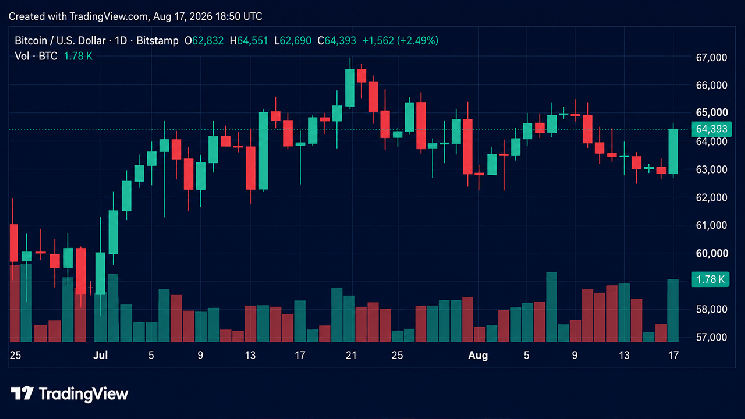
Bitcoin surged back above $64,000 on Monday, reversing a dip below $63,000 that had threatened to revisit mid-August lows. The rally coincided with an announcement from MicroStrategy stating it had neither bought nor sold any Bitcoin over the past week. After falling to a daily low near $62,653, Bitcoin sharply reversed course, climbing approximately $1,000 in six hours to reach a daily high above $64,375. By early afternoon EST, it was trading above $64,200, marking a nearly 2% daily gain and turning its weekly performance positive. The price movement triggered significant liquidations in the derivatives market, with leveraged short positions losing $57.4 million over 24 hours, contributing to total crypto market liquidations nearing $220 million. While MicroStrategy paused its Bitcoin purchases, it increased its cash reserves to $4.8 billion using part of the proceeds from a recent common stock sale. The funds were also used for share buybacks and preferred dividend payments. Analysts suggest this focus on balance sheet strength helps mitigate near-term liquidation pressure, especially as Bitcoin's price remains about 15% below MicroStrategy's average acquisition cost of $75,385. However, critics argue the capital allocation disproportionately benefits preferred shareholders (STRC) over common stockholders (MSTR) and sidelines the company's core growth strategy of aggressive Bitcoin accumulation. Bitcoin initially appeared to react positively to reports of a potential 60-day ceasefire extension between the U.S. and Iran, but the rally's momentum faded after Iranian officials denied the reports. Consequently, Bitcoin currently lacks a clear macroeconomic catalyst to sustain a decisive bullish breakout.

cryptonews.ru2h ago

Bitcoin Breaches $64,000 Mark Again as Short Sellers Lose $57.4 Million in Liquidations

cryptonews.ru2h ago

Trading

Spot

Hot Articles

What is $BITCOIN

DIGITAL GOLD ($BITCOIN): A Comprehensive Analysis Introduction to DIGITAL GOLD ($BITCOIN) DIGITAL GOLD ($BITCOIN) is a blockchain-based project operating on the Solana network, which aims to combine the characteristics of traditional precious metals with the innovation of decentralized technologies. While it shares a name with Bitcoin, often referred to as “digital gold” due to its perception as a store of value, DIGITAL GOLD is a separate token designed to create a unique ecosystem within the Web3 landscape. Its goal is to position itself as a viable alternative digital asset, although specifics regarding its applications and functionalities are still developing. What is DIGITAL GOLD ($BITCOIN)? DIGITAL GOLD ($BITCOIN) is a cryptocurrency token explicitly designed for use on the Solana blockchain. In contrast to Bitcoin, which provides a widely recognized value storage role, this token appears to focus on broader applications and characteristics. Notable aspects include: Blockchain Infrastructure: The token is built on the Solana blockchain, known for its capacity to handle high-speed and low-cost transactions. Supply Dynamics: DIGITAL GOLD has a maximum supply capped at 100 quadrillion tokens (100P $BITCOIN), although details regarding its circulating supply are currently undisclosed. Utility: While precise functionalities are not explicitly outlined, there are indications that the token could be utilized for various applications, potentially involving decentralized applications (dApps) or asset tokenization strategies. Who is the Creator of DIGITAL GOLD ($BITCOIN)? At present, the identity of the creators and development team behind DIGITAL GOLD ($BITCOIN) remains unknown. This situation is typical among many innovative projects within the blockchain space, particularly those aligning with decentralized finance and meme coin phenomena. While such anonymity may foster a community-driven culture, it intensifies concerns about governance and accountability. Who are the Investors of DIGITAL GOLD ($BITCOIN)? The available information indicates that DIGITAL GOLD ($BITCOIN) does not have any known institutional backers or prominent venture capital investments. The project seems to operate on a peer-to-peer model focused on community support and adoption rather than traditional funding routes. Its activity and liquidity are primarily situated on decentralized exchanges (DEXs), such as PumpSwap, rather than established centralized trading platforms, further highlighting its grassroots approach. How DIGITAL GOLD ($BITCOIN) Works The operational mechanics of DIGITAL GOLD ($BITCOIN) can be elaborated on based on its blockchain design and network attributes: Consensus Mechanism: By leveraging Solana’s unique proof-of-history (PoH) combined with a proof-of-stake (PoS) model, the project ensures efficient transaction validation contributing to the network's high performance. Tokenomics: While specific deflationary mechanisms have not been extensively detailed, the vast maximum token supply implies that it may cater to microtransactions or niche use cases that are still to be defined. Interoperability: There exists the potential for integration with Solana’s broader ecosystem, including various decentralized finance (DeFi) platforms. However, the details regarding specific integrations remain unspecified. Timeline of Key Events Here is a timeline that highlights significant milestones concerning DIGITAL GOLD ($BITCOIN): 2023: The initial deployment of the token occurs on the Solana blockchain, marked by its contract address. 2024: DIGITAL GOLD gains visibility as it becomes available for trading on decentralized exchanges like PumpSwap, allowing users to trade it against SOL. 2025: The project witnesses sporadic trading activity and potential interest in community-led engagements, although no noteworthy partnerships or technical advancements have been documented as of yet. Critical Analysis Strengths Scalability: The underlying Solana infrastructure supports high transaction volumes, which could enhance the utility of $BITCOIN in various transaction scenarios. Accessibility: The potential low trading price per token could attract retail investors, facilitating wider participation due to fractional ownership opportunities. Risks Lack of Transparency: The absence of publicly known backers, developers, or an audit process may yield skepticism regarding the project's sustainability and trustworthiness. Market Volatility: The trading activity is heavily reliant on speculative behavior, which can result in significant price volatility and uncertainty for investors. Conclusion DIGITAL GOLD ($BITCOIN) emerges as an intriguing yet ambiguous project within the rapidly evolving Solana ecosystem. While it attempts to leverage the “digital gold” narrative, its departure from Bitcoin's established role as a store of value underscores the need for a clearer differentiation of its intended utility and governance structure. Future acceptance and adoption will likely depend on addressing the current opacity and defining its operational and economic strategies more explicitly. Note: This report encompasses synthesised information available as of October 2023, and developments may have transpired beyond the research period.

1.9k Total ViewsPublished 2025.05.13Updated 2025.05.13

What is $BITCOIN

Discussions

Welcome to the HTX Community. Here, you can stay informed about the latest platform developments and gain access to professional market insights. Users' opinions on the price of BTC (BTC) are presented below.

活动图片