Ripple CEO Drops Truth Bomb On XRP Vs. RLUSD Rumors

bitcoinistPublished on 2025-11-06Last updated on 2025-11-06

Abstract

Ripple CEO Brad Garlinghouse moved to puncture speculation that the company’s new US dollar stablecoin, RLUSD, has displaced XRP at...

Trusted Editorial content, reviewed by leading industry experts and seasoned editors. Ad Disclosure

Ripple CEO Brad Garlinghouse moved to puncture speculation that the company’s new US dollar stablecoin, RLUSD, has displaced XRP at the core of the company’s strategy, telling Crypto in America reporter Eleanor Terrett that XRP remains foundational even as it routes transactions over multiple assets depending on corridor economics and customer needs.

Ripple CEO Sets The Record Straight: XRP Vs. RLUSD

In a November 5 interview, Terrett pressed Garlinghouse on social media debates over whether the launch of RLUSD and Ripple’s push beyond cross-border payments have diluted XRP’s role. Garlinghouse’s response was unambiguous: “XRP sits at the center of everything Ripple does.” He framed the recent discourse as a byproduct of “a lot of misinformation and sometimes disinformation in crypto Twitter,” adding that narratives suggesting Ripple has “given up on XRP” “just don’t make sense.”

Garlinghouse situated XRP within a broader, multi-rail payments and treasury stack, pointing GTreasury and Ripple payments. In his telling, the firm’s routing logic is asset-agnostic and driven by corridor specifics—currency pair, liquidity depth, cost, and reliability—rather than ideology. “Some of those go through stablecoins. Some of it goes through XRP,” he said. “We want to deliver the best possible product to a customer at the best price, and sometimes that may be a stablecoin. Sometimes it may not.”

In one of the interview’s most striking disclosures, Garlinghouse said that during the “first part of ’23,” Ripple’s institutional payment activity was significant enough that “Ripple was minting 20 percent of all USDC.” He presented that figure as evidence of a pragmatic approach in which Ripple used what worked for specific institutional flows: “We also used USDC. We also used XRP.” The point, he argued, is that customers buy solutions, not tokens, and the firm’s job is to select the “right technologies” for defined problems. “We are not XRP maximalists. There’s going to be different chains for different solutions and different technologies.”

Garlinghouse tied XRP’s role to its performance characteristics—“very scalable, very fast and very inexpensive on a per transaction basis”—but he avoided absolutism, acknowledging that those attributes make XRP “good for some things and probably less good for other things.”

The presence of RLUSD in Ripple’s toolkit does not negate XRP’s value proposition, he suggested; rather, it expands the company’s ability to optimize routing. In corridors where a fiat-denominated stablecoin provides better pricing or liquidity conditions, flows can shift there; where XRP’s speed-to-finality and low unit costs are decisive, XRP can carry the traffic.

Crucially, Garlinghouse framed market share as secondary to total throughput growth across Ripple’s platforms. He said the objective is to scale from “tens of billions of dollars of payment transactions to hundreds of billions… to trillions,” and that XRP’s success tracks the overall pie. “If XRP doesn’t have 100 percent of that pie, but the pie is growing very quickly, like that’s great. I’m happy. That’s a really good place to be.”

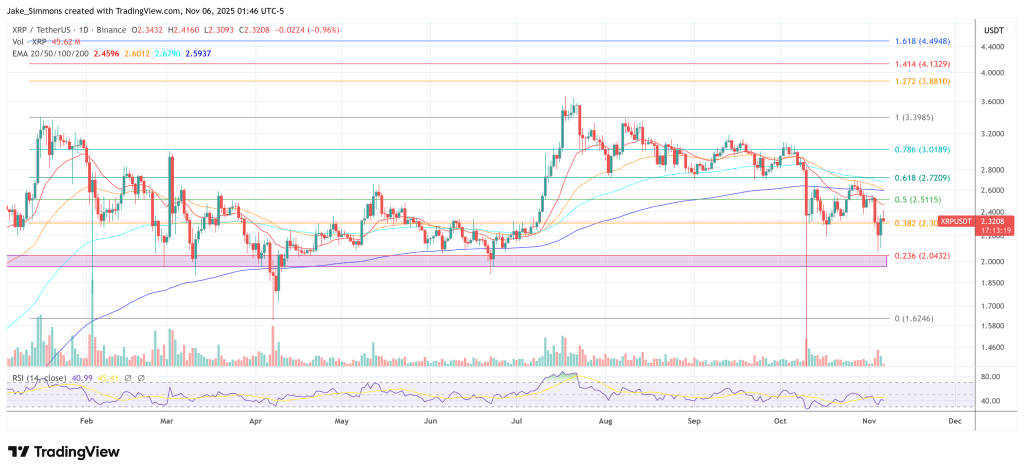
At press time, XRP traded at $2.32.
XRP price
XRP recovers above the 0.236 Fib, 1-day chart | Source: XRPUSDT on TradingView.com
Featured image created with DALL.E, chart from TradingView.com
Editorial Process for bitcoinist is centered on delivering thoroughly researched, accurate, and unbiased content. We uphold strict sourcing standards, and each page undergoes diligent review by our team of top technology experts and seasoned editors. This process ensures the integrity, relevance, and value of our content for our readers.

Jake Simmons has been a Bitcoin enthusiast since 2016. Ever since he heard about Bitcoin, he has been studying the topic every day and trying to share his knowledge with others. His goal is to contribute to Bitcoin's financial revolution, which will replace the fiat money system. Besides BTC and crypto, Jake studied Business Informatics at a university. After graduation in 2017, he has been working in the blockchain and crypto sector. You can follow Jake on Twitter at @realJakeSimmons.

Trending Cryptos

Related Reads

Analyst Who Predicted Bitcoin's Major Drop in October Now Predicts What Could Happen Next

Sean Farrell, head of digital asset strategy at Fundstrat, analyzes the current uncertain and volatile crypto market. He notes that while traditional tech stocks hit record highs, lagging crypto assets have created market apathy, which could be an early sign of a bottom forming. Farrell's base case suggests Bitcoin and the broader crypto market may experience one final sharp decline before initiating a sustained upward trend. It remains unclear if this drop will form a new deep low or test recent lows. He points out that global liquidity conditions and rising US 10-year Treasury yields continue to pressure liquidity-sensitive assets like cryptocurrencies in the short term. Farrell states that the tech sector's growth is driven by significant corporate profit increases, whereas the crypto market hasn't yet received the necessary monetary and fiscal liquidity. Although high US Treasury issuance and rising long-term bond yields are pressuring the market, he predicts a potential shift within the next 3-6 months. After risk appetite diminishes due to high interest rates, liquidity-boosting measures from regulators or central banks could trigger a new bull market. Additionally, Farrell believes that if a new governance proposal aimed at reducing inflation on the Solana network is adopted, it would lessen sell-side pressure and could act as a significant catalyst for the token's price.

cryptonews.ru3h ago

Analyst Who Predicted Bitcoin's Major Drop in October Now Predicts What Could Happen Next

cryptonews.ru3h ago

Bitcoin Breaches $64,000 Mark Again as Short Sellers Lose $57.4 Million in Liquidations

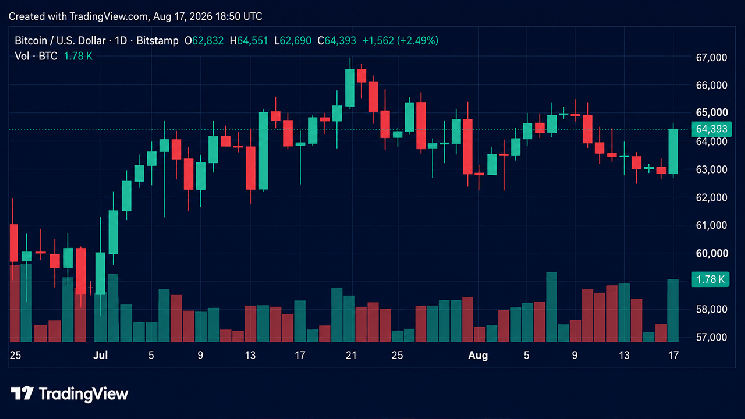
Bitcoin surged back above $64,000 on Monday, reversing a dip below $63,000 that had threatened to revisit mid-August lows. The rally coincided with an announcement from MicroStrategy stating it had neither bought nor sold any Bitcoin over the past week. After falling to a daily low near $62,653, Bitcoin sharply reversed course, climbing approximately $1,000 in six hours to reach a daily high above $64,375. By early afternoon EST, it was trading above $64,200, marking a nearly 2% daily gain and turning its weekly performance positive. The price movement triggered significant liquidations in the derivatives market, with leveraged short positions losing $57.4 million over 24 hours, contributing to total crypto market liquidations nearing $220 million. While MicroStrategy paused its Bitcoin purchases, it increased its cash reserves to $4.8 billion using part of the proceeds from a recent common stock sale. The funds were also used for share buybacks and preferred dividend payments. Analysts suggest this focus on balance sheet strength helps mitigate near-term liquidation pressure, especially as Bitcoin's price remains about 15% below MicroStrategy's average acquisition cost of $75,385. However, critics argue the capital allocation disproportionately benefits preferred shareholders (STRC) over common stockholders (MSTR) and sidelines the company's core growth strategy of aggressive Bitcoin accumulation. Bitcoin initially appeared to react positively to reports of a potential 60-day ceasefire extension between the U.S. and Iran, but the rally's momentum faded after Iranian officials denied the reports. Consequently, Bitcoin currently lacks a clear macroeconomic catalyst to sustain a decisive bullish breakout.

cryptonews.ru3h ago

Bitcoin Breaches $64,000 Mark Again as Short Sellers Lose $57.4 Million in Liquidations

cryptonews.ru3h ago

Trading

Spot

Hot Articles

What is XRP 2.0

XRP 2.0: A New Frontier in the Cryptocurrency Landscape Introduction to XRP 2.0 In the ever-evolving realm of cryptocurrency, new projects continuously emerge, vying for attention and adoption. One such promising initiative is XRP 2.0, a novel cryptocurrency project designed to leverage advanced blockchain technology and robust encryption methodologies. While the name draws parallels with Ripple’s XRP, it’s crucial to note that XRP 2.0 operates independently, focusing on enhancing transaction security, privacy, and scalability. As the digital financial landscape increasingly embraces decentralized solutions, XRP 2.0 aims to contribute meaningfully to web3 and the overall expansion of crypto projects. What is XRP 2.0? At its core, XRP 2.0 is a cryptocurrency project that aims to create a secure and decentralized digital currency ecosystem. Its foundational technology integrates sophisticated blockchain principles with cutting-edge encryption techniques. The overarching goal of XRP 2.0 is to establish itself as a reliable and efficient platform enabling swift transaction execution while prioritizing enhanced privacy protections for its users. The project is promoted as a solution to many limitations faced by existing cryptocurrencies, proposing a system that can handle a higher volume of transactions with improved speed and privacy. This versatility positions XRP 2.0 as a significant contender in a marketplace riddled with various digital currencies. Who is the Creator of XRP 2.0? The identity of the creator behind XRP 2.0 has been flagged as ‘Wilbur.’ However, comprehensive details regarding Wilbur or their associated entity remain elusive. The anonymity of many cryptocurrency creators is not an uncommon phenomenon in the industry, often designed to maintain a degree of privacy and security. Who are the Investors of XRP 2.0? As of now, specific information related to the investment foundations or organizations supporting XRP 2.0 is not publicly available. In the cryptocurrency sector, the backing by reputed investors can significantly influence a project's credibility and success, yet the transparency regarding the financial supporters of XRP 2.0 has not been established. How Does XRP 2.0 Work? XRP 2.0 stands out by employing a combination of blockchain technology and advanced encryption algorithms that ensures secure and decentralized transactions. Its innovative structure includes unique features designed to foster user engagement and broaden functionalities beyond conventional cryptocurrency transactions. Among these features, XRP 2.0 incorporates AI-powered capabilities, such as text-to-image and text-to-speech functionalities. These additions are designed to enhance the interactive experience for users, promoting broader applicability across various sectors. By bridging technological advancements with user-centered design, XRP 2.0 aims to capture the attention of a diverse range of individuals and enterprises looking to integrate cryptocurrency solutions into their operational frameworks. Timeline of XRP 2.0 Understanding XRP 2.0 requires examining the milestones that have defined its journey thus far: July 23, 2023: XRP 2.0 is introduced as a novel cryptocurrency project, aiming to revolutionize secure and decentralized transaction capabilities in the blockchain domain. September 8, 2023: The launching of another project, XRP20, occurs, marking the emergence of an ERC-20 token on the Ethereum blockchain that remains unrelated to XRP 2.0. November 13, 2023: The XRP Ledger undergoes a significant update with the release of rippled server software version 2.0.0. It is essential to note that this development is disconnected from the XRP 2.0 cryptocurrency project. Key Points About XRP 2.0 To distill the essence of XRP 2.0, several critical factors emerge: Unique Features: The inclusion of features like AI-powered text-to-image and text-to-speech further diversifies the potential applications of XRP 2.0. Blockchain Technology: The framework utilizes advanced blockchain mechanisms and encryption protocols, ensuring a secure and decentralized environment for transactions. Scalability and Privacy: XRP 2.0 prioritizes enhanced privacy protections in transaction processes and the scalability necessary to accommodate a growing user base. No Affiliation with Ripple: Importantly, despite its name, XRP 2.0 does not have any allegiance or collaboration with Ripple’s XRP, distinguishing its operational framework and objectives within the cryptocurrency ecosystem. Conclusion XRP 2.0 represents an ambitious venture into the cryptocurrency sphere, aiming to offer a combination of security, privacy, and efficiency in digital transactions. By integrating sophisticated technologies and user-friendly features, the project sets out to broaden the horizons of what cryptocurrency can achieve in today's digital economy. While the anonymity of its creator and lack of disclosed investors might raise questions for some, XRP 2.0's focus on advanced functionalities and decentralisation enhances its appeal amidst an increasingly crowded crypto market. As the cryptocurrency landscape continues to evolve, XRP 2.0 may yet emerge as a pivotal player in the expansion of secure and scalable blockchain solutions.

1.5k Total ViewsPublished 2024.04.01Updated 2024.12.03

What is XRP 2.0

Discussions

Welcome to the HTX Community. Here, you can stay informed about the latest platform developments and gain access to professional market insights. Users' opinions on the price of XRP (XRP) are presented below.

活动图片