Bear Market Won’t Hurt Strategy Too Much, Says Analyst. Traders Watch PEPENODE as Safe Buy Now

bitcoinistPublished on 2025-11-05Last updated on 2025-11-05

Abstract

Quick Facts: ➡️ Analyst Willy Woo has flagged potential liquidation risks in Strategy’s debt structure, marking it as more resilient...

Trusted Editorial content, reviewed by leading industry experts and seasoned editors. Ad Disclosure

Quick Facts:

➡️ Analyst Willy Woo has flagged potential liquidation risks in Strategy’s debt structure, marking it as more resilient than in past cycles — a sign of improved structural strength in the large-cap crypto sector.
➡️ PEPENODE offers a gamified mine-to-earn loop: users buy virtual meme nodes, upgrade facilities, and combine nodes to boost bonuses inside a browser-based server-room simulator.
➡️ $PEPENODE is currently offered in presale at $0.0011317, via $ETH, $BNB, $USDT or $USDC (ERC-20 & BEP-20) and via card payments for instant ‘buy & stake’ participation.
➡️ Staking rewards are currently set at 627%. The token’s total supply is 210B, with allocations for public sale and staking rewards. The roadmap includes simulated mining, leaderboards, and cross-meme-coin bonuses.

Macro jitters persist, yet analysts say the next downturn may not trigger the same forced selling that wrecked past cycles.

Bitcoin strategist Willy Woo’s data on Strategy’s leverage indicates that the firm’s position remains safe even under bearish scenarios, a sign of greater structural resilience in today’s crypto market.

With major players better hedged, traders are rotating into emerging tokens like PEPENODE ($PEPENODE), whose staking yields and gamified mining model have driven over $2M in presale inflows. Many now see it as a low-risk speculative play amid market uncertainty.
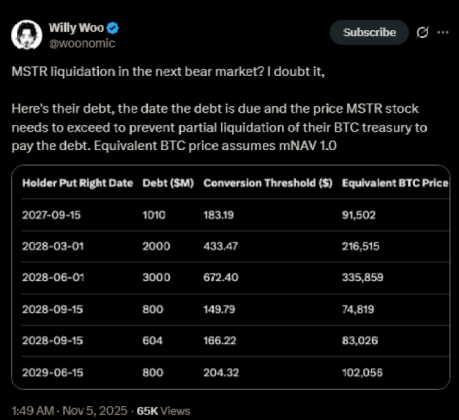
Willy Woo’s X post casting doubt on MSTR’s liquidation in the unfolding bear market.

Analysts say the market is shifting from panic-driven exits to selective accumulation of tokens with utility and community stickiness.

Unlike past meme cycles fueled by hype alone, today’s traders seek a balance between fun and function – tangible rewards, engagement, and yield. Projects that turn participation into measurable in-app outcomes, such as points, staking, or status, are retaining users even during sideways markets.

That’s where $PEPENODE shines. The mine-to-earn memecoin lets players build virtual server rooms, upgrade ‘meme nodes,’ and earn staking bonuses. With over $2M raised, it’s positioned as a gamified economy, not a fleeting meme, rewarding time in-app, not just time in chat.

Investor backing so far suggests that a community is forming around consistent participation rather than short-term speculation —a key differentiator in a choppy 2025 market.

PEPENODE ($PEPENODE) — Mine-To-Earn Meme Token With Built-In Staking

PEPENODE’s ($PEPENODE) turns meme culture into a playable economy. Its core loop is refreshingly simple: buy virtual meme nodes, upgrade your server room, and earn rewards through a browser-based mining simulator.

The platform’s three-step interface and leaderboard progression make it instantly accessible while encouraging competition, combining nodes, climbing ranks, and unlocking higher-tier bonuses.

For meme-coin fans tired of passive hype, it offers an interactive, gamified way to earn that keeps users engaged long after the launch buzz has died down.

Currently in presale with tokens priced at $0.001137, over $2M has already been raised, signaling strong early traction. With its mix of DeFi mechanics and game-like incentives, PEPENODE is emerging as one of the best meme coins heading into 2026.
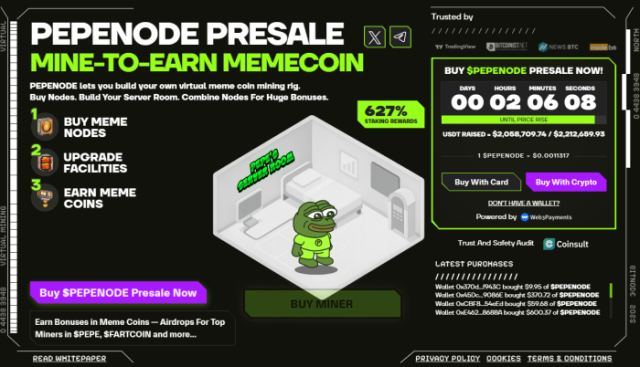
PEPENODE’s presale information.

The PEPENODE ($PEPENODE) presale accepts $ETH, $BNB, $USDT, and $USDC (ERC-20 & BEP-20), and even card payments, lowering barriers for first-time buyers.

Staking rewards of up to 627% APY headline the offer, a figure designed to encourage holding and simulator engagement over short-term flipping. That structure fits the ‘safer meme’ narrative favored by traders seeking yield and utility in one place.

The token’s total supply is 210B, with clear allocations for presale and staking rewards. No private rounds or insider allocations are listed, underscoring a community-first approach. Supported wallets include MetaMask, Base Wallet, and Best Wallet for easy participation.

Following the TGE, the roadmap includes the Server Room Builder, node upgrades, and DEX listings, followed by the launch of the Virtual Mining Simulator, where users can earn cross-project bonuses in tokens such as $PEPE or future partner coins.

As with any early-stage token, presale terms and APY may evolve, and long-term success will depend on community participation and platform engagement.

Still, analyst projections suggest strong upside potential — some forecasts place $PEPENODE near $0.0244 by 2030, representing an ROI of over 2,000% from current presale prices.

For investors looking to combine meme-coin energy with DeFi utility, PEPENODE offers a unique blend of gamification, yield, and accessibility.

If you want in, visit the official presale page and buy your $PEPENODE today!

This article is informational only. Always DYOR and assess risks before investing.

Authored by Bogdan Patru, Bitcoinist: https://bitcoinist.com/bear-market-wont-hurt-strategy-pepenode-safe-buy

Editorial Process for bitcoinist is centered on delivering thoroughly researched, accurate, and unbiased content. We uphold strict sourcing standards, and each page undergoes diligent review by our team of top technology experts and seasoned editors. This process ensures the integrity, relevance, and value of our content for our readers.

As a crypto writer, Bogdan’s responsibilities are split between researching and writing articles and entertaining the team with his humor bordering on the politically incorrect, an aspiring Bill Burr, if you will. Thanks to his 12+ years of writing experience in just as many fields, including tech, cybersecurity, modelling, fitness, crypto, and other topics-that-shall-not-be-named, he's become a genuine asset to the team. While his position as a senior writer at PrivacyAffairs thought him valuable lessons about the power of self-management, his entire writing career was and is an exercise in self-improvement. Now, he's ready to sink his teeth into crypto and teach people how to take control of their own money on the blockchain. With fiat as an eternally devaluing currency, Bitcoin and altcoins seem like the best-fitting alternative for Bogdan. Bogdan’s biggest professional accomplishment, aside from securing a position as a main writer for Bitcoinist, was his 5-year run as a writing manager at Blackwood Productions, where he coordinated a team of four writers. During that time, he learned the value of teamwork and that of creating a working environment that breeds efficiency, positivity, and friendship.

Trending Cryptos

Related Reads

South Korean Retail Investors 'Move from Seoul to Wall Street': Buying SK Hynix ADR, Betting on Triple-Leverage ETF

A surge of Korean retail investors is shifting funds from the volatile Seoul market to Wall Street, intensifying their bets on the AI theme through unconventional and high-risk instruments. Data shows Korean investors were net buyers of about $4.5 billion in US stocks in July, nearing a yearly peak. A notable trend is their purchase of approximately $840 million worth of SK Hynix American Depositary Receipts (ADRs), despite a significant 10% premium over the company's domestic shares, leading analysts to label the move as speculative and irrational. Simultaneously, Korean traders are heavily favoring leveraged ETFs. The triple-leveraged semiconductor ETF SOXL was the most-bought US product in July, with leveraged products occupying four of the top ten spots. Experts note that this shift in geography does not represent a diversification of risk; instead, investors are merely expressing the same concentrated bet on AI hardware through different, often riskier, US-listed vehicles. Analysts warn that while this capital inflow is unlikely to systemically impact the vast US institutional market, it risks creating localized distortions and amplifying volatility, particularly in the targeted sectors and instruments. The move follows a sharp correction in the Korean market, where high leverage in semiconductor stocks and related ETFs had previously led to significant losses, prompting this search for alternative avenues to chase the AI narrative.

marsbit24m ago

South Korean Retail Investors 'Move from Seoul to Wall Street': Buying SK Hynix ADR, Betting on Triple-Leverage ETF

marsbit24m ago

Bithumb's First Half Report: Net Loss Exceeds $76 Million, Where Did the Profits Go?

**Title: Bithumb H1 2026 Report: Net Loss Exceeds $76M – Where Did the Profits Go?** Despite a headline net loss of approximately 108.7 billion KRW (~$76.44 million) for the first half of 2026, a detailed breakdown reveals Bithumb's core exchange business remained profitable. The significant loss was primarily driven by two major non-operating items: substantial losses on the disposal and valuation of the company's own cryptocurrency holdings (net loss ~$48.21 million) and a sharp increase in litigation provisions (~$25.93 million), largely linked to a regulatory fine. Operating revenue fell 48.7% year-on-year to ~$119 million, almost entirely from transaction fees, as market activity cooled. While the company drastically cut marketing and subsidy expenses by ~70% to protect margins, more rigid costs like payment processing and salaries declined only modestly. This highlights the vulnerability of its highly fee-dependent revenue model in a down market. Total assets decreased by ~$584 million, but this was largely attributable to an ~86% drop in client KRW deposits. The market value of client crypto assets under custody also fell (~32.7%), partly influenced by declining cryptocurrency prices rather than solely client withdrawals. In summary, the report indicates underlying exchange profitability was eroded by significant crypto asset losses and mounting regulatory/legal costs, against a backdrop of declining trading revenue. Future focus should be on revenue recovery, managing crypto-related损益, and the ongoing impact of regulatory challenges.

marsbit43m ago

Bithumb's First Half Report: Net Loss Exceeds $76 Million, Where Did the Profits Go?

marsbit43m ago

BitMart's Final 9 Days: A True Exchange Crisis Is Never About Shutting Down

BitMart's Final 9 Days: A True Exchange Crisis Is Not About Shutting Down On August 17, 2026, with just 9 days until BitMart's scheduled cessation of trading, the focus shifted from the platform's orderly closure to serious questions about user withdrawals, platform solvency, employee payments, and reserve transparency. Stakeholders, claiming to represent users and staff, publicly demanded asset/liability disclosures, explanations for withdrawal delays, a user repayment plan, and an independent audit, setting an August 19 deadline. While BitMart CEO Sheldon Lee denied allegations of insolvency or wrongdoing, the controversy highlighted a core vulnerability of centralized exchanges (CEXs). When an exchange announces its shutdown, normal user behavior changes dramatically, triggering a mass withdrawal event—the ultimate stress test for its liquidity and custodial integrity. The key question becomes not whether the platform has assets, but whether it holds sufficient *liquid* assets to cover all user liabilities on demand. The article argues that the trust placed in CEXs is based on the convenience they provide, abstracting users from direct control of their private keys. This trust is rarely questioned during normal operations but becomes critically exposed during a wind-down. The situation underscores the limitations of simple Proof of Reserves, which shows "what we have" but not the crucial "what we owe." True financial credibility requires transparent, auditable data on assets, liabilities, and segregated user funds. BitMart's situation reflects a broader, often overlooked issue in the crypto industry: while there is extensive focus on growth mechanisms for exchanges, there is little discussion or established protocol for a safe and transparent "exit mechanism." The final measure of an exchange's integrity, the article concludes, is not its user count or trading volume during a bull market, but its ability to ensure every last user can successfully withdraw their assets when the doors are closing. The outcome will be determined not by statements, but by whether the final user's funds securely leave the platform.

marsbit1h ago

BitMart's Final 9 Days: A True Exchange Crisis Is Never About Shutting Down

marsbit1h ago

Don't Speculate on 100x Coins, Just Bet on 'Cash Cows': Which Projects Are Worth Dollar-Cost Averaging in the Bear Market?

In a bearish crypto market, finding sustainable investments is more prudent than chasing speculative meme coins. This article analyzes projects generating consistent revenue, highlighting them as potential "cash cows" for long-term dollar-cost averaging (DCA). The top performers are "picks-and-shovels" plays. **Pump.fun**, a Solana-based meme coin launchpad, leads with $415.3M in monthly revenue, profiting from a 1.25% fee on token transactions. Despite market volatility, it has averaged tens of millions in monthly income in 2024. Perpetual DEX **Hyperliquid** stands out as a "bear market star," accumulating ~$352M in revenue over seven months. Its model funnels ~99% of fees into buying back and permanently burning its HYPE token. Established giants are also adapting. **Uniswap**, after enabling its fee switch, now earns protocol revenue (e.g., $5.6M recently), which is used to buy back and burn UNI, giving the token direct value accrual. Similarly, oracle provider **Chainlink** generates stable monthly revenue (~$4.57M recently) from its essential data, cross-chain, and automation services. Its new Payment Abstraction feature automatically converts service fees into LINK, accruing value in its treasury. The core thesis is clear: in a downturn, focus on projects with proven, resilient business models—those acting as essential infrastructure or capturing consistent transaction fees—rather than speculative narratives.

marsbit1h ago

Don't Speculate on 100x Coins, Just Bet on 'Cash Cows': Which Projects Are Worth Dollar-Cost Averaging in the Bear Market?

marsbit1h ago

Trading

Spot

Hot Articles

How to Buy T

Welcome to HTX.com! We've made purchasing Threshold Network Token (T) simple and convenient. Follow our step-by-step guide to embark on your crypto journey.Step 1: Create Your HTX AccountUse your email or phone number to sign up for a free account on HTX. Experience a hassle-free registration journey and unlock all features.Get My AccountStep 2: Go to Buy Crypto and Choose Your Payment MethodCredit/Debit Card: Use your Visa or Mastercard to buy Threshold Network Token (T) instantly.Balance: Use funds from your HTX account balance to trade seamlessly.Third Parties: We've added popular payment methods such as Google Pay and Apple Pay to enhance convenience.P2P: Trade directly with other users on HTX.Over-the-Counter (OTC): We offer tailor-made services and competitive exchange rates for traders.Step 3: Store Your Threshold Network Token (T)After purchasing your Threshold Network Token (T), store it in your HTX account. Alternatively, you can send it elsewhere via blockchain transfer or use it to trade other cryptocurrencies.Step 4: Trade Threshold Network Token (T)Easily trade Threshold Network Token (T) on HTX's spot market. Simply access your account, select your trading pair, execute your trades, and monitor in real-time. We offer a user-friendly experience for both beginners and seasoned traders.

13.0k Total ViewsPublished 2024.03.29Updated 2026.06.02

How to Buy T

Discussions

Welcome to the HTX Community. Here, you can stay informed about the latest platform developments and gain access to professional market insights. Users' opinions on the price of T (T) are presented below.

活动图片