MARA Reaches Record-High Q3 Revenue as Bitcoin Hyper Becomes One of the Best Altcoins on the Market

bitcoinistPublished on 2025-11-05Last updated on 2025-11-05

Abstract

Quick Facts: ➡️ MARA’s Q3 revenues hit a record high of $252.4M, a 92% increase from 2024’s $131.6M. ➡️ MARA...

Trusted Editorial content, reviewed by leading industry experts and seasoned editors. Ad Disclosure

Quick Facts:

  • ➡️ MARA’s Q3 revenues hit a record high of $252.4M, a 92% increase from 2024’s $131.6M.
  • ➡️ MARA mined 2,144 $BTC this Q3, over 98% more compared to 2024’s numbers, increasing their yearly Bitcoin production to 53,000 over the span of 12 months.
  • ➡️ Frederick Thiel, MARA CEO, attributes this growth to the company’s expansion into the AI ecosystem, which grew MARA’s peta hash rate by 20%, while lowering costs by 15%.
  • ➡️ Bitcoin Hyper ($HYPER) reaches $25.8M in presale and promises faster and cheaper Bitcoin transactions once its Layer 2 goes live.

Bitcoin mining company MARA just announced record-high revenues for this past Q3, at $252.4M. This represents a 92% increase compared to 2024’s Q3, when the company bagged $131.6M.

MARA owes this growth rate to its expanding Bitcoin mining system, which generated 98% more $BTC over a one-year span. The company mined 2,144 $BTC during this Q3 or almost 53,000 between 2024 and 2025.

Fred Thiel, MARA’s CEO, explained this mass expansion in the context of adopting open-source AI tech to replace the standard GPUs:

We are already seeing the alternatives to GPUs enter the market, and open source AI is making it far easier and much less expensive for companies to deploy advanced AI systems directly in their own private cloud environments.

Frederick Thiel, MARA Holdings Q3 Earnings Call

As Salman Khan, MARA’s CFO, explains during the same call, the company’s hash rate grew by roughly 20%, while the cost per peta hash per day dropped 15% over the last year. This allowed MARA to almost double its performance in just 12 months.

MARA’s achievement, paired with Bitcoin Hyper’s ($HYPER) $25.8M presale, could revitalize a slipping Bitcoin which is barely holding above $100K right now.

As Bitcoin’s Layer 2 solution, Hyper could have an even bigger impact in 2026, promising faster and cheaper Bitcoin transactions for a more scalable and performant network.

Institutions Support Bitcoin Unconditionally

As Fred Thiel himself noticed, Bitcoin has ‘entered its institutional phase’, with names like City Corp, BlackRock, and JP Morgan ‘integrating Bitcoin into traditional frameworks’.

Then we have governments and public and private companies hoarding $BTC at an unprecedented rate. As Bitcoin Treasuries data shows, 353 entities hold over 4.05M $BTC and their accumulation rate went up 4.12% over the last 30 days.
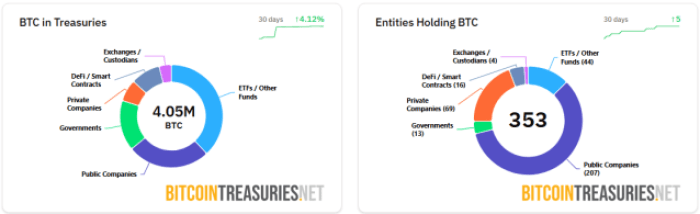
Bitcoin in treasuries across multiple sectors.

This ever-expanding ecosystem offers unlimited opportunities and Thiel’s MARA is all for it. As the CEO explained, the company plans to expand on the marriage between Bitcoin and AI tech:

Bitcoin mining monetizes underutilized energy and stabilizes grids, while AI inference transforms that same energy into intelligence and productivity. By bringing Bitcoin and AI together, we seek to maximize the value of every megawatt-hour we manage.

Fred Thiel, MARA Holdings Q3 Earnings Call

To that end, MARA already secured a partnership with MPLX with the goal of expanding its operations into West Texas. MPLX will offer ‘long-term access to low-cost natural gas at scale’, which will complement MARA’s computing infrastructure for higher throughput.

The projected initial capacity goes in the ballpark of 400 megawatts or 1.5 gigawatts across three areas.

These developments position MARA to become the leader in Bitcoin mining, which can only work in Bitcoin’s favor.

Bitcoin Hyper ($HYPER) contributes to that by promising a faster and cheaper Bitcoin network than ever before.

How Bitcoin Hyper Makes Bitcoin Fast, Scalable, and More Performant Than Ever

Bitcoin Hyper ($HYPER) promises a faster, more performant, and more cost-effective Bitcoin network with the help of tools like SVM and the Canonical Bridge.

The Canonical Bridge, in particular, addresses Bitcoin’s most pressing issue: its performance limitation.

The Bitcoin network is now capped at 7 transactions per second (TPS), which impacts its finality times and increases transaction costs due to the fee-based priority system. The latter is the result of miners prioritizing larger transactions with higher fees in the confirmation queue.

Because of this, smaller transactions can sometimes experience confirmation times of hours, which explains the network’s low adoption rate.

The Canonical Bridge fixes this issue by minting the users’ bitcoins into the Hyper layer as soon as the Bitcoin Relay Program confirms the transaction details.

The entire process lasts seconds, vastly improving Bitcoin’s confirmation times and removing the 7-TPS cap.
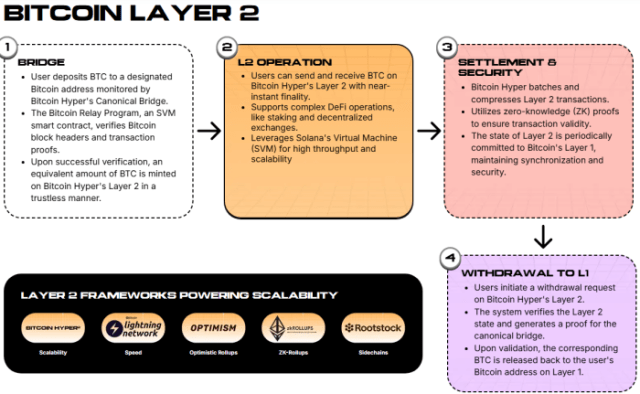
How Hyper’s Canonical Bridge works.

The Solana Virtual Machine (SVM) contributes to the ecosystem’s overall performance by enabling the ultra-fast execution of smart contracts and DeFi apps.

This will increase Bitcoin’s ranking on the list of the fastest blockchains today and make the network more feasible for institutional investors.

The presale is at over $25.8M so far and it’s growing at a steady pace, despite the October 10 meltdown, which sent the market into a downward spiral. The project’s resilience already ranks it among the best presales of 2025.

$HYPER is available at the presale price of $0.013225 and shows great long-term potential. A realistic price prediction for $HYPER puts the token at $1.50 by 2030 for a 5-year ROI of 11,242%. With on-point implementation and widespread adoption, the price can get considerably higher.

This makes $HYPER one of the best altcoins to buy this coming Q4.

So, if you want it, go to the presale page and buy your $HYPER today.

This isn’t financial advice. Do your own research (DYOR) before investing.

Authored by Bogdan Patru, Bitcoinist: https://bitcoinist.com/bitcoin-miner-mara-revenue-bitcoin-hyper-best-altcoins

Editorial Process for bitcoinist is centered on delivering thoroughly researched, accurate, and unbiased content. We uphold strict sourcing standards, and each page undergoes diligent review by our team of top technology experts and seasoned editors. This process ensures the integrity, relevance, and value of our content for our readers.

As a crypto writer, Bogdan’s responsibilities are split between researching and writing articles and entertaining the team with his humor bordering on the politically incorrect, an aspiring Bill Burr, if you will. Thanks to his 12+ years of writing experience in just as many fields, including tech, cybersecurity, modelling, fitness, crypto, and other topics-that-shall-not-be-named, he's become a genuine asset to the team. While his position as a senior writer at PrivacyAffairs thought him valuable lessons about the power of self-management, his entire writing career was and is an exercise in self-improvement. Now, he's ready to sink his teeth into crypto and teach people how to take control of their own money on the blockchain. With fiat as an eternally devaluing currency, Bitcoin and altcoins seem like the best-fitting alternative for Bogdan. Bogdan’s biggest professional accomplishment, aside from securing a position as a main writer for Bitcoinist, was his 5-year run as a writing manager at Blackwood Productions, where he coordinated a team of four writers. During that time, he learned the value of teamwork and that of creating a working environment that breeds efficiency, positivity, and friendship.

Trending Cryptos

Related Reads

Farewell to Crash-Style Plunges: An In-Depth Review of the Crypto Lending and Futures Markets in Q2 2026

This report analyzes the Q2 2026 crypto lending and derivatives market, highlighting a continuation of controlled deleveraging. Unlike the 2022 crash, where loan volumes plummeted 55% in a single quarter, the current downturn is characterized by a gradual, stepwise decline across CeFi, DeFi, and crypto-collateralized CDP stablecoins, with Q2 seeing a total reduction of $113.3 billion (-16.78%) to $561.6 billion. DeFi lending saw the sharpest quarterly drop (-27.61%), while CeFi borrowing declined more moderately (-9.62%). For the first time since Q3 2023, CeFi outstanding loans surpassed DeFi. Corporate digital asset treasury (DAT) debt also decreased by $15 billion, largely due to a debt buyback by Strategy Inc. Futures open interest (OI) saw a modest 3.08% quarterly decline to $1032 billion, with notable divergence: Bitcoin OI fell 6.24%, while Ethereum OI dropped 26.31%. Both rebounded in July. A deep dive into Aave V3 revealed high leverage, particularly within "e-mode" loans, which are heavily concentrated on Ethereum staking/restaking tokens, with debt-weighted health factors near liquidation thresholds. The report concludes that the market is undergoing a healthier, managed deleveraging cycle driven by voluntary risk reduction rather than forced liquidations or counterparty failures, suggesting increased resilience against a repeat of the 2022 cascade. Early Q3 2026 data indicates potential stabilization in futures OI and DeFi lending volumes.

marsbit10m ago

Farewell to Crash-Style Plunges: An In-Depth Review of the Crypto Lending and Futures Markets in Q2 2026

marsbit10m ago

Crypto Funding Halves in Q1, Why Is Stablecoin Payment Still Attracting Money Against the Trend?

Crypto venture capital funding fell roughly 50% quarter-over-quarter in Q1 2026, yet the stablecoin payments sector was a notable exception, continuing to secure significant funding rounds. This shift signals that capital is moving away from speculative "token narratives" toward companies generating real revenue, as stablecoins evolve from a trading tool into payment infrastructure. Despite the overall funding slowdown, companies like Rain, OpenFX, and RedotPay completed major raises, focusing on areas such as card issuance, cross-border payments, and banking connectivity. Investors are attracted to the sector's potential to address long-standing inefficiencies in traditional cross-border payments through 24/7 settlement and clearer revenue models like transaction fees and FX spreads. However, the momentum may be overstated. On-chain stablecoin transaction volume does not equate to real-world payments for goods and services, and funding is concentrated in a few leading firms with reported volumes and customers. Key challenges remain, including compliance, fiat on/off-ramps, local banking relationships, and the risk of core services becoming commoditized. Looking ahead, capital is likely to flow into areas like cross-border B2B payments, bank-to-stablecoin connectivity, stablecoin-linked cards, multi-chain payment orchestration, and payments for AI agents. Ultimately, the investor interest reflects a bet on the necessary infrastructure to integrate stablecoins into the traditional financial system, with future valuations hinging on demonstrable payment volume, real revenue, and profitable market expansion.

marsbit46m ago

Crypto Funding Halves in Q1, Why Is Stablecoin Payment Still Attracting Money Against the Trend?

marsbit46m ago

South Korean Retail Investors 'Move from Seoul to Wall Street': Buying SK Hynix ADR, Betting on Triple-Leverage ETF

A surge of Korean retail investors is shifting funds from the volatile Seoul market to Wall Street, intensifying their bets on the AI theme through unconventional and high-risk instruments. Data shows Korean investors were net buyers of about $4.5 billion in US stocks in July, nearing a yearly peak. A notable trend is their purchase of approximately $840 million worth of SK Hynix American Depositary Receipts (ADRs), despite a significant 10% premium over the company's domestic shares, leading analysts to label the move as speculative and irrational. Simultaneously, Korean traders are heavily favoring leveraged ETFs. The triple-leveraged semiconductor ETF SOXL was the most-bought US product in July, with leveraged products occupying four of the top ten spots. Experts note that this shift in geography does not represent a diversification of risk; instead, investors are merely expressing the same concentrated bet on AI hardware through different, often riskier, US-listed vehicles. Analysts warn that while this capital inflow is unlikely to systemically impact the vast US institutional market, it risks creating localized distortions and amplifying volatility, particularly in the targeted sectors and instruments. The move follows a sharp correction in the Korean market, where high leverage in semiconductor stocks and related ETFs had previously led to significant losses, prompting this search for alternative avenues to chase the AI narrative.

marsbit1h ago

South Korean Retail Investors 'Move from Seoul to Wall Street': Buying SK Hynix ADR, Betting on Triple-Leverage ETF

marsbit1h ago

Bithumb's First Half Report: Net Loss Exceeds $76 Million, Where Did the Profits Go?

**Title: Bithumb H1 2026 Report: Net Loss Exceeds $76M – Where Did the Profits Go?** Despite a headline net loss of approximately 108.7 billion KRW (~$76.44 million) for the first half of 2026, a detailed breakdown reveals Bithumb's core exchange business remained profitable. The significant loss was primarily driven by two major non-operating items: substantial losses on the disposal and valuation of the company's own cryptocurrency holdings (net loss ~$48.21 million) and a sharp increase in litigation provisions (~$25.93 million), largely linked to a regulatory fine. Operating revenue fell 48.7% year-on-year to ~$119 million, almost entirely from transaction fees, as market activity cooled. While the company drastically cut marketing and subsidy expenses by ~70% to protect margins, more rigid costs like payment processing and salaries declined only modestly. This highlights the vulnerability of its highly fee-dependent revenue model in a down market. Total assets decreased by ~$584 million, but this was largely attributable to an ~86% drop in client KRW deposits. The market value of client crypto assets under custody also fell (~32.7%), partly influenced by declining cryptocurrency prices rather than solely client withdrawals. In summary, the report indicates underlying exchange profitability was eroded by significant crypto asset losses and mounting regulatory/legal costs, against a backdrop of declining trading revenue. Future focus should be on revenue recovery, managing crypto-related损益, and the ongoing impact of regulatory challenges.

marsbit2h ago

Bithumb's First Half Report: Net Loss Exceeds $76 Million, Where Did the Profits Go?

marsbit2h ago

Trading

Spot

Hot Articles

What is $BITCOIN

DIGITAL GOLD ($BITCOIN): A Comprehensive Analysis Introduction to DIGITAL GOLD ($BITCOIN) DIGITAL GOLD ($BITCOIN) is a blockchain-based project operating on the Solana network, which aims to combine the characteristics of traditional precious metals with the innovation of decentralized technologies. While it shares a name with Bitcoin, often referred to as “digital gold” due to its perception as a store of value, DIGITAL GOLD is a separate token designed to create a unique ecosystem within the Web3 landscape. Its goal is to position itself as a viable alternative digital asset, although specifics regarding its applications and functionalities are still developing. What is DIGITAL GOLD ($BITCOIN)? DIGITAL GOLD ($BITCOIN) is a cryptocurrency token explicitly designed for use on the Solana blockchain. In contrast to Bitcoin, which provides a widely recognized value storage role, this token appears to focus on broader applications and characteristics. Notable aspects include: Blockchain Infrastructure: The token is built on the Solana blockchain, known for its capacity to handle high-speed and low-cost transactions. Supply Dynamics: DIGITAL GOLD has a maximum supply capped at 100 quadrillion tokens (100P $BITCOIN), although details regarding its circulating supply are currently undisclosed. Utility: While precise functionalities are not explicitly outlined, there are indications that the token could be utilized for various applications, potentially involving decentralized applications (dApps) or asset tokenization strategies. Who is the Creator of DIGITAL GOLD ($BITCOIN)? At present, the identity of the creators and development team behind DIGITAL GOLD ($BITCOIN) remains unknown. This situation is typical among many innovative projects within the blockchain space, particularly those aligning with decentralized finance and meme coin phenomena. While such anonymity may foster a community-driven culture, it intensifies concerns about governance and accountability. Who are the Investors of DIGITAL GOLD ($BITCOIN)? The available information indicates that DIGITAL GOLD ($BITCOIN) does not have any known institutional backers or prominent venture capital investments. The project seems to operate on a peer-to-peer model focused on community support and adoption rather than traditional funding routes. Its activity and liquidity are primarily situated on decentralized exchanges (DEXs), such as PumpSwap, rather than established centralized trading platforms, further highlighting its grassroots approach. How DIGITAL GOLD ($BITCOIN) Works The operational mechanics of DIGITAL GOLD ($BITCOIN) can be elaborated on based on its blockchain design and network attributes: Consensus Mechanism: By leveraging Solana’s unique proof-of-history (PoH) combined with a proof-of-stake (PoS) model, the project ensures efficient transaction validation contributing to the network's high performance. Tokenomics: While specific deflationary mechanisms have not been extensively detailed, the vast maximum token supply implies that it may cater to microtransactions or niche use cases that are still to be defined. Interoperability: There exists the potential for integration with Solana’s broader ecosystem, including various decentralized finance (DeFi) platforms. However, the details regarding specific integrations remain unspecified. Timeline of Key Events Here is a timeline that highlights significant milestones concerning DIGITAL GOLD ($BITCOIN): 2023: The initial deployment of the token occurs on the Solana blockchain, marked by its contract address. 2024: DIGITAL GOLD gains visibility as it becomes available for trading on decentralized exchanges like PumpSwap, allowing users to trade it against SOL. 2025: The project witnesses sporadic trading activity and potential interest in community-led engagements, although no noteworthy partnerships or technical advancements have been documented as of yet. Critical Analysis Strengths Scalability: The underlying Solana infrastructure supports high transaction volumes, which could enhance the utility of $BITCOIN in various transaction scenarios. Accessibility: The potential low trading price per token could attract retail investors, facilitating wider participation due to fractional ownership opportunities. Risks Lack of Transparency: The absence of publicly known backers, developers, or an audit process may yield skepticism regarding the project's sustainability and trustworthiness. Market Volatility: The trading activity is heavily reliant on speculative behavior, which can result in significant price volatility and uncertainty for investors. Conclusion DIGITAL GOLD ($BITCOIN) emerges as an intriguing yet ambiguous project within the rapidly evolving Solana ecosystem. While it attempts to leverage the “digital gold” narrative, its departure from Bitcoin's established role as a store of value underscores the need for a clearer differentiation of its intended utility and governance structure. Future acceptance and adoption will likely depend on addressing the current opacity and defining its operational and economic strategies more explicitly. Note: This report encompasses synthesised information available as of October 2023, and developments may have transpired beyond the research period.

1.9k Total ViewsPublished 2025.05.13Updated 2025.05.13

What is $BITCOIN

Discussions

Welcome to the HTX Community. Here, you can stay informed about the latest platform developments and gain access to professional market insights. Users' opinions on the price of BTC (BTC) are presented below.

活动图片