Cardano Founder Slams ‘Clickbait’ Reports He Blamed ADA Users

bitcoinistPublished on 2025-11-05Last updated on 2025-11-05

Abstract

Charles Hoskinson issued a rebuttal on November 3, rejecting circulating headlines that claimed he blamed Cardano’s users for the network’s...

Trusted Editorial content, reviewed by leading industry experts and seasoned editors. Ad Disclosure

Charles Hoskinson issued a rebuttal on November 3, rejecting circulating headlines that claimed he blamed Cardano’s users for the network’s decentralized finance shortfall. In a brief video, the Cardano founder said media outlets misrepresented his prior comments about participation patterns across the ecosystem, stressing that his point was a structural “mismatch” between who stakes and governs versus who takes part in DeFi—not blame.

“I never once blamed anyone from the Cardano ecosystem for the DeFi [woes],” Hoskinson said, naming The Crypto Basic as an example of outlets whose framing he called fundamentally inaccurate. “I’m sorry crypto media that you guys are […] and you just want clickbait headlines. You guys have to cut this the […] out.” He added that there is “not a single person in the Cardano ecosystem who I am blaming for our DeFi situation right now.”

Cardano’s DeFi Gap Is A Participation Mismatch

Hoskinson’s core claim is numerical and directional rather than accusatory. He argued there is a demonstrable divergence between Cardano’s high participation in staking and governance and its lower participation in DeFi protocols, which depresses total value locked. “I pointed out in a video that there is a mismatch between the people who participate in staking and governance and the people who participate in DeFi. And if there was proportionality there… our TVL would be at least five to 10 billion,” he said. He characterized the recent headlines as “materially wrong and factually wrong” because they attributed intent—“blaming users”—that he explicitly disavowed.

The founder anchored his point in a specific user count comparison. Some third-party measurements, he said, “are asserting that Cardano has only 10,000 to 50,000 actual users when there’s 1.3 million who are using staking.” For Hoskinson, that delta underscores that Cardano “has a large population, a large wallet base, and a lot of users as evidenced by the enormous level of participation in both governance and staking,” even if those participants are not currently “deploying to the other side of the aisle, to the TVL side, to the DeFi side.”

He repeatedly emphasized that diagnosing the participation gap is an ecosystem responsibility, not a morality play. “I’m not blaming them for not participating,” he said. “Never once said it’s their fault and they’re bad people and they’ve done something wrong.” Instead, he called for a frank community conversation about the drivers behind users’ choices. “It could be slippage. It could be fees. It could be user experience. It could be yields. It could be safety concerns. It could be education. There could be 150,000 different reasons for that. But we as an ecosystem have to have that discussion.”

The remedy, in his view, is a coordinated governance agenda rather than a media narrative. He urged Cardano stakeholders to treat the participation gap as a 2026 workstream and to fund targeted initiatives through delegated authority. “We as an ecosystem have to ask why that mismatch exists and how can we correct that mismatch… as a 2026 governance agenda, and get some delegated authority funding and effort to correct that,” he said. If the proportionality problem were addressed, Hoskinson argued, “that alone can get our TVL up 5 billion to 10 billion,” potentially placing Cardano “in the top ranks of TVL, the top five to top 10.”

The dispute originated, he said, when media took a narrow, data-driven observation about where Cardano users allocate capital and translated it into a blame narrative. “People say something very specific, very targeted, and then it gets misinterpreted, and then everybody judges you based upon the headlines,” he said. “I’m not going to allow the crypto media to go ahead and put words in my mouth.” He reiterated the same point multiple times for emphasis: “I did not blame the Cardano ecosystem. I did not blame the Cardano users for anything. I was very careful, guarded, and specific in the things that I said.”

Hoskinson coupled the clarification with a broader critique of crypto media practices. “If you continue to broadcast, you’re lying to people,” he said, adding, “I expect that from the crypto media because they are scum. They do lie. Everything’s sensational. Everything’s clickbait.” He framed his intervention as a corrective to prevent a headline cycle from hardening into accepted fact: “The record has been corrected.”

Beyond media criticism, the practical substance of his message focused on mobilizing existing users rather than conjuring new ones. “We have the users. We have the capital,” he said. “For some reason, those users with their capital are not participating in DeFi.” While he acknowledged having personal “suspicions” and hearing “frustrations” from ecosystem participants, he stopped short of diagnosing root causes, instead calling for an open, data-first process to “systematically chip away” at barriers that deter stakers and governance participants from crossing into DeFi activity.

Across the video, Hoskinson’s throughline never deviated: the issue is proportional participation by an already large user base. “There is a mismatch between the people participating in staking and governance—of which it’s seven figures over a million people—and the people participating in DeFi,” he said. “We have to get to the bottom of that mismatch as an ecosystem… But I’m not blaming the Cardano users for that mismatch. I’m not saying it’s their fault. I’m not saying that they did something wrong.”

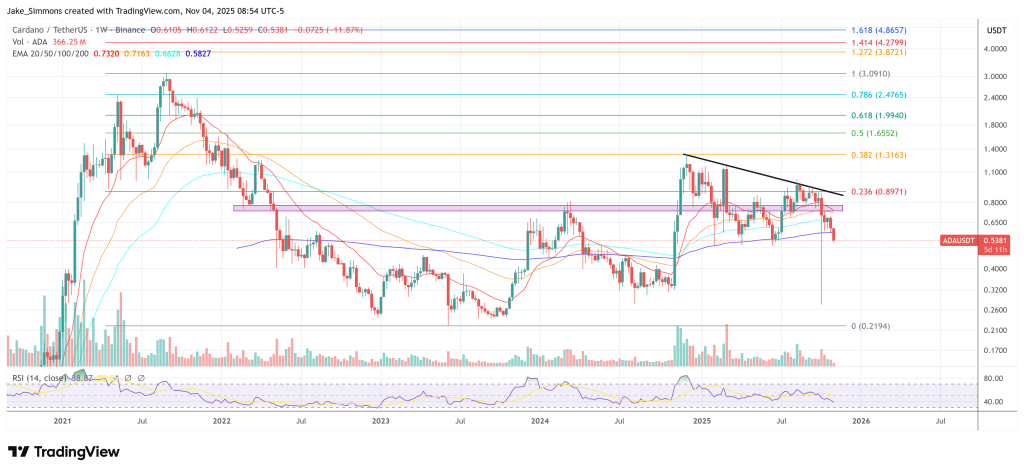
At press time, ADA traded at $0.538.
Cardano price
ADA drops below the EMA200, 1-week chart | Source: ADAUSDT on TradingView.com
Featured image created with DALL.E, chart from TradingView.com
Editorial Process for bitcoinist is centered on delivering thoroughly researched, accurate, and unbiased content. We uphold strict sourcing standards, and each page undergoes diligent review by our team of top technology experts and seasoned editors. This process ensures the integrity, relevance, and value of our content for our readers.

Jake Simmons has been a Bitcoin enthusiast since 2016. Ever since he heard about Bitcoin, he has been studying the topic every day and trying to share his knowledge with others. His goal is to contribute to Bitcoin's financial revolution, which will replace the fiat money system. Besides BTC and crypto, Jake studied Business Informatics at a university. After graduation in 2017, he has been working in the blockchain and crypto sector. You can follow Jake on Twitter at @realJakeSimmons.

Trending Cryptos

Related Reads

Podcast Notes | Conversation with Bitwise CIO Matt: If You Have 0% Crypto Allocation Now, You Are Actively Bearish on the Market Outlook

Podcast Notes | Interview with Bitwise CIO Matt Hougan: "A 0% Crypto Allocation Today is an Active Bearish Bet" **Key Takeaways from Matt Hougan (CIO, Bitwise):** * **Market Sentiment:** Despite crypto being down ~50% from highs, Wall Street is "ALL-IN." Major institutions like BlackRock, Morgan Stanley, Wells Fargo, and UBS view crypto as a long-term asset class, continuing to build and launch products (e.g., tokenized funds, ETFs) regardless of short-term price or regulatory delays (like the CLARITY Act). * **BTC Resilience:** Bitcoin's recent price stability amid negative news (AI stock sell-off, MicroStrategy sales, fading regulatory odds) signals underlying strength. Hougan argues the "weak hands" have sold; remaining holders are long-term believers. * **Regulatory Outlook:** The CLARITY Act may remain in legislative limbo, but crypto development won't wait. Tokenization of real-world assets (RWA) is a major, irreversible trend backed by large traditional finance players. * **Investment Strategy:** Hougan advocates for a 5% crypto allocation in a traditional portfolio. He calls this the "magic number" for significantly boosting returns without materially increasing overall portfolio volatility. Critically, he states that a 0% allocation is not neutral but an **"active bearish bet"** against the asset class, given crypto's current ~2% share of global equity market cap. * **Ethereum & Altcoins:** Hougan is bullish on Ethereum (price target: $8000), citing its leading role in tokenization and stablecoins. For altcoins, he highlights assets tied to the tokenization narrative (e.g., Solana, Chainlink, Ondo) and those generating "real yield" (e.g., Hyperliquid). * **DCA vs. Lump Sum:** Both strategies have merit. Dollar-cost averaging (DCA) provides behavioral protection against volatility, while a lump sum investment may capture more upside if Bitcoin's suppressed volatility breaks upward.

marsbit7m ago

Podcast Notes | Conversation with Bitwise CIO Matt: If You Have 0% Crypto Allocation Now, You Are Actively Bearish on the Market Outlook

marsbit7m ago

Anthropic, Dario Amodei, and "The Last Private Company"

The article explores the contrasting narratives surrounding Anthropic and its founder, Dario Amodei. He is portrayed as both a cautious "watchman" warning of AI's existential dangers and an ambitious driver racing to build that very future. The core tension lies in Amodei's belief that since powerful AI is inevitable, Anthropic must lead its development to ensure it's done "responsibly." Driven by personal tragedy—his father's death before a cure arrived—Amodei is obsessed with accelerating science. He co-founded Anthropic after leaving OpenAI over governance concerns, aiming to build top models while establishing safety standards. Anthropic developed "Constitutional AI" to align models and proposed risk-based policies, positioning itself as both creator and regulator. Amodei envisions AI bringing immense benefits, like curing diseases within years. However, his roadmap reveals a geopolitical vision: he argues the US and its allies must secure a dominant, "unipolar" advantage in advanced AI to lock in strategic supremacy before sharing benefits. The article critiques this logic. While Amodei eloquently warns of concentrated corporate power and influence, his solutions consistently grant Anthropic more authority. He disqualifies other actors—markets, the public, rival nations—as unfit to steer the future, ultimately positioning Anthropic as the necessary custodian. This culminates in an alleged, unconfirmed internal vision where Anthropic becomes "the world's only private company." The piece concludes that Amodei, sincerely believing he sees the dangers most clearly, has authored his own justification to hold the wheel.

marsbit17m ago

Anthropic, Dario Amodei, and "The Last Private Company"

marsbit17m ago

Trading

Spot

Hot Articles

Discussions

Welcome to the HTX Community. Here, you can stay informed about the latest platform developments and gain access to professional market insights. Users' opinions on the price of ADA (ADA) are presented below.

活动图片