Bitcoin Experten reden Tacheles: Saylor und Kiyosaki geben ihre Jahresprognosen ab

bitcoinistPublished on 2025-11-05Last updated on 2025-11-05

Abstract

Michael Saylor und Robert Kiyosaki erwarten eine deutliche Bitcoin-Rally bis Ende 2025. Beide verweisen auf langfristige Trends und die Bedeutung...

Trusted Editorial content, reviewed by leading industry experts and seasoned editors. Ad Disclosure
  • Michael Saylor und Robert Kiyosaki erwarten eine deutliche Bitcoin-Rally bis Ende 2025.
  • Beide verweisen auf langfristige Trends und die Bedeutung von emotionaler Disziplin in volatilen Märkten.
  • Trotz kurzfristiger Schwankungen und Rücksetzer bei MicroStrategy zeigt sich das langfristige Vertrauen stark.

Bitcoin sorgt erneut für Schlagzeilen. Zwei der bekanntesten Stimmen im Kryptomarkt senden bullische Signale – und das, obwohl der Kurs nach Rekordständen zuletzt korrigiert hat. Michael Saylor und Robert Kiyosaki bleiben überzeugt, dass BTC noch ganz am Anfang seiner Reise steht. Ihre Botschaft ist klar: Wer jetzt Nerven zeigt, könnte später belohnt werden.

Prominente Prognosen für eine neue Bitcoin-Rally

Bitcoin polarisiert wie kaum ein Asset und legt ein weiteres Kapitel intensiver Debatten hin. Nachdem der Kurs sein Rekordhoch erreicht hat, folgte eine scharfe Korrektur. Dennoch treten zwei der lautesten Fürsprecher auf den Plan und setzen ein Zeichen des Vertrauens. Michael Saylor und Robert Kiyosaki sind überzeugt, dass die Kryptowährung weiter steigen wird und neue Höchststände erreichbar sind.

Während viele Anleger verunsichert reagieren, bleiben diese prominenten Marktbeobachter optimistisch. Sie sehen die aktuelle Phase als normalen Zyklus in einem langfristigen Aufwärtstrend. Ihre Prognosen spiegeln nicht nur Hoffnung wider, sondern basieren auf historischen Mustern und neuen Marktstrukturen. Für sie ist der Rückgang kein Signal zur Panik, sondern eine Chance zum Handeln.

Michael Saylor sieht strukturelle Stärke im Markt

Michael Saylor, Executive Chairman von MicroStrategy, betont die wachsende Stabilität des BTC-Ökosystems. Trotz des jüngsten Schocks von Milliardenliquidationen sieht er eine robuste Marktstruktur. Laut Saylor bleibt der Aufwärtstrend bestehen, da Volatilität sinkt und institutionelle Nutzung zunimmt. Sein Kursziel von $150.000 bis Ende 2025 basiert auf Analysten-Konsens und langfristiger Fundamentalanalyse.

Er geht sogar weiter und spricht von einem möglichen Anstieg bis hin zu siebenstelligen Beträgen innerhalb weniger Jahre. Seine Firma setzt diese Überzeugung in Taten um und kaufte zuletzt erneut hunderte Bitcoin. MicroStrategys Strategie bleibt klar: Bitcoin als primäres Wertaufbewahrungsmittel. Dass die Aktie von MicroStrategy parallel zur Korrektur fiel, zeigt die starke Bindung an den Kryptomarkt.

MicroStrategy bleibt auf Einkaufskurs

Die jüngste Akquisition von 390 BTC unterstreicht das Vertrauen des Unternehmens. Mit über 640.000 Bitcoin hält MicroStrategy eine Position, die im Krypto-Sektor nahezu einzigartig ist. Trotz Kursverlusten von rund 13% im Aktienpreis bleibt die Strategie unverändert. Für Saylor ist Bitcoin ein langfristiges Anlagevehikel, das traditionelle Finanzsysteme herausfordert.

Die Marktreaktion zeigt jedoch, dass Anleger kurzfristig sensibel auf Preisbewegungen reagieren. Der Rückgang bestätigt die enge Korrelation zwischen Bitcoin-Preis und Unternehmensbewertung. Dennoch sieht Saylor diese Schwankungen gelassen. Sein Fokus liegt klar auf langfristigen Wertzuwächsen und strukturellem Wachstum des Bitcoin-Netzwerks, nicht auf täglichen Kursbewegungen.

Kiyosaki setzt auf emotionale Stärke und Kursziele

Robert Kiyosaki, Bestseller-Autor und bekannter Investor, teilt eine noch aggressivere Prognose. Auf X erklärte er, dass BTC bis Jahresende $200.000 erreichen könne. Er betont jedoch nicht nur Zahlen, sondern das emotionale Management beim Investieren. Angst sei laut ihm der häufigste Grund, Chancen zu verpassen.

Les hier, wieso einige Experten bei BTC noch dieses Jahr eine Rally bis 250k sehen.
Kiyosaki erklärt, dass Anleger mehr verlieren, wenn sie aus Furcht handeln statt rational. Er selbst hält nach eigenen Aussagen BTC im Millionenbereich. Seine Sichtweise spricht besonders Kleinanleger an, die sich in volatilen Märkten schnell verunsichern lassen. Für ihn ist Bitcoin ein Werkzeug zur finanziellen Freiheit und Absicherung gegen Inflation.

Marktdaten zeigen gemischtes Stimmungsbild

Bitcoin handelt aktuell nahe $111.000 und liegt damit unter seinem Allzeithoch. Handelsvolumen und Futures-Finanzierung haben nachgelassen, was auf geringere Marktaktivität hinweist. Gleichzeitig zeigen institutionelle Zuflüsse, dass das Interesse großer Anleger weiter besteht. Analysten sehen den Rückzug daher eher als Mid-Cycle-Korrektur, nicht als Trendbruch.

On-Chain-Daten bestätigen verstärkte Akkumulation, da mehr Coins von Börsen abgezogen werden. Niedrigere Liquidität erhöht zwar kurzfristiges Risiko, doch langfristige Anleger nutzen Rücksetzer zum Kauf. Diese Dynamik stützt die These eines gesunden Marktumfeldes. Geduld und Strategie scheinen derzeit wichtiger als schnelle Entscheidungen.

Langfristige Perspektive trotz kurzfristiger Schwankungen

Sowohl Saylor als auch Kiyosaki verweisen auf die Bedeutung des langfristigen Blicks. Ihre Einschätzungen beruhen auf strukturellen Trends, nicht auf tagesaktuellen Charts. Beide gehen davon aus, dass BTC weiter wachsen wird, gestützt durch institutionelle Nachfrage und klare Angebotsstruktur. Die aktuelle Unsicherheit sei temporär und Teil des Zyklus.

Für Anleger bedeutet dies: Ruhe bewahren, Risiken kennen und langfristig denken. Emotionale Disziplin wird zum Schlüssel in einer hochdynamischen Anlageklasse. Wer BTC als langfristige Investition betrachtet, könnte von zukünftigen Kursanstiegen profitieren. Die Vision bleibt klar: ein digitaler Wertspeicher mit globaler Reichweite und enormem Wachstumspotenzial.

Bitcoin Hyper: Profiteur eines prognostizierten Anstiegs von BTC

Viele Experten prognostizieren für dieses Jahr einen deutlichen Anstieg von BTC. Mit steigendem Interesse und institutioneller Teilnahme gewinnt BTC weiter an Bedeutung. Bitcoin Hyper baut direkt auf dieser Entwicklung auf: Es verbindet die Sicherheit von Bitcoin mit der Geschwindigkeit von Solana und macht BTC anwendbar – nicht nur ein Wertaufbewahrungsmittel. Gelangt Bitcoin in eine neue Wachstumsphase, steht Bitcoin Hyper bereit, davon zu profitieren.
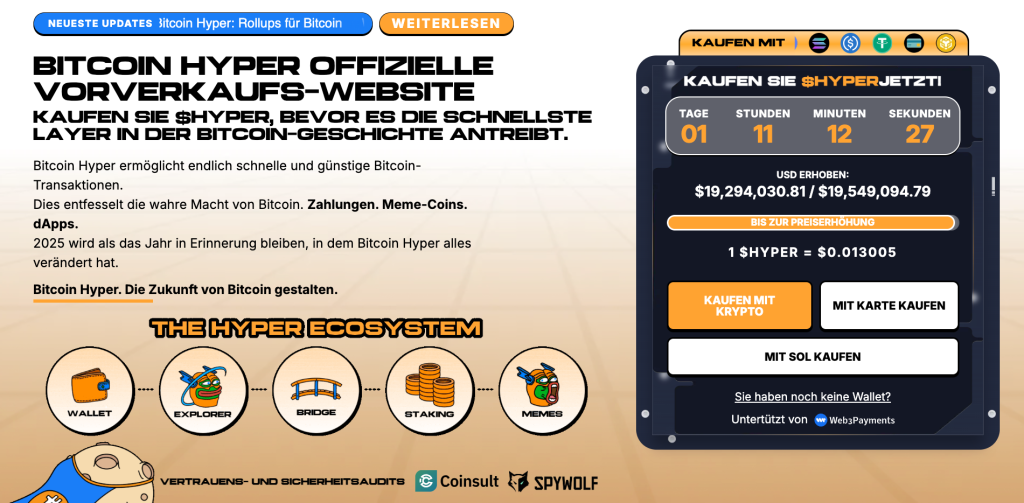
Bitcoin Hyper Presale Oktober 2025
Bitcoin Hyper Presale

Lies hier eine langfristige Prognose für BTC Hyper!

$HYPER: Wenn BTC steigt, könnte Hyper mitsteigen

$HYPER ist der Token, der diese Erweiterung möglich macht. Steigt BTC wie von Experten erwartet, steigt auch der Bedarf an Lösungen, die BTC nutzbar machen. Hyper erfüllt genau diesen Bedarf – und $HYPER könnte von dieser Dynamik mittel- bis langfristig profitieren.

[su_button url=”https://icobench.com/de/visit/bitcoinhyper” style=”flat” background=”#f69422″ size=”8″ center=”yes”]Hier Bitcoin HYPER kaufen[/su_button]

Ihr Kapital ist im Risiko.

Jeder Handel ist riskant. Keine Gewinngarantie. Jeglicher Inhalt unserer Webseite dient ausschließlich dem Zwecke der Information und stellt keine Kauf- oder Verkaufsempfehlung dar. Dies gilt sowohl für Assets, als auch für Produkte, Dienstleistungen oder anderweitige Investments. Die Meinungen, welche auf dieser Seite kommuniziert werden, stellen keine Investmentberatung dar und unabhängiger finanzieller Rat sollte, immer wenn möglich, eingeholt werden. Diese Website steht Ihnen kostenlos zur Verfügung, wir erhalten jedoch möglicherweise Provisionen von den Unternehmen, die wir auf dieser Website anbieten.

Editorial Process for bitcoinist is centered on delivering thoroughly researched, accurate, and unbiased content. We uphold strict sourcing standards, and each page undergoes diligent review by our team of top technology experts and seasoned editors. This process ensures the integrity, relevance, and value of our content for our readers.

Trending Cryptos

Related Reads

The "Impossible Triad" Is Fundamentally a Pseudo-Problem

The article argues that blockchain's fundamental limitation is not the scalability trilemma (decentralization, scalability, security), which has been largely solved, but the lack of **privacy** and, until recently, clear **legitimacy**. Blockchain is described as a slow, expensive, globally shared computer whose core value is censorship resistance and verifiability. While ideal for native digital assets like money (e.g., stablecoins), its default transparency acts as a **tax**, exposing all transactions and enabling MEV extraction, which deters serious institutional capital. Simultaneously, its permissionless nature created regulatory ambiguity. The piece contends that **privacy** is the missing critical feature. It rejects the false choice between total transparency and complete anonymity. Modern cryptography (like zero-knowledge proofs) enables **compliant privacy**: users can prove facts (solvency, KYC status, compliance) without revealing the underlying sensitive data (specific holdings, identities). This preserves auditability for regulators and eliminates the leak of financial information. With recent regulatory progress (e.g., the GENIUS Act) addressing legitimacy, adding default, provably compliant privacy becomes a pure upgrade. It transforms blockchain from a costly, public ledger into a confidential settlement layer, finally bridging the gap to mainstream institutional and individual adoption of on-chain finance.

链捕手6h ago

The "Impossible Triad" Is Fundamentally a Pseudo-Problem

链捕手6h ago

Optical Chips: Collective Capacity Expansion

The global optical chip industry is experiencing a massive wave of expansion driven by surging AI data center demand. Major players across the US, Japan, Europe, and China are aggressively investing to ramp up production capacity. In the US, Coherent is expanding its 6-inch Indium Phosphide (InP) semiconductor fab in Texas, supported by CHIPS Act funding and a $2 billion strategic investment from NVIDIA. Lumentum is building a new factory for InP optical devices, and Nokia is scaling its advanced photonic chip packaging and testing capabilities. NVIDIA's investments aim to secure future supply of critical lasers and optical interconnect products for AI infrastructure. Japan's JX Advanced Metals, a leading InP substrate supplier, plans a multi-billion yen investment to increase its capacity 7-10 times, strengthening its grip on the crucial upstream materials market. In Europe, IQE and Tower Semiconductor settled a patent dispute and signed a multi-year InP epitaxial wafer supply agreement, highlighting that next-generation silicon photonics platforms will integrate high-performance InP components. STMicroelectronics and Sivers Semiconductors are also expanding silicon photonics production and partnerships. China is rapidly building out its domestic supply chain. Dongshan Precision's subsidiary, Source Photonics, announced a $12 billion project to expand optical chip and module production. Companies like Sanan Optoelectronics and Yunnan Germanium are scaling up InP chip manufacturing and substrate production, moving towards vertical integration from materials to modules. While debate continues around the exact future architecture—whether CPO (Co-Packaged Optics), NPO, or pluggables will dominate—analysts like Morgan Stanley argue the underlying driver is unchangeable: the explosive growth in bandwidth demand. This will inevitably increase the volume of optical engines, lasers, and related content per GPU, regardless of the final technical path. The competition for "more light" in the AI era has intensified into a global, full-chain capacity race.

marsbit8h ago

Optical Chips: Collective Capacity Expansion

marsbit8h ago

Stablecoins Finally Find Real Yield: An In-Depth Look at On-Chain Reinsurance Re | A Conversation with Re Founder Karan Saroya

Stablecoin Real Yield Found: A Deep Dive into On-Chain Reinsurance with Re's Karan Saroya As stablecoin supply exceeds $170 billion, the search for sustainable, non-speculative yield intensifies. Re, an on-chain reinsurance platform, provides an answer: connecting stablecoin capital to the trillion-dollar traditional reinsurance market. Re operates as a regulated reinsurer, accepting stablecoin deposits as collateral to back US insurance companies. These insurers pay premiums, generating yield that flows back to on-chain depositors. Currently supporting 35 insurers and underwriting $500 million, Re projects scaling to over $1 billion soon. Key insights from a Bankless podcast with founder Karan Saroya and investor Avichal of Electric Capital: 1. **Uncorrelated, Real-World Yield:** Re offers stablecoin holders access to reinsurance returns (targeting 12-14%+), an asset class entirely separate from crypto or equity markets. 2. **Operational Efficiency via Smart Contracts:** Re replaces traditional, labor-intensive capital fundraising with smart contracts, allowing a ~12-person team to compete with industry giants. 3. **Regulatory Leverage:** For every $1 of collateral, regulations allow backing $5-7 in written premiums. This leverage amplifies returns from the underlying risk-free rate. 4. **DeFi Integration:** Depositors receive receipt tokens, which can be used in protocols like Morpho for "looping," potentially pushing yields to 18-20%+. 5. **The "DeFi Mullet" Model:** A compliant front-end (regulated reinsurer) paired with a decentralized back-end (smart contracts, DeFi capital markets). 6. **RE Governance Token:** Modeled on Lloyd's of London, the token governs the central capital pool's allocation, counterparty acceptance, and parameters. 7. **Real Economic Impact:** Capital funds real-world productivity (factories, clinics, businesses) via insurance, moving beyond crypto's internal loops. The discussion highlights a pivotal moment: DeFi's supply-side infrastructure is now met by real demand for productive yield, potentially kickstarting a flywheel where vast on-chain stablecoin capital seeks these real-world returns.

链捕手10h ago

Stablecoins Finally Find Real Yield: An In-Depth Look at On-Chain Reinsurance Re | A Conversation with Re Founder Karan Saroya

链捕手10h ago

1996 or 1999? Walsh's First Test is 'How to View AI'

"1996 or 1999? Wall's First Big Test Is 'How to View AI'" Federal Reserve Chairman Wall's initial challenge is not whether to raise or cut rates, but a more fundamental judgment: what kind of boom is the current AI boom? This will determine the Fed's policy path and define his legacy. Economics is split between two opposing views, according to reporter Nick Timiraos. One sees imminent productivity gains that will increase supply and cool inflation, allowing the Fed to hold steady. The other argues that while productivity benefits are distant, demand shocks are here now, and waiting for data confirmation risks missing the intervention window, forcing sharper rate hikes later. Wall has signaled a leaning toward the first view, echoing 1996-era Alan Greenspan, who embraced strong, productivity-driven growth without fear of inflation. However, Wall faces a different macro environment than Greenspan did, with tariff pressures, expanding fiscal deficits, and diminishing globalization benefits, which could force more significant inflation pressures even if AI benefits materialize. Wall's logic, expressed before taking office, is that AI-driven productivity gains won't show in official data for years. If the Fed waits for confirmation, it might mistakenly tighten policy and choke off the very growth that could suppress inflation. This argues for using forward-looking narratives over lagging data. Chicago Fed President Austan Goolsbee presents a key counter-argument. He distinguishes between expected and unexpected productivity booms. A widely anticipated boom, like the current AI wave, can cause people to spend future wealth gains in advance, overheating the economy before productivity actually rises, thus requiring preemptive rate hikes. He cites rising costs for AI data centers as evidence of such overheating. Fed Governor Christopher Waller offers a rebuttal to Goolsbee, noting the "expected spending" mechanism only works if people can borrow against future income, which many households cannot do due to borrowing constraints. Wall also faces a paradox related to his desire to reduce the Fed's use of "forward guidance" (pre-announcing policy moves). This practice was established in 1999 when Greenspan began signaling hikes to avoid market shocks. If the economy follows a less optimistic path, Wall may be forced to choose between using the guidance he wants to abolish or risking market volatility by staying silent. The ultimate question defining Wall's first major test remains: Is this 1996 or 1999?

marsbit11h ago

1996 or 1999? Walsh's First Test is 'How to View AI'

marsbit11h ago

Trading

Spot
Futures

Hot Articles

What is $BITCOIN

DIGITAL GOLD ($BITCOIN): A Comprehensive Analysis Introduction to DIGITAL GOLD ($BITCOIN) DIGITAL GOLD ($BITCOIN) is a blockchain-based project operating on the Solana network, which aims to combine the characteristics of traditional precious metals with the innovation of decentralized technologies. While it shares a name with Bitcoin, often referred to as “digital gold” due to its perception as a store of value, DIGITAL GOLD is a separate token designed to create a unique ecosystem within the Web3 landscape. Its goal is to position itself as a viable alternative digital asset, although specifics regarding its applications and functionalities are still developing. What is DIGITAL GOLD ($BITCOIN)? DIGITAL GOLD ($BITCOIN) is a cryptocurrency token explicitly designed for use on the Solana blockchain. In contrast to Bitcoin, which provides a widely recognized value storage role, this token appears to focus on broader applications and characteristics. Notable aspects include: Blockchain Infrastructure: The token is built on the Solana blockchain, known for its capacity to handle high-speed and low-cost transactions. Supply Dynamics: DIGITAL GOLD has a maximum supply capped at 100 quadrillion tokens (100P $BITCOIN), although details regarding its circulating supply are currently undisclosed. Utility: While precise functionalities are not explicitly outlined, there are indications that the token could be utilized for various applications, potentially involving decentralized applications (dApps) or asset tokenization strategies. Who is the Creator of DIGITAL GOLD ($BITCOIN)? At present, the identity of the creators and development team behind DIGITAL GOLD ($BITCOIN) remains unknown. This situation is typical among many innovative projects within the blockchain space, particularly those aligning with decentralized finance and meme coin phenomena. While such anonymity may foster a community-driven culture, it intensifies concerns about governance and accountability. Who are the Investors of DIGITAL GOLD ($BITCOIN)? The available information indicates that DIGITAL GOLD ($BITCOIN) does not have any known institutional backers or prominent venture capital investments. The project seems to operate on a peer-to-peer model focused on community support and adoption rather than traditional funding routes. Its activity and liquidity are primarily situated on decentralized exchanges (DEXs), such as PumpSwap, rather than established centralized trading platforms, further highlighting its grassroots approach. How DIGITAL GOLD ($BITCOIN) Works The operational mechanics of DIGITAL GOLD ($BITCOIN) can be elaborated on based on its blockchain design and network attributes: Consensus Mechanism: By leveraging Solana’s unique proof-of-history (PoH) combined with a proof-of-stake (PoS) model, the project ensures efficient transaction validation contributing to the network's high performance. Tokenomics: While specific deflationary mechanisms have not been extensively detailed, the vast maximum token supply implies that it may cater to microtransactions or niche use cases that are still to be defined. Interoperability: There exists the potential for integration with Solana’s broader ecosystem, including various decentralized finance (DeFi) platforms. However, the details regarding specific integrations remain unspecified. Timeline of Key Events Here is a timeline that highlights significant milestones concerning DIGITAL GOLD ($BITCOIN): 2023: The initial deployment of the token occurs on the Solana blockchain, marked by its contract address. 2024: DIGITAL GOLD gains visibility as it becomes available for trading on decentralized exchanges like PumpSwap, allowing users to trade it against SOL. 2025: The project witnesses sporadic trading activity and potential interest in community-led engagements, although no noteworthy partnerships or technical advancements have been documented as of yet. Critical Analysis Strengths Scalability: The underlying Solana infrastructure supports high transaction volumes, which could enhance the utility of $BITCOIN in various transaction scenarios. Accessibility: The potential low trading price per token could attract retail investors, facilitating wider participation due to fractional ownership opportunities. Risks Lack of Transparency: The absence of publicly known backers, developers, or an audit process may yield skepticism regarding the project's sustainability and trustworthiness. Market Volatility: The trading activity is heavily reliant on speculative behavior, which can result in significant price volatility and uncertainty for investors. Conclusion DIGITAL GOLD ($BITCOIN) emerges as an intriguing yet ambiguous project within the rapidly evolving Solana ecosystem. While it attempts to leverage the “digital gold” narrative, its departure from Bitcoin's established role as a store of value underscores the need for a clearer differentiation of its intended utility and governance structure. Future acceptance and adoption will likely depend on addressing the current opacity and defining its operational and economic strategies more explicitly. Note: This report encompasses synthesised information available as of October 2023, and developments may have transpired beyond the research period.

406 Total ViewsPublished 2025.05.13Updated 2025.05.13

What is $BITCOIN

Discussions

Welcome to the HTX Community. Here, you can stay informed about the latest platform developments and gain access to professional market insights. Users' opinions on the price of BTC (BTC) are presented below.

活动图片