Coinbase Reports $433M Profit Thanks to Stablecoin Growth – Best Wallet Token Crosses $16.7M

bitcoinistPublished on 2025-10-31Last updated on 2025-10-31

Abstract

Quick Facts: 1️⃣ Coinbase’s Q3 net income hits $433M with $1.8B in revenue. 2️⃣ Stablecoin income climbed to $355M, with...

Trusted Editorial content, reviewed by leading industry experts and seasoned editors. Ad Disclosure

Quick Facts:

  • 1️⃣ Coinbase’s Q3 net income hits $433M with $1.8B in revenue.
  • 2️⃣ Stablecoin income climbed to $355M, with a record average $USDC balances across products reaching $15B.
  • 3️⃣ Coinbase continues to grow thanks to its $2.9B Deribit acquisition and multiple bank partnerships.
  • 4️⃣ $BEST stands out as a token fueling a retail-ready economy. The presale has raised over $16.7M with 79% staking yields available for early buyers.

Coinbase has just posted a 32% jump in net income, confirming that crypto trading and stablecoins are back in full swing as we enter November.

The exchange has reported $433M net profit for Q3 2025 with revenues of $1.8B. This has outperformed analyst expectations and brought the stock to almost a 32% gain (before consolidating) since the start of the year.
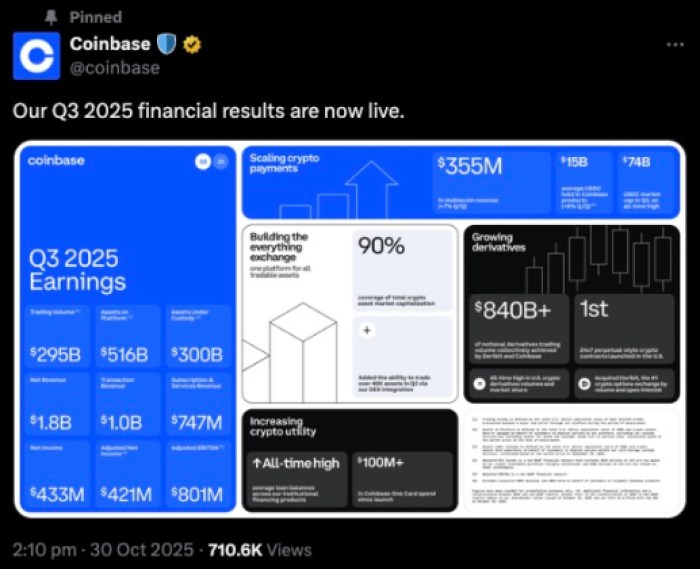
Coinbase Q3 financial results.
Source: @coinbase on X

Trading activity rebounded pretty fast after Bitcoin made moves in Q3 to reach an all-time high twice, first in July and then in August. Add to that a more accommodating regulatory stance from the Trump administration, and it’s clear why Coinbase had such a good quarter.

They’ll be hoping for much of the same in Q4, as transaction revenue rose 83% year-on-year to $1B, while subscription and service income climbed 34% to $747M.

Behind all the numbers is a clear story. Stablecoins are now arguably the most important profit generator. Coinbase produced $355M in stablecoin-related revenue this quarter, with its average $USDC holdings across its products hitting a record $15B. That’s a 7% and 9% increase since Q2, respectively. Impressive.

But what’s fueling this demand? Financial institutions are increasingly parking their liquidity in tokenized dollars, using them for settlement, yield strategies, and cross-border payments.

Even with all this success, Coinbase continued to increase its Bitcoin holdings. CEO Brian Armstrong announced on X that the company’s $BTC holdings increased in Q3 by 2,772 $BTC.
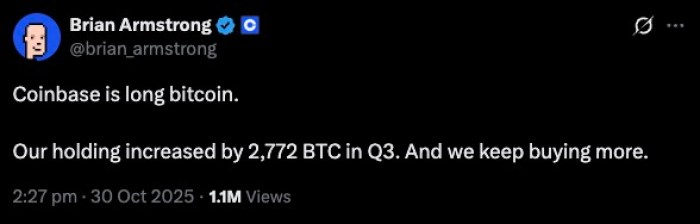
Coinbase CEO announcing the company’s $BTC holding increase of 2,773 $BTC.
Source: @brian_armstrong on X

Coinbase is also continuously investing and expanding in other ways. In Q2, it acquired Deribit for $2.9B. Coinbase then opened the doors to crypto-as-a-service integration due to partnerships with JPMorgan, Citigroup, and PNC.

With clearer guidance from both US and European regulators, stablecoin adoption is moving from the fringe to the mainstream.

This renewed faith in stablecoins and friction-free usability is shifting attention to crypto wallets, as the everyday interface between traders and tokens.

And that’s where projects like Best Wallet Token ($BEST) come in, providing a tool that seamlessly combines security, liquidity, and accessibility in an intuitive design, ready for retail users.

From Institutions to Everyday Users

Coinbase’s Q3 results prove that liquidity and compliance are no longer the main barriers to crypto growth. The next frontier is user experience.

With maturing stablecoin and trading infrastructure, competition is increasing in the retail layer. This includes the wallets where people actually hold, swap, and use their assets.

While exchanges like Coinbase build top-down integrations with banks, Web3 wallets build bottom-up trust for retail users.

This is precisely the audience for whom Best Wallet and its native token $BEST have been built.

Best Wallet Token ($BEST) – The Gateway for Retail Adoption

Best Wallet is positioning itself as a new kind of Web3 gateway. One that merges security, simplicity, and earning potential into a single app.

The wallet provides a unified platform to manage assets, swap tokens, and access crypto presales all within the interface. Stablecoins like $USDT and $USDC are available across the Ethereum, BNB, and Solana networks, with plans to eventually support 60+ chains.

Retail users demand secure crypto wallets. Best Wallet uses Fireblocks MPC-CMP technology (the same used by financial institutions) to protect your private keys through distributed encryption. This removes the single point of failure that, unfortunately, plagues most crypto wallets.

The $BEST token powers this modern financial app. By holding $BEST, you can enjoy reduced transaction fees, early access to presales, increased staking rewards, and governance rights to vote on the wallet’s future.

🪙 Learn how to buy Best Wallet Token in our step-by-step guide.
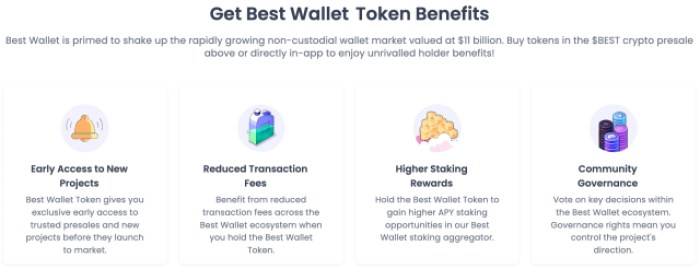
Best Wallet Token ($BEST) benefits for holders.

Soon, you’ll be able to access the Best Card. This crypto debit card will enable you to spend your assets anywhere Mastercard is accepted, while earning cash back. Holding and staking $BEST will lower your transaction fees once again.

The presale traction so far has been impressive. $BEST has raised over $16.7M, with tokens priced at $0.025875. If the app’s 50% month-on-month user growth continues, we believe a Best Wallet Token price prediction of $0.62 is feasible in 2026. That would be close to a 24x from today’s price.

As wallets evolve into more than just a place to store crypto, the more user-friendly and income-generating features on offer, the more likely you are to succeed. Best Wallet ticks every box by offering built-in reward systems for everyday crypto use.

Join the $BEST presale and start earning 79% staking rewards.

As always, this article does not constitute financial advice. Presales and crypto in general carry inherent risks. Please do your own research (DYOR) and never invest more than you can afford to lose.

Authored by Aidan Weeks, Bitcoinist — https://bitcoinist.com/coinbase-income-surges-433M-stablecoin-rally-best-wallet-token-16-7-m

Editorial Process for bitcoinist is centered on delivering thoroughly researched, accurate, and unbiased content. We uphold strict sourcing standards, and each page undergoes diligent review by our team of top technology experts and seasoned editors. This process ensures the integrity, relevance, and value of our content for our readers.

Aidan Weeks, a Master's graduate in Mechanical Engineering, has thrived as a content writer for over four years. Specializing in crypto, tech, engineering, AI, and B2B sectors, Aidan adeptly crafts web copy, blog posts, buying guides, manuals, product pages, and more, making complex concepts accessible and engaging. His transition from academia to full-time writing reflects his passion for bridging technical expertise with clear, informative content. Since joining Bitcoinist, Aidan has written extensively about DeFi, dApps, AI, and meme coins, solidifying his grasp on emerging blockchain technologies. An early adopter, he began investing in Solana in 2020, further deepening his insights into crypto markets and innovation. Today, he combines hands-on experience with a sharp editorial instinct to help readers cut through hype, spot real trends, and make sense of a fast-moving space.

Related Reads

We Captured Thousands of Job Postings and Discovered ByteDance is Reviving Smartphone R&D

This article analyzes ByteDance's recent hiring activities, revealing a potential restart of smartphone hardware development. By scraping and analyzing thousands of ByteDance job postings, the authors identify three key categories: roles for the "Doubao Phone Assistant" (an AI agent), for a "Mobile OS" (system-level development), and for hardware/engineering positions in Shenzhen (a manufacturing hub). The piece traces the context to the 2025 launch of the "Doubao Phone," a concept device that integrated an AI agent directly into a smartphone, allowing it to see the screen, operate apps, and perform tasks like shopping or booking tickets. While innovative as an early AI Agent prototype, it faced operational restrictions from major platforms like WeChat and Alipay. The new hiring signals a deeper commitment. "Doubao Phone Assistant" roles focus on core Agent capabilities (task execution, memory, cross-app operation). "Mobile OS" positions involve deep system work (kernel, chip adaptation, power/thermal management) necessary for a responsive, always-on AI. Shenzhen-based hardware roles (structure design, testing, production) suggest preparation for physical device manufacturing. The article concludes that in the AI era, where phones may become an Agent's "body," controlling the operating system and hardware is critical. For a company like ByteDance, being merely an app within others' ecosystems is no longer sustainable if it aims to own the next-generation user interface. Therefore, while a consumer phone brand isn't confirmed, ByteDance is decisively moving beyond app development into the complex domain of system-level and hardware-integrated AI.

marsbit31m ago

We Captured Thousands of Job Postings and Discovered ByteDance is Reviving Smartphone R&D

marsbit31m ago

AI Impact on SaaS Software Stocks: Deconstructing the Bottom-Fishing Logic of Salesforce, ServiceNow, and Snowflake

"AI Nightmare for SaaS Stocks: Unpacking the Bottom-Fishing Logic for Salesforce, ServiceNow, and Snowflake" A deep dive analysis argues that the recent collapse in SaaS software stocks, dubbed the "SaaS Doom," presents a contrarian buying opportunity. The market panic, triggered by fears that AI will disrupt traditional per-user subscription models through "seat compression" and AI agents bypassing software UIs, has led to extreme selling in the software sector. The analysis evaluates three major players under a unified framework: 1. **Salesforce (CRM):** Positioned as a "margin of safety" play. Trading at historically low valuations (13-14x forward P/E), with strong cash flow and a massive buyback, it offers value. Its key challenge is transitioning from a "seat economy" to an AI-driven "task economy" with its Agentforce platform. 2. **ServiceNow (NOW):** The "clearest AI narrative" play. Its "AI Control Tower" strategy aims to become the governance and orchestration layer for enterprise AI agents, benefiting from AI proliferation. Backed by Nvidia's CEO, it trades at a relatively low valuation post-correction. 3. **Snowflake (SNOW):** The "high-risk, high-reward" bet. Its consumption-based model aligns with rising AI workloads, and its RPO growth is strong. However, it faces intense competition (e.g., Databricks), is not yet GAAP profitable, and carries the highest valuation. The conclusion counters the simplified "AI kills software" narrative. AI is eliminating software that sells only functional interfaces but rewarding platforms that provide essential infrastructure, data, and governance. The current sell-off may have created a buying opportunity for resilient software leaders positioned as future AI infrastructure platforms.

marsbit52m ago

AI Impact on SaaS Software Stocks: Deconstructing the Bottom-Fishing Logic of Salesforce, ServiceNow, and Snowflake

marsbit52m ago

Just Now, Ilya Drops Another Mind-Blowing Image ‘The Thinker’: What’s on His Mind in the Ocean of AI Chips?

Shortly after going quiet, Ilya Sutskever, AI's enigmatic spiritual leader, posted a mysterious sketch titled "The Thinker" on Instagram. The drawing depicts Rodin's iconic sculpture perched on a cliff, contemplating a vast, purple microscopic universe made of transistors and digital circuits—a chip die shot—signed "IS 2026." This cryptic image, saying "nothing yet everything," ignited widespread speculation in Silicon Valley. Some see it as a search for sacred meaning in silicon, others as a silent critique of brute-force compute scaling. It echoes Ilya's past influence, like the original OpenAI logo he once doodled on a wall. The post coincided with a triple announcement from OpenAI, intensifying the frenzy. First, an internal reasoning model discovered new geometric constructions, challenging a long-standing conjecture and impressing Fields Medalist Tim Gowers. Second, Codex for Mac introduced "Appshots," allowing it to access application windows—even text outside the view—and gained features like Goal Mode, a built-in browser, and plugin capabilities, evolving from a coding assistant into a persistent "resident engineer." Third, reports surfaced that OpenAI is preparing for a confidential IPO filing with banks like Goldman Sachs and Morgan Stanley, potentially eyeing a fall public listing. Together, these moves signal that AGI (Artificial General Intelligence) is not a distant slogan but an active force reshaping science, software engineering, and capital markets. Ilya's art hints at a paradigm shift where the boundary between human thought and silicon computation blurs. As OpenAI insiders excitedly say, "Feel the AGI," it suggests a tangible breakthrough may be imminent—one our generation is likely to witness.

marsbit1h ago

Just Now, Ilya Drops Another Mind-Blowing Image ‘The Thinker’: What’s on His Mind in the Ocean of AI Chips?

marsbit1h ago

Vitalik on the Future of the Ethereum Foundation: A Smaller, More Distinct, but Longer-Lasting Ship

Vitalik discusses the future direction of the Ethereum Foundation (EF), emphasizing a shift towards a smaller, more focused, and longer-lasting organization. He clarifies this is his personal view and that his own influence within EF is diminishing, which he welcomes. The key driver is aligning EF's actions with its stated values of decentralization, privacy, and being a "sanctuary technology," addressing criticism that its operations haven't fully reflected these ideals. He argues that EF should not be the "center" of Ethereum but one node among many with a specific mandate. With limited resources (holding only ~0.16% of all ETH), EF must focus its remaining efforts on long-term, mission-critical activities that wouldn't happen without its push, particularly those reinforcing Ethereum's core CROPS values (Censorship-Resistance, Resilience, Openness, Privacy, Security). This means making hard choices, potentially spinning out even respected projects to attract external capital, and cultivating a distinct cultural stance. The core technical vision is for Ethereum to be "amazing" not by chasing maximal throughput, but by excelling in the CROPS dimension. Key goals include: a provably bug-free Ethereum via AI-assisted formal verification; high-availability chain consensus combining the best of BFT and Bitcoin-style security; and minimization of intermediaries in transaction sending and user experience. These "unreasonable" ambitions aim to make Ethereum profoundly impressive in its core values, which also support ETH as a robust asset. The future EF will be a smaller, more opinionated ship built for longevity and meaningful impact.

链捕手1h ago

Vitalik on the Future of the Ethereum Foundation: A Smaller, More Distinct, but Longer-Lasting Ship

链捕手1h ago

Trading

Spot
Futures

Hot Articles

What is DOGE M

Doge Matrix ($doge m): The New Breed of Community-Driven Cryptocurrency Introduction In the ever-evolving landscape of cryptocurrency, new projects constantly emerge, each aiming to capture the interest of investors and enthusiasts alike. One of the latest entrants to this domain is Doge Matrix, represented by the ticker symbol $doge m. This project has attracted attention thanks to its roots in the popular meme culture surrounding Dogecoin, establishing its place within the web3 space. This article aims to provide a comprehensive analysis of Doge Matrix, covering its overview, creator, investors, functionality, timeline, and notable aspects. What is Doge Matrix ($doge m)? Doge Matrix is a community-driven cryptocurrency project that seemingly builds upon the widespread appeal of Dogecoin, a digital currency known for its Shiba Inu mascot and its meme origins. While the overarching objectives of Doge Matrix are not extensively defined, it is characterised by a commitment to harnessing community involvement and support. Unlike traditional cryptocurrencies that often emphasise utility or intrinsic value through underlying technologies, Doge Matrix positions itself within a space that embraces the cultural phenomenon of cryptocurrencies, particularly appealing to those who resonate with the ethos of meme-based assets. Drawing on the strengths of the Dogecoin community, Doge Matrix operates as part of a broader ecosystem, inviting participation and engagement from users who share an interest in cryptocurrency and the digital landscape. Who is the Creator of Doge Matrix ($doge m)? The identity of the creator of Doge Matrix remains unknown. This lack of transparency is not an uncommon occurrence in the cryptocurrency space, where some projects are launched without revealing the identities of their founders. The absence of information regarding the founding team can raise questions among potential investors about the project’s accountability and direction. Who are the Investors of Doge Matrix ($doge m)? As it stands, there is no publicly available information detailing the investors or investment foundations that back Doge Matrix. The project appears to rely primarily on community support rather than institutional investment. This model aligns with the community-driven nature of the initiative, fostering an environment where the direction of the project is shaped by its participants rather than being dictated by a select few financial backers. How Does Doge Matrix ($doge m) Work? The specifics regarding the operational mechanisms of Doge Matrix are somewhat vague, reflecting a broader trend of projects in the meme coin space where innovative functionalities are not always clearly articulated. Nonetheless, Doge Matrix seems designed to tap into the existing cryptocurrency ecosystem by encouraging user participation while tapping into the familiar cultural references associated with Dogecoin. Its potentially unique characteristics derive from community interactions rather than technological advancements, emphasising shared experiences and collaboration among token holders. While the exact innovations have not been explicitly outlined, the project appears to create a space where community members can engage, share ideas, and propel the project's potential forward. Timeline of Doge Matrix ($doge m) Reflecting on the project’s timeline reveals notable events that have defined its journey thus far: November 25, 2024: Doge Matrix reached its all-time high value, marking a significant milestone in its early history. January 1, 2025: Conversely, Doge Matrix hit its all-time low value, illustrating the volatility often associated with cryptocurrencies, especially in the early stages of a project's lifecycle. Ongoing: The project continues to be actively traded and supported by its community, although specific future milestones or objectives have yet to be disclosed. Key Points About Doge Matrix ($doge m) Community Focus At the heart of Doge Matrix is a commitment to community engagement. The project thrives on the premise of collaboration and shared objectives among its members, emphasising the importance of collective effort. Unlike centralised projects that often have a defined leadership structure, Doge Matrix at present showcases a more fluid approach to governance, where every community member's voice matters. Volatility The cryptocurrency market is notorious for its volatility, and Doge Matrix is no exception. Its price history reflects significant fluctuations between high and low values, which is typical of many new cryptocurrencies but underscores the risks associated with investment in emerging tokens. Lack of Detailed Information One of the most striking features about Doge Matrix is the scarcity of detailed information regarding its technological underpinnings and operational mechanisms. This ambiguity necessitates that potential investors conduct thorough due diligence before engaging with the project. Conclusion In summary, Doge Matrix ($doge m) illustrates a new wave of cryptocurrency projects that lean heavily on community engagement and cultural relevance. While lacking in certain specifics—such as clear leadership, defined objectives, and detailed functionality—the project has managed to generate interest within the crypto community, leveraging the established appeal of meme culture. As with any investment in the cryptocurrency space, understanding the inherent risks and conducting comprehensive research is essential for potential participants. Doge Matrix stands as a reminder of the dynamic, sometimes unpredictable nature of the crypto industry, marked by constant evolution and enthusiasm for community-driven initiatives.

492 Total ViewsPublished 2025.02.03Updated 2025.02.03

What is DOGE M

What is $M

Understanding Mantis ($M): A New Era in Cross-Chain Interoperability In the continually evolving landscape of Web3 and cryptocurrency, new projects strive to offer innovative solutions aimed at enhancing the user experience and expanding functional possibilities within the decentralised financial ecosystem. One such project garnering attention is Mantis ($M), a pioneering protocol founded on the principles of cross-chain interoperability and intent-based settlements. This article delves into the essential aspects of Mantis, including its core functionality, creators, investment backing, innovative features, and critical milestones. What is Mantis ($M)? Mantis is described as a multi-domain intent settlement protocol that simplifies cross-chain interactions, enabling users to execute complex financial transactions across various blockchain platforms seamlessly. The protocol operates through three primary layers: Intent Expression: Users can articulate their transaction goals using natural language facilitated by the DISE LLM, an advanced AI language model. For instance, a user might express a desire to swap Ethereum (ETH) for Solana (SOL) with a specific slippage tolerance of 1%. Execution: This layer employs a network of solvers that compete to fulfil user intents. Transactions are executed using mechanisms such as Coincidence of Wants (CoWs) and Order Flow Auctions (OFAs), which ensure that user demands are met optimally. Settlement: Leveraging the Inter-Blockchain Communication (IBC) protocol, Mantis enables atomic cross-chain transactions, allowing users to operate across various supported chains, including Ethereum, Solana, and Cosmos. Mantis is engineered to introduce native yield generation for idle assets, employing cryptographic proofs to maintain the integrity of transactions throughout the entire process. Creators & Development Team Mantis was conceived by the Composable Foundation, a research-driven organisation notable for its emphasis on blockchain interoperability solutions. This foundation collaborates with esteemed academic institutions, including Harvard University and the University of Lisbon, contributing to extensive research and development efforts that inform Mantis's architecture and functionality. The Composable Foundation’s commitment to fostering innovation in the blockchain space positions Mantis as a robust solution for the growing demand for interoperability among multiple blockchain networks. Investors & Backing While specific details about individual investors have not been publicly disclosed, Mantis enjoys substantial backing from various entities, including: Ecosystem grants from IBC-enabled chains, which support the protocol's growth and integration within decentralised finance ecosystems. Strategic partnerships with infrastructure providers that enhance Mantis's network capabilities and deployment strategies. Funding through the Composable Foundation's treasury, ensuring sustained financial support for ongoing development and operational costs. These collaborative efforts reflect a consensus among stakeholders about the importance of enhancing cross-chain functionality and the potential utility of Mantis's infrastructural innovations. Key Innovations Mantis sets itself apart through several pioneering innovations that enhance its functionality and utility: Chain-Agnostic Intents: Users can initiate transactions from any supported chain while settling on another. This flexibility empowers users, driving increased interaction among different platforms. AI-Powered Interface: The integration of DISE LLM allows users to conduct complex DeFi operations using natural language, thereby simplifying interactions and making blockchain technology accessible to a broader audience. Cross-Domain MEV Capture: Mantis creates an internal market for maximal extractable value (MEV) through competitions among solvers. This innovative approach allows for greater efficiency and value extraction in complex transactions. Modular Settlement Layer: The protocol supports various verification methods, including zero-knowledge proofs and optimistic rollups, providing a versatile framework that can adapt to emerging blockchain technologies. Historical Timeline Mantis's development is marked by several critical milestones that chart its trajectory and growth: | Year | Milestone | |————|————————————————————————-| | 2022 | Initial concept development within the Composable Foundation's research division. | | Q3 2024 | Launch of the testnet with bridging capabilities between Solana and Ethereum. | | Q1 2025 | Anticipated Token Generation Event (TGE) alongside the mainnet launch. | | Q2 2025 | Expected integration of DISE LLM and expansion of cross-chain capabilities. | | 2025 H2 | Planned support for over 15 chains through further IBC upgrades. | This timeline outlines Mantis's evolution, from conceptual discussions to active implementation and future growth phases. Ecosystem Growth Strategy Mantis's strategy for ecosystem growth includes several initiatives designed to encourage user participation and developer engagement: Credits System: Users can earn protocol credits by providing liquidity and engaging in referral programmes. These credits are redeemable for incentives in the future, fostering a robust user community. Modular Software Development Kit (SDK): This toolkit empowers developers to create applications based on intent-driven models utilising Mantis's infrastructure, thus promoting innovation within its ecosystem. Governance Model: As the protocol matures, $M token holders will have a voice in protocol governance, allowing them to vote on proposed upgrades and changes, thereby enhancing community engagement and decentralisation. Mantis represents a significant advancement in the realm of cross-chain architecture. By seamlessly integrating advanced AI algorithms with a robust settlement framework, Mantis seeks to tackle the problems of fragmentation within multi-chain ecosystems. Its innovative approach prioritises improved user experiences while adhering to the foundational principles of decentralisation and security, setting a new standard for the future interoperability of blockchain technologies. As Mantis continues its journey of growth and implementation, it promises to be a project to watch closely in the competitive landscape of Web3 and decentralised finance. With its focus on crossing boundaries and elevating user engagement, Mantis is poised to be an integral part of the future developments in the cryptocurrency space.

41 Total ViewsPublished 2025.03.18Updated 2025.03.18

What is $M

Discussions

Welcome to the HTX Community. Here, you can stay informed about the latest platform developments and gain access to professional market insights. Users' opinions on the price of M (M) are presented below.

活动图片