Ripple CEO Highlights Top 5 Acquisitions The Company Has Made As XRP Ledger Usage Rises

bitcoinistPublished on 2025-10-27Last updated on 2025-10-27

Abstract

Ripple’s rapid expansion across the global finance space, along with the continued growth of the XRP Ledger (XRPL), has drawn...

Trusted Editorial content, reviewed by leading industry experts and seasoned editors. Ad Disclosure

Ripple’s rapid expansion across the global finance space, along with the continued growth of the XRP Ledger (XRPL), has drawn significant attention from the broader market. Ripple CEO Brad Garlinghouse recently spotlighted the company’s top five strategic acquisitions, emphasizing how these deals are shaping the crypto payment firm’s future and reinforcing XRP’s central role within the evolving ecosystem. 

Ripple and XRP Ledger Solidify Global Position Through Acquisitions

In an X social media post on Friday, Garlinghouse confirmed that with the complete acquisition of Hidden Road, now rebranded as Ripple Prime, the crypto payments company has finalized five key takeovers in roughly two years. These include GTreasury, Rail, Standard Custody, Metaco, and now Ripple Prime. Each acquisition strengthens the company’s position in the global finance ecosystem and aligns with its vision to create what Garlinghouse calls an “internet of value,” where one moves as easily as information does online.

Garlinghouse emphasized in his post that XRP sits “at the center of everything Ripple does,” underscoring its vital role in the company’s growing range of financial products. Every acquisition, whether focused on liquidity management, custody, or settlement, aims to enhance how institutions leverage Ripple’s payment technology and, ultimately, the XRP Ledger to transfer value globally with greater efficiency and security. 

Following Garlinghouse’s post, crypto market expert Crypto Sensei raised an important question about how the company’s new integration would handle settlement. He also asked whether the company’s stablecoin, RLUSD, which already lives on Ethereum, would also operate on the XRP Ledger. While the Ripple CEO has not confirmed the specifics, the community chimed in, suggesting that the payments firm plans to roll out RLUSD on XRPL soon. This would allow the recently acquired brokerage platform, Ripple Prime, to handle both liquidity and settlement natively on the ledger. 

If this happens, the company could soon control everything from trade execution to settlement, with XRP acting as the core bridge asset. It’s a move that could help the company achieve its clear goals of integrating traditional financial infrastructure with blockchain-based liquidity.  

The Firm Uses XRP In Landmark Equity Deal

In another major development, crypto enthusiast Diana announced that Ripple has confirmed through a US Securities and Exchange Commission (SEC) filing that it paid for a corporate acquisition using XRP as the payment currency. The filing by Armada Acquisition Corp II revealed that Ripple contributed 126,791,458 XRP, approximately $305 million, in exchange for equity units that would convert into PubCo Class A shares upon closing.

The transaction marks one of the first instances where XRP has been used directly as a financial instrument in a regulated equity deal. This move signifies a milestone for Ripple, especially since it officially concluded a 7-year lawsuit with the SEC earlier this year, which had alleged that XRP was a security. 

According to Diana, the purchase will effectively transform XRP from a utility token into a form of institutional capital. The payment firm’s use of XRP as payment also comes on the heels of its GTreasury acquisition and its inclusion in the Federal Reserve’s Faster Payments Task Force Steering Committee, further embedding XRP into mainstream financial operations.

XRP
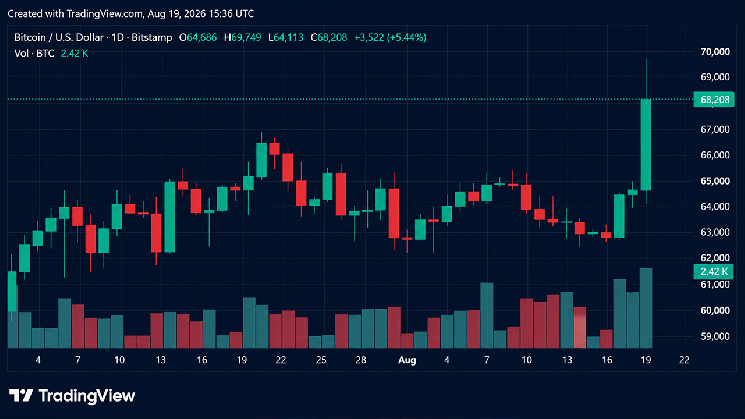
XRP trading at $2.61 on the 1D chart | Source: XRPUSDT on Tradingview.com
Featured image from iStock, chart from Tradingview.com
Editorial Process for bitcoinist is centered on delivering thoroughly researched, accurate, and unbiased content. We uphold strict sourcing standards, and each page undergoes diligent review by our team of top technology experts and seasoned editors. This process ensures the integrity, relevance, and value of our content for our readers.

Scott Matherson is a leading crypto writer at Bitcoinist, who possesses a sharp analytical mind and a deep understanding of the digital currency landscape. Scott has earned a reputation for delivering thought-provoking and well-researched articles that resonate with both newcomers and seasoned crypto enthusiasts. Outside of his writing, Scott is passionate about promoting crypto literacy and often works to educate the public on the potential of blockchain.

Related Reads

CEO's Unexpected Passing: Will ONDO's 'Tokenization Narrative' Change?

Ondo Finance, a leading project in the RWA (Real World Assets) and tokenization space, faces a significant challenge following the unexpected passing of its founder and CEO, Nathan Allman. Known for his traditional finance background and pivotal role in shaping Ondo's strategy, Allman was central to its evolution from a DeFi structured yield platform to a key player tokenizing assets like US treasuries, stocks, and ETFs. The company announced that President Ian De Bode, a former McKinsey partner with deep experience in digital assets and corporate strategy, will assume the CEO role. The leadership transition presents a critical test for Ondo. While Allman's vision and execution were instrumental in establishing its "tokenization narrative," the project's medium to long-term trajectory will depend on the existing team's ability to maintain business continuity. Analysts note short-term concerns regarding vision continuity, institutional partnerships, and market sentiment for the ONDO token. However, Ondo has built a substantial product suite (OUSG, USDY, Ondo Global Markets) and a management team with strong traditional finance credentials. De Bode's background in strategy and execution may align well with the next phase of RWA growth, which focuses heavily on compliance, scaling, and institutional adoption. Ultimately, the event shifts focus to whether Ondo is a founder-driven story or a sustainable financial infrastructure. Its future as a "first tokenization asset" will be determined by the new leadership's success in delivering product growth, asset scaling, and real-world demand, rather than narrative alone.

marsbit1h ago

CEO's Unexpected Passing: Will ONDO's 'Tokenization Narrative' Change?

marsbit1h ago

Trading

Spot
Futures

Hot Articles

What is XRP 2.0

XRP 2.0: A New Frontier in the Cryptocurrency Landscape Introduction to XRP 2.0 In the ever-evolving realm of cryptocurrency, new projects continuously emerge, vying for attention and adoption. One such promising initiative is XRP 2.0, a novel cryptocurrency project designed to leverage advanced blockchain technology and robust encryption methodologies. While the name draws parallels with Ripple’s XRP, it’s crucial to note that XRP 2.0 operates independently, focusing on enhancing transaction security, privacy, and scalability. As the digital financial landscape increasingly embraces decentralized solutions, XRP 2.0 aims to contribute meaningfully to web3 and the overall expansion of crypto projects. What is XRP 2.0? At its core, XRP 2.0 is a cryptocurrency project that aims to create a secure and decentralized digital currency ecosystem. Its foundational technology integrates sophisticated blockchain principles with cutting-edge encryption techniques. The overarching goal of XRP 2.0 is to establish itself as a reliable and efficient platform enabling swift transaction execution while prioritizing enhanced privacy protections for its users. The project is promoted as a solution to many limitations faced by existing cryptocurrencies, proposing a system that can handle a higher volume of transactions with improved speed and privacy. This versatility positions XRP 2.0 as a significant contender in a marketplace riddled with various digital currencies. Who is the Creator of XRP 2.0? The identity of the creator behind XRP 2.0 has been flagged as ‘Wilbur.’ However, comprehensive details regarding Wilbur or their associated entity remain elusive. The anonymity of many cryptocurrency creators is not an uncommon phenomenon in the industry, often designed to maintain a degree of privacy and security. Who are the Investors of XRP 2.0? As of now, specific information related to the investment foundations or organizations supporting XRP 2.0 is not publicly available. In the cryptocurrency sector, the backing by reputed investors can significantly influence a project's credibility and success, yet the transparency regarding the financial supporters of XRP 2.0 has not been established. How Does XRP 2.0 Work? XRP 2.0 stands out by employing a combination of blockchain technology and advanced encryption algorithms that ensures secure and decentralized transactions. Its innovative structure includes unique features designed to foster user engagement and broaden functionalities beyond conventional cryptocurrency transactions. Among these features, XRP 2.0 incorporates AI-powered capabilities, such as text-to-image and text-to-speech functionalities. These additions are designed to enhance the interactive experience for users, promoting broader applicability across various sectors. By bridging technological advancements with user-centered design, XRP 2.0 aims to capture the attention of a diverse range of individuals and enterprises looking to integrate cryptocurrency solutions into their operational frameworks. Timeline of XRP 2.0 Understanding XRP 2.0 requires examining the milestones that have defined its journey thus far: July 23, 2023: XRP 2.0 is introduced as a novel cryptocurrency project, aiming to revolutionize secure and decentralized transaction capabilities in the blockchain domain. September 8, 2023: The launching of another project, XRP20, occurs, marking the emergence of an ERC-20 token on the Ethereum blockchain that remains unrelated to XRP 2.0. November 13, 2023: The XRP Ledger undergoes a significant update with the release of rippled server software version 2.0.0. It is essential to note that this development is disconnected from the XRP 2.0 cryptocurrency project. Key Points About XRP 2.0 To distill the essence of XRP 2.0, several critical factors emerge: Unique Features: The inclusion of features like AI-powered text-to-image and text-to-speech further diversifies the potential applications of XRP 2.0. Blockchain Technology: The framework utilizes advanced blockchain mechanisms and encryption protocols, ensuring a secure and decentralized environment for transactions. Scalability and Privacy: XRP 2.0 prioritizes enhanced privacy protections in transaction processes and the scalability necessary to accommodate a growing user base. No Affiliation with Ripple: Importantly, despite its name, XRP 2.0 does not have any allegiance or collaboration with Ripple’s XRP, distinguishing its operational framework and objectives within the cryptocurrency ecosystem. Conclusion XRP 2.0 represents an ambitious venture into the cryptocurrency sphere, aiming to offer a combination of security, privacy, and efficiency in digital transactions. By integrating sophisticated technologies and user-friendly features, the project sets out to broaden the horizons of what cryptocurrency can achieve in today's digital economy. While the anonymity of its creator and lack of disclosed investors might raise questions for some, XRP 2.0's focus on advanced functionalities and decentralisation enhances its appeal amidst an increasingly crowded crypto market. As the cryptocurrency landscape continues to evolve, XRP 2.0 may yet emerge as a pivotal player in the expansion of secure and scalable blockchain solutions.

942 Total ViewsPublished 2024.04.01Updated 2024.12.03

What is XRP 2.0

Discussions

Welcome to the HTX Community. Here, you can stay informed about the latest platform developments and gain access to professional market insights. Users' opinions on the price of XRP (XRP) are presented below.

活动图片