Bitcoin Developers Clash Over Soft Fork Proposal To Combat ‘Spam’

bitcoinistPublished on 2025-10-27Last updated on 2025-10-27

Abstract

A fresh soft-fork concept billed as a “temporary” fix for non-monetary data on Bitcoin has ignited one of the sharpest...

Trusted Editorial content, reviewed by leading industry experts and seasoned editors. Ad Disclosure

A fresh soft-fork concept billed as a “temporary” fix for non-monetary data on Bitcoin has ignited one of the sharpest developer rows since the blocksize wars, with critics decrying the move as censorship theater—and, more explosively, as an attempt to force changes under the specter of legal liability.

The proposal—submitted on Oct. 24, 2025, to the Bitcoin Improvement Proposals (BIPs) repository as “Reduced Data Temporary Softfork”—seeks to “temporarily limit arbitrary data at the consensus level.” Authored by contributor “dathonohm,” it explicitly cites an earlier mailing-list idea from longtime developer Luke Dashjr and frames the effort as a short-run measure while longer-term designs are pursued. The pull request was labeled “New BIP,” with discussion organized around two activation paths described as “proactive” and “reactive.”

Although many in the debate refer to the document as “BIP-444,” the draft in the repository has not been assigned a number and still appears as “bip-????.mediawiki.” Even so, the conversation quickly escaped the confines of GitHub and the dev mailing list, morphing into a full-blown culture clash on X.

An ‘Attack On Bitcoin’?

At the core is a claim familiar from the inscription/Ordinals fights of 2023–2024: Bitcoin is “a monetary network,” not “an arbitrary data transfer protocol.” Supporters argue that constraining arbitrary payloads is about protocol purpose, not adjudicating content. In the draft’s discussion, the author stresses that limiting data avoids turning Bitcoin into “a content moderation system,” and contends that permissive data storage risks centralization and stigma if the chain becomes known as a venue for illegal material. “Node operators shouldn’t have to defend hosting arbitrary data just to participate in a monetary network,” one passage reads.

The draft also floats a one-year horizon by anchoring the rules to a specific block height. In the PR discussion, a reviewer asked why the document blocks at “987424,” noting that if the intent is “to have it be a year out,” the magic number should be explained in an FAQ because height would drift during debate. The author replied to “see the deployment section,” underscoring that the change is designed to expire.

What the change actually does is still being refined in the thread, but the direction is clear: clamp down on overt channels for large data blobs—explicitly OP_RETURN—and close obvious hiding spots in tapscript. One reviewer challenged the scope, noting that if the point were merely OP_RETURN, the draft would not also touch “MAST and OP_IF,” revealing that the specification aims beyond legacy datacarriers to curtail more expressive script paths that can be abused for storage.

That breadth—combined with the document’s rhetoric—sparked immediate blowback. “Luke is being very clear that he expects his soft-fork to get adopted due to legal threats,” said cryptographer Peter Todd.

He also amplified a separate line of attack: that the change could perversely create a censorship-based double-spend vector. “BIP-444 creates a ‘C-SCAM’ attack where you use censoring reorgs to double spend,” Todd wrote, echoing BitMEX Research’s warning that a malicious actor could embed illegal content on-chain “to cause a re-org and succeed with their attack,” thereby creating “an economic incentive for onchain CSAM.”

Galaxy’s head of research Alex Thorn weighed in even more bluntly: “this is explicitly an attack on bitcoin… however it’s also incredibly stupid.” Long-time Bitcoin developer Matt Corallo summarized the cultural dissonance with acid irony: “Bitcoin devs: ‘we have to be really careful…’ This BIP: ‘YOLO’.”

Todd also claimed to have demonstrated the futility of the approach. “Done with a decade old script that doesn’t even use segwit, let alone taproot… 100% standard and fully compatible with [Luke Dashjr’s] BIP-444,” he wrote alongside a transaction said to contain the entire text of the proposed BIP.

The episode underscores a technical reality the draft itself acknowledges: there will “always be ways to hide data,” which is precisely why the author frames the goal as raising costs, eliminating overt lanes, and—crucially—signaling that large unencrypted files are not a supported use case, thereby “minimizing legal liability for users who run nodes.”

If adopted, the proposal would have immediate implications for protocols that piggyback on witness/script space for non-monetary payloads—Ordinals-style inscriptions foremost among them—at least for the lifetime of the temporary fork. Critics counter that treating such activity as “abuse” is a normative move masquerading as neutrality, and that activating even a temporary fork which can strand funds or encourage censoring reorgs destroys a hard-won norm: forks must never set a precedent where funds can be effectively seized or transactions retroactively delegitimized.

At press time, BTC traded at $115,743.
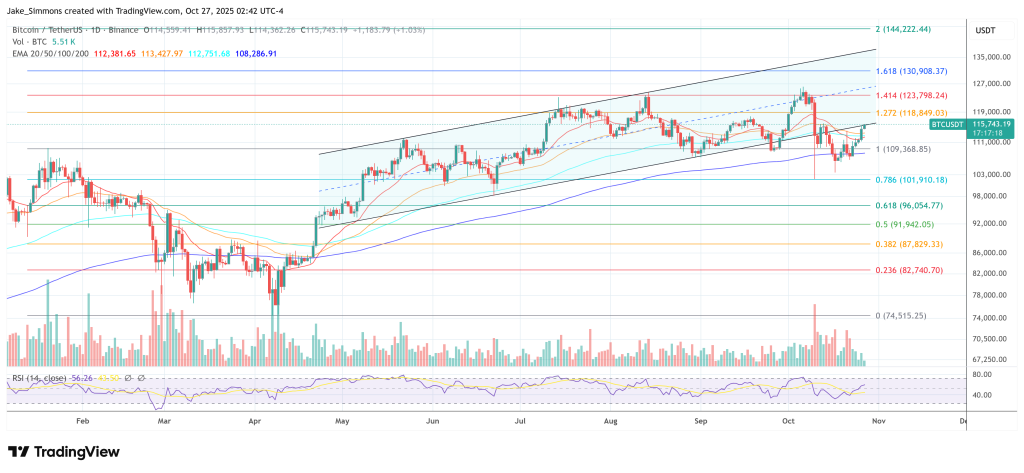
Bitcoin price
Bitcoin tries to reclaim the channel, 1-day chart | Source: BTCUSDT on TradingView.com
Featured image created with DALL.E, chart from TradingView.com
Editorial Process for bitcoinist is centered on delivering thoroughly researched, accurate, and unbiased content. We uphold strict sourcing standards, and each page undergoes diligent review by our team of top technology experts and seasoned editors. This process ensures the integrity, relevance, and value of our content for our readers.

Jake Simmons has been a Bitcoin enthusiast since 2016. Ever since he heard about Bitcoin, he has been studying the topic every day and trying to share his knowledge with others. His goal is to contribute to Bitcoin's financial revolution, which will replace the fiat money system. Besides BTC and crypto, Jake studied Business Informatics at a university. After graduation in 2017, he has been working in the blockchain and crypto sector. You can follow Jake on Twitter at @realJakeSimmons.

Related Reads

From Mining Pool to Mars: Why Is Wang Chun in the SpaceX Cockpit?

Title: From Mining Pool to Mars: Why Wang Chun is in the SpaceX Cockpit? When SpaceX announced that Wang Chun, co-founder of F2Pool, would command the first commercial crewed interplanetary mission, many were shocked. Why would a Bitcoin mining pool founder be on a Mars mission roster? However, understanding Wang Chun's journey over the past decade and the deepening ties between the crypto industry and SpaceX reveals this is not accidental, but an inevitable result of a new era taking shape. Today's Mars plan is no longer just a space engineering project; it is evolving into a civilization-upgrading experiment driven by global tech capital, AI, computing power, energy, and the crypto economy. Wang Chun stands precisely at the intersection of these forces. Part 1: From F2Pool to SpaceX – Wang Chun's Leap F2Pool, founded when Bitcoin was still niche, is one of the earliest large-scale mining pools and once held a significant share of global Bitcoin hash rate. Wang Chun belongs to the first generation of Chinese Bitcoin advocates and infrastructure builders—idealists and engineers who believed in a new value network independent of traditional finance. Miners like him built the hardware, energy, and computing power foundational to decentralized networks. This aligns with the long-term, high-engineering, future-oriented vision required for space civilization. Elon Musk’s space endeavors value such long-term builders over mere capital players, which explains Wang Chun's entry into the SpaceX ecosystem. Part 2: Why Crypto and SpaceX Are Growing Closer The core of global tech competition is shifting from internet applications to next-generation infrastructure. Both crypto and SpaceX are part of this. SpaceX's goal is to drastically reduce space access costs. If successful, it could enable orbital servers, space-based energy, global satellite internet, and Martian bases. These new frontiers will require new payment systems, value networks, and global financial architectures. Cryptocurrencies, inherently global and trustless, are poised to become key to off-planet economies. Moreover, crypto and SpaceX share a high-risk, long-termist ethos—believing in ambitious, world-changing goals despite early skepticism. Part 3: Human Spaceflight Enters the Commercial Era Space exploration, long dominated by state actors, is now being transformed by commercial entities like SpaceX. Wang Chun's involvement signifies that future deep-space participants may include not just career astronauts, but also entrepreneurs, engineers, and AI researchers. This mirrors the Age of Exploration, where commercial capital eventually drove global expansion. Wang Chun has emphasized that Mars colonization must not be delayed for future generations, countering a potential over-focus on nearer-term, commercial lunar projects. His presence symbolizes how new capital, technical communities, and idealists from the crypto world are now entering the interstellar age. In summary, the true significance is not an individual's journey to Mars, but the shift in the driving force of human civilization expansion from state machinery to tech companies, AI systems, and global technology capital. Wang Chun's path—from mining pool to Mars, from the Bitcoin network to starships—may be a preview of technological civilization's evolution in the coming decades.

marsbit2h ago

From Mining Pool to Mars: Why Is Wang Chun in the SpaceX Cockpit?

marsbit2h ago

Trading

Spot
Futures

Hot Articles

What is $BITCOIN

DIGITAL GOLD ($BITCOIN): A Comprehensive Analysis Introduction to DIGITAL GOLD ($BITCOIN) DIGITAL GOLD ($BITCOIN) is a blockchain-based project operating on the Solana network, which aims to combine the characteristics of traditional precious metals with the innovation of decentralized technologies. While it shares a name with Bitcoin, often referred to as “digital gold” due to its perception as a store of value, DIGITAL GOLD is a separate token designed to create a unique ecosystem within the Web3 landscape. Its goal is to position itself as a viable alternative digital asset, although specifics regarding its applications and functionalities are still developing. What is DIGITAL GOLD ($BITCOIN)? DIGITAL GOLD ($BITCOIN) is a cryptocurrency token explicitly designed for use on the Solana blockchain. In contrast to Bitcoin, which provides a widely recognized value storage role, this token appears to focus on broader applications and characteristics. Notable aspects include: Blockchain Infrastructure: The token is built on the Solana blockchain, known for its capacity to handle high-speed and low-cost transactions. Supply Dynamics: DIGITAL GOLD has a maximum supply capped at 100 quadrillion tokens (100P $BITCOIN), although details regarding its circulating supply are currently undisclosed. Utility: While precise functionalities are not explicitly outlined, there are indications that the token could be utilized for various applications, potentially involving decentralized applications (dApps) or asset tokenization strategies. Who is the Creator of DIGITAL GOLD ($BITCOIN)? At present, the identity of the creators and development team behind DIGITAL GOLD ($BITCOIN) remains unknown. This situation is typical among many innovative projects within the blockchain space, particularly those aligning with decentralized finance and meme coin phenomena. While such anonymity may foster a community-driven culture, it intensifies concerns about governance and accountability. Who are the Investors of DIGITAL GOLD ($BITCOIN)? The available information indicates that DIGITAL GOLD ($BITCOIN) does not have any known institutional backers or prominent venture capital investments. The project seems to operate on a peer-to-peer model focused on community support and adoption rather than traditional funding routes. Its activity and liquidity are primarily situated on decentralized exchanges (DEXs), such as PumpSwap, rather than established centralized trading platforms, further highlighting its grassroots approach. How DIGITAL GOLD ($BITCOIN) Works The operational mechanics of DIGITAL GOLD ($BITCOIN) can be elaborated on based on its blockchain design and network attributes: Consensus Mechanism: By leveraging Solana’s unique proof-of-history (PoH) combined with a proof-of-stake (PoS) model, the project ensures efficient transaction validation contributing to the network's high performance. Tokenomics: While specific deflationary mechanisms have not been extensively detailed, the vast maximum token supply implies that it may cater to microtransactions or niche use cases that are still to be defined. Interoperability: There exists the potential for integration with Solana’s broader ecosystem, including various decentralized finance (DeFi) platforms. However, the details regarding specific integrations remain unspecified. Timeline of Key Events Here is a timeline that highlights significant milestones concerning DIGITAL GOLD ($BITCOIN): 2023: The initial deployment of the token occurs on the Solana blockchain, marked by its contract address. 2024: DIGITAL GOLD gains visibility as it becomes available for trading on decentralized exchanges like PumpSwap, allowing users to trade it against SOL. 2025: The project witnesses sporadic trading activity and potential interest in community-led engagements, although no noteworthy partnerships or technical advancements have been documented as of yet. Critical Analysis Strengths Scalability: The underlying Solana infrastructure supports high transaction volumes, which could enhance the utility of $BITCOIN in various transaction scenarios. Accessibility: The potential low trading price per token could attract retail investors, facilitating wider participation due to fractional ownership opportunities. Risks Lack of Transparency: The absence of publicly known backers, developers, or an audit process may yield skepticism regarding the project's sustainability and trustworthiness. Market Volatility: The trading activity is heavily reliant on speculative behavior, which can result in significant price volatility and uncertainty for investors. Conclusion DIGITAL GOLD ($BITCOIN) emerges as an intriguing yet ambiguous project within the rapidly evolving Solana ecosystem. While it attempts to leverage the “digital gold” narrative, its departure from Bitcoin's established role as a store of value underscores the need for a clearer differentiation of its intended utility and governance structure. Future acceptance and adoption will likely depend on addressing the current opacity and defining its operational and economic strategies more explicitly. Note: This report encompasses synthesised information available as of October 2023, and developments may have transpired beyond the research period.

363 Total ViewsPublished 2025.05.13Updated 2025.05.13

What is $BITCOIN

Discussions

Welcome to the HTX Community. Here, you can stay informed about the latest platform developments and gain access to professional market insights. Users' opinions on the price of BTC (BTC) are presented below.

活动图片