Миллиардер Кен Гриффин из Citadel инвестировал в Solana-казначейскую компанию

cryptonews.ruPublished on 2025-08-22Last updated on 2025-10-23

Основатель и CEO одного из крупнейших управляющих активами на Уолл-стрит Citadel Securities Кеннет Гриффин владеет 4,5% долей в DeFi Development, которая аккумулирует Solana (SOL) в качестве резервного актива. Такие данные содержатся в S-13G для SEC.

В документе для Комиссии по ценным бумагам и биржам США (SEC) сообщается, что Гриффин приобрел 1,31 млн акций DeFi Development.

Отдельно Citadel Advisors и аффилированные лица владеют 800 000 ценными бумагами DFDV, или около 2,7% в SOL-казначейской публичной компании, Citadel Securities — еще 415 272 (1,4%). Также на двух акционеров приходится еще 515 654 ценных бумаг DeFi Development (1,8%)
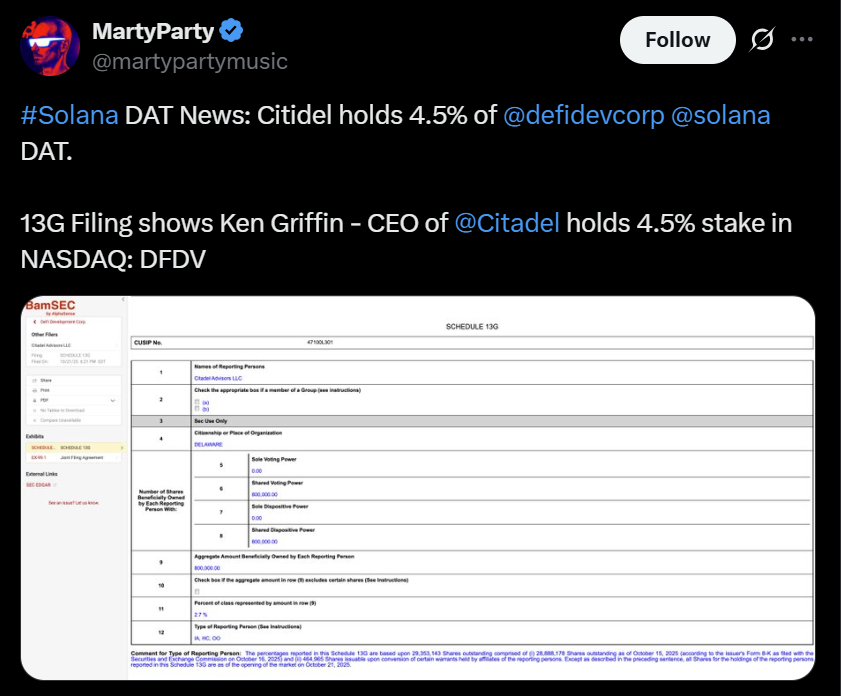
Источник: MartyParty.

Раскрытие информации подтверждает тезис отчета a16z Crypto об ускорении внедрения криптовалют среди институционалов. В исследовании эксперты привели примеры инициатив от BlackRock, JPMorgan Chase, Fidelity и Citigroup.

Citadel Advisors является подразделением по управлению инвестициями группы хедж-фондов Citadel и зарегистрированным инвестиционным консультантом в SEC. Компания распоряжается активами на ~$69 млрд в различных фондах.

Citadel Securities работает как маркетмейкер. Доход за 2024 год составил $9,7 млрд, чистая прибыль — $4,2 млрд.

По теме: Джон Боллинджер допустил сильное восходящее движение Ethereum и Solana

Обострение конкуренции

DeFi Development является третьей по величине корпорацией с казначейством в Solana с 2,196 млн SOL, уступая Forward Insdustrues и Solana Company с 6,82 млн SOL и 2,2 млн SOL соответственно, согласно Strategic SOL Reserve.
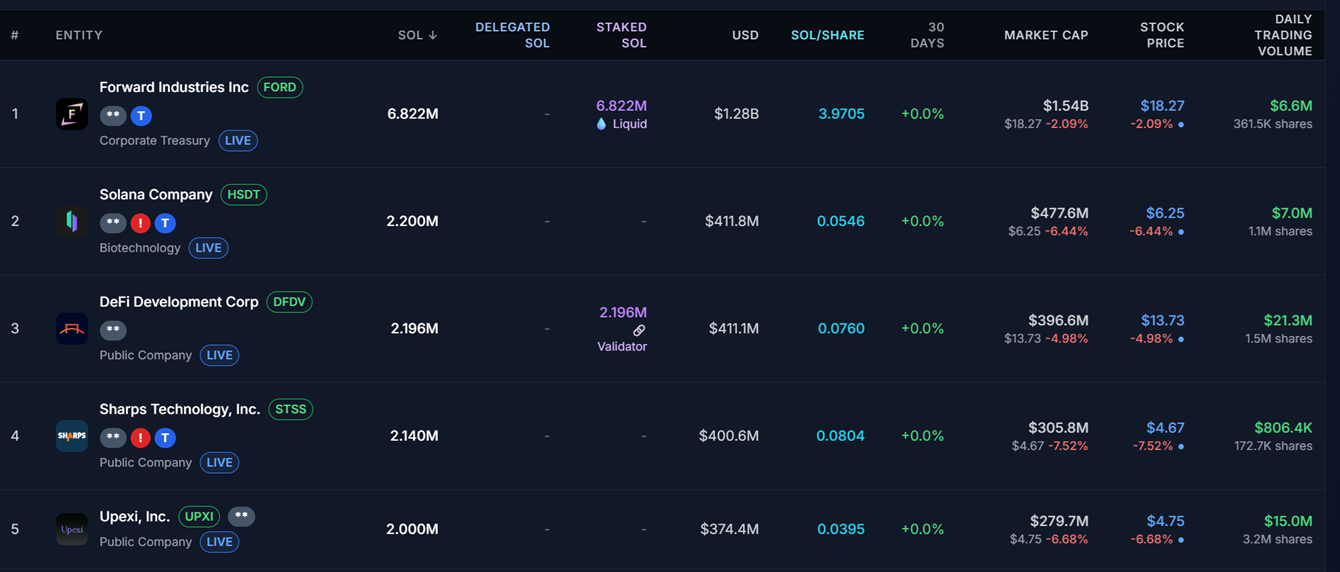
Инвестиции, Solana, Hedge fund
Источник: Strategic SOL Reserve.

За последние 30 дней DeFi Development добавила 86 307 SOL, по данным CoinGecko.
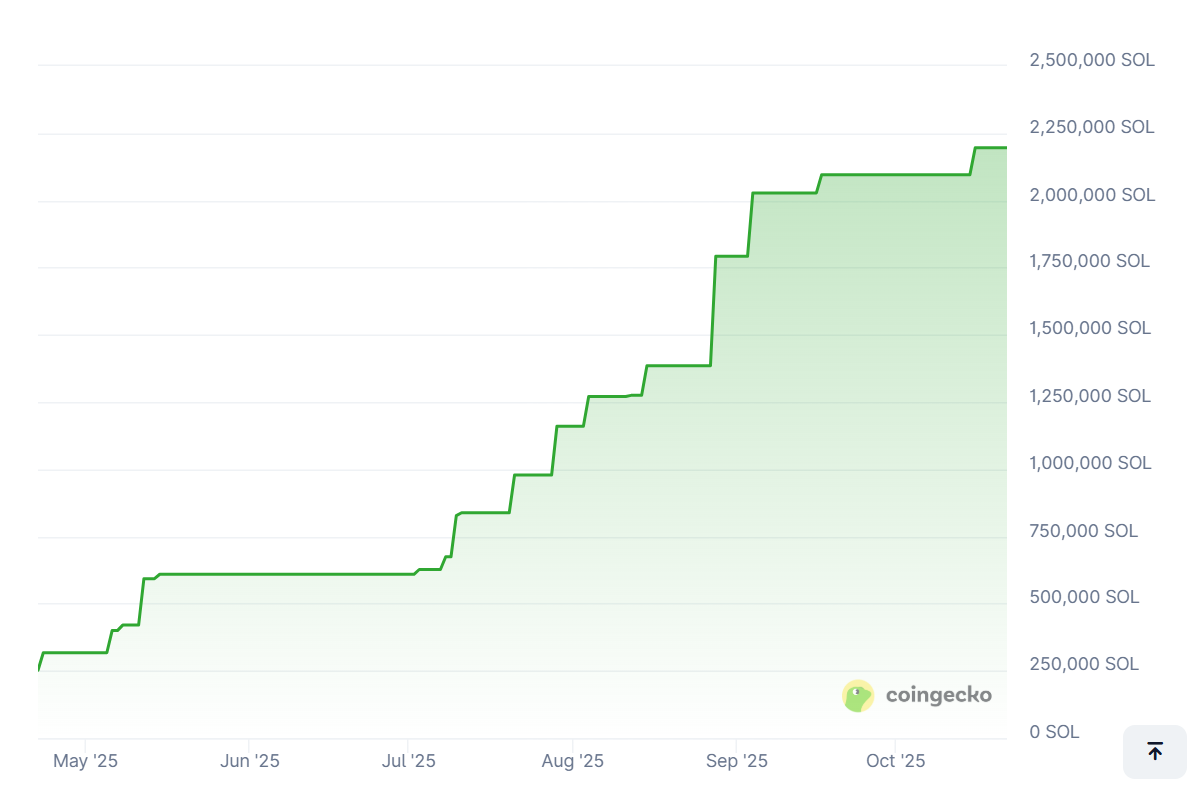
Источник: CoinGecko.

Капитализация DeFi Development составляет $397,8 млн, стоимость монет на ее балансе — $411,2 млн, mNAV в 0,97 — меньше 1.

Ранее в Standard Chartered упомянули DeFi Development среди тех, кто фиксирует снижение mNAV ниже пороговой величины на фоне «адаптации сектора к новым рыночным реалиям».
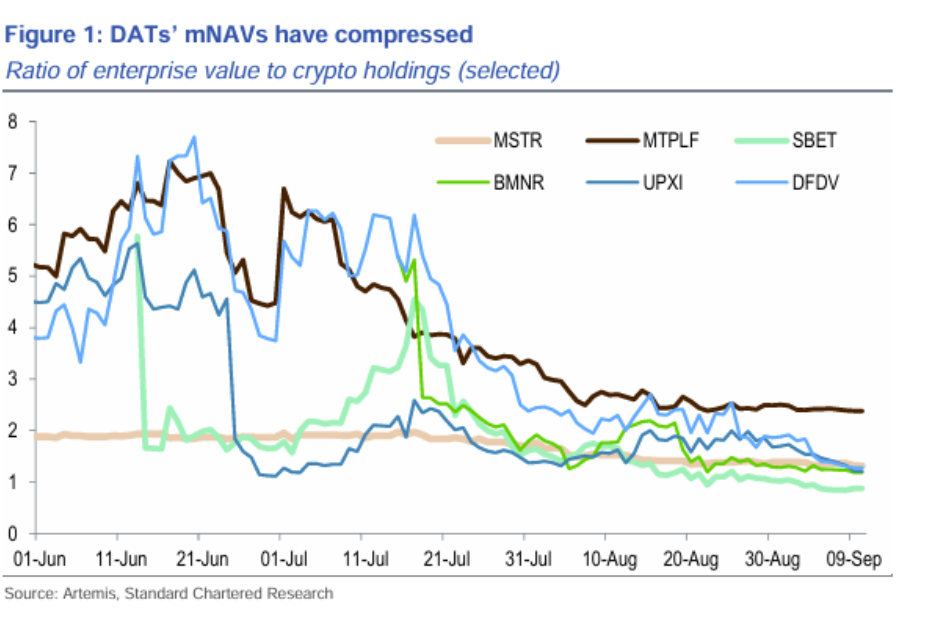
Источник: Standard Chartered.

По теме: проблемы криптоказначейских компаний открывают новые возможности — 10x Research

Trending Cryptos

Related Reads

Upbit is Anxious: A Hasty Counterattack Aimed at Regaining Stablecoin Market Share

Title: Upbit's Rushed Counterattack to Reclaim Stablecoin Market Share Facing a dramatic shift in South Korea's stablecoin market, leading exchange Upbit launched a promotional campaign from July 26 to August 9, waiving the 0.05% trading fee for stablecoins paired with the Korean Won (KRW) and rapidly listing new stablecoins like RLUSD and USDG. This move is a direct response to its plummeting market share in this sector. Historically a duopoly with Bithumb, the market has been reshaped since October 2025 when Coinone permanently removed fees for USDC trading. By June 2026, Coinone led with 34.8% of stablecoin volume, followed by Bithumb (31.1%) and Upbit (30.1%). This contrasts sharply with the overall crypto market, where Upbit commands 60%. The data shows stablecoin demand is highly sensitive to fees, as users primarily buy them to transfer capital overseas for derivatives trading or forex arbitrage. South Korean exchanges have seen a net outflow of stablecoins for 18 consecutive months, totaling approximately 14.9 trillion KRW, underscoring their role as a cross-border capital conduit. Upbit's limited-time promotion initially boosted its daily stablecoin volume by 162%, but the surge was almost entirely in USDT (98.1% of volume). The newly listed stablecoins saw negligible, fleeting interest. Furthermore, the promotional effect quickly waned in the second week, with volume dropping 33% on weekdays. A concurrent weakening of the KRW also contributed to the trading spike, independent of the fee waiver. The analysis suggests that once the promotion ends, Upbit is unlikely to retain its temporary gains unless it matches Coinone's permanent zero-fee policy, forcing a choice between market share and fee revenue. Upbit's strategic push may be less about immediate profit and more about preparing for future regulatory shifts. With South Korea's *Digital Asset Basic Act* on the horizon, which will regulate KRW-backed stablecoins, and following Dunamu's (Upbit's parent) integration into Naver Financial to build a payment ecosystem, securing a dominant position in the dollar stablecoin distribution channel holds long-term strategic value. However, potential regulatory conflicts could prevent Upbit from listing a future Naver-issued KRW stablecoin, making the current fight for dollar stablecoin flow even more critical.

marsbit5h ago

Upbit is Anxious: A Hasty Counterattack Aimed at Regaining Stablecoin Market Share

marsbit5h ago

Michael Saylor Compares Bitcoin and Gold!

Michael Saylor, founder of MicroStrategy, argues that Bitcoin fundamentally changes how wealth is stored and transferred by transforming digital scarcity into economic value. He describes Bitcoin as the first digital monetary network, combining computers, digital networks, and cryptography. It digitizes monetary assets, allowing their supply to be controlled by public protocols rather than institutions, thus converting economic value into information transmissible over global networks. Comparing Bitcoin to gold, Saylor states that while increasing Bitcoin's supply is harder, its integration with software and transfer is easier. He highlights Bitcoin's proof-of-work mechanism, which ties it to the physical world by consuming real energy to secure the ledger, making past transactions immutable. This creates a shared security system involving miners, energy companies, and investors. Saylor suggests "digital monetary energy" is a more accurate term than "digital gold." He emphasizes that the Bitcoin network is an adaptive ecosystem of miners, nodes, developers, and users. Its core design is intentionally simple, focused on maintaining a secure ledger for scarce digital assets, with complex functionalities built in higher-layer applications. This architecture allows Bitcoin to serve as a foundation for transmitting value and fostering innovation in payments and financial services. Saylor notes Bitcoin's deeper impact lies in creating digital sovereignty, where private keys give individuals permissionless control over their economic power, with ownership verified mathematically, not by institutions. He concludes that while gold's physical scarcity makes it money, Bitcoin's digital scarcity does the same, characterizing Bitcoin as the monetary energy of the digital age.

cryptonews.ru6h ago

Michael Saylor Compares Bitcoin and Gold!

cryptonews.ru6h ago

Trading

Spot

Hot Articles

Discussions

Welcome to the HTX Community. Here, you can stay informed about the latest platform developments and gain access to professional market insights. Users' opinions on the price of SOL (SOL) are presented below.

活动图片