Ethereum Will Impose Gas Limit In Fusaka Upgrade

bitcoinistPublished on 2025-10-23Last updated on 2025-10-23

Abstract

The Ethereum Foundation has confirmed that the upcoming Fusaka hard fork will introduce a protocol-level ceiling on how much gas...

Trusted Editorial content, reviewed by leading industry experts and seasoned editors. Ad Disclosure

The Ethereum Foundation has confirmed that the upcoming Fusaka hard fork will introduce a protocol-level ceiling on how much gas a single transaction may consume, formally codified as EIP-7825. The cap is set at 2²⁴ gas—16,777,216 units—marking the first time Ethereum enforces a per-transaction limit distinct from the block gas limit. The change is already active on Holesky and Sepolia and will go live on mainnet when Fusaka activates.

In a post published October 21, Toni Wahrstätter framed the rationale in direct terms: “Starting with the upcoming Fusaka hard fork, EIP-7825 introduces a per-transaction gas limit cap of 2²⁴ (≈ 16.78 million gas).” The Foundation’s note emphasizes that while the cap bounds individual transactions, it does not alter the block gas limit; instead, it is designed to mitigate denial-of-service vectors where a single oversized call monopolizes an entire block and to improve block packing predictability as the network prepares for parallel execution.

EIP-7825 draws a clean line between transaction-level complexity and system-level throughput. Previously, exceptionally large calls could approach the full block gas target (around 45 million at times), creating timing and scheduling pathologies for builders and validators.

The new ceiling obliges workloads that would exceed 16.78 million gas to be broken into smaller, sequenced calls. The Foundation’s guidance is careful to note that “for most users, nothing changes,” since the statistical distribution of real-world transactions already sits well below the threshold; the risk surface primarily concerns batch-heavy contracts, deployment scripts, and specialized routers.

What This Means For Ethereum And Users

From a roadmap perspective, the cap is explicitly positioned as groundwork for parallel execution. The blog post connects the change to anticipated efforts such as EIP-7928 in the “Glamsterdam” era, where predictable, bounded transactions are a prerequisite for meaningful concurrency in the execution layer. By ensuring that at least several independent transactions can be packed per block—even under pathological mempool conditions—the cap reduces worst-case contention and simplifies scheduler design for builders experimenting with parallelizable execution paths.

The specification itself is spare and mechanical. EIP-7825’s abstract states the intent “to 16,777,216 (2^24) gas” per transaction, improving resilience against certain DoS vectors and making transaction processing more predictable as block limits rise. That simplicity has been part of its appeal in core-dev channels: a small, well-scoped constraint that preserves forward compatibility with more ambitious scaling work.

Debate on how to encode and communicate the ceiling has been active for months, including discussions over naming and parameterization on Ethereum Magicians and during AllCoreDevs calls. One thread summarized the core guarantee being targeted by several contributors: aligning block targets to multiples of 2²⁴ so builders can always include at least n transactions if the mempool has n eligible ones—an argument for predictability rather than raw throughput.

Operationally, the Foundation says all major clients—Geth, Erigon, Reth, Nethermind, and Besu—have implemented the change in Fusaka-ready releases, reducing cross-client divergence risk at activation. The post also stresses that eth_call semantics are unaffected and that pre-signed transactions whose gas limits exceed 2²⁴ will need to be re-signed below the cap. The upgrade path for developers is straightforward: test against Holesky or Sepolia, re-tool batch operations that flirt with the limit, and adjust gas-estimation logic and alerts so they fail fast when constructions exceed the new ceiling.

The policy context is worth parsing. Ethereum’s history has favored minimal, general-purpose constraints, deferring complexity to higher layers. EIP-7825 fits that pattern: it does not opine on what contracts should do, only that they respect an upper bound that protects liveness and prepares the execution layer for a multi-threaded future.

It also sidesteps fee-market alterations and leaves blob-space economics and block targets to other EIPs and forks. As the Foundation put it, the cap “establishes a safer and more predictable foundation for higher throughput in future forks,” a line that sums up the trade-off succinctly.

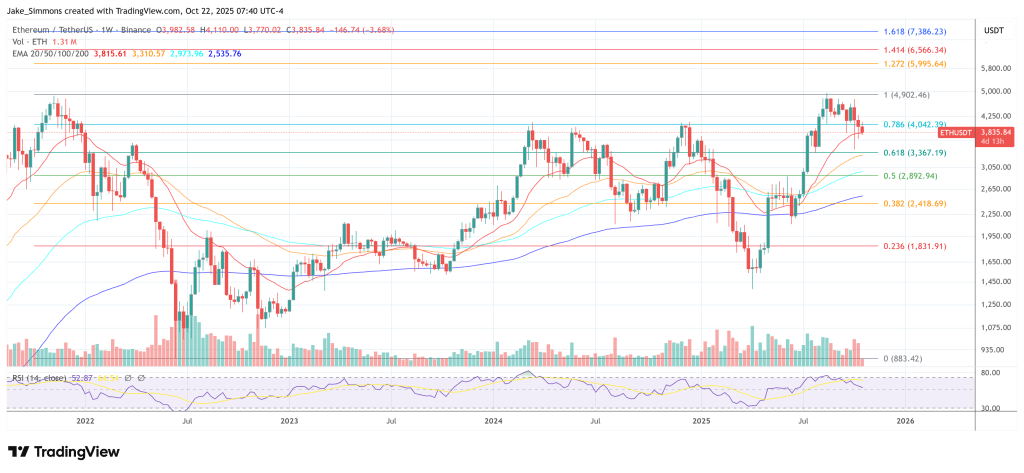
At press time, ETH traded at $3,835.
Ethereum price
ETH holds above the EMA20, 1-week chart | Source: ETHUSDT on TradingView.com
Featured image created with DALL.E, chart from TradingView.com
Editorial Process for bitcoinist is centered on delivering thoroughly researched, accurate, and unbiased content. We uphold strict sourcing standards, and each page undergoes diligent review by our team of top technology experts and seasoned editors. This process ensures the integrity, relevance, and value of our content for our readers.

Jake Simmons has been a Bitcoin enthusiast since 2016. Ever since he heard about Bitcoin, he has been studying the topic every day and trying to share his knowledge with others. His goal is to contribute to Bitcoin's financial revolution, which will replace the fiat money system. Besides BTC and crypto, Jake studied Business Informatics at a university. After graduation in 2017, he has been working in the blockchain and crypto sector. You can follow Jake on Twitter at @realJakeSimmons.

Trending Cryptos

Related Reads

HSBC Research Report Analysis: Behind 12 Million Starlink Users, the Space Economy is Feeding Back to Earth

HSBC Research Report Analysis: The 120 Million Starlink Users and How the Space Economy is Fueling Earth's Industries. The core value of the new space race is returning to Earth, driving industrial upgrades across multiple sectors, according to an HSBC report covering 12 industries. Key developments include: SpaceX’s Starlink has surpassed a critical scale with 10,200 satellites, 12 million broadband users, and 7.4 million direct-to-cell devices. It is evolving from a backup solution to default infrastructure in maritime, aviation, trucking, and remote areas, complementing rather than competing with terrestrial telecom operators. Starship aims to reduce launch costs to $100-$300 per kilogram, a 95%+ reduction from historical averages. This drastic cost compression is reshaping the economics of satellite manufacturing, in-orbit services, and future ventures like asteroid mining. SpaceX’s plans for orbital AI data centers (100 GW by 2040) and the Terafab vertically integrated semiconductor foundry (a joint venture with Tesla and xAI) represent strategic shifts. While orbital data center costs are currently triple those on Earth, they offer a policy-independent backup for power-constrained AI growth. Terafab poses a potential challenge to the traditional fabless-foundry model. The report warns that aggressive capacity expansion by SpaceX and others could lead to a compute surplus by the late 2020s, potentially commoditizing LLMs and pressuring hardware vendors. The space race is most directly reshaping three core industries: 1. **Power/Utilities:** AI data centers are boosting annual U.S. electricity demand growth. Renewable energy and grid infrastructure are clear beneficiaries. 2. **Semiconductors:** Demand is created for "low-Earth orbit optimized" chips, while the vertically integrated Terafab model threatens traditional foundries. 3. **Robotics/Industrial:** Technologies for space mining, lunar construction, and in-orbit servicing are advancing with direct feedback to terrestrial applications in autonomous machinery and navigation. In conclusion, the space economy is already acting as an accelerator for Earth's industries through Starlink's scale, Starship's cost curve, and strategic projects like Terafab, with the most immediate impacts felt in power, semiconductors, and robotics.

marsbit15m ago

HSBC Research Report Analysis: Behind 12 Million Starlink Users, the Space Economy is Feeding Back to Earth

marsbit15m ago

Trading

Spot

Hot Articles

How to Buy GAS

Welcome to HTX.com! We've made purchasing GAS (GAS) simple and convenient. Follow our step-by-step guide to embark on your crypto journey.Step 1: Create Your HTX AccountUse your email or phone number to sign up for a free account on HTX. Experience a hassle-free registration journey and unlock all features.Get My AccountStep 2: Go to Buy Crypto and Choose Your Payment MethodCredit/Debit Card: Use your Visa or Mastercard to buy GAS (GAS) instantly.Balance: Use funds from your HTX account balance to trade seamlessly.Third Parties: We've added popular payment methods such as Google Pay and Apple Pay to enhance convenience.P2P: Trade directly with other users on HTX.Over-the-Counter (OTC): We offer tailor-made services and competitive exchange rates for traders.Step 3: Store Your GAS (GAS)After purchasing your GAS (GAS), store it in your HTX account. Alternatively, you can send it elsewhere via blockchain transfer or use it to trade other cryptocurrencies.Step 4: Trade GAS (GAS)Easily trade GAS (GAS) on HTX's spot market. Simply access your account, select your trading pair, execute your trades, and monitor in real-time. We offer a user-friendly experience for both beginners and seasoned traders.

3.7k Total ViewsPublished 2024.03.29Updated 2026.06.02

How to Buy GAS

Discussions

Welcome to the HTX Community. Here, you can stay informed about the latest platform developments and gain access to professional market insights. Users' opinions on the price of GAS (GAS) are presented below.

活动图片