Whales Accumulate Millions in ADA as Bearish Momentum Persists, Can Cardano Repeat Its 60% Rally?

bitcoinistPublished on 2025-10-21Last updated on 2025-10-22

Abstract

Cardano (ADA) slipped about 4% to $0.64, trading below the 20-, 50- and 200-day moving averages ($0.735, $0.804, $0.741), a...

Trusted Editorial content, reviewed by leading industry experts and seasoned editors. Ad Disclosure

Cardano (ADA) slipped about 4% to $0.64, trading below the 20-, 50- and 200-day moving averages ($0.735, $0.804, $0.741), a setup that keeps short- and medium-term pressure tilted lower. Even so, on-chain flow shows whales accumulating roughly 200 million ADA as developers push fresh upgrades.

However, fundamentals have brightened with Cardano’s Hydra scaling and Midnight privacy tech advanced, daily transaction value topped $10B, and ADA joined the S&P Digital Markets 50, all factors often cited by institutions building longer-term positions.

Derivatives data echo the mixed tone as open interest has climbed above $600M, reflecting active speculation despite price compression, while steady exchange outflows point to broader staking/long-term holding behavior.

Can a MACD ‘Golden Cross’ Repeat June’s 60% Rally?

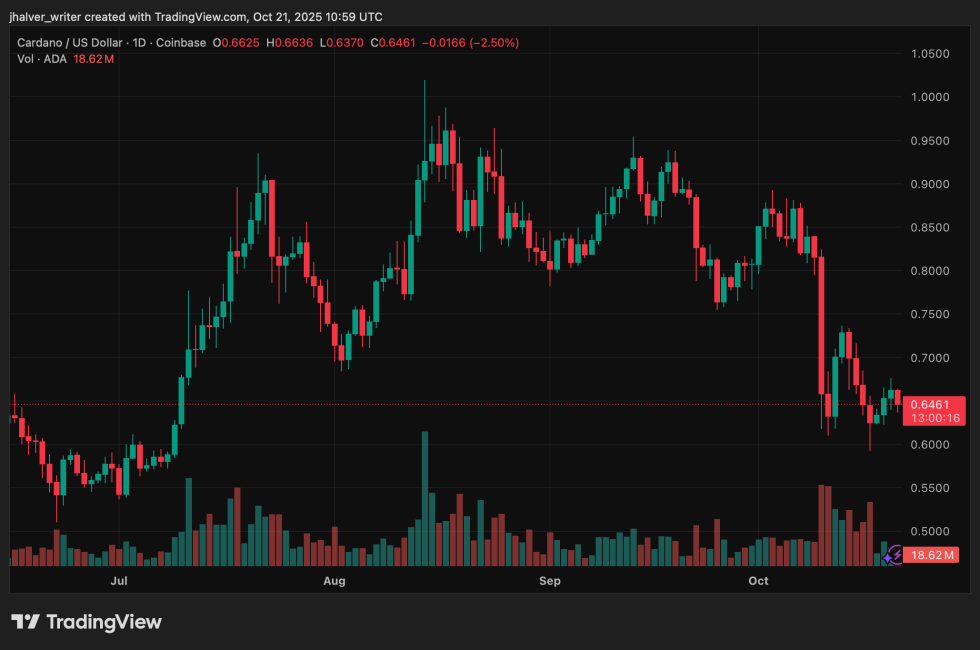
Momentum remains conflicted. The daily MACD is nearing a bullish crossover, a pattern that preceded June’s 60% ADA surge from the $0.53 zone to $0.93 within weeks.

Oversold oscillators (daily RSI 33, negative CCI, soft Awesome Oscillator) suggest sellers may be tiring into support, yet the ADX still favors the prevailing trend, arguing for patience until confirmation.

Technically, bulls must reclaim $0.664 and the 20-DMA to neutralize near-term downside. Above, $0.74–$0.77 (former support now resistance) and $0.80 align with a descending trendline from the Aug. 14 swing, forming a decisive ceiling.

A clean break and hold over $0.71–$0.74 (0.618 Fib confluence/EMA cluster) would strengthen the case for a trend reversal, and reopen talk of a move toward over $1.00 if momentum expands.
Cardano ADA ADAUSD

ADA's price trends to the downside on the daily chart. Source: ADAUSD on Tradingview
ADA Price Levels and Outlook: Support First, Then Confirmation

Near term, analysts see range-bound risk with downside skew. Models project $0.542–$0.590 over the next week if sellers press, with the Ichimoku Kijun support near $0.583 acting as a pivot.

Immediate levels to watch for Cardano (ADA) remain well-defined as the token trades within a tightening range. On the downside, support is seen at $0.639, followed by $0.602 and $0.583, with a breakdown below $0.60 likely to expose the $0.542 zone.

On the upside, resistance sits near $0.664, aligning with the 20-day moving average (20-DMA), while stronger hurdles appear around $0.74–$0.77 and the $0.80 trendline, which marks a key test for sustained bullish momentum.

Cover image from ChatGPT, ADAUSD chart from Tradingview

Editorial Process for bitcoinist is centered on delivering thoroughly researched, accurate, and unbiased content. We uphold strict sourcing standards, and each page undergoes diligent review by our team of top technology experts and seasoned editors. This process ensures the integrity, relevance, and value of our content for our readers.

Related Reads

A Trillion-Dollar Frenzy for Memory Sellers, Halved Profits for Memory Buyers

Summary: A stark divide has emerged in the tech industry. While memory chipmaker Micron's stock soared 19% in a single day, pushing its market cap over $1 trillion, smartphone manufacturer Xiaomi reported a 43% plunge in adjusted net profit. The core driver is a severe supply crunch in memory chips, particularly for AI applications. Wall Street analysts, led by UBS and its unprecedented 204% target price hike for Micron, argue that long-term agreements (LTAs) from AI cloud giants are fundamentally ending the sector's notorious boom-and-bust cycles, justifying a re-rating from cyclical to infrastructure-like valuations. However, the "storage" market is now fragmented into three tiers. The first, AI-grade memory like HBM and server DDR5, faces extreme shortages and soaring prices driven by massive cloud capex. The second, mobile memory for smartphones, is also seeing sharp price hikes as manufacturers like Xiaomi are forced to pay more for remaining capacity, severely squeezing their margins. The third, PC retail channels, shows price declines due to existing inventory. The article questions the sustainability of the "supercycle" narrative. It highlights that Micron's revenue surge is driven almost entirely by price increases, not shipment volumes, making it vulnerable to a potential demand slowdown. While LTAs may dampen volatility, history suggests they are often tested during downturns. The current peak earnings, used to justify high valuations, represent a classic cyclical top. The piece concludes with a note of caution: when the entire Street chants "this time is different," it's wise to remember past bubbles, even as it acknowledges AI demand may indeed be structural.

marsbit49m ago

A Trillion-Dollar Frenzy for Memory Sellers, Halved Profits for Memory Buyers

marsbit49m ago

This New Generation of US Stock Trading Gods No Longer Read Financial Reports

The new generation of "stock gods" in the 2026 US AI bull market are not analyzing traditional financial reports. Instead of focusing on giants like NVIDIA, figures like the 22-year-old Leopold Aschenbrenner (who reportedly turned $200M into $14B) and influencers like Serenity on platforms like Reddit's WallStreetBets, X, and Substack are gaining fame and returns by targeting obscure, low-cap "micro-cap" stocks. Their strategy, dubbed "supply chain sniping," involves identifying critical, often monopolistic, bottlenecks in the AI hardware supply chain—such as specific materials or components essential for giants like Google and NVIDIA—that are missed by mainstream Wall Street analysts. Serenity's call on AXTI, a $700M company supplying indium phosphide substrates crucial for photonics and optical interconnects, saw the stock soar from ~$12 to nearly $150. Similarly, accounts like KawzInvests and PhotonCap focus on thematic, supply-chain-driven research in areas like AI infrastructure, optics, and cloud services for SMEs, bypassing traditional valuation metrics. This shift represents a cultural move away from Warren Buffett-style value investing based on deep financial statement analysis. The new approach thrives on low liquidity, early narratives, and strong community propagation on social media, similar to meme stocks or crypto. However, this "attention economy" strategy carries risks: it depends on sustained information gaps, the underlying companies' ability to deliver fundamental results, and the potential for crowded, volatile exits as narratives shift. The trend also shows crypto traders applying their narrative-sensing skills to US micro-caps, marking a significant evolution in trading culture.

marsbit52m ago

This New Generation of US Stock Trading Gods No Longer Read Financial Reports

marsbit52m ago

Trillion-Dollar Euphoria for Memory Sellers, Halved Profits for Memory Buyers

Title: The Trillion-Dollar Memory Seller's Carnival vs. The Buyer's Halved Profits On May 26, a stark contrast unfolded. While memory chipmaker Micron's market cap surged past $1 trillion, smartphone maker Xiaomi reported plummeting profits. Xiaomi's Q1 2026 profits fell 43% year-on-year. Executive Lu Weibing cited memory prices quadrupling from last year, adding roughly $210 to a phone's cost. To survive, Xiaomi is cutting entry-level models, sacrificing volume. Micron's stock, however, skyrocketed over 19% in a day, capping an 8x gain in a year. Major banks like UBS and JPMorgan issued bullish reports, raising price targets drastically. Their core thesis: Long-Term Agreements (LTAs) with AI cloud giants (Microsoft, Google, etc.) are eliminating the memory industry's notorious boom-bust cycle. By locking in fixed-price, multi-year contracts for AI-grade memory (HBM, server DDR5), these deals promise stable, utility-like earnings, justifying a higher valuation (20-30x P/E vs. the historical 8-15x). The article reveals a three-tiered memory market in 2026: 1) **AI Storage (HBM/DDR5/Enterprise SSD)**: Extreme shortage, soaring prices, LTAs. This is Micron's story. 2) **Mobile/Embedded Memory**: Also facing sharp price hikes as AI production crowds out capacity, severely pressuring phone makers like Xiaomi. 3) **PC Retail**: Some spot prices are falling due to channel inventory liquidation, creating a divergence from contract markets. The author questions if LTAs truly end the cycle. It hinges on sustained, hyper-growth AI demand. Micron's current profits are at a cycle peak, driven mostly by price hikes, not volume. If AI capital expenditure growth slows, the massive industry capacity expansion (e.g., Micron's $250B+ CapEx plan) could lead to a glut. Historically, using peak-cycle earnings for valuation is a classic trap. While the AI-driven structural shift might be real, the unanimous Wall Street euphoria warrants caution, echoing past bubbles like Cisco's in 2000. The memory seller's trillion-dollar狂欢 (carnival) continues, but the cycle's shadow remains.

链捕手58m ago

Trillion-Dollar Euphoria for Memory Sellers, Halved Profits for Memory Buyers

链捕手58m ago

Trading

Spot
Futures

Hot Articles

Discussions

Welcome to the HTX Community. Here, you can stay informed about the latest platform developments and gain access to professional market insights. Users' opinions on the price of ADA (ADA) are presented below.

活动图片