Ethereum Network Sees Nearly $1B in USDT Mints – Fresh Liquidity Amid Market Downturn

bitcoinistPublished on 2025-10-18Last updated on 2025-10-18

Abstract

The Ethereum network witnessed another major stablecoin issuance, with $991.9 million in ETH-backed USDT minted just hours ago, according to...

Trusted Editorial content, reviewed by leading industry experts and seasoned editors. Ad Disclosure

The Ethereum network witnessed another major stablecoin issuance, with $991.9 million in ETH-backed USDT minted just hours ago, according to onchain data shared by analyst Maartunn. This large-scale mint by Tether comes at a crucial time, as both Ethereum (ETH) and Bitcoin (BTC) face growing pressure across the market.

Ethereum has struggled to establish solid support over the past few days, trading near recent local lows as investor sentiment turns increasingly cautious. Meanwhile, Bitcoin continues to test range-bottom levels not seen since June, signaling that the broader crypto market remains in a corrective phase following last week’s violent liquidation event.

Large Tether mints, particularly those issued on Ethereum, are often viewed as signals of incoming liquidity — historically coinciding with short-term rebounds or preparations by market makers to “buy the dip.” However, given current volatility and declining momentum, traders remain divided over whether this mint represents a bullish setup or a liquidity safety measure during uncertainty.

Market Makers May Be Positioning for a Short-Term Bitcoin Bounce

According to Maartunn, the recent ETH-backed Tether mint of nearly $1 billion could be an early sign that market makers are preparing to buy the dip. Historically, large USDT mints — especially those occurring during market downturns — have preceded short-term rebounds in Bitcoin (BTC) and other major assets. These mints often serve as liquidity injections, enabling trading desks and institutional players to deploy capital quickly once volatility begins to subside.

Maartunn shared a chart comparing BTC price movements with the timing of Ethereum-based USDT mints, showing a clear pattern: spikes in Tether issuance frequently align with local market bottoms. This correlation suggests that fresh stablecoin liquidity tends to flow into Bitcoin and Ethereum during periods of panic, stabilizing prices and occasionally triggering sharp relief rallies.
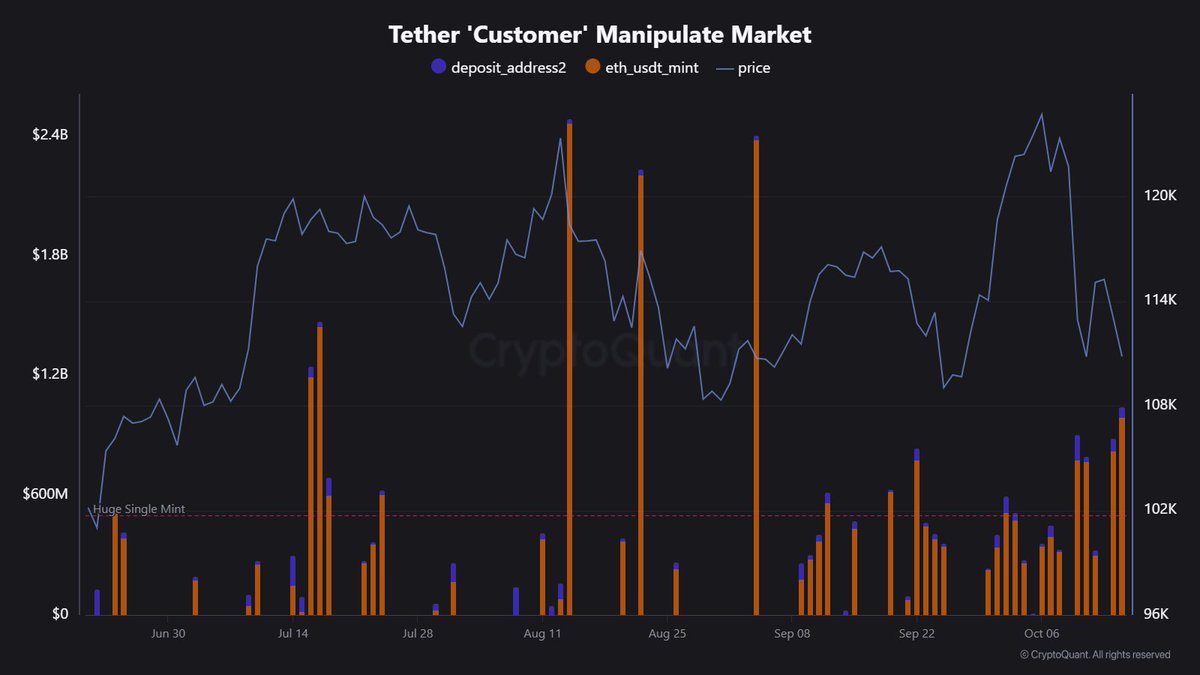
Tether 'Customer' Manipulate Market with BTC price chart | Source: Maartunn
Tether ‘Customer’ Manipulate Market with BTC price chart | Source: Maartunn

However, the market remains in a state of fear and uncertainty, with BTC trading near $110,000 and testing lower support levels. Funding rates remain subdued, and open interest continues to unwind after last week’s historic liquidation event.

In the coming days, price action around the $106K–$110K zone will be crucial to gauge sentiment. If the mint-driven liquidity begins to circulate into spot markets, Bitcoin could experience a short-term rebound. But if caution prevails and liquidity remains sidelined, the market could see another leg of consolidation before a clearer direction emerges.

Total Crypto Market Cap Tests Key Support

The total cryptocurrency market capitalization has fallen sharply, dropping over 4.4% in the last 24 hours to around $3.47 trillion, according to the chart. This decline extends the correction that began after the recent local peak near $4.2 trillion, erasing weeks of gains and pushing the market back toward its 200-day moving average — a critical long-term support now positioned near $3.46 trillion.
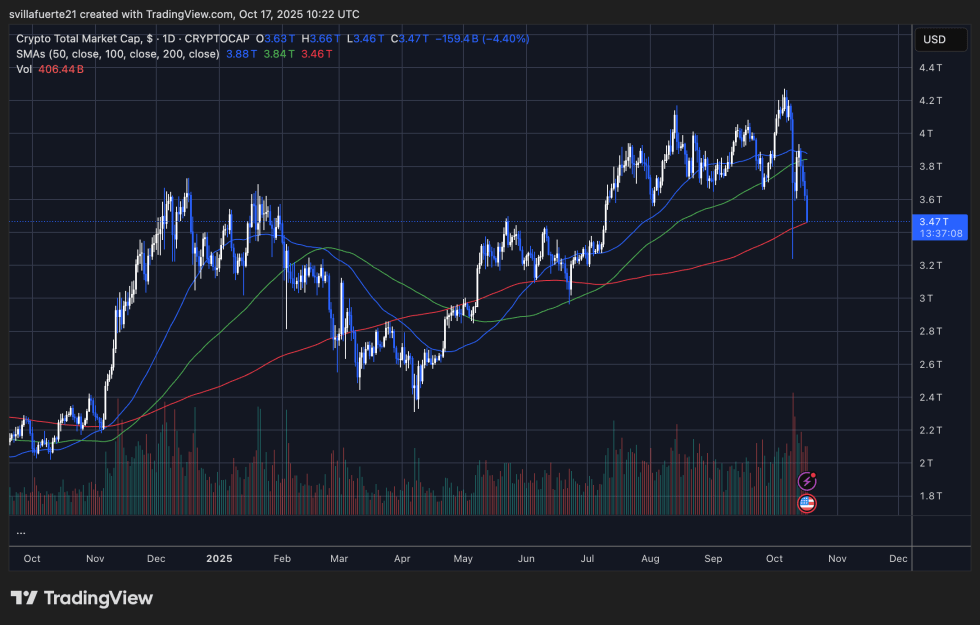
Crypto Total Market Cap testing the 200-day SMA | Source: BTCUSDT chart on TradingView
Crypto Total Market Cap testing the 200-day SMA | Source: TOTAL chart on TradingView

This level is significant because it represents both a psychological threshold and a technical pivot point for overall market structure. A clear break below it could open the door to deeper losses, with the next notable support seen near $3.2 trillion, while a strong rebound from here could confirm that the broader uptrend remains intact.

The 50-day and 100-day moving averages (currently at $3.88T and $3.84T) have both turned downward, reflecting weakening momentum and growing caution among investors. The recent spike in trading volume suggests capitulation-like activity, possibly linked to forced liquidations across Bitcoin, Ethereum, and major altcoins.

For now, the total market cap sits at a crossroads — maintaining the $3.4T zone could mark the start of stabilization, but losing it may confirm a deeper phase of correction before any sustainable recovery.

Featured image from ChatGPT, chart from TradingView.com

Editorial Process for bitcoinist is centered on delivering thoroughly researched, accurate, and unbiased content. We uphold strict sourcing standards, and each page undergoes diligent review by our team of top technology experts and seasoned editors. This process ensures the integrity, relevance, and value of our content for our readers.

Sebastian's journey into the world of crypto began four years ago, driven by a fascination with the potential of blockchain technology to revolutionize financial systems. His initial exploration focused on understanding the intricacies of various crypto projects, particularly those focused on building innovative financial solutions. Through countless hours of research and learning, Sebastian developed a deep understanding of the underlying technologies, market dynamics, and potential applications of cryptocurrencies. As his knowledge grew, Sebastian felt compelled to share his insights with others. He began actively contributing to online discussions on platforms like X and LinkedIn, focusing on fintech and crypto-related content. His goal was to expose valuable trends and insights to a wider audience, fostering a deeper understanding of the rapidly evolving crypto landscape. Sebastian's contributions quickly gained recognition, and he became a trusted voice in the online crypto community. To further enhance his expertise, Sebastian pursued a UC Berkeley Fintech: Frameworks, Applications, and Strategies certification. This rigorous program equipped him with valuable skills and knowledge regarding Financial Technology, bridging the gap between traditional finance (TradFi) and decentralized finance (DeFi). The certification deepened his understanding of the broader financial landscape and its intersection with blockchain technology. Sebastian's passion for finance and writing is evident in his work. He enjoys delving into financial research, analyzing market trends, and exploring the latest developments in the crypto space. In his spare time, Sebastian can often be found immersed in charts, studying 10-K forms, or engaging in thought-provoking discussions about the future of finance. Sebastian's journey as a crypto analyst and investor has been marked by a relentless pursuit of knowledge and a dedication to sharing his insights. His ability to navigate the complex world of crypto, combined with his passion for financial research and communication, makes him a valuable asset to the industry. As the crypto landscape continues to evolve, Sebastian remains at the forefront, providing valuable insights and contributing to the growth of this revolutionary technology.

Trending Cryptos

Related Reads

Morgan Stanley Research Report Analysis: Treasury's Repurchase Scale Doubles, The Logic for a Steepening Yield Curve Remains Unchanged

Morgan Stanley report: US Treasury doubles long-term bond buyback size, steepening yield curve thesis intact. The US Treasury will double the size of its regular liquidity support buyback operations for 10-20 year and 20-30 year bonds to at least $4 billion per operation starting Sept 9. Morgan Stanley views this move, the first adjustment outside a quarterly refunding window since the program's May 2024 launch, as a more important signal than the buybacks themselves. The Treasury is signaling close attention to long-end yield dynamics, using the tool to buy time ahead of the November refunding where it could cut long-term issuance. The report argues recent long-end yield rises and curve steepening are driven not by supply/deficit concerns but by repricing of energy prices and central bank policy paths. Analysis of cash Treasury vs. swap spreads shows no clear pattern consistent with dominant supply worries. The action echoes a November 2023 "supply surprise" that briefly flattened the curve. MS maintains its recommendation to steepen the 7s30s curve, targeting a 100 bps spread vs. ~71 bps currently. It believes fundamentals—cooling inflation, weaker-than-expected labor data, and potential downward revision of the Fed's terminal rate—will ultimately drive markets, supporting further steepening. In FX, MS strategists note the move was interpreted as a mild tool to curb USD strength. A refocus on USD policy could lead to further weakness, particularly against CHF, with EUR/USD potentially rising toward 1.2150.

marsbit18m ago

Morgan Stanley Research Report Analysis: Treasury's Repurchase Scale Doubles, The Logic for a Steepening Yield Curve Remains Unchanged

marsbit18m ago

Kaito Revives 'Talk-to-Earn' Economy, But Many Are Hesitant to Install the New Plugin

Kaito AI has launched a new browser extension called Kaito Pulse, aiming to integrate users' discussions on X (formerly Twitter) with their on-chain activities and social influence to build a new "attention + behavior verification" scoring system. The plugin displays users' public trading positions from platforms like Polymarket directly on the X timeline, allowing others to assess if their statements align with their actual market behavior. This move is seen as reviving "influence-to-earn" incentives. However, the launch sparked significant privacy concerns. Critics, including an analysis by "Ultra," allege the extension collects extensive data, such as device fingerprints (via GPU, hardware info), X user behavior (browsing paths, clicks), and may access sensitive data from third-party accounts (e.g., ChatGPT, trading platforms). This raised debates about trading privacy for verified influence. In response, Kaito founder Yu Hu stated the design follows data minimization principles, aiming to generate verification proofs without collecting or storing raw user data, using technologies like zkTLS. He acknowledged some permission descriptions could be misleading and promised improvements. The controversy highlights a core dilemma for social finance (SocialFi) platforms: as fake engagement and AI content grow, more user data is needed to verify genuine influence, but this risks encroaching on user privacy and trust.

marsbit19m ago

Kaito Revives 'Talk-to-Earn' Economy, But Many Are Hesitant to Install the New Plugin

marsbit19m ago

Kaito Reboots 'Talk-to-Earn Economy', but Many Are Hesitant to Install the New Plugin

Kaito AI has launched a new browser extension called Kaito Pulse, aiming to revitalize what the community terms the "talk-to-earn" or "social-fi" economy on X (formerly Twitter). The plugin displays users' on-chain trading activity, such as positions from platforms like Polymarket, directly within the X timeline. This aims to create a new "attention + behavior verification" system, shifting focus from who generates the most discussion to whose discussions are backed by credible, verifiable actions. However, the launch quickly sparked significant privacy concerns within the crypto community. Critics, led by an analysis from user "Ultra," allege the extension's code enables deep data collection. This includes potential device fingerprinting (using GPU, hardware, and audio data), tracking of X user behavior (browsing paths, clicks, engagement), and verification processes that could access sensitive data from third-party accounts like ChatGPT, Claude, and trading platforms. The debate centers on whether such extensive verification is necessary to combat fake engagement and AI-generated content, or if it constitutes an unacceptable privacy sacrifice. In response, Kaito founder Yu Hu stated the design follows data minimization principles. He claimed Kaito Pulse does not collect or store users' raw data but instead uses verification techniques, including zkTLS, to generate proofs of identity or behavior without exposing the underlying information. Yu Hu acknowledged that some permission descriptions could be misleading and promised improvements in future versions. The controversy highlights a core dilemma for social-fi projects: platforms need more user data to distinguish real influence from artificial hype, but users must decide how much privacy they are willing to trade for potential rewards and ranking within these new incentive systems.

Odaily星球日报39m ago

Kaito Reboots 'Talk-to-Earn Economy', but Many Are Hesitant to Install the New Plugin

Odaily星球日报39m ago

After Two and a Half Years of Entrepreneurship and Full AI Adoption, the Company Has Actually Become More 'Traditional'

"After 2.5 years of running my company, achieving near 100% AI adoption with Agents in roles like finance, HR, and operations, we've paradoxically become more 'traditional.' We learned that establishing a thick AI middle layer creates bottlenecks. Instead, we advocate for a 'thin platform, thick frontline' model, empowering employees closest to problems to use AI tools themselves, fostering ownership and initiative. The true foundation isn't the AI models, but the unique data and context a company accumulates—our most vital, irreplaceable asset, requiring diligent governance. As AI handles repetitive, describable tasks, human roles revert to their core: building genuine relationships, trust, and brand reputation through authentic communication, which AI cannot accelerate. A critical question is where the time saved by AI goes. It must be returned—to clients, to creative work, to employees' own lives—rather than just fueling higher output demands. For managers, AI strips away execution-focused busywork, exposing the necessity to define clear goals, make tough judgments, and take ultimate responsibility. Onboarding newcomers presents a challenge: while AI can generate 80% solutions instantly, we must deliberately design paths for them to develop judgment, understand context, and safely learn from mistakes. Ultimately, AI's organizational value isn't about replacing people but removing unnecessary friction, allowing more meaningful human connection. The real test of an 'AI-era' company isn't its tech stack, but how it treats people: delegating creative power, returning saved time, fostering growth, and upholding accountability. The core luxury and purpose of our work remains authentic human relationships."

marsbit48m ago

After Two and a Half Years of Entrepreneurship and Full AI Adoption, the Company Has Actually Become More 'Traditional'

marsbit48m ago

Trading

Spot

Hot Articles

Discussions

Welcome to the HTX Community. Here, you can stay informed about the latest platform developments and gain access to professional market insights. Users' opinions on the price of ETH (ETH) are presented below.

活动图片