Uniswap добавила поддержку Solana

cryptonews.ruPublished on 2025-05-16Last updated on 2025-10-17

Ведущая некастодиальная биржа Uniswap добавила поддержку сети Solana в веб-приложении.

Solana is now live on the Uniswap Web App 🦄

(Yes, you read that right) pic.twitter.com/XBurgVCgmS

— Uniswap Labs 🦄 (@Uniswap) October 16, 2025

«Ethereum и Solana — крупнейшие DeFi-экосистемы. Однако они развивались отдельно, из-за чего пользователям приходилось использовать разные кошельки, осваивать новые интерфейсы и переключаться между приложениями. Теперь доступ к Solana, Ethereum и более чем 13 другим сетям можно получить внутри одного интерфейса», — отметили разработчики.

Чтобы воспользоваться сетью «народной криптовалюты» в Uniswap, нужно открыть сайт приложения, подключить совместимый кошелек вроде Phantom и выбрать соответствующий блокчейн.

Команда подчеркнула, что это лишь первый этап поддержки Solana на популярной DEX. В будущем разработчики займутся интеграцией кроссчейн-переводов и обменов, а также Uniswap Wallet.

TVL

По объему заблокированной стоимости (TVL) экосистема Solana уступает лишь Ethereum, но с большим отрывом — $11 млрд против $84,8 млрд.
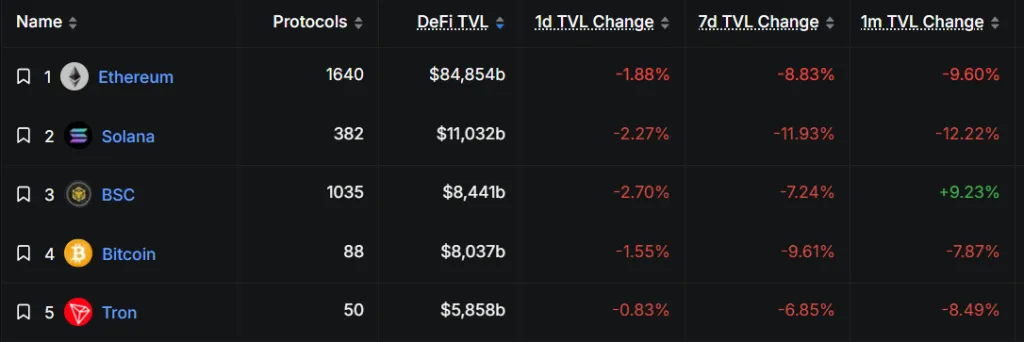
Топ-5 крупнейших экосистем сегмента децентрализованных финансов. Источник: DeFi Llama.

Децентрализованная биржа Uniswap существенно опережает конкурирующие протоколы:
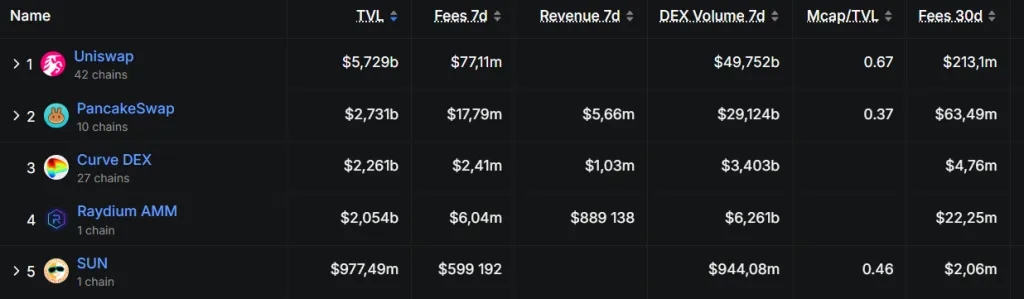
Топ-5 крупнейших DEX. Источник: DeFi Llama.

Примечателен отрыв от главного конкурента — PancakeSwap. По объему комиссионного дохода за месяц ведущая DEX лидирует с показателем $213 млн против $63 млн.

Напомним, в сентябре разработчики Uniswap представили инструмент The Compact v1, призванный решить проблему кроссчейн-фрагментации.


Trending Cryptos

Related Reads

Robotic GPT-3 Moment Shakes Silicon Valley: Zero Lines of Code, Learns Instantly, with Investments from Jensen Huang and Fei-Fei Li

Generalist AI's newly released robot foundation model GEN-1.5 is being hailed as the "GPT-3 moment" for embodied AI. The model demonstrates remarkable one-shot and few-shot learning capabilities in physical manipulation tasks. By watching a single 3-12 second demonstration video (physical prompting) without any training or code, the robot can attempt the task with a 59% average success rate across 10 tasks. With just 5 minutes of demonstration data and minimal fine-tuning (10 gradient steps), the success rate jumps to 83%. The most significant breakthrough is the emergence of spontaneous, improvisational problem-solving abilities not present in the training data. For instance, after learning to sweep blocks with a brush, the robot can adapt to use a banana similarly or switch to a completely new "scoop-and-pour" strategy when given a dustpan. Other emergent behaviors include removing obstacles, correcting errors, and spontaneously sorting objects. These capabilities stem from over 8 months of large-scale pre-training on physical interaction data, suggesting the existence of a Scaling Law for embodied intelligence—where model generalization improves with more data and training time. This approach drastically reduces the cost and expertise needed to teach robots new skills, potentially democratizing robot programming. The release coincides with a surge in the humanoid robotics sector, marked by events like the World Robot Conference and significant investments. While the demonstrated tasks are still relatively simple, the scaling trend and emergent behaviors point toward a future where general-purpose robot "brains" could be easily adapted to various hardware "bodies," reshaping the industry's competitive landscape.

marsbit35m ago

Robotic GPT-3 Moment Shakes Silicon Valley: Zero Lines of Code, Learns Instantly, with Investments from Jensen Huang and Fei-Fei Li

marsbit35m ago

Semiconductor Industry Sees a New Wave of Price Hikes, with STMicroelectronics, Maxscend and Others Increasing Prices Intensively

The semiconductor industry is experiencing a new wave of price increases driven by supply-demand dynamics and rising costs. Throughout August, multiple international and domestic semiconductor companies have issued price adjustment notices to clients, with a focus on analog and RF chips. Key companies adjusting prices include STMicroelectronics, which is implementing its third price hike in 2026 effective August 23, citing sustained demand pressure and rising costs across the supply chain. Analog Devices, Inc. (ADI) has also announced a second price increase for 2026, effective September 13, due to "unprecedented" demand growth and escalating manufacturing costs. In China, RF chip leader Zhuosheng Microelectronics issued a price adjustment notice for its full RF product line, effective September 1, its first hike this year, attributing it to rising raw material and foundry costs. Additionally, Chinese MCU manufacturer Nations Technologies announced a 10-20% price increase for some products from October 1. This new round of price hikes has shifted its focus to mature process nodes (e.g., analog, RF, power, MCUs), partly due to AI computing demand consuming 8-inch wafer capacity. This contrasts with the first half of 2026, when the surge was led by AI memory chips like HBM and server DRAM. Analysts note that the long lead time for expanding analog/power semiconductor capacity (18-24 months) may sustain price resilience in the short term. However, downstream manufacturers' cost tolerance and fluctuating global demand could become constraints, potentially limiting further significant price increases. Companies have linked the hikes to ensuring future supply stability by funding capacity expansion.

marsbit38m ago

Semiconductor Industry Sees a New Wave of Price Hikes, with STMicroelectronics, Maxscend and Others Increasing Prices Intensively

marsbit38m ago

Trading

Spot

Hot Articles

Discussions

Welcome to the HTX Community. Here, you can stay informed about the latest platform developments and gain access to professional market insights. Users' opinions on the price of SOL (SOL) are presented below.

活动图片