KOL 站队引发 Meme 社区内战,共识机制面临考验

比推Published on 2025-10-16Last updated on 2025-10-16

作者:Cookie

原标题:新meme被分流,为何这次玩家们愤怒?


前天,币安发起了「重生支持」计划,并在昨天发放了首批「重生支持」空投,这无疑给了 BSC 上的 meme 玩家又一个好的题材。

但是,一场「分流」事件,引起了玩家们的争吵。

最先聚集起玩家们的共识并跑出来的「重生」币,是合约地址以「4444」为结尾的。从下面的 K 线图可以看到,从成功发射出来后,合约以「4444」为结尾的「重生」币就开始了上涨,最高市值一度突破 1500 万美元。


而在大约 8 小时后,另一个「重生」币,合约以「4444」为开头的,也成功发射了出来,并且在接下来的 2 小时快速上涨,最高市值一度突破 1200 万美元。


在新「重生」币快速上涨的期间,OG「重生」币遭遇了重创,一度下跌超过 50%。这时,KOL 李平的一条支持新「重生」币的推文,让他成为了玩家们声讨的对象:

很快,另一名站位 OG「重生」币的 KOL Chenpepe 对这种「分流」的行为进行了抨击:
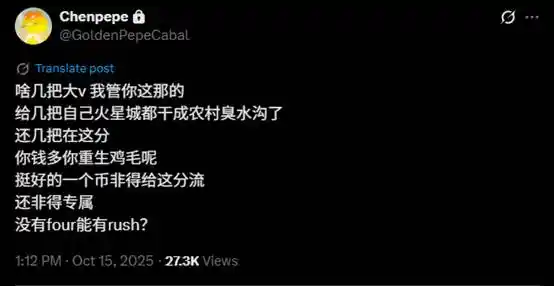
此前,「分流」的情况在币圈并不是没有发生过,比如大小写 Neiro、CZ 的狗「西兰花」等等。但这一次,回到昨天的环境下,币安仍处于被大量玩家「围剿」的舆论风口浪尖上,BSC meme 行情本就不如之前火热。加之,OG「重生」币此前靠自发的共识已经跑到了最高 1500 万美元市值,在这种情况下,新「重生」币突然开启暴涨并且出现 KOL 站台,很难让支持 OG「重生」币的玩家们认为,新「重生」币的起势是自发的共识迁移,而不是阴谋。

如果这两个币是同时发射成功迁移到外盘开始竞争,玩家们就不会有如此之大的情绪。在许多玩家看来,一个有着相当影响力的 KOL,如果看好一个题材,在自身财务能力本身就强过许多普通玩家的情况下,加入进来一起把市值发展到更高又如何?哪怕是一开始两个题材、ticker 都完全相同的币,在同一起跑线上竞争,至少也还是相对公平的。

昨晚,gmgn.ai 的创始人 @haze0x 也发表了自己的看法,表示「分流」的行为应该被反对:
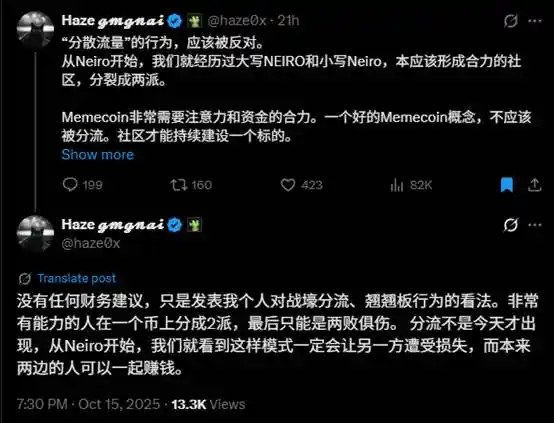
陷入争议的 KOL 李平在今早做出了回应,表示自己最开始两个币都买了,但后续转向支持新「重生」币,并且再次对新「重生」币表示支持:
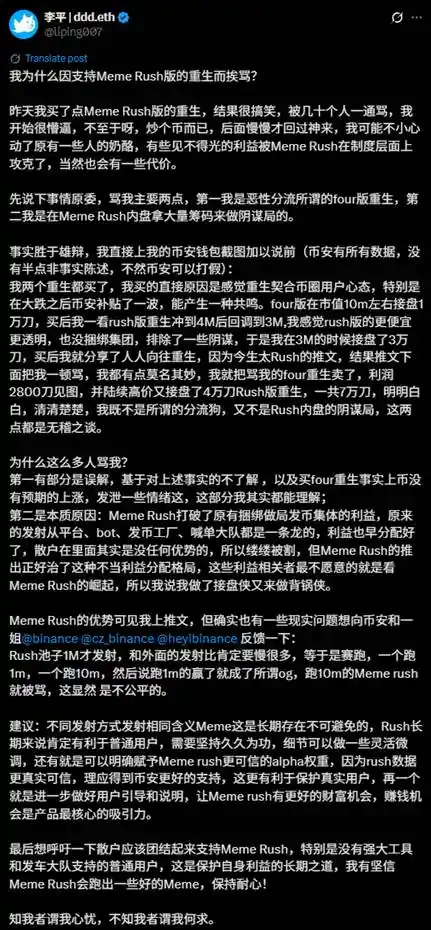
目前,新「重生」币的市值和 OG「重生」币的市值均约为 370 万美元,二者又回到了同一起跑线上。

随着 CZ 发出支持中文 ticker 的推文,以及疑似币安正在测试中文 ticker 合约的消息,BSC meme 市场中的中文 ticker 代币开始回暖。「重生」币之间的纷扰,想必不会很快就此揭过,而是会随着可能到来的第二波中文行情继续下去。


Twitter:https://twitter.com/BitpushNewsCN

比推 TG 交流群:https://t.me/BitPushCommunity

比推 TG 订阅: https://t.me/bitpush

说明: 比推所有文章只代表作者观点,不构成投资建议

Trending Cryptos

Related Reads

Upbit is Anxious: A Hasty Counterattack Aimed at Regaining Stablecoin Market Share

Title: Upbit's Rushed Counterattack to Reclaim Stablecoin Market Share Facing a dramatic shift in South Korea's stablecoin market, leading exchange Upbit launched a promotional campaign from July 26 to August 9, waiving the 0.05% trading fee for stablecoins paired with the Korean Won (KRW) and rapidly listing new stablecoins like RLUSD and USDG. This move is a direct response to its plummeting market share in this sector. Historically a duopoly with Bithumb, the market has been reshaped since October 2025 when Coinone permanently removed fees for USDC trading. By June 2026, Coinone led with 34.8% of stablecoin volume, followed by Bithumb (31.1%) and Upbit (30.1%). This contrasts sharply with the overall crypto market, where Upbit commands 60%. The data shows stablecoin demand is highly sensitive to fees, as users primarily buy them to transfer capital overseas for derivatives trading or forex arbitrage. South Korean exchanges have seen a net outflow of stablecoins for 18 consecutive months, totaling approximately 14.9 trillion KRW, underscoring their role as a cross-border capital conduit. Upbit's limited-time promotion initially boosted its daily stablecoin volume by 162%, but the surge was almost entirely in USDT (98.1% of volume). The newly listed stablecoins saw negligible, fleeting interest. Furthermore, the promotional effect quickly waned in the second week, with volume dropping 33% on weekdays. A concurrent weakening of the KRW also contributed to the trading spike, independent of the fee waiver. The analysis suggests that once the promotion ends, Upbit is unlikely to retain its temporary gains unless it matches Coinone's permanent zero-fee policy, forcing a choice between market share and fee revenue. Upbit's strategic push may be less about immediate profit and more about preparing for future regulatory shifts. With South Korea's *Digital Asset Basic Act* on the horizon, which will regulate KRW-backed stablecoins, and following Dunamu's (Upbit's parent) integration into Naver Financial to build a payment ecosystem, securing a dominant position in the dollar stablecoin distribution channel holds long-term strategic value. However, potential regulatory conflicts could prevent Upbit from listing a future Naver-issued KRW stablecoin, making the current fight for dollar stablecoin flow even more critical.

marsbit3h ago

Upbit is Anxious: A Hasty Counterattack Aimed at Regaining Stablecoin Market Share

marsbit3h ago

Michael Saylor Compares Bitcoin and Gold!

Michael Saylor, founder of MicroStrategy, argues that Bitcoin fundamentally changes how wealth is stored and transferred by transforming digital scarcity into economic value. He describes Bitcoin as the first digital monetary network, combining computers, digital networks, and cryptography. It digitizes monetary assets, allowing their supply to be controlled by public protocols rather than institutions, thus converting economic value into information transmissible over global networks. Comparing Bitcoin to gold, Saylor states that while increasing Bitcoin's supply is harder, its integration with software and transfer is easier. He highlights Bitcoin's proof-of-work mechanism, which ties it to the physical world by consuming real energy to secure the ledger, making past transactions immutable. This creates a shared security system involving miners, energy companies, and investors. Saylor suggests "digital monetary energy" is a more accurate term than "digital gold." He emphasizes that the Bitcoin network is an adaptive ecosystem of miners, nodes, developers, and users. Its core design is intentionally simple, focused on maintaining a secure ledger for scarce digital assets, with complex functionalities built in higher-layer applications. This architecture allows Bitcoin to serve as a foundation for transmitting value and fostering innovation in payments and financial services. Saylor notes Bitcoin's deeper impact lies in creating digital sovereignty, where private keys give individuals permissionless control over their economic power, with ownership verified mathematically, not by institutions. He concludes that while gold's physical scarcity makes it money, Bitcoin's digital scarcity does the same, characterizing Bitcoin as the monetary energy of the digital age.

cryptonews.ru4h ago

Michael Saylor Compares Bitcoin and Gold!

cryptonews.ru4h ago

Trading

Spot

Hot Articles

Discussions

Welcome to the HTX Community. Here, you can stay informed about the latest platform developments and gain access to professional market insights. Users' opinions on the price of MEME (MEME) are presented below.

活动图片