同样是脱锚,为何USDe挺过风暴,而LUNA轰然倒塌?

比推Published on 2025-10-14Last updated on 2025-10-14

作者:MSX 研究院

原文标题:同样是稳定币脱锚,为何USDe活下来而LUNA归零?


2025 年 10 月的脱锚事件与哈耶克预言的交汇

2025 年 10 月 11 日,加密市场恐慌情绪引发合成稳定币 USDe 遭遇极端冲击 —— 在比特币从 11.7 万美元暴跌至 10.59 万美元(单日跌幅 13.2%)、以太坊单日重挫 16% 的 「史诗级崩盘」 中,USDe 在 2025-10-11 的盘中一度跌至约 $0.65(较 $1 兑价下跌约 34%),随后在数小时内恢复。同期,全球加密市场 24 小时爆仓额飙升至 193.58 亿美元,166 万交易者被迫平仓,这一数据创下历史最大单日爆仓纪录。

从微观市场表现看,去中心化交易所 Uniswap 上的 USDe-USDT 流动性池深度在事件高峰时仅剩 320 万美元,较事件前缩水 89%,导致 10 万枚 USDe 的抛售订单因滑点产生 25% 折价(挂单 0.7 美元,实际成交价 0.62 美元);同时,6 家头部做市商因将 USDe 作为跨保证金,面临保证金价值缩水 40% 的爆仓风险,进一步加剧市场流动性黑洞。

然而,这场 「危机」 在 24 小时内迎来关键反转:USDe 价格逐步回升至 0.98 美元,Ethena Labs 披露的第三方储备证明显示,其抵押率仍维持在 120% 以上,超额抵押规模达 6600 万美元;更关键的是,用户赎回功能始终正常,抵押品中的 ETH、BTC 等资产可随时兑现,这一特征成为市场信心修复的核心支撑。

麦通 MSX 研究院认为,这种 「暴跌 – 复苏」 曲线与 2022 年 LUNA-UST 脱锚后彻底归零的结局形成尖锐对比,也让这场事件超越普通 「稳定币波动」 范畴 —— 它成为数字时代对哈耶克《货币的非国家化》理论的首次极端压力测试。

1976 年,哈耶克在《货币的非国家化》中提出,「货币如同其他商品,最好由私人发行者通过竞争提供,而不是由政府垄断发行」。他认为,政府对货币发行的垄断「是货币体系一切弊端的根源」,而垄断机制的最大问题在于它阻碍了发现更优货币形式的过程。在他设想的竞争框架下,私人发行的货币必须保持购买力稳定,否则将因失去公众信任而被市场淘汰;因此,竞争性的货币发行者「有强烈的动机限制其数量或失去其业务」。

半个世纪后,USDe 的出现恰体现了这种思想的当代表达。它不依赖主权法币储备,而以加密市场共识资产为价值支撑,通过衍生品对冲维持稳定,其信誉与流通完全依托市场选择与技术透明度。无论 2025 年 10 月的脱锚与复苏结果如何,这一机制的实践都可被视为哈耶克式「竞争发现优质货币」的现实实验——既验证了市场在货币稳定中的潜在自我调节力量,也揭示了数字私人货币在复杂环境下的制度韧性与演化方向。

USDe 的机制创新

USDe 的 「抵押品 – 对冲 – 收益」 三位一体架构,每一环都渗透着市场自发调节的逻辑,而非中心化设计的强制约束,这与哈耶克强调的 「市场秩序源于个体自发行动」 高度契合。

抵押品体系:市场共识构建的价值底座

USDe 的抵押品选择,完全遵循加密市场的流动性共识 ——ETH 与 BTC 合计占比超六成,这两种资产并非由任何机构指定,而是在十余年的交易中被全球投资者认可为 「数字世界的硬资产」。辅助的流动性质押衍生品(WBETH、BNSOL 等),同样是市场为提升资金效率自发诞生的产物,既能保留质押收益,又不牺牲流动性;而占比 10% 的 USDT/USDC,更是市场选择的 「过渡性稳定工具」,在极端行情中为 USDe 提供缓冲。

整个抵押体系始终维持超额状态,2025 年 10 月事发时抵押率仍超 120%,且由智能合约实时估值、自动清算。

稳定机制:衍生品市场的自发对冲

USDe 与传统法币抵押稳定币的核心差异,在于其不依赖 「国家信用支撑的法币储备」,而是通过衍生品市场的空头头寸实现风险对冲。这种设计的本质,是借助全球加密衍生品市场的流动性,让市场自身消化价格波动 —— 当 ETH 价格上涨时,现货资产的盈利抵消空头亏损;当 ETH 价格下跌时,空头的盈利弥补现货损失,整个过程无需任何中心化机构干预,完全由市场价格信号驱动。

2025 年 10 月 ETH 暴跌 16% 时,这种对冲机制虽因流动性瞬间枯竭出现短暂滞后,但并未失效 ——Ethena Labs 持有的空头头寸最终产生 1.2 亿美元浮盈,这些盈利并非来自行政补贴,而是来自衍生品市场中多空双方的自愿交易。

收益机制:吸引市场参与的自发激励

USDe 设计的 「质押收益 + 循环借贷」 模式,并非传统金融中的 「刚性兑付高息」,而是对市场参与者承担风险的合理补偿。基础的 12% 年化补贴,来自生态资金对 「货币流通量提升」 的自发投入;而通过循环借贷将杠杆放大至 3-6 倍、年化收益达 40%-50% 的机制,本质是让用户自主选择风险与收益的匹配 —— 愿意承担更高杠杆风险的用户,获得更高收益;风险偏好低的用户,可选择基础质押。

三类稳定币机制对比:市场选择与行政干预的分野
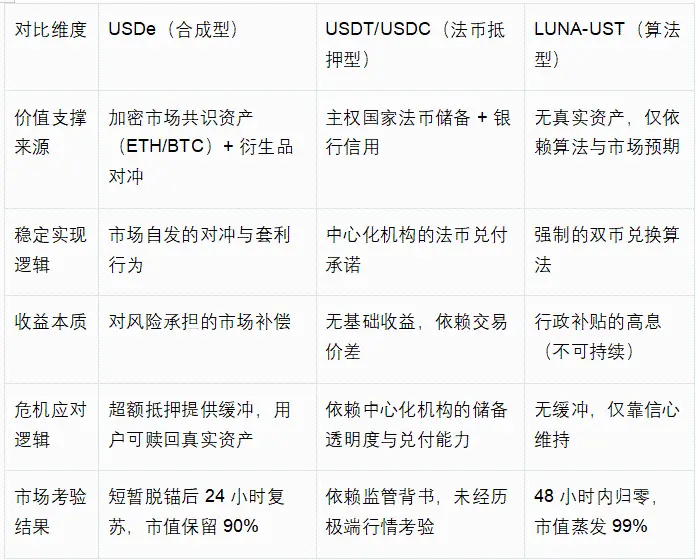
市场考验的真相:USDe 为何能与 LUNA-UST 划清界限

2025 年 10 月的脱锚事件,常被误解为 USDe 与 LUNA-UST 的 「同类风险暴露」,但从奥地利学派视角看,两者的本质差异恰恰在这场考验中被彻底凸显 ——USDe 的复苏是 「非国家化货币经受市场检验」 的成功,而 LUNA-UST 的崩盘是 「脱离真实资产的伪创新」 的必然结局。

价值锚点的本质差异:真实资产 vs 虚无预期

USDe 的价值锚点是 ETH、BTC 等可随时兑现的真实资产,即便在极端行情中,用户仍可通过赎回机制获得等值加密资产 ——2025 年 10 月脱锚期间,USDe 的赎回功能始终正常运行,第三方储备证明显示超额抵押达 6600 万美元,这种 「可兑现的价值承诺」 是市场信心的根基。

而 LUNA-UST 没有任何真实资产支撑,其价值完全依赖 「用户对 LUNA 价格的预期」。当市场恐慌爆发时,UST 的兑换机制需要通过增发 LUNA 来实现,而无限增发的 LUNA 最终失去价值,导致整个体系崩盘。这种 「无资产支撑的货币」,从诞生之初就违背了哈耶克 「货币必须有真实价值基础」 的原则,崩盘是必然结果。

危机应对的逻辑差异:市场自发修复 vs 行政干预失效

USDe 在脱锚后的应对,完全遵循市场逻辑:Ethena Labs 没有发布 「行政命令式的救市方案」,而是通过公开储备证明、优化抵押品结构(将流动性质押衍生品占比从 25% 降至 15%)、限制杠杆倍数等方式,向市场传递 「机制透明、资产安全」 的信号,最终依靠用户的自发信任实现价格修复。

LUNA-UST 在危机中的应对,则是典型的 「行政干预失效」:Luna Foundation Guard 试图通过抛售比特币储备救市,但这种中心化的操作无法对抗市场的自发抛售 —— 比特币本身在极端行情中也出现下跌,储备资产与 UST 风险高度绑定,最终救市失败。

长期生命力的差异:市场适应性 vs 机制脆弱性

USDe 在脱锚后不仅恢复价格,更通过机制优化提升了长期适应性:限制循环借贷杠杆至 2 倍、引入合规国债资产(USDtb)提升抵押品稳定性、跨交易所分散对冲头寸 —— 这些调整并非来自行政命令,而是对市场反馈的自发响应,让机制更符合 「风险与收益匹配」 的市场规律。

LUNA-UST 则从一开始就缺乏市场适应性:其核心的 Anchor 协议 20% 高息,依赖生态资金的持续补贴,而非真实的支付需求(UST 的真实支付场景占比不足 5%)。当补贴无法持续时,资金链断裂,整个体系瞬间崩塌。这种 「依赖不可持续的行政补贴」 的模式,注定无法在市场竞争中长久生存。

机制瑕疵与批判反思:非国家化货币的成长之困

USDe 的创新价值不容否认,但 2025 年 10 月的压力测试及日常运行中,其机制设计仍存在与哈耶克 「完全市场自发调节」 理念的偏差,暴露出需警惕的风险隐患,这些瑕疵并非不可修正的本质缺陷,却是其向成熟非国家化货币演进必须跨越的障碍。

抵押品集中风险:加密资产周期的系统性绑定

USDe 超六成抵押品集中于 ETH 与 BTC,虽符合当前加密市场的流动性共识,却陷入 「单一市场周期绑定」 的困境。2025 年 10 月的脱锚本质上是加密市场单边下跌引发的连锁反应 —— 当 ETH 单日暴跌 16% 时,即便有衍生品对冲,抵押品市值的瞬时缩水仍引发市场恐慌。

更值得警惕的是,当前辅助抵押品中的流动性质押衍生品(WBETH 等)仍未脱离以太坊生态,本质是 「加密资产的二次衍生」,未能实现真正的风险分散。这种 「加密资产内部循环」 的抵押结构,与传统货币依托实体经济价值的逻辑相比,仍显脆弱。

对冲机制局限:中心化交易所的隐性依赖

USDe 的衍生品对冲高度依赖头部中心化交易所的流动性,2025 年 10 月对冲机制的短暂滞后,正是因为某头部交易所暂停永续合约交易导致的流动性断层。USDe 当前约 70% 的空头头寸集中于两家交易所,这种集中度使其难以完全摆脱对中心化平台规则的被动接受。

此外,资金费率的剧烈波动暴露了对冲工具的单一性。USDe 当前仅依赖永续合约进行风险对冲,缺乏期权、期货等多元工具的组合配置,导致在多空力量极端失衡时,难以快速调整对冲策略,这反映出其机制设计仍未充分利用市场的多元风险定价能力。

RWA 锚定升级:非国家化货币的进阶路径

面对现有机制瑕疵,融入黄金代币、美股代币等 RWA 资产优化锚定体系,既是对 USDe 缺陷的精准修正,更是契合 RWA 市场爆发趋势(2025 年规模达 264 亿美元,年增 113%)的必然选择。这种升级并非背离非国家化核心,而是通过对接实体经济价值,让哈耶克理念在数字时代更具生命力。

RWA 锚定的底层逻辑

货币价值应源于 广泛市场共识的真实资产,RWA 资产恰好具备这一属性 —— 黄金作为千年硬通货,其价值共识跨越国家与时代;美股代币对应上市公司的实体经济收益,锚定的是企业创造价值的能力;国债代币则依托主权国家的税收能力,提供低波动的价值基准。这些资产的价值不依赖加密市场周期,而是来自现实世界的生产与交易,能为 USDe 构建 「跨市场的价值缓冲垫」。

2024 年贝莱德推出的 BUIDL 代币(锚定美国国债等资产)已验证 RWA 锚定的可行性,其与 USDe 的核心差异在于 BUIDL 依赖中心化机构发行,而 USDe 可通过智能合约实现 RWA 资产的去中心化确权与估值,真正践行 「市场自发管理」 的逻辑。

多元 RWA 资产的适配与配置策略

USDe 的 RWA 锚定升级应遵循 「市场共识优先、风险分散适配」 原则,结合当前 RWA 代币化成熟度,可构建 「核心 – 辅助 – 弹性」 三层配置体系,具体如下表所示:
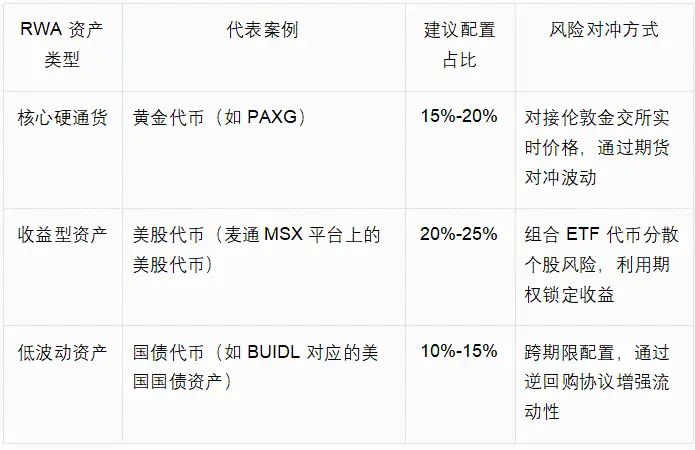
这种配置可将 USDe 的加密资产抵押占比从当前的 80% 降至 40%-50%,既保留加密市场的流动性优势,又通过 RWA 资产实现跨市场风险分散。以黄金代币为例,其与 ETH 的价格相关性仅为 0.2,在加密市场下跌时可发挥 「价值锚」 作用,避免 2025 年 10 月的集中抛售恐慌。

奥地利学派的再启示:从创新到成熟的进化逻辑

USDe 的瑕疵与 RWA 升级路径,进一步印证了哈耶克《货币的非国家化》的深层内涵:非国家化货币不是静态的机制设计,而是动态的市场进化过程,唯有通过持续的自我修正与创新,才能在货币竞争中胜出。

价值基础的进化:从单一市场共识到跨域价值锚定

USDe 当前的加密资产抵押,是数字时代非国家化货币的 「初级形态」—— 其价值共识局限于加密市场参与者。而融入 RWA 资产,本质是将价值共识扩展至传统金融与实体经济领域,让 USDe 的价值基础从 「数字共识」 升级为 「跨域真实价值」。这种进化完全契合哈耶克 「货币价值应源于最广泛市场信任」 的主张,当 USDe 同时锚定加密资产、黄金、美股等多元资产时,其抵御单一市场风险的能力将显著提升,真正成为 「超越主权与单一市场的价值载体」。

调节机制的完善:从单一工具到多元市场协同

当前 USDe 的对冲机制依赖单一衍生品市场,是 「市场工具利用不充分」 的体现。哈耶克强调的 「市场自我修复」,应建立在多元市场协同的基础上 ——RWA 资产的融入不仅丰富了抵押品,更创造了 「加密衍生品市场 + 传统金融市场」 的协同对冲可能。例如,美股代币的波动可通过传统股票期权对冲,黄金代币则可对接伦敦金市的远期合约,这种跨市场协同让对冲机制更具韧性,避免了对单一市场流动性的依赖。

结论:从创新标杆到进化范本的跨越

2025 年 10 月的市场考验,不仅验证了 USDe 作为非国家化货币创新标杆的价值,更揭示了其从 「初级创新」 向 「成熟货币」 进化的必然路径。它与 LUNA-UST 的本质分野,在于真实价值支撑与市场调节能力;而其当前的机制瑕疵,则是创新过程中难以避免的成长代价。

麦通 MSX 研究院认为,融入黄金代币、美股代币等 RWA 资产的升级策略,为 USDe 提供了清晰的进化方向 —— 这不是对现有创新的否定,而是在哈耶克理念指引下的深化与完善。

对于市场参与者而言,USDe 的进化历程带来更深刻的启示:非国家化货币的核心竞争力,不仅在于打破主权垄断的勇气,更在于持续自我修正的能力;评判其价值的标准,不仅是短期的稳定表现,更是长期对接真实价值、适应市场进化的韧性。当 USDe 完成 RWA 升级,它将不再只是加密市场的创新实验,而是真正具备挑战传统货币体系潜力的 「跨域价值载体」。


Twitter:https://twitter.com/BitpushNewsCN

比推 TG 交流群:https://t.me/BitPushCommunity

比推 TG 订阅: https://t.me/bitpush

说明: 比推所有文章只代表作者观点,不构成投资建议

Trending Cryptos

Related Reads

Upbit is Anxious: A Hasty Counterattack Aimed at Regaining Stablecoin Market Share

Title: Upbit's Rushed Counterattack to Reclaim Stablecoin Market Share Facing a dramatic shift in South Korea's stablecoin market, leading exchange Upbit launched a promotional campaign from July 26 to August 9, waiving the 0.05% trading fee for stablecoins paired with the Korean Won (KRW) and rapidly listing new stablecoins like RLUSD and USDG. This move is a direct response to its plummeting market share in this sector. Historically a duopoly with Bithumb, the market has been reshaped since October 2025 when Coinone permanently removed fees for USDC trading. By June 2026, Coinone led with 34.8% of stablecoin volume, followed by Bithumb (31.1%) and Upbit (30.1%). This contrasts sharply with the overall crypto market, where Upbit commands 60%. The data shows stablecoin demand is highly sensitive to fees, as users primarily buy them to transfer capital overseas for derivatives trading or forex arbitrage. South Korean exchanges have seen a net outflow of stablecoins for 18 consecutive months, totaling approximately 14.9 trillion KRW, underscoring their role as a cross-border capital conduit. Upbit's limited-time promotion initially boosted its daily stablecoin volume by 162%, but the surge was almost entirely in USDT (98.1% of volume). The newly listed stablecoins saw negligible, fleeting interest. Furthermore, the promotional effect quickly waned in the second week, with volume dropping 33% on weekdays. A concurrent weakening of the KRW also contributed to the trading spike, independent of the fee waiver. The analysis suggests that once the promotion ends, Upbit is unlikely to retain its temporary gains unless it matches Coinone's permanent zero-fee policy, forcing a choice between market share and fee revenue. Upbit's strategic push may be less about immediate profit and more about preparing for future regulatory shifts. With South Korea's *Digital Asset Basic Act* on the horizon, which will regulate KRW-backed stablecoins, and following Dunamu's (Upbit's parent) integration into Naver Financial to build a payment ecosystem, securing a dominant position in the dollar stablecoin distribution channel holds long-term strategic value. However, potential regulatory conflicts could prevent Upbit from listing a future Naver-issued KRW stablecoin, making the current fight for dollar stablecoin flow even more critical.

marsbit5h ago

Upbit is Anxious: A Hasty Counterattack Aimed at Regaining Stablecoin Market Share

marsbit5h ago

Michael Saylor Compares Bitcoin and Gold!

Michael Saylor, founder of MicroStrategy, argues that Bitcoin fundamentally changes how wealth is stored and transferred by transforming digital scarcity into economic value. He describes Bitcoin as the first digital monetary network, combining computers, digital networks, and cryptography. It digitizes monetary assets, allowing their supply to be controlled by public protocols rather than institutions, thus converting economic value into information transmissible over global networks. Comparing Bitcoin to gold, Saylor states that while increasing Bitcoin's supply is harder, its integration with software and transfer is easier. He highlights Bitcoin's proof-of-work mechanism, which ties it to the physical world by consuming real energy to secure the ledger, making past transactions immutable. This creates a shared security system involving miners, energy companies, and investors. Saylor suggests "digital monetary energy" is a more accurate term than "digital gold." He emphasizes that the Bitcoin network is an adaptive ecosystem of miners, nodes, developers, and users. Its core design is intentionally simple, focused on maintaining a secure ledger for scarce digital assets, with complex functionalities built in higher-layer applications. This architecture allows Bitcoin to serve as a foundation for transmitting value and fostering innovation in payments and financial services. Saylor notes Bitcoin's deeper impact lies in creating digital sovereignty, where private keys give individuals permissionless control over their economic power, with ownership verified mathematically, not by institutions. He concludes that while gold's physical scarcity makes it money, Bitcoin's digital scarcity does the same, characterizing Bitcoin as the monetary energy of the digital age.

cryptonews.ru6h ago

Michael Saylor Compares Bitcoin and Gold!

cryptonews.ru6h ago

Trading

Spot

Hot Articles

How to Buy LUNA

Welcome to HTX.com! We've made purchasing Terra (LUNA) simple and convenient. Follow our step-by-step guide to embark on your crypto journey.Step 1: Create Your HTX AccountUse your email or phone number to sign up for a free account on HTX. Experience a hassle-free registration journey and unlock all features.Get My AccountStep 2: Go to Buy Crypto and Choose Your Payment MethodCredit/Debit Card: Use your Visa or Mastercard to buy Terra (LUNA) instantly.Balance: Use funds from your HTX account balance to trade seamlessly.Third Parties: We've added popular payment methods such as Google Pay and Apple Pay to enhance convenience.P2P: Trade directly with other users on HTX.Over-the-Counter (OTC): We offer tailor-made services and competitive exchange rates for traders.Step 3: Store Your Terra (LUNA)After purchasing your Terra (LUNA), store it in your HTX account. Alternatively, you can send it elsewhere via blockchain transfer or use it to trade other cryptocurrencies.Step 4: Trade Terra (LUNA)Easily trade Terra (LUNA) on HTX's spot market. Simply access your account, select your trading pair, execute your trades, and monitor in real-time. We offer a user-friendly experience for both beginners and seasoned traders.

5.7k Total ViewsPublished 2024.03.29Updated 2026.06.02

How to Buy LUNA

What is $LUNA

Luna28 ($$LUNA): A Moon-Inspired Crypto Venture Introduction In the ever-evolving world of cryptocurrencies, innovation is key. Luna28 stands out as a project that not only embraces technology but also intertwines it with the mystique of cosmic cycles. Inspired by the moon's 28-day cycle, Luna28 ($$LUNA) aims to create a unique and engaging experience for its community, merging the concepts of tokenomics and lunar-themed non-fungible tokens (NFTs). At its core, this project employs a distinctive token burn mechanism aligned with lunar and solar eclipses, setting a new precedent in the crypto space. What is Luna28? Luna28 is a token-based cryptocurrency project built on the Ethereum blockchain. It seeks to offer its users a blend of cosmic engagement through a series of innovative features. Key to its identity is the launch of lunar-themed NFTs which enhance community interaction while celebrating the moon's cultural significance. The project aims to create a deeper connection between its community members and the cosmos. This connection is facilitated through a carefully crafted ecosystem that leverages lunar themes, token burns, and dynamic activities associated with celestial events. The goal is not just about enhancing token value but fostering a sense of belonging and enjoyment within the community. Creator of Luna28 The details surrounding the creator of Luna28 remain largely unknown. This lack of information has led to an air of mystery around the project, further adding to its uniqueness. The anonymous nature of its creation reflects a broader trend within the crypto industry, where the focus is often on the project and its community rather than individual profiles. Investors of Luna28 Currently, there is no publicly available information regarding the specific investment foundations or organizations that support Luna28. This aspect may indicate a grassroots initiative where the community plays a vital role in the project's development and growth. The absence of prominent investors can sometimes create a more decentralized and independent project, allowing for organic community engagement and involvement. How Does Luna28 Work? One of the most compelling aspects of Luna28 is how it operates, particularly its unique features that set it apart from other cryptocurrency projects. 1. Lunar and Solar Eclipse Token Burns Luna28 incorporates a special token burn mechanism, which involves periodically burning a portion of its token supply during lunar and solar eclipses. This approach not only creates excitement around celestial events but also works on the fundamental principle of increasing scarcity. By reducing the overall token supply through burns, the remaining tokens have the potential for increased value, benefiting all holders. 2. Tokenomics The economic structure of Luna28 is crafted to ensure sustainability and growth. Each transaction incurs a 4.4% tax: 2% contributes to the Moon Cycle Fund, which is burned every 28 days during the full moon. The remaining 2.4% is earmarked for development and marketing, facilitating the project’s expansion and continuous improvement. This tax structure establishes a steady flow of funding while maintaining a deflationary approach that can enhance the token's value proposition. 3. 100% Burned Liquidity Security and trust are paramount in any cryptocurrency project. Luna28 addresses these concerns by locking its liquidity pool tokens in a burn wallet. This ensures that liquidity is permanently secured, fostering confidence within the community as they engage with the platform. 4. NFT Drops Further enhancing community engagement, Luna28 plans to release lunar-themed NFTs. These digital collectibles not only serve as a source of fun and creativity but also offer users unique assets tied to the larger lunar theme. The introduction of NFTs reflects a growing trend in the crypto space, blending traditional forms of artistic expression with innovative technology. 5. Hyper Deflationary Token Luna28 is classified as a hyper deflationary token, emphasizing its commitment to a declining token supply through systematic burns. This design encourages long-term holding, as community members anticipate potential value growth driven by scarcity. 6. First Buyer Incentive In a bid to promote active participation, Luna28 offers a unique first buyer incentive. After each celestial burn event, the first participant in the market is rewarded with 10% of the tokens burned during that event. This encourages immediate engagement and interest surrounding each significant celestial phenomenon. 7. Sustainable Tax Structure The project's tax model is specifically designed to encourage sustainable growth, balancing the need for ongoing project development with the goal of enhancing token value. This innovative tax structure serves the dual purpose of supporting the community's interests while maintaining a healthy ecosystem for the project. Timeline of Luna28 A well-charted timeline helps in understanding the progression and milestones of Luna28. Here’s a synopsis of important events in the project’s history: Stealth Launch: The project entered the crypto arena under a stealth launch, garnering significant community interest and posting a remarkable 1792% increase from its initial listing. This initial surge indicated strong community reception and a solid foundation for future growth. Token Burns: Committing to its unique approach, Luna28 plans to burn 28% of its token supply over a three-year period, timed specifically during lunar and solar eclipses. Community members eagerly await their opportunities to participate in these events. Community Involvement: Emphasizing transparency and the importance of community feedback, Luna28 plans to notify its users in advance about upcoming token burn events. This engagement approach encourages active participation, fostering a strong sense of community. Key Features Luna28's distinctive features bolster its appeal within the cryptocurrency sector: Hyper Deflationary Nature: The project's focus on hyper deflationary mechanics enables a strategic reduction in supply, aiming for enhanced value retention. Incentives for Early Engagement: The project rewards early participants with direct benefits, which cultivates a proactive community eager to contribute. Commitment to Community Development: The sustainable tax model not only ensures the project's growth but also actively involves the community in shaping its future direction. Conclusion Luna28 represents a unique fusion of technology, community engagement, and celestial inspiration in the cryptocurrency landscape. By integrating innovative mechanisms such as token burns during astrological events and creating engaging lunar-themed NFTs, the project distinguishes itself as a trailblazer within its niche. As a community-driven endeavor, Luna28 promises to deliver not just another cryptocurrency but an experience that marries elements of cosmic fascination with blockchain technology. With its innovative features and strong emphasis on community involvement, Luna28 has the potential to create a lasting impact in the world of digital currencies. The connection it forges between its users and the universe represents not only a creative endeavor but also a brilliantly calculated business strategy poised for growth. As we observe the evolution of Luna28, it is evident that it is more than just a token; it is a concept that encourages its community to look up at the cosmos and ponder their place within it, all while navigating the exciting world of cryptocurrency. The future for Luna28 looks bright and full of potential, eagerly awaiting its next lunar cycle.

1.3k Total ViewsPublished 2024.04.01Updated 2024.12.03

What is $LUNA

What is TERRA

Exploring the Terra Ecosystem: A Comprehensive Overview Introduction In the ever-evolving landscape of blockchain technology and cryptocurrency, the Terra Ecosystem has emerged as an ambitious project designed to facilitate a decentralized financial system. This innovative platform focuses on creating stable and scalable algorithmic stablecoins, aimed at driving the widespread adoption of cryptocurrencies. In this article, we will delve into the foundational aspects of the Terra Ecosystem, exploring its operational mechanisms, its creators, investors, notable components, and the timeline of its development. What is the Terra Ecosystem? Founded in 2018, the Terra Ecosystem is a layer-one blockchain designed to provide an efficient and reliable payment platform. The core mission of Terra is to create a preferred form of money that is not only decentralized but also practical for everyday use. At the heart of the ecosystem is its native algorithmic stablecoin, TerraUSD (UST), which is pegged to the US dollar using an innovative algorithmic mechanism. This unique approach addresses a common concern in the cryptocurrency space: the volatility that often accompanies digital assets. The Terra Ecosystem aims to enhance the usability of cryptocurrencies by creating an environment where digital currencies function similarly to traditional currencies. By being user-friendly and stable, Terra sets out to attract users outside of the crypto community, ultimately fostering mass adoption. The Creators of the Terra Ecosystem The Terra Ecosystem emerged under the guidance of its co-founders Daniel Shin and Do Kwon. Both individuals, with a wealth of experience in entrepreneurship and technology, launched Terraform Labs to spearhead this groundbreaking project. Daniel Shin, a prominent figure in the South Korean tech landscape, has co-founded multiple tech companies, while Do Kwon has an extensive background in computer science and engineering. Their partnership is pivotal in steering the development and growth trajectory of the Terra Ecosystem. Investors in the Terra Ecosystem While detailed information about specific investors remains limited, it is widely acknowledged that Terraform Labs has garnered substantial financial support from a variety of angel investors and venture capital firms. This backing provides the necessary resources for the ongoing development and expansion of the Terra Ecosystem. The emphasis on acquiring diversified investment sources reflects the strong belief in the project's potential within the cryptocurrency community. How Does the Terra Ecosystem Work? At the core of the Terra Ecosystem's functionality lies its innovative proof-of-stake (PoS) consensus mechanism. This allows holders of the LUNA token, the native currency of the ecosystem, to participate in the governance and operation of the network. The dual-token structure differentiates Terra from many other projects, with LUNA serving both as a stake for validators and as a governance token. The mechanism operates in a distinctive way, whereby the supply of LUNA backs the stablecoin UST. If the demand for UST increases, the algorithm automatically adjusts the supply of LUNA to maintain the stability of UST at its dollar peg. Users are enabled to exchange 1 UST for an equivalent value in LUNA, ensuring that fluctuations in demand do not affect the peg. This innovative approach enables the Terra Ecosystem to maintain price stability, one of its primary goals. Timeline of the Terra Ecosystem The development journey of the Terra Ecosystem has been marked by significant milestones: 2018: Establishment of Terraform Labs by Daniel Shin and Do Kwon, laying the groundwork for the Terra Ecosystem. April 2019: The initial release of the Terra blockchain, initiating its journey into the broader cryptocurrency landscape. 2021: Terra experiences remarkable growth as its total value locked (TVL) reaches new heights, positioning it as a dominant player in decentralized finance (DeFi). May 2022: A turbulent period arises as the Terra blockchain is temporarily halted following the collapse of UST and LUNA, leading to a significant impact on market perception and capitalization. January 2024: Terraform Labs files for bankruptcy, marking another critical event in the project's history, sparking discussions on the sustainability and future of the ecosystem. Key Components of the Terra Ecosystem A variety of features contribute to the unique functionality of the Terra Ecosystem: Core Functionality The Terra Ecosystem includes essential functionalities such as managing transaction fees, monitoring price fluctuations, and maintaining historical balances of transactions, all of which are crucial for ensuring user experience and operational integrity. Applications One of the flagship features of the Terra Ecosystem is its diverse array of applications. This includes: Anchor Protocol: A money market protocol that provides high stablecoin yields and tokenized stakes for users seeking to maximize returns on their investments. Mirroring Technology: Enabling users to create assets that mirror real-world assets and trades, allowing for broader use cases and applications. Chai: A payment platform designed to facilitate everyday transactions using Terra's stablecoin technology. Swaps and Exchanges The ecosystem provides functionality for seamless asset exchanges. Notable features include native swapping capabilities and platforms such as Terraswap, allowing users to exchange Terra assets efficiently while benefiting from competitive rates. Governance Governance plays a critical role in the decentralized nature of the Terra Ecosystem. Token holders use their LUNA tokens to propose changes or vote on proposals that affect the network, ensuring collective decision-making and community involvement in the ecosystem's evolution. Notable Projects in the Terra Ecosystem Beyond the core functionalities, the Terra Ecosystem is also home to notable projects that further augment its capabilities: Terraswap: This decentralized exchange (DEX) emerged to facilitate easy swapping of Terra assets, thus promoting a vibrant trading environment within the ecosystem. Astroport: Another DEX known for its high total value locked, Astroport enhances trading opportunities and liquidity provision for users. Loop Markets: This integrated exchange hub offers users a range of trading tools and services, significantly contributing to the user experience across the Terra platform. Conclusion The Terra Ecosystem stands as a significant player within the blockchain and cryptocurrency domains, aiming to create a stable and scalable financial platform designed for widespread cryptocurrency adoption. Although the ecosystem faced dramatic challenges, notably the collapse of its stablecoin UST and the LUNA token, it continues to adapt and evolve in the face of adversity. As the project navigates its future, it remains committed to its foundational vision of building practical products accessible to a broader audience, thereby reinforcing the potential of decentralized finance. The Terra Ecosystem, with its robust features and innovative approach, holds promise as it seeks to redefine the landscape of digital currency use, remaining a focal point for enthusiasts and investors alike in the ongoing evolution of blockchain technology.

1.7k Total ViewsPublished 2024.12.17Updated 2024.12.17

What is TERRA

Discussions

Welcome to the HTX Community. Here, you can stay informed about the latest platform developments and gain access to professional market insights. Users' opinions on the price of LUNA (LUNA) are presented below.

活动图片













