Why Zcash Beats Monero And Even Bitcoin: MIT Research Scientist

bitcoinistPublished on 2025-10-10Last updated on 2025-10-10

Abstract

MIT research scientist and Zcash co-founder Madars Virza has set off a fresh round of privacy-coin debate after arguing that...

Trusted Editorial content, reviewed by leading industry experts and seasoned editors. Ad Disclosure

MIT research scientist and Zcash co-founder Madars Virza has set off a fresh round of privacy-coin debate after arguing that Zcash’s shielded pool delivers materially stronger anonymity than Monero’s ring-signature model—and that Zcash’s design choices also give it an edge over Bitcoin in a post-quantum world.

Virza framed the discussion with a pointed update to the “conservative advice” that circulated in Bitcoin’s early years. “Conservative advice back then: ‘allocate 1% of your NW to Bitcoin,’” he wrote on October 7. “Conservative advice today: ‘encrypt at least 1% of your Bitcoin.’” The shift in emphasis—from owning BTC to hardening its transactional privacy—set the stage for an extended technical exchange about how different privacy systems hold up under modern analysis.

Zcash Better Than Monero And Bitcoin?

Pressed by an X user on “Why not Monero?”, Virza argued that Monero’s core privacy primitive—ring signatures with fixed-size decoy sets—creates a relatively small and attackable anonymity set. “Each Monero spend references the actual spend (just like in Bitcoin) plus 16 randomly decoys,” he wrote. “16 is not a large number and easily falls to generic attacks,” he added, pointing to research presentations on tracing heuristics.

He further noted that real-world sampling biases can shrink the effective protection: “Because of biases in the random distribution, 16 is more like 4.2 in practice (OSPEAD attack).” In other words, even though each spend is bundled with 16 decoys, selection patterns can leak enough information that the true spender becomes statistically distinguishable far more often than users expect.

By contrast, Virza said, Zcash’s fully shielded transfers avoid the small, fixed ring entirely. “Each shielded Zcash spend has an anonymity set of all previous Zcash outputs in that shielded pool—that’s millions and thus much more private,” he wrote. Because the system proves correctness with zero-knowledge proofs, the transaction does not have to disclose which prior note is being spent, so the anonymity set scales with the entire shielded pool rather than a handful of decoys.

Virza also pointed to practical composability as a strategic advantage: “Another reason for Zcash is DeFi integrations—you have deep liquidity for atomic swaps.” In his view, those integrations make it easier for users to move value into and out of the shielded pool and, potentially, to “encrypt” portions of their Bitcoin exposure via swap-based workflows.

ZEC Is Almost Quantum-Secure

A second vector in Virza’s critique concerned long-term security against quantum adversaries. “Zcash is also post-quantum private (if you use unique shielded addresses) but a quantum adversary will be able to completely recover Monero transaction graph by breaking discrete logs for all key images,” he wrote.

The point is subtle but consequential: Monero’s linkability-prevention relies on properties (discrete logarithms) that are known to be vulnerable to sufficiently advanced quantum computers, which could allow future attackers to map historical spending relations. Zcash’s shielded model, by design, leaves far less reconstructable metadata on-chain—so even if public-key systems eventually fall to quantum attacks, there is less transactional structure for an adversary to “unwind.”

Zcash engineer Sean Bowe reinforced the same theme in a July exchange that Virza cited, arguing that Zcash’s privacy stems from the omission of sensitive data rather than the obfuscation of it. “For example, there is no quantum computer or powerful AI that will be able to look back at the Zcash blockchain 1000 years from now and figure out who made every fully shielded transaction,” Bowe wrote.

“That information, among other things, never even touches the ledger. It’s already gone.” He added that while boundary surfaces—where shielded transactions meet exchanges, wallets, or other public systems—can still leak, the baseline is unusually strong: “To be certain about your privacy you must start by using shielded Zcash. You almost cannot even begin otherwise.” In Bowe’s words, Zcash begins from “something that is already extremely private” and is working toward global scalability from that foundation.

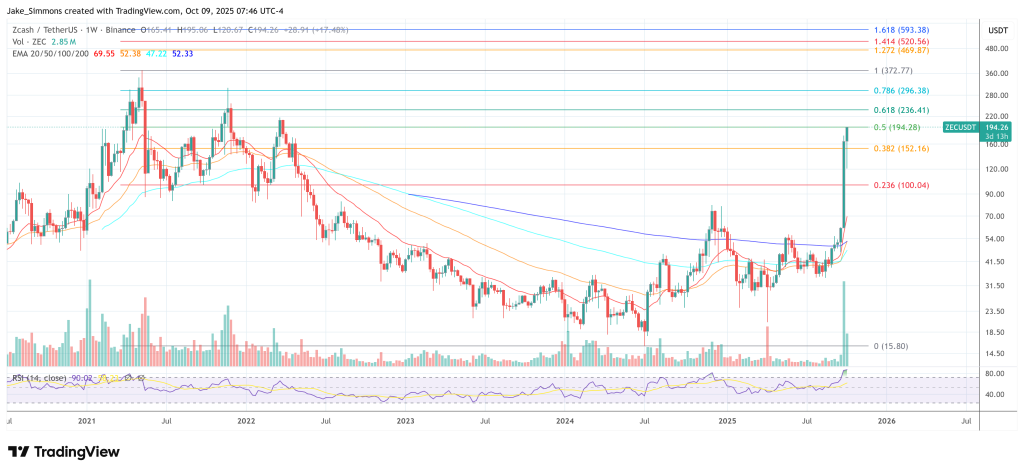
At press time, ZEC is up almost 52% since yesterday, trading at $194.
Zcash price
ZEC hits the 0.5 Fib, 1-week chart | Source: ZECUSDT on TradingView.com
Featured image created with DALL.E, chart from TradingView.com
Editorial Process for bitcoinist is centered on delivering thoroughly researched, accurate, and unbiased content. We uphold strict sourcing standards, and each page undergoes diligent review by our team of top technology experts and seasoned editors. This process ensures the integrity, relevance, and value of our content for our readers.

Jake Simmons has been a Bitcoin enthusiast since 2016. Ever since he heard about Bitcoin, he has been studying the topic every day and trying to share his knowledge with others. His goal is to contribute to Bitcoin's financial revolution, which will replace the fiat money system. Besides BTC and crypto, Jake studied Business Informatics at a university. After graduation in 2017, he has been working in the blockchain and crypto sector. You can follow Jake on Twitter at @realJakeSimmons.

Trending Cryptos

Related Reads

Trading

Spot

Hot Articles

What is $BITCOIN

DIGITAL GOLD ($BITCOIN): A Comprehensive Analysis Introduction to DIGITAL GOLD ($BITCOIN) DIGITAL GOLD ($BITCOIN) is a blockchain-based project operating on the Solana network, which aims to combine the characteristics of traditional precious metals with the innovation of decentralized technologies. While it shares a name with Bitcoin, often referred to as “digital gold” due to its perception as a store of value, DIGITAL GOLD is a separate token designed to create a unique ecosystem within the Web3 landscape. Its goal is to position itself as a viable alternative digital asset, although specifics regarding its applications and functionalities are still developing. What is DIGITAL GOLD ($BITCOIN)? DIGITAL GOLD ($BITCOIN) is a cryptocurrency token explicitly designed for use on the Solana blockchain. In contrast to Bitcoin, which provides a widely recognized value storage role, this token appears to focus on broader applications and characteristics. Notable aspects include: Blockchain Infrastructure: The token is built on the Solana blockchain, known for its capacity to handle high-speed and low-cost transactions. Supply Dynamics: DIGITAL GOLD has a maximum supply capped at 100 quadrillion tokens (100P $BITCOIN), although details regarding its circulating supply are currently undisclosed. Utility: While precise functionalities are not explicitly outlined, there are indications that the token could be utilized for various applications, potentially involving decentralized applications (dApps) or asset tokenization strategies. Who is the Creator of DIGITAL GOLD ($BITCOIN)? At present, the identity of the creators and development team behind DIGITAL GOLD ($BITCOIN) remains unknown. This situation is typical among many innovative projects within the blockchain space, particularly those aligning with decentralized finance and meme coin phenomena. While such anonymity may foster a community-driven culture, it intensifies concerns about governance and accountability. Who are the Investors of DIGITAL GOLD ($BITCOIN)? The available information indicates that DIGITAL GOLD ($BITCOIN) does not have any known institutional backers or prominent venture capital investments. The project seems to operate on a peer-to-peer model focused on community support and adoption rather than traditional funding routes. Its activity and liquidity are primarily situated on decentralized exchanges (DEXs), such as PumpSwap, rather than established centralized trading platforms, further highlighting its grassroots approach. How DIGITAL GOLD ($BITCOIN) Works The operational mechanics of DIGITAL GOLD ($BITCOIN) can be elaborated on based on its blockchain design and network attributes: Consensus Mechanism: By leveraging Solana’s unique proof-of-history (PoH) combined with a proof-of-stake (PoS) model, the project ensures efficient transaction validation contributing to the network's high performance. Tokenomics: While specific deflationary mechanisms have not been extensively detailed, the vast maximum token supply implies that it may cater to microtransactions or niche use cases that are still to be defined. Interoperability: There exists the potential for integration with Solana’s broader ecosystem, including various decentralized finance (DeFi) platforms. However, the details regarding specific integrations remain unspecified. Timeline of Key Events Here is a timeline that highlights significant milestones concerning DIGITAL GOLD ($BITCOIN): 2023: The initial deployment of the token occurs on the Solana blockchain, marked by its contract address. 2024: DIGITAL GOLD gains visibility as it becomes available for trading on decentralized exchanges like PumpSwap, allowing users to trade it against SOL. 2025: The project witnesses sporadic trading activity and potential interest in community-led engagements, although no noteworthy partnerships or technical advancements have been documented as of yet. Critical Analysis Strengths Scalability: The underlying Solana infrastructure supports high transaction volumes, which could enhance the utility of $BITCOIN in various transaction scenarios. Accessibility: The potential low trading price per token could attract retail investors, facilitating wider participation due to fractional ownership opportunities. Risks Lack of Transparency: The absence of publicly known backers, developers, or an audit process may yield skepticism regarding the project's sustainability and trustworthiness. Market Volatility: The trading activity is heavily reliant on speculative behavior, which can result in significant price volatility and uncertainty for investors. Conclusion DIGITAL GOLD ($BITCOIN) emerges as an intriguing yet ambiguous project within the rapidly evolving Solana ecosystem. While it attempts to leverage the “digital gold” narrative, its departure from Bitcoin's established role as a store of value underscores the need for a clearer differentiation of its intended utility and governance structure. Future acceptance and adoption will likely depend on addressing the current opacity and defining its operational and economic strategies more explicitly. Note: This report encompasses synthesised information available as of October 2023, and developments may have transpired beyond the research period.

2.0k Total ViewsPublished 2025.05.13Updated 2025.05.13

What is $BITCOIN

Discussions

Welcome to the HTX Community. Here, you can stay informed about the latest platform developments and gain access to professional market insights. Users' opinions on the price of BTC (BTC) are presented below.

活动图片