How Has The BlackRock Bitcoin ETF Fared Compared To Its Older Funds?

bitcoinistPublished on 2025-10-08Last updated on 2025-10-08

Abstract

Bloomberg analyst Eric Balchunas has highlighted how the BlackRock Bitcoin ETF (IBIT) has performed in comparison to the world’s largest...

Trusted Editorial content, reviewed by leading industry experts and seasoned editors. Ad Disclosure

Bloomberg analyst Eric Balchunas has highlighted how the BlackRock Bitcoin ETF (IBIT) has performed in comparison to the world’s largest asset manager’s older funds. This comes as the fund approaches the $100 billion milestone, which will make it the fastest to reach this milestone. 

BlackRock Bitcoin ETF Becomes Most Profitable Fund

In an X post, Balchunas revealed that the BlackRock Bitcoin ETF, which is approaching $100 billion, is now the most profitable fund for the asset manager by a “good amount.” The Bloomberg analyst also highlighted that this is a massive feat for the Bitcoin fund, considering its age in comparison to the other funds.  

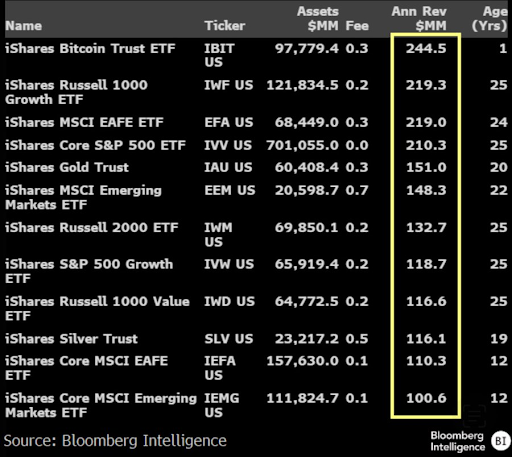
The BlackRock Bitcoin ETF, which was launched last year, is currently generating an annual revenue of $244.5 million for the world’s largest asset manager. This is well ahead of BlackRock’s Russell 1000 Growth ETF, which is 25 years old and generates an annual revenue of $219.3 million, placing it in second place. 

Notably, the BlackRock Bitcoin ETF is the only fund on the list that has a single-digit age. The other of BlackRock’s funds are 12 years and above. Eric Balchunas also noted that IBIT was approaching $100 billion in assets under management (AuM), which could make it the fastest to reach this milestone. 
Bitcoin
Source: Chart from Eric Balchunas on X

The Bloomberg analyst revealed that the Vanguard S&P 500 ETF currently holds this record, although it achieved this feat in 2,011 days. Meanwhile, the BlackRock Bitcoin ETF, which is just 437 days old, currently has $99.44 billion in assets under management, putting it on track to surpass this record by a considerable margin.

This comes as the BlackRock BTC ETF continues to lead the pack, with massive daily net inflows. On October 6, these Bitcoin funds saw $1.19 billion in daily net inflows, with IBIT accounting $970 million of these flows. Meanwhile, they recorded a daily net inflow of $875.6 million yesterday, with IBIT accounting for $899.4 million of these flows. 

IBIT Also Among Top 20 ETFs By AuM

Eric Balchunas also revealed that the BlackRock Bitcoin ETF is now in the top 20 in ETF assets following the rapid increase in its AuM. Based on its current AuM, IBIT is 19th on the list of largest ETFs, just ahead of Vanguard’s VIG and the “legendary” Technology Select Sector SPDR Fund. 

The Bloomberg analyst remarked that if the last 12 months are repeated, it may not take too long for the BlackRock Bitcoin ETF to break into the top 10. He noted that the fund took in $40 billion over the last 12 months and saw an 85% increase. He added that he will put the timeline at December 2026 if he has to give one. 

At the time of writing, the BTC price is trading at around $121,500, down over 2% in the last 24 hours, according to data from CoinMarketCap.

Bitcoin
BTC trading at $121,899 on the 1D chart | Source: BTCUSDT on Tradingview.com
Featured image from Getty Images, chart from Tradingview.com
Editorial Process for bitcoinist is centered on delivering thoroughly researched, accurate, and unbiased content. We uphold strict sourcing standards, and each page undergoes diligent review by our team of top technology experts and seasoned editors. This process ensures the integrity, relevance, and value of our content for our readers.

Scott Matherson is a leading crypto writer at Bitcoinist, who possesses a sharp analytical mind and a deep understanding of the digital currency landscape. Scott has earned a reputation for delivering thought-provoking and well-researched articles that resonate with both newcomers and seasoned crypto enthusiasts. Outside of his writing, Scott is passionate about promoting crypto literacy and often works to educate the public on the potential of blockchain.

Related Reads

AI Bubble Warning: AI Investments Are Negative Returns for Most Tech Giants

The article issues a stark warning about a potential AI investment bubble. It notes that while the AI boom shares similarities with the TMT bubble of the late 1990s, its scale is vastly larger, currently driving 93% of U.S. GDP growth. Major hyperscale cloud providers like Microsoft, Alphabet, Amazon, Meta, and Oracle are planning to invest trillions in AI data centers over the coming years. However, calculations based on analyst projections for 2025-2030 reveal a concerning math problem: expected capital expenditure growth far outpaces projected revenue growth. Even under an extremely optimistic scenario of zero costs, the implied return on investment for most of these tech giants (except Amazon) is deeply negative. This suggests that the current trajectory could lead to one of history's largest shareholder value destruction events. The piece outlines two potential escapes: AI generating vastly more revenue than currently anticipated—a near-impossible task—or a significant cutback in the planned investment splurge. The latter scenario could trigger a domino effect, severely impacting the entire tech supply chain (from Nvidia to TSMC), potentially pushing the U.S. economy into recession, and causing a major stock market downturn. The author suggests upcoming high-profile IPOs by companies like OpenAI and Anthropic might represent a transfer of risk from early investors to public market participants. While the peak of the hype cycle might sustain investment through 2026, the fundamental financial dilemma remains unresolved, setting the stage for a potential market correction in 2027 or 2028, similar to the years following Alan Greenspan's "irrational exuberance" warning.

marsbit36m ago

AI Bubble Warning: AI Investments Are Negative Returns for Most Tech Giants

marsbit36m ago

From Tokens to Machine Labor: AI is Shifting from Tool to "Worker"

The article "From Token to Machine Labor: AI is Evolving from Tool to 'Worker'" argues that the business model for AI is shifting beyond simply selling computational resources (tokens, GPU hours) or model access. Instead, a new "machine labor market" is emerging, where the core economic transaction is the purchase of economically useful work directly performed by software. The central thesis is that AI pricing will evolve through four stages: 1) raw tokens, 2) standardized LLM capabilities (e.g., text generation), 3) industry-specific labor markets (e.g., legal review, radiology), and finally 4) a programmable results market where tasks like resolving a support ticket are bid on and priced based on outcome. In this future, buyers will care less about *which* model or GPU completes a task and more about whether the work meets specified standards for accuracy, latency, and cost. This transition reframes the impact of AI on human labor. Rather than simple replacement, it suggests a re-coordination where machines handle standardized, verifiable work, freeing humans for roles involving oversight, context management, responsibility, and final judgment. In some cases, this "last 1%" of human input becomes more valuable as it enables the other 99% to be automated. Furthermore, as AI reduces the cost of work, demand may expand, creating larger markets (e.g., 24/7 customer service) rather than just cheaper versions of existing ones. The article concludes that while infrastructure (GPUs, models, tokens) remains crucial upstream, the market is converging on a simpler, tradeable unit: machine labor that can be defined, measured, priced, and procured based on contractible specifications.

marsbit46m ago

From Tokens to Machine Labor: AI is Shifting from Tool to "Worker"

marsbit46m ago

Xiaomi MiMo's 99% Price Cut is Not Marketing! Luo Fuli Posts on X to Refute Critics

The price of Xiaomi's MiMo-V2.5 series API has been permanently reduced by up to 99%, specifically for the "Input (Cache Hit)" cost, which covers users re-reading historical context in long conversations. MiMo's head, Luo Fuli, published a detailed technical blog to clarify that this drastic price cut stems from genuine engineering breakthroughs, not a marketing stunt or a simple price war. The core of the achievement lies in six key engineering optimizations. First, the model architecture adopts a Hybrid Sliding Window Attention (SWA), reducing the memory footprint (KVCache) to 1/7th of a traditional model. Second, a dual-pool memory management system actually utilizes these savings, allowing a single GPU to handle over 5 times more concurrent users. Third, an upgraded prefix caching mechanism achieves a cache hit rate of 93-95% for repeated reads, meaning most such requests bypass GPU computation entirely. Fourth, a self-developed distributed cache (GCache) utilizes idle SSD space on existing GPU servers, eliminating additional storage costs. Fifth, an intelligent scheduling system (LLM-Router) efficiently routes requests to maximize cache reuse and performance. Sixth, Multi-Token Prediction (MTP) accelerates the model's text generation ("output") side. Together, these systemic optimizations dramatically lower the real computational cost per request, enabling the 99% price reduction for cached inputs while reportedly maintaining positive gross margins. Luo Fuli's disclosure aims to shift the narrative from "price war" to a demonstration of substantive AI engineering progress.

marsbit2h ago

Xiaomi MiMo's 99% Price Cut is Not Marketing! Luo Fuli Posts on X to Refute Critics

marsbit2h ago

$26 Billion: An 'All-Chinese Team' Backs the World's Highest-Valued AI Programming Company

Cognition AI, the company behind the AI programmer "Devin," has raised over $1 billion in new funding at a valuation of $26 billion, just eight months after reaching a $10.2 billion valuation. The round was led by Lux Capital, General Catalyst, and 8VC. Founded by three young Chinese entrepreneurs with strong competitive programming backgrounds, Cognition initially gained fame with Devin, marketed as the world's first AI software engineer capable of handling tasks from start to finish. While its early demos were impressive, real-world usage revealed reliability and cost-effectiveness issues, leading to a significant price cut for Devin in 2025. A pivotal moment came when Cognition acquired the assets of AI IDE company Windsurf after a failed acquisition by OpenAI. This move gave Cognition a crucial developer-facing tool, allowing it to pursue a two-pronged strategy: Devin for autonomous task execution and Windsurf for integrated, collaborative coding within an IDE. This shift helped the company move away from the controversial "AI replacement" narrative towards a model of augmenting human engineers, particularly for repetitive or maintenance tasks. This strategic pivot is backed by strong commercial metrics. The company reports a 10x increase in enterprise usage this year, with an annual revenue run-rate of $492 million and a 50% month-over-month growth in enterprise Devin usage over the past six months. Its client list now includes major corporations like Goldman Sachs and Mercedes-Benz, as well as government agencies like NASA and the U.S. Army. Investors are betting on Cognition becoming a foundational piece of next-generation software engineering infrastructure, positioning it at the center of a hybrid future where AI agents and human developers work in tandem.

marsbit2h ago

$26 Billion: An 'All-Chinese Team' Backs the World's Highest-Valued AI Programming Company

marsbit2h ago

The Hottest 00s Generation on Wall Street

"Wall Street's Hottest '00s Phenom: The 25-Year-Old Fund Manager Who Bet on AI's 'Boring' Backbone" At just 25, Leopold Aschenbrenner, once fired by OpenAI, now runs a hedge fund worth $13.7 billion. His strategy? Betting against the consensus. While others chased AI chips, he invested early in the physical infrastructure powering the AI boom: electricity, data centers, and energy. Expelled from OpenAI's safety team in 2024, Aschenbrenner foresaw the coming bottleneck. He argued that AI progress would be limited not by algorithms, but by power, chip capacity, and space. Acting on this, he founded Situational Awareness LP to go long on these "old economy" assets. His bets have paid off spectacularly. His fund's assets soared from $255 million in late 2024 to $13.7 billion by Q1 2026. His portfolio is a direct reflection of his thesis: major long positions in fuel cell company Bloom Energy and data center/bitcoin mining firms like CleanSpark and Riot Platforms, which control critical land and power resources. Conversely, he holds massive put options against overheated semiconductor giants like NVIDIA and AMD. A notable exception was his bullish bet on storage company SanDisk, which surged ~160% in Q2. Aschenbrenner's vision is materializing. Tech giants like Amazon, Alphabet, and Meta are ramping up colossal capital expenditure on data centers. Global data center power consumption is projected to skyrocket, with AI accounting for over half by 2030. The demand for enabling technologies like optical fiber and modules is also exploding. His story underscores a fundamental truth of the AI era: the ethereal intelligence of algorithms rests on a very physical, heavy, and power-hungry foundation. The future is being built not just in code, but in concrete, copper, and kilowatts.

marsbit5h ago

The Hottest 00s Generation on Wall Street

marsbit5h ago

Trading

Spot
Futures

Hot Articles

What is $BITCOIN

DIGITAL GOLD ($BITCOIN): A Comprehensive Analysis Introduction to DIGITAL GOLD ($BITCOIN) DIGITAL GOLD ($BITCOIN) is a blockchain-based project operating on the Solana network, which aims to combine the characteristics of traditional precious metals with the innovation of decentralized technologies. While it shares a name with Bitcoin, often referred to as “digital gold” due to its perception as a store of value, DIGITAL GOLD is a separate token designed to create a unique ecosystem within the Web3 landscape. Its goal is to position itself as a viable alternative digital asset, although specifics regarding its applications and functionalities are still developing. What is DIGITAL GOLD ($BITCOIN)? DIGITAL GOLD ($BITCOIN) is a cryptocurrency token explicitly designed for use on the Solana blockchain. In contrast to Bitcoin, which provides a widely recognized value storage role, this token appears to focus on broader applications and characteristics. Notable aspects include: Blockchain Infrastructure: The token is built on the Solana blockchain, known for its capacity to handle high-speed and low-cost transactions. Supply Dynamics: DIGITAL GOLD has a maximum supply capped at 100 quadrillion tokens (100P $BITCOIN), although details regarding its circulating supply are currently undisclosed. Utility: While precise functionalities are not explicitly outlined, there are indications that the token could be utilized for various applications, potentially involving decentralized applications (dApps) or asset tokenization strategies. Who is the Creator of DIGITAL GOLD ($BITCOIN)? At present, the identity of the creators and development team behind DIGITAL GOLD ($BITCOIN) remains unknown. This situation is typical among many innovative projects within the blockchain space, particularly those aligning with decentralized finance and meme coin phenomena. While such anonymity may foster a community-driven culture, it intensifies concerns about governance and accountability. Who are the Investors of DIGITAL GOLD ($BITCOIN)? The available information indicates that DIGITAL GOLD ($BITCOIN) does not have any known institutional backers or prominent venture capital investments. The project seems to operate on a peer-to-peer model focused on community support and adoption rather than traditional funding routes. Its activity and liquidity are primarily situated on decentralized exchanges (DEXs), such as PumpSwap, rather than established centralized trading platforms, further highlighting its grassroots approach. How DIGITAL GOLD ($BITCOIN) Works The operational mechanics of DIGITAL GOLD ($BITCOIN) can be elaborated on based on its blockchain design and network attributes: Consensus Mechanism: By leveraging Solana’s unique proof-of-history (PoH) combined with a proof-of-stake (PoS) model, the project ensures efficient transaction validation contributing to the network's high performance. Tokenomics: While specific deflationary mechanisms have not been extensively detailed, the vast maximum token supply implies that it may cater to microtransactions or niche use cases that are still to be defined. Interoperability: There exists the potential for integration with Solana’s broader ecosystem, including various decentralized finance (DeFi) platforms. However, the details regarding specific integrations remain unspecified. Timeline of Key Events Here is a timeline that highlights significant milestones concerning DIGITAL GOLD ($BITCOIN): 2023: The initial deployment of the token occurs on the Solana blockchain, marked by its contract address. 2024: DIGITAL GOLD gains visibility as it becomes available for trading on decentralized exchanges like PumpSwap, allowing users to trade it against SOL. 2025: The project witnesses sporadic trading activity and potential interest in community-led engagements, although no noteworthy partnerships or technical advancements have been documented as of yet. Critical Analysis Strengths Scalability: The underlying Solana infrastructure supports high transaction volumes, which could enhance the utility of $BITCOIN in various transaction scenarios. Accessibility: The potential low trading price per token could attract retail investors, facilitating wider participation due to fractional ownership opportunities. Risks Lack of Transparency: The absence of publicly known backers, developers, or an audit process may yield skepticism regarding the project's sustainability and trustworthiness. Market Volatility: The trading activity is heavily reliant on speculative behavior, which can result in significant price volatility and uncertainty for investors. Conclusion DIGITAL GOLD ($BITCOIN) emerges as an intriguing yet ambiguous project within the rapidly evolving Solana ecosystem. While it attempts to leverage the “digital gold” narrative, its departure from Bitcoin's established role as a store of value underscores the need for a clearer differentiation of its intended utility and governance structure. Future acceptance and adoption will likely depend on addressing the current opacity and defining its operational and economic strategies more explicitly. Note: This report encompasses synthesised information available as of October 2023, and developments may have transpired beyond the research period.

363 Total ViewsPublished 2025.05.13Updated 2025.05.13

What is $BITCOIN

Discussions

Welcome to the HTX Community. Here, you can stay informed about the latest platform developments and gain access to professional market insights. Users' opinions on the price of BTC (BTC) are presented below.

活动图片