Bitcoin Breaks $125K ATH as Uptober Sets In and Bitcoin Hyper’s $21.6M Presale Soars

bitcoinistPublished on 2025-10-06Last updated on 2025-10-06

Abstract

Bitcoin just broke the $125K ATH this Sunday, trading at $125,376.68 on CoinMarketCap for a short period before contracting slightly....

Trusted Editorial content, reviewed by leading industry experts and seasoned editors. Ad Disclosure

Bitcoin just broke the $125K ATH this Sunday, trading at $125,376.68 on CoinMarketCap for a short period before contracting slightly.

However, momentum didn’t wear off. Bitcoin is still hovering around $124K, which suggests consolidation before the next push.

The main catalysts? Trump’s recent government shutdown is the most impactful, causing fear and uncertainty due to suspending government services and putting around 40% of the federal workforce on unpaid leave.

In turn, this increased the likelihood of another tax rate cut at the next FOMC meeting planned for end-October. FedWatch puts the odds of a favorable decision at 95%, up from 89% on September 29, before the governmental shutdown.
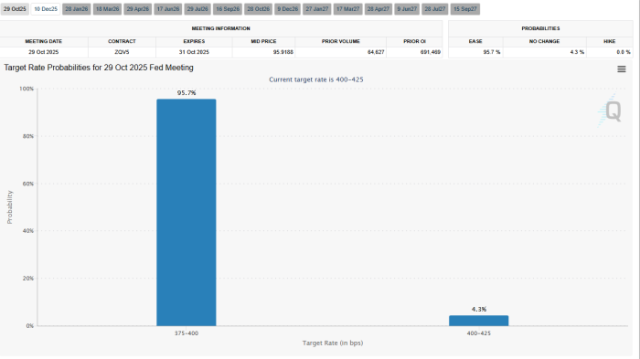
FedWatch’s odds of a tax rate cut on October 29

Furthermore, the government uncertainty and chaos is weakening the US dollar and worries investors. This explains their migration to crypto in general and Bitcoin in particular, as the once high-risk assets are becoming more appealing by the day (especially as an inflation hedge).

Bitcoin Hyper ($HYPER) will also benefit from this increasing pro-crypto trend. As a Bitcoin Layer 2 solution, it promises faster and cheaper transactions and a more scalable network, with the presale raising over $21.6M.

Will Bitcoin Retain Its Momentum In October?

There’s little doubt that Bitcoin will retain its bullish momentum into October and beyond, because we have officially entered the bull zone.

Between 2013 and 2025, a 13-year period, Bitcoin’s only had four red Octobers, the last one in 2022, according to CoinGlass data.
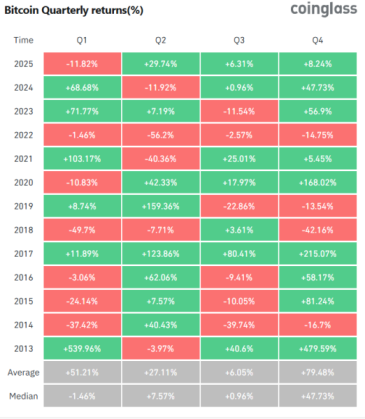
Bitcoin’s quarterly returns between 2013 and 2025

This year’s Q4 has already started with an 8.24% pump and the expectations are high considering the catalytic factors fueling Bitcoin’s drive.

The recent governmental shutdown may be the most impactful now, but it’s far from the only one.

September’s ADP Employment Report is one of them, highlighting 32,000 job losses, compared to the expected 50,000 in job creations.

The massive discrepancy contributed to the fear and uncertainty among investors and explained, at least partly, the market’s migration to crypto.

Then we have the growing institutional adoption, with the largest Bitcoin treasuries hoarding $BTC at a steady pace throughout 2025.
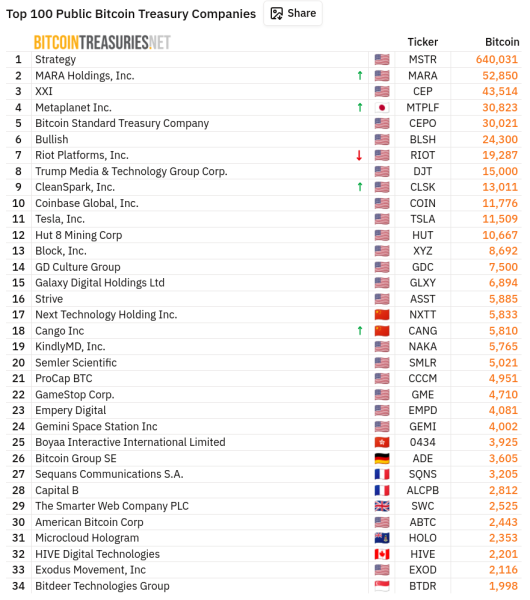
The top 100 largest Bitcoin treasuries in 2025

Together with the increasingly pro-crypto legislation, marked by Trump’s GENIUS Act, these factors could support Bitcoin’s continued growth into 2026 and beyond.

Strategy’s Michael Saylor ascribes to that idea wholeheartedly, when he commented, after being asked about Bitcoin’s next winter phase during a Bloomberg interview back in June:

Winter is not coming back. We’re past that phase. If Bitcoin isn’t going to zero, it’s going to $1M.

Michael Saylor, Bloomberg interview

With a targeted Q4 public release, Bitcoin Hyper ($HYPER) will also likely contribute to Bitcoin’s 2025 bull run.

Bitcoin Hyper Promises Faster and Cheaper Bitcoin Transactions

Bitcoin Hyper ($HYPER) is the Layer 2 solution to Bitcoin’s most pressing issue: its performance limitation of seven transactions per second (TPS). By addressing this problem head-on, Hyper promises to offer faster and cheaper transactions for a more performant and scalable Bitcoin.

The Canonical Bridge is one of the primary tools to help with that. Once the Bitcoin Relay Program confirms incoming transactions, the Bridge then mints the users’ Bitcoins into the Hyper layer.
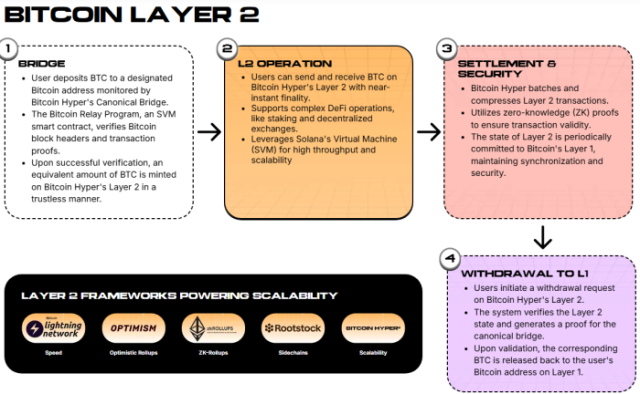
How Hyper’s Canonical Bridge functions

Any transactions to and from the Hyper layer have near-instant finality, drastically upgrading the ecosystem’s responsiveness and overall performance. You can also withdraw your Bitcoins to Layer 1 whenever necessary.

Hyper’s Layer 2 maintains strong synchronization with Bitcoin’s native Layer 1 to ensure optimal performance and security.

The Solana Virtual Machine is another welcomed addition to Hyper’s tool set, enabling the ultra-fast execution of DeFi apps and smart contracts.

These tools contribute to a faster, cheaper, and more scalable Bitcoin ecosystem, making it a more viable choice for institutional investors.

The presale has raised $21.6M so far and it’s growing rapidly. You can buy your $HYPER at the presale price of $0.013065, which could be the lowest price point you’ll ever get.

Based on Hyper’s utility and presale performance, our price prediction for $HYPER puts the coin at $0.32 by the end of 2025. By 2030, we could see $HYPER climbing to $1.50 or higher, especially following mainstream adoption.

If you want to invest, read our guide on how to buy $HYPER and get your stack while it’s cheap.

This isn’t financial advice. Do your own research (DYOR) and invest wisely.

Authored by Bogdan Patru, Bitcoinist: https://bitcoinist.com/bitcoin-breaks-125k-ath-as-bull-run-pushes-investors-to-bitcoin-hyper

Editorial Process for bitcoinist is centered on delivering thoroughly researched, accurate, and unbiased content. We uphold strict sourcing standards, and each page undergoes diligent review by our team of top technology experts and seasoned editors. This process ensures the integrity, relevance, and value of our content for our readers.

As a crypto writer, Bogdan’s responsibilities are split between researching and writing articles and entertaining the team with his humor bordering on the politically incorrect, an aspiring Bill Burr, if you will. Thanks to his 12+ years of writing experience in just as many fields, including tech, cybersecurity, modelling, fitness, crypto, and other topics-that-shall-not-be-named, he's become a genuine asset to the team. While his position as a senior writer at PrivacyAffairs thought him valuable lessons about the power of self-management, his entire writing career was and is an exercise in self-improvement. Now, he's ready to sink his teeth into crypto and teach people how to take control of their own money on the blockchain. With fiat as an eternally devaluing currency, Bitcoin and altcoins seem like the best-fitting alternative for Bogdan. Bogdan’s biggest professional accomplishment, aside from securing a position as a main writer for Bitcoinist, was his 5-year run as a writing manager at Blackwood Productions, where he coordinated a team of four writers. During that time, he learned the value of teamwork and that of creating a working environment that breeds efficiency, positivity, and friendship.

Related Reads

Interpreting Investment Opportunities in the Age of Great Navigation, Invesco Great Wall Fund Releases '2026 Report on Chinese Enterprises Going Global'

Invesco Great Wall Fund has released its "2026 China Corporate Globalization Report," titled "The 'Great Navigation Era' of Chinese Enterprises." The report analyzes the new trends and investment opportunities as Chinese companies expand globally, moving from simple product exports to comprehensive overseas operations involving services, branding, and local production. Driven by factors like trade friction, the pursuit of higher profit margins abroad, and policy support, globalization is becoming essential for Chinese companies. The report outlines an evolution: from early product export ("Globalization 1.0") to the current "Globalization 2.0," characterized by overseas capacity, capital goods investment, consumer brand expansion, and service exports. Chinese firms' competitive advantages are highlighted, including a vast engineer talent pool, low-cost and robust infrastructure, and complete industrial clusters. Specific sectors with significant出海 potential are identified: * **Capital Goods** (e.g., engineering machinery, power equipment): Benefiting from global demand, especially in Belt & Road markets and the AI-driven power grid upgrade cycle. * **Consumer Brands**: Transitioning from cost to brand advantage, leveraging供应链 efficiency. * **Technology & Innovation**: Including AI applications, optical modules within global tech supply chains, and new energy vehicles focusing on local production. * **Pharmaceuticals**: Chinese biotech firms are becoming preferred partners for global pharma, with potential for breakthrough drugs in areas like oncology and weight loss. The report concludes that corporate globalization represents a sustained, core theme for China's capital markets, though companies must navigate challenges like geopolitics and localization.

marsbit3m ago

Interpreting Investment Opportunities in the Age of Great Navigation, Invesco Great Wall Fund Releases '2026 Report on Chinese Enterprises Going Global'

marsbit3m ago

GitHub, Transfixed by AI

On the night of February 9th, GitHub suffered a major outage caused by a simple configuration change—reducing a cache refresh interval from 12 to 2 hours—that triggered a cascade of failures. This was not an isolated event, but part of a broader pattern. In early 2026, GitHub experienced at least 8 major incidents, failing to meet its promised 99.9% availability. These outages stemmed from structural issues: explosive growth in load, tight service coupling, and insufficient protection against abnormal traffic. This unprecedented load is driven by AI Agents. In 2025, GitHub handled ~1 billion commits. By 2026, weekly commits reached 275 million, projecting to ~14 billion for the year—a 14x increase. AI tools like Claude Code now contribute 4.5% of all public repository commits, with weekly submissions surging 25x in just three months. AI-generated pull requests jumped from 4 million to 17 million per month in half a year. Unlike human developers, AI Agents work continuously, generating commits at a scale that overwhelms infrastructure designed for human rhythms. The surge also shattered GitHub's business model. Copilot's flat-rate pricing, based on assisting human developers, became unsustainable as Agentic AI sessions consumed resources worth hundreds of dollars for a few dollars in fees. In response, GitHub imposed usage limits and, by June 1st, shifted to a pay-per-use "AI Credits" system. Facing this new reality, GitHub realized a 10x scaling plan was insufficient. It announced a need to *redesign* its architecture for 30x current scale—decoupling services, adding fault isolation, and improving change management to prevent cascading failures. Other platforms like Stripe and AWS are facing similar challenges with AI Agents. Fundamentally, GitHub is transitioning from a human collaboration platform to an "exhaust pipe" for automated AI workflows. Its detailed post-mortem reports aim to maintain trust during this turbulent rebuild. The February outage was not just a technical glitch, but a signal of the software industry's entry into a new, AI-driven era.

marsbit43m ago

GitHub, Transfixed by AI

marsbit43m ago

Both Suffer Massive Losses Exceeding $90 Billion, Which Is in Greater Peril: Strategy or Bitmine?

Facing massive paper losses exceeding $90 billion each amidst a sharp market downturn, "Digital Asset Treasury" (DAT) giants Strategy and Bitmine find themselves in a precarious position, but with different underlying risks. Strategy, heavily invested in Bitcoin (BTC), faces significant financial strain. Its strategy relies heavily on debt, including convertible notes and preferred stock (STRC) requiring substantial dividend payments. With its cash reserves dwindling and BTC offering no staking yield for cash flow, Strategy's high leverage makes it vulnerable. A continued price decline could force asset sales to meet obligations, potentially creating a negative feedback loop. Its market value has already fallen sharply. In contrast, Bitmine, an Ethereum (ETH) holder, appears on firmer financial ground. It primarily funds its purchases through equity offerings (like ATM programs), avoiding debt pressure. It also generates income by staking a large portion of its ETH holdings. While not immune to market drops and shareholder dilution concerns, Bitmine maintains more flexibility, recently announcing a new preferred share offering to raise further capital. The core divergence lies in their financing: Bitmine uses equity (investor money), while Strategy uses debt (borrowed money). Consequently, Bitmine currently faces less immediate liquidity pressure than Strategy, which must navigate the dual challenge of servicing debt/dividends and a declining core asset (BTC) price.

marsbit50m ago

Both Suffer Massive Losses Exceeding $90 Billion, Which Is in Greater Peril: Strategy or Bitmine?

marsbit50m ago

Trading

Spot
Futures

Hot Articles

What is $BITCOIN

DIGITAL GOLD ($BITCOIN): A Comprehensive Analysis Introduction to DIGITAL GOLD ($BITCOIN) DIGITAL GOLD ($BITCOIN) is a blockchain-based project operating on the Solana network, which aims to combine the characteristics of traditional precious metals with the innovation of decentralized technologies. While it shares a name with Bitcoin, often referred to as “digital gold” due to its perception as a store of value, DIGITAL GOLD is a separate token designed to create a unique ecosystem within the Web3 landscape. Its goal is to position itself as a viable alternative digital asset, although specifics regarding its applications and functionalities are still developing. What is DIGITAL GOLD ($BITCOIN)? DIGITAL GOLD ($BITCOIN) is a cryptocurrency token explicitly designed for use on the Solana blockchain. In contrast to Bitcoin, which provides a widely recognized value storage role, this token appears to focus on broader applications and characteristics. Notable aspects include: Blockchain Infrastructure: The token is built on the Solana blockchain, known for its capacity to handle high-speed and low-cost transactions. Supply Dynamics: DIGITAL GOLD has a maximum supply capped at 100 quadrillion tokens (100P $BITCOIN), although details regarding its circulating supply are currently undisclosed. Utility: While precise functionalities are not explicitly outlined, there are indications that the token could be utilized for various applications, potentially involving decentralized applications (dApps) or asset tokenization strategies. Who is the Creator of DIGITAL GOLD ($BITCOIN)? At present, the identity of the creators and development team behind DIGITAL GOLD ($BITCOIN) remains unknown. This situation is typical among many innovative projects within the blockchain space, particularly those aligning with decentralized finance and meme coin phenomena. While such anonymity may foster a community-driven culture, it intensifies concerns about governance and accountability. Who are the Investors of DIGITAL GOLD ($BITCOIN)? The available information indicates that DIGITAL GOLD ($BITCOIN) does not have any known institutional backers or prominent venture capital investments. The project seems to operate on a peer-to-peer model focused on community support and adoption rather than traditional funding routes. Its activity and liquidity are primarily situated on decentralized exchanges (DEXs), such as PumpSwap, rather than established centralized trading platforms, further highlighting its grassroots approach. How DIGITAL GOLD ($BITCOIN) Works The operational mechanics of DIGITAL GOLD ($BITCOIN) can be elaborated on based on its blockchain design and network attributes: Consensus Mechanism: By leveraging Solana’s unique proof-of-history (PoH) combined with a proof-of-stake (PoS) model, the project ensures efficient transaction validation contributing to the network's high performance. Tokenomics: While specific deflationary mechanisms have not been extensively detailed, the vast maximum token supply implies that it may cater to microtransactions or niche use cases that are still to be defined. Interoperability: There exists the potential for integration with Solana’s broader ecosystem, including various decentralized finance (DeFi) platforms. However, the details regarding specific integrations remain unspecified. Timeline of Key Events Here is a timeline that highlights significant milestones concerning DIGITAL GOLD ($BITCOIN): 2023: The initial deployment of the token occurs on the Solana blockchain, marked by its contract address. 2024: DIGITAL GOLD gains visibility as it becomes available for trading on decentralized exchanges like PumpSwap, allowing users to trade it against SOL. 2025: The project witnesses sporadic trading activity and potential interest in community-led engagements, although no noteworthy partnerships or technical advancements have been documented as of yet. Critical Analysis Strengths Scalability: The underlying Solana infrastructure supports high transaction volumes, which could enhance the utility of $BITCOIN in various transaction scenarios. Accessibility: The potential low trading price per token could attract retail investors, facilitating wider participation due to fractional ownership opportunities. Risks Lack of Transparency: The absence of publicly known backers, developers, or an audit process may yield skepticism regarding the project's sustainability and trustworthiness. Market Volatility: The trading activity is heavily reliant on speculative behavior, which can result in significant price volatility and uncertainty for investors. Conclusion DIGITAL GOLD ($BITCOIN) emerges as an intriguing yet ambiguous project within the rapidly evolving Solana ecosystem. While it attempts to leverage the “digital gold” narrative, its departure from Bitcoin's established role as a store of value underscores the need for a clearer differentiation of its intended utility and governance structure. Future acceptance and adoption will likely depend on addressing the current opacity and defining its operational and economic strategies more explicitly. Note: This report encompasses synthesised information available as of October 2023, and developments may have transpired beyond the research period.

363 Total ViewsPublished 2025.05.13Updated 2025.05.13

What is $BITCOIN

Discussions

Welcome to the HTX Community. Here, you can stay informed about the latest platform developments and gain access to professional market insights. Users' opinions on the price of BTC (BTC) are presented below.

活动图片















