美SEC新规后决策日期“失效”:五大候选谁将通关10月加密ETF

marsbitPublished on 2025-10-03Last updated on 2025-10-04

在本轮加密牛市的众多催化剂中,ETF 特别是现货比特币和以太坊 ETF,作为一种革命性的金融工具,显著降低了投资加密货币的门槛,扮演了关键的“资金桥梁”角色。自比特币现货 ETF 于 2024 年初获批以来,整个行业已累计吸引上千亿美元的机构资金流入,推动比特币价格从 6 万美元飙升至当前约 11.35 万美元。

截至目前,美国证券交易委员会(SEC)有 92 只加密现货 ETF(包括单一资产和指数型)处于排队审批状态。其中,单一资产 ETF 约占 69 只,涵盖 24 种不同币种。这些申请主要来自 Grayscale、VanEck 等机构,最终决策截止日期大多在 10 月。

在此背景下,美国证券交易委员会(SEC)近日批准了一项提案,加密现货 ETF 的上市方式出现了根本性变革。因而 10 月的批准情况不仅将成为加密 ETF 浪潮的转折点,也将折射出本轮牛市的未来走向。


美国 SEC 批准变更提案,从“个案审批”到“标准通关”

9 月 7 日,美国 SEC 批准了三大交易所(Nasdaq、Cboe BZX 和 NYSE Arca)提出的规则变更,引入了“Commodity-Based Trust Shares”(商品型信托份额)的通用上市标准。该标准主要针对持有现货商品(包括数字资产)的交易所交易产品(ETP),取代逐案审查的繁琐程序,旨在简化上市流程。

美国 SEC 主席对此文件表示,这些变化标志着 SEC 对数字资产 ETP 的监管从“谨慎逐案”转向“标准化高效”,旨在“最大化投资者选择并促进创新”。

新规定的核心内容如下:
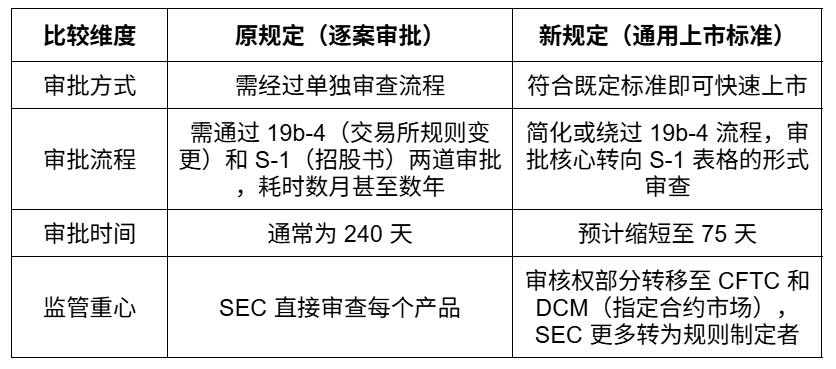
SEC

该规定提出了三种上市路径:

  1. 商品在 Intermarket Surveillance Group(ISG)成员市场交易,且有市场监视共享协议。
  2. 商品期货在 CFTC 监管的 DCM 上市至少 6 个月,并有监视共享协议。
  3. 若现有 ETF 在美国全国性证券交易所上市,且其至少 40% 资产配置于该商品,新 ETP 可豁免部分要求。

简而言之,新规为符合特定条件的加密资产 ETF 开辟了一条“快车道”。基于上述三个路径,10 月份或将是首批新 ETF 上市的“爆发期”,重点针对已有 CFTC 监管期货合约 6 个月以上的资产。


原有决策日期“失效”,ETF 发行方“站在同一起跑线”

新标准的生效直接影响了原本已在排队等候的 ETF 申请。9 月 29 日,美国 SEC 要求 LTC、XRP、SOL、ADA、DOGE 现货 ETF 发行方撤回 19b-4 申报文件,发行方需按新标准推进上市,撤回申请可能最早于本周开始。此次撤回并非意味着 ETF 申请被彻底否决,而是转向更高效的监管路径。

值得注意的是,撤回 19b-4 申报后,其原有的决定日期(通常指 SEC 对申报的最终裁决截止期限,如提交后 240 天内)或许不再具有参考价值。在新规则下,SEC 可能无需严格的截止日期,而是基于通用上市标准快速评估。

对于 ETF 究竟何时能获批,尽管发行方需要根据新通用规则重新提交或调整申请,这可能涉及额外行政工作和短暂延迟,但多数人士对此持乐观态度,认为批准速度可能“异常迅速”,类似于 ETH ETF 从撤回到批准仅用数周的时间,即有望在 10 月份获批。

加密记者 Eleanor Terrett 发文分析称,“只要代币符合现有标准,SEC 只需提交的 S-1 文件即可随时批准加密货币 ETF。因此,即使这些单个 ETF 的截止日期迫在眉睫,SEC 理论上也可以随时对其中任何或所有 ETF 做出决定”。

不过,彭博 ETF 分析师 James Seyffart 提醒道,“一切都充满不确定性。再加上政府关门的可能性,情况可能会变得非常不稳定”。

目前虽然尚不清楚 SEC 将以多快的速度处理 S-1 申请,消除了原有决定日期的预测性,但这一变化优化了流程,为后续更多加密货币 ETF 进入市场减少了延迟。


五大候选谁将领跑 ETF 竞赛?

虽然此前排队等候的 ETF 申请重回“起跑线”,但目前 SEC 要求发行方撤回的申请仅涉及 LTC、XRP、SOL、ADA、DOGE,或预示着首批获准的 ETF 将从中产生(或全部获批)。

1. XRP ETFs

XRP ETF 是 10 月最受瞩目的焦点,目前有 7 只 XRP ETF 的申请,包括 Bitwise、21Shares、Canary、Grayscale 等机构,此前有 6 个申请挤在 10 月 18-25 日窗口,Franklin Templeton 的申请被推迟至最晚 11 月 14 日做决定。

XRP 现货 ETF 申请于 2025 年 1 月提交,Ripple 诉讼缓解后 SEC 于 7 月开放评论,XRP 期货已在 CME 上市超一年,符合新规条件。此前彭博分析师 James Seyffart 和 Eric Balchunas 将 XRP 现货 ETF 的获批概率上调至 95%。这一高概率的预测源于 SEC 对申请文件的参与增加,分析师认为这种交流程度是一个“明确的绿灯”。

此外,XRP 的一个关键优势在于它已被监管机构视为商品,极大的减少了其 ETF 的申请障碍。

2. SOL ETFs

SOL 现货 ETF 是目前最受关注的申请之一,有 7 家大型机构参与其中,包括 VanEck 、21Shares、Bitwise、Franklin Templeton 等。

9 月 27 日,包括 Fidelity、Franklin Templeton、CoinShares、Bitwise、Grayscale、Canary Capital 和 VanEck 等资产管理公司,陆续向美国 SEC 递交最新版本的 S-1 表格。这些修订文件都围绕在 Solana ETF 的质押操作细节。

SEC 要求发行方撤回 19b-4 申报文件后,彭博 ETF 分析师 Eric Balchunas 将 SOL ETF 获批的几率从 95% 提高至 100%。其表示:“说实话,现在获批概率真的就是100%了……通用上市标准让 19b-4 表格变得毫无意义。现在就只剩下 S-1 表格相关事宜了,SOL ETF 随时可能获批”。

但值得一提的是,BlackRock(比特币和以太坊 ETF 的最大发行方)尚未提交 Solana ETF 申请,这可能反映出其对 Solana 监管风险的谨慎态度。

3. LTC ETFs

作为加密市场上运行时间最长的代币之一,LTC 自 2011 年推出以来一直保持较高的安全性和去中心化程度。目前有三只 Litecoin ETF 的申请,包括 Canary Litecoin ETF、Grayscale Litecoin Trust ETF 和 CoinShares Litecoin ETF。

此前 Litecoin ETF 的 10 月 10 日截止日期使其成为“开门红”候选。虽然原有决定日期的“失效”,Litecoin ETF 率先获批的可能性有所下降,但 LTC 长期的市场稳定性、较强的合规性以及与比特币相似的技术架构,使其仍有极大概率在首批上市。

此外,Litecoin 并未像 XRP 或 SOL 那样曾被 SEC 认定为证券,更接近于比特币的商品属性,显著降低了监管上的障碍。

4. Cardano (ADA) ETF

Grayscale 的 Cardano Trust 计划转换为 ETF,该 ETF 的 S-1 文件于 8 月注册,此前最终截止日期定于 10 月 26 日。Cardano 以学术基础和可持续性闻名,若该现货型 ETF 获批,将是首个非 ETH PoS 平台产品。值得注意的是,Grayscale 的 GDLC(数字大型股基金)已于 7 月 1 日获批,其中包括 ADA,进一步提升了 ADA ETF 获批概率。

5. DOGE ETFs

目前有三只 DOGE ETF 的申请,包括 Bitwise、Grayscale 和 21Shares。此前 SEC 最晚将在 10 月 12 日前作出裁定。DOGE 现货 ETF 获批,将成为第一个 Meme ETF。


结语

10 月的关键窗口期无论最终结果如何,都将成为加密 ETF 史上重要转折点,它不仅会影响相关加密货币的价格,更会决定机构资金流入加密货币的规模和速度。加密市场正在走向成熟,而 10 月的 ETF 决策可能是其进一步获得主流认可的关键一环。


Related Reads

Learn Codex with the "Morning Briefing": Six Replicable Levels of Use

This article introduces a "Morning Briefing" as a simple, progressive framework for learning to effectively use Codex (an AI assistant), moving from basic information gathering to a more sophisticated, autonomous work partner. It outlines six actionable levels: **Level 1: Basic Information Query.** Start by simply asking Codex to check your Slack, Gmail, and Calendar to summarize what needs your attention today. **Level 2: Personalization with an Agents File.** Create a persistent file containing your default preferences for the briefing's format and content, so it's consistently useful. **Level 3: Automation.** Set the briefing to run automatically every weekday morning, creating a reliable starting point for your day. **Level 4: Project-Specific Briefings.** Instead of one overwhelming summary, create separate, dedicated threads for different projects (e.g., a launch, recruitment), each with its own focused briefing. **Level 5: Drafting Follow-Up Actions.** Elevate the briefing from a summary to an action starter by having it draft replies, prepare meeting notes, or highlight stalled decisions—ready for your review. **Level 6: Building a Memory System (Vault).** Integrate a knowledge vault (a structured file system) where important recurring information (project statuses, key people, decisions) is stored and updated. The briefing consults this vault to provide richer context and learns over time. The approach's strength is its incremental nature. Each level teaches a core Codex capability (connectors, personalization, automation, project context, assisted work, persistent memory) within a familiar, practical workflow, avoiding overwhelming theoretical concepts. It transforms a simple daily check-in into a personalized, evolving work operating system.

marsbit10m ago

Learn Codex with the "Morning Briefing": Six Replicable Levels of Use

marsbit10m ago

Can Alibaba Cloud Rewrite Itself?

Over the past five months, Alibaba Cloud's MaaS (Model as a Service) revenue has surged 15x, marking a strategic overhaul where the company is shifting its 17-year-old system designed for "humans using cloud" to a new paradigm centered on "Agents consuming Tokens." At its recent summit, Alibaba Cloud announced a full-stack upgrade encompassing "chip-cloud-model-inference," all optimized for AI Agents. Key launches include the new AI product portal "QianWen Cloud," hyper-node servers powered by the in-house AI chip Zhenwu M890, and the latest flagship model, Qwen3.7-Max. Senior VP Liu Weiguang described this as building "China's largest AI factory," where chips are raw materials, the cloud is the workshop, models are machines, and the inference platform is the assembly line, with Tokens as the final product. The company is now emphasizing its chip strategy, unveiling the Zhenwu M890 and a two-year roadmap for future chips. With over 560,000 chips deployed across 400+ clients, Alibaba Cloud aims to control the marginal cost per Token, mirroring Google's integration of TPU and Gemini for optimal cost-performance. The cloud infrastructure itself is being rewritten. Traditional cloud interfaces are being transformed into standardized, Agent-callable Skills. A new scheduling logic focuses on "task scheduling" over "resource scheduling" to handle the unpredictable, elastic workloads of Agents. Liu noted that AI applications now automatically provision cloud resources, with one customer's daily automated provisioning equaling two weeks of manual work. For models, the focus has shifted from conversational prowess to execution capability. Qwen3.7-Max demonstrated this by autonomously writing and optimizing a production-grade AI compute kernel for the new Zhenwu M890 chip over 35 hours, achieving a 10x performance improvement. The underlying Bailian platform was upgraded for efficiency, and it maintains an open ecosystem, hosting third-party models. This restructuring extends beyond technology to sales, organization, and metrics. Alibaba Cloud has established dedicated MaaS sales teams, separated from traditional IaaS, with new KPIs focusing on high-quality Tokens that solve real problems, the number of core business systems integrated with models, and the efficiency of Agent task completion. The underlying bet is clear: AI represents an opportunity orders of magnitude larger than before. Despite the uncertainty, Alibaba Cloud is aggressively rebuilding its entire system, betting on an AI-driven future where Tokens could become its largest product line.

marsbit1h ago

Can Alibaba Cloud Rewrite Itself?

marsbit1h ago

Trading

Spot
Futures

Hot Articles

What is $BITCOIN

DIGITAL GOLD ($BITCOIN): A Comprehensive Analysis Introduction to DIGITAL GOLD ($BITCOIN) DIGITAL GOLD ($BITCOIN) is a blockchain-based project operating on the Solana network, which aims to combine the characteristics of traditional precious metals with the innovation of decentralized technologies. While it shares a name with Bitcoin, often referred to as “digital gold” due to its perception as a store of value, DIGITAL GOLD is a separate token designed to create a unique ecosystem within the Web3 landscape. Its goal is to position itself as a viable alternative digital asset, although specifics regarding its applications and functionalities are still developing. What is DIGITAL GOLD ($BITCOIN)? DIGITAL GOLD ($BITCOIN) is a cryptocurrency token explicitly designed for use on the Solana blockchain. In contrast to Bitcoin, which provides a widely recognized value storage role, this token appears to focus on broader applications and characteristics. Notable aspects include: Blockchain Infrastructure: The token is built on the Solana blockchain, known for its capacity to handle high-speed and low-cost transactions. Supply Dynamics: DIGITAL GOLD has a maximum supply capped at 100 quadrillion tokens (100P $BITCOIN), although details regarding its circulating supply are currently undisclosed. Utility: While precise functionalities are not explicitly outlined, there are indications that the token could be utilized for various applications, potentially involving decentralized applications (dApps) or asset tokenization strategies. Who is the Creator of DIGITAL GOLD ($BITCOIN)? At present, the identity of the creators and development team behind DIGITAL GOLD ($BITCOIN) remains unknown. This situation is typical among many innovative projects within the blockchain space, particularly those aligning with decentralized finance and meme coin phenomena. While such anonymity may foster a community-driven culture, it intensifies concerns about governance and accountability. Who are the Investors of DIGITAL GOLD ($BITCOIN)? The available information indicates that DIGITAL GOLD ($BITCOIN) does not have any known institutional backers or prominent venture capital investments. The project seems to operate on a peer-to-peer model focused on community support and adoption rather than traditional funding routes. Its activity and liquidity are primarily situated on decentralized exchanges (DEXs), such as PumpSwap, rather than established centralized trading platforms, further highlighting its grassroots approach. How DIGITAL GOLD ($BITCOIN) Works The operational mechanics of DIGITAL GOLD ($BITCOIN) can be elaborated on based on its blockchain design and network attributes: Consensus Mechanism: By leveraging Solana’s unique proof-of-history (PoH) combined with a proof-of-stake (PoS) model, the project ensures efficient transaction validation contributing to the network's high performance. Tokenomics: While specific deflationary mechanisms have not been extensively detailed, the vast maximum token supply implies that it may cater to microtransactions or niche use cases that are still to be defined. Interoperability: There exists the potential for integration with Solana’s broader ecosystem, including various decentralized finance (DeFi) platforms. However, the details regarding specific integrations remain unspecified. Timeline of Key Events Here is a timeline that highlights significant milestones concerning DIGITAL GOLD ($BITCOIN): 2023: The initial deployment of the token occurs on the Solana blockchain, marked by its contract address. 2024: DIGITAL GOLD gains visibility as it becomes available for trading on decentralized exchanges like PumpSwap, allowing users to trade it against SOL. 2025: The project witnesses sporadic trading activity and potential interest in community-led engagements, although no noteworthy partnerships or technical advancements have been documented as of yet. Critical Analysis Strengths Scalability: The underlying Solana infrastructure supports high transaction volumes, which could enhance the utility of $BITCOIN in various transaction scenarios. Accessibility: The potential low trading price per token could attract retail investors, facilitating wider participation due to fractional ownership opportunities. Risks Lack of Transparency: The absence of publicly known backers, developers, or an audit process may yield skepticism regarding the project's sustainability and trustworthiness. Market Volatility: The trading activity is heavily reliant on speculative behavior, which can result in significant price volatility and uncertainty for investors. Conclusion DIGITAL GOLD ($BITCOIN) emerges as an intriguing yet ambiguous project within the rapidly evolving Solana ecosystem. While it attempts to leverage the “digital gold” narrative, its departure from Bitcoin's established role as a store of value underscores the need for a clearer differentiation of its intended utility and governance structure. Future acceptance and adoption will likely depend on addressing the current opacity and defining its operational and economic strategies more explicitly. Note: This report encompasses synthesised information available as of October 2023, and developments may have transpired beyond the research period.

363 Total ViewsPublished 2025.05.13Updated 2025.05.13

What is $BITCOIN

Discussions

Welcome to the HTX Community. Here, you can stay informed about the latest platform developments and gain access to professional market insights. Users' opinions on the price of BTC (BTC) are presented below.

活动图片