Ripple Maps XRP Ledger’s Future: ‘No Privacy, No Adoption’

bitcoinistPublished on 2025-10-03Last updated on 2025-10-03

Abstract

Ripple’s latest think piece on the XRP Ledger (XRPL) makes a blunt case that institutional finance will not move on-chain...

Trusted Editorial content, reviewed by leading industry experts and seasoned editors. Ad Disclosure

Ripple’s latest think piece on the XRP Ledger (XRPL) makes a blunt case that institutional finance will not move on-chain at scale without first-class privacy—and that the missing capability can be delivered without abandoning public-chain transparency or compliance.

Ripple Pushes Programmable Privacy For The XRP Ledger

In an article published on October 2, Senior Director of Engineering J. Ayo Akinyele argues that “finance cannot function without confidentiality, yet blockchains are built on transparency,” framing the next phase of XRPL development around programmable privacy, verifiable compliance, and trust-minimized scalability.

Akinyele, a cryptographer with a decade of applied-privacy work, sets out a two-track roadmap: embed privacy primitives directly into infrastructure, and pair them with mechanisms that let market participants—and regulators—verify rules were followed without exposing sensitive data.

He points to zero-knowledge proofs (ZKPs) for selective disclosure and confidential computing for protected off-chain logic, alongside “fair ordering” via trusted execution environments to mitigate frontrunning and MEV. The throughline is that confidentiality and accountability are not opposites; in his words, programmable privacy can enable institutions to “prove adherence to compliance requirements… without revealing sensitive transaction data.”

The timing is not theoretical. On October 1, the XRP Ledger activated its Multi-Purpose Token (MPT) standard on mainnet—a protocol-level framework for issuing fungible tokens without custom smart contracts that is explicitly aimed at institutional tokenization. Ripple engineers emphasized the institutional design goal in public posts announcing the activation.

Akinyele’s privacy focus dovetails with a parallel standards push to extend MPTs with confidentiality. In mid-September, Ripple engineers Murat Cenk and Aanchal Malhotra opened an XRPL Standards discussion for “Confidential Multi-Purpose Tokens,” proposing to encrypt balances and transfer amounts using EC-ElGamal and ZKPs while preserving the accounting semantics of XRPL’s existing MPT framework. The draft describes confidential transfers and balances with proofs that let verifiers check correctness without reading underlying values. The discussion was posted on September 12, and coverage spread in the days that followed.

In practical terms, the confidential-MPT blueprint targets precisely the friction that keeps heavily regulated issuers on private ledgers or permissioned systems. Under the approach, an issuer could demonstrate that a customer passed KYC/AML checks or that reserves are fully collateralized, while keeping the customer’s identity and transaction amounts hidden from the public. Akinyele cites these as canonical examples of how “regulated DeFi” can operate on public infrastructure: private, compliant markets for tokenized collateral, stablecoins, and real-world assets, with auditability preserved through cryptographic proofs rather than intermediaries.

The argument is also a critique of how some chains pursued throughput by eroding trust assumptions. Akinyele contends that scale must be achieved without sacrificing verifiability or decentralization, and he situates ZK light clients, fair ordering, and enclave-based confidential computation as complementary parts of that design space.

The XRPL angle here is that features historically built into the protocol—such as the native DEX, escrow, and payment channels—can be extended with privacy and compliance controls at the same layer, rather than scattered across bespoke contracts. Ripple’s documentation positions MPTs as a “version 2” fungible token standard that distills lessons from trust-line tokens and is being integrated more deeply into issuance, trading, and settlement flows on XRPL’s native rails.

Akinyele’s near-term horizon is explicit. He writes that the next 12 months will prioritize ZKPs on XRPL to enable private, compliant transactions while improving scalability, and that 2026 is targeted for “confidential MPTs” bringing privacy-preserving tokenized collateral to market. That roadmap triangulates with the standards draft now under discussion and with the October 1 activation of baseline MPTs, which collectively sketch a path from private issuance to private trading and settlement—without asking institutions to abandon the assurance that public chains provide.

The message to institutions is unambiguous and, in Akinyele’s framing, non-negotiable. Privacy is not a bolt-on for bad actors; it is the precondition for legitimate finance to operate in the open. “With programmable privacy, we can have both,” he writes—confidentiality for users and counterparties, and verifiable compliance for auditors and regulators. For XRPL specifically, the combination of a live protocol-level token standard and an active proposal to make those tokens confidential signals a bet that public-chain neutrality, with privacy and compliance embedded, is the architecture that can unlock the next wave of tokenized assets.

At press time, XRP traded at $3.04.
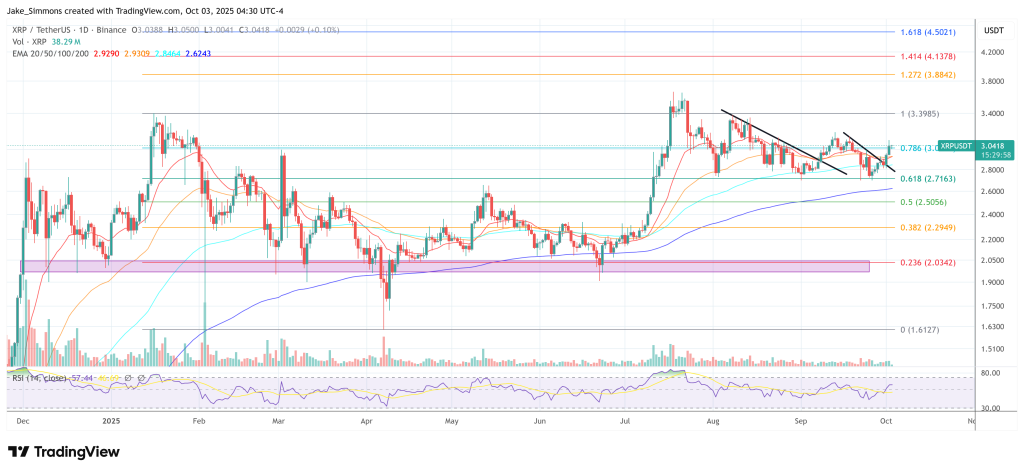
XRP price
XRP price, 1-day chart | Source: XRPUSDT on TradingView.com
Featured image created with DALL.E, chart from TradingView.com
Editorial Process for bitcoinist is centered on delivering thoroughly researched, accurate, and unbiased content. We uphold strict sourcing standards, and each page undergoes diligent review by our team of top technology experts and seasoned editors. This process ensures the integrity, relevance, and value of our content for our readers.

Jake Simmons has been a Bitcoin enthusiast since 2016. Ever since he heard about Bitcoin, he has been studying the topic every day and trying to share his knowledge with others. His goal is to contribute to Bitcoin's financial revolution, which will replace the fiat money system. Besides BTC and crypto, Jake studied Business Informatics at a university. After graduation in 2017, he has been working in the blockchain and crypto sector. You can follow Jake on Twitter at @realJakeSimmons.

Related Reads

Trading

Spot
Futures

Hot Articles

What is XRP 2.0

XRP 2.0: A New Frontier in the Cryptocurrency Landscape Introduction to XRP 2.0 In the ever-evolving realm of cryptocurrency, new projects continuously emerge, vying for attention and adoption. One such promising initiative is XRP 2.0, a novel cryptocurrency project designed to leverage advanced blockchain technology and robust encryption methodologies. While the name draws parallels with Ripple’s XRP, it’s crucial to note that XRP 2.0 operates independently, focusing on enhancing transaction security, privacy, and scalability. As the digital financial landscape increasingly embraces decentralized solutions, XRP 2.0 aims to contribute meaningfully to web3 and the overall expansion of crypto projects. What is XRP 2.0? At its core, XRP 2.0 is a cryptocurrency project that aims to create a secure and decentralized digital currency ecosystem. Its foundational technology integrates sophisticated blockchain principles with cutting-edge encryption techniques. The overarching goal of XRP 2.0 is to establish itself as a reliable and efficient platform enabling swift transaction execution while prioritizing enhanced privacy protections for its users. The project is promoted as a solution to many limitations faced by existing cryptocurrencies, proposing a system that can handle a higher volume of transactions with improved speed and privacy. This versatility positions XRP 2.0 as a significant contender in a marketplace riddled with various digital currencies. Who is the Creator of XRP 2.0? The identity of the creator behind XRP 2.0 has been flagged as ‘Wilbur.’ However, comprehensive details regarding Wilbur or their associated entity remain elusive. The anonymity of many cryptocurrency creators is not an uncommon phenomenon in the industry, often designed to maintain a degree of privacy and security. Who are the Investors of XRP 2.0? As of now, specific information related to the investment foundations or organizations supporting XRP 2.0 is not publicly available. In the cryptocurrency sector, the backing by reputed investors can significantly influence a project's credibility and success, yet the transparency regarding the financial supporters of XRP 2.0 has not been established. How Does XRP 2.0 Work? XRP 2.0 stands out by employing a combination of blockchain technology and advanced encryption algorithms that ensures secure and decentralized transactions. Its innovative structure includes unique features designed to foster user engagement and broaden functionalities beyond conventional cryptocurrency transactions. Among these features, XRP 2.0 incorporates AI-powered capabilities, such as text-to-image and text-to-speech functionalities. These additions are designed to enhance the interactive experience for users, promoting broader applicability across various sectors. By bridging technological advancements with user-centered design, XRP 2.0 aims to capture the attention of a diverse range of individuals and enterprises looking to integrate cryptocurrency solutions into their operational frameworks. Timeline of XRP 2.0 Understanding XRP 2.0 requires examining the milestones that have defined its journey thus far: July 23, 2023: XRP 2.0 is introduced as a novel cryptocurrency project, aiming to revolutionize secure and decentralized transaction capabilities in the blockchain domain. September 8, 2023: The launching of another project, XRP20, occurs, marking the emergence of an ERC-20 token on the Ethereum blockchain that remains unrelated to XRP 2.0. November 13, 2023: The XRP Ledger undergoes a significant update with the release of rippled server software version 2.0.0. It is essential to note that this development is disconnected from the XRP 2.0 cryptocurrency project. Key Points About XRP 2.0 To distill the essence of XRP 2.0, several critical factors emerge: Unique Features: The inclusion of features like AI-powered text-to-image and text-to-speech further diversifies the potential applications of XRP 2.0. Blockchain Technology: The framework utilizes advanced blockchain mechanisms and encryption protocols, ensuring a secure and decentralized environment for transactions. Scalability and Privacy: XRP 2.0 prioritizes enhanced privacy protections in transaction processes and the scalability necessary to accommodate a growing user base. No Affiliation with Ripple: Importantly, despite its name, XRP 2.0 does not have any allegiance or collaboration with Ripple’s XRP, distinguishing its operational framework and objectives within the cryptocurrency ecosystem. Conclusion XRP 2.0 represents an ambitious venture into the cryptocurrency sphere, aiming to offer a combination of security, privacy, and efficiency in digital transactions. By integrating sophisticated technologies and user-friendly features, the project sets out to broaden the horizons of what cryptocurrency can achieve in today's digital economy. While the anonymity of its creator and lack of disclosed investors might raise questions for some, XRP 2.0's focus on advanced functionalities and decentralisation enhances its appeal amidst an increasingly crowded crypto market. As the cryptocurrency landscape continues to evolve, XRP 2.0 may yet emerge as a pivotal player in the expansion of secure and scalable blockchain solutions.

942 Total ViewsPublished 2024.04.01Updated 2024.12.03

What is XRP 2.0

Discussions

Welcome to the HTX Community. Here, you can stay informed about the latest platform developments and gain access to professional market insights. Users' opinions on the price of XRP (XRP) are presented below.

活动图片