Приватные монеты обгоняют биткоин и Ethereum с ростом на 71,6%

cryptonews.ruPublished on 2025-10-19Last updated on 2025-10-19

В год, когда заголовки пестрели новостями о рекордах биткоина (BTC), ралли Ethereum (ETH), мемкоинах и решениях второго уровня, монеты конфиденциальности неожиданно стали лидерами в криптовалютном секторе

Несмотря на слабое внимание СМИ и общественности, рынок монет конфиденциальности обогнал другие сектора. Недавнее бычье ралли ведущих токенов конфиденциальности ускорило этот рост.

Монеты конфиденциальности — лучший криптосектор 2025 года

По данным Google Trends, интерес к запросу «монета конфиденциальности» оставался низким в первой половине 2025 года, начав расти только в августе и достигнув пика. Однако вскоре интерес снова угас.
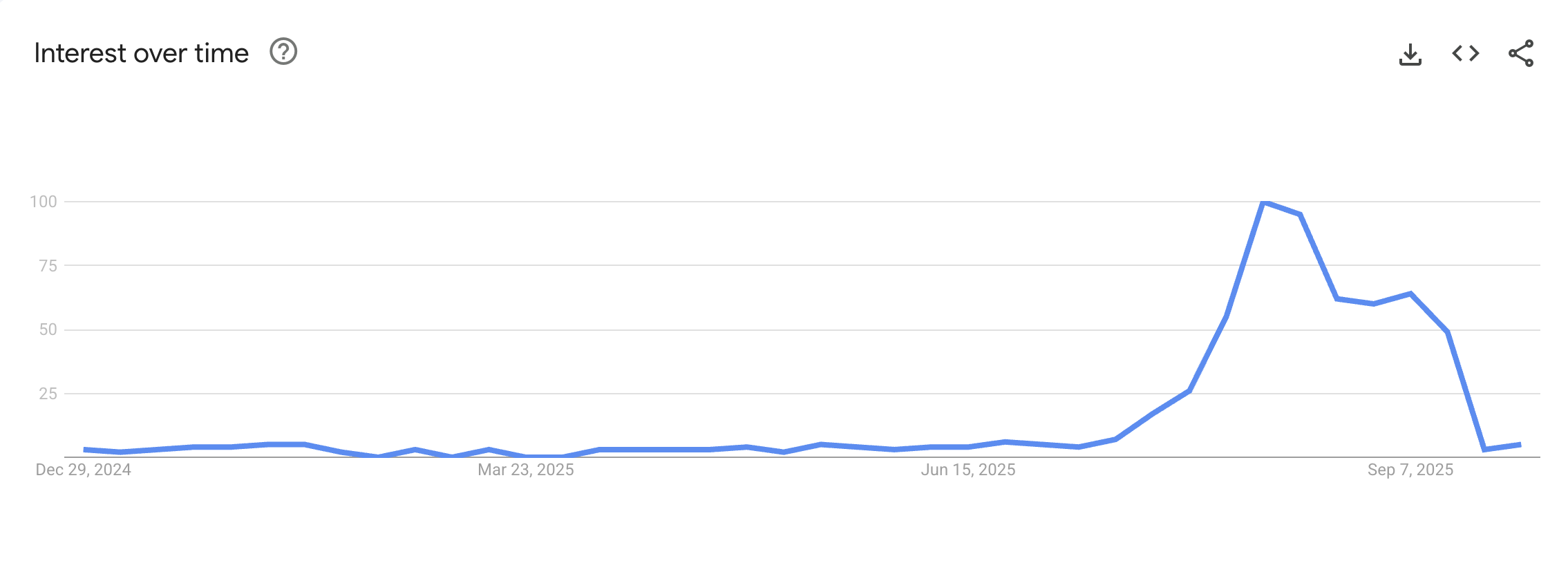
Интерес к термину «монета конфиденциальности».
Интерес к термину «монета конфиденциальности». Источник: Google Trends

По сравнению с запросами, такими как «крипто» или «альткоин», интерес оставался низким, что указывает на слабый интерес розничных инвесторов к этому сектору.

Тем не менее, криптовалюты, ориентированные на конфиденциальность, продолжают расти. По последним данным Artemis, сектор увеличился на 71,6% в 2025 году — это самый высокий показатель среди всех криптосекторов.
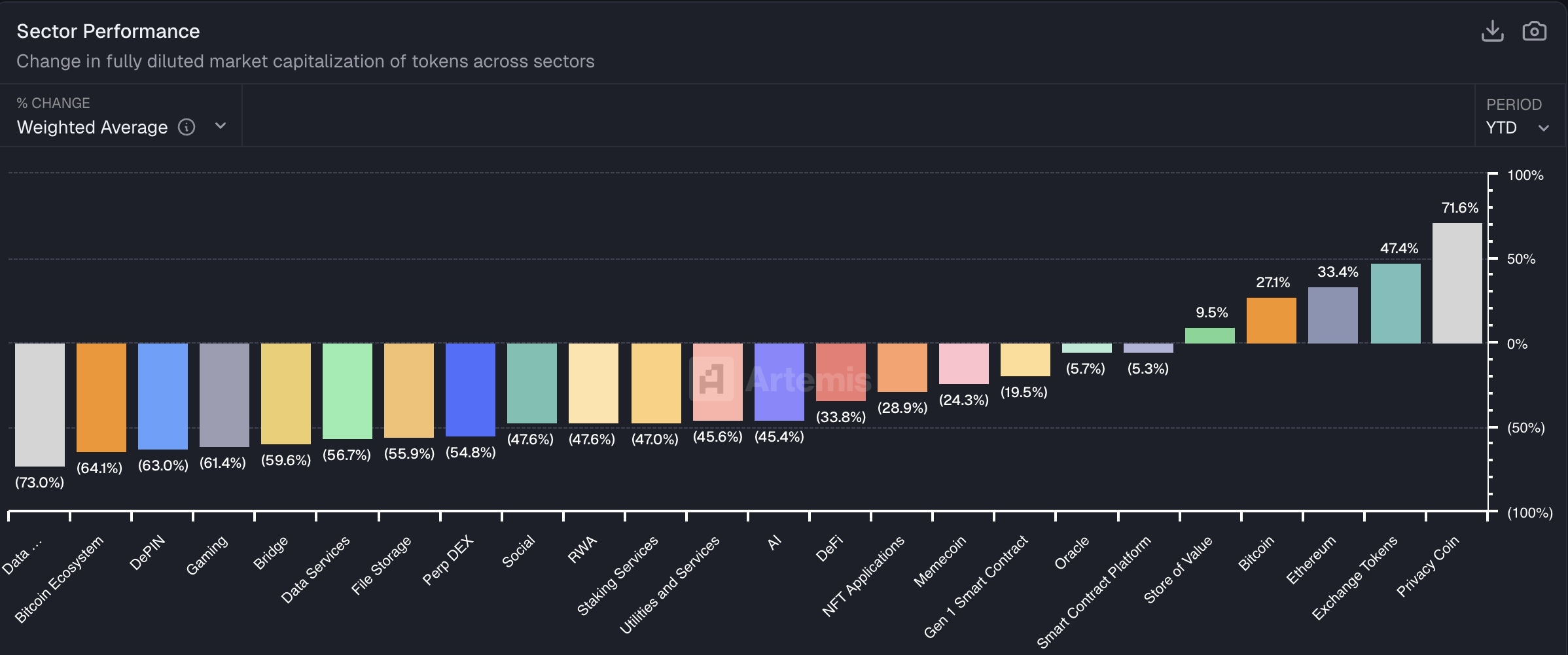
Производительность монет конфиденциальности
Производительность монет конфиденциальности. Источник: Artemis

Для сравнения, биткоин вырос на 27,1%. Ethereum, токены бирж и активы-хранилища ценности подорожали на 33,4%, 47,4% и 9,5% соответственно. В то же время другие сектора понесли убытки.

Zcash возглавляет ралли приватных монет в 2025 году

Интерес розничных инвесторов к монетам конфиденциальности все еще существует. Последние ралли ведущих токенов показывают, что импульс усилился.

Например, Zcash (ZEC) стал лидером, взлетев более чем на 150% за последнюю неделю. Альткоин достиг трехлетнего максимума с месячной доходностью в 247%.

Bitcoin is insurance against fiat.

ZCash is insurance against Bitcoin. https://t.co/rqMrR3bW7O

— Naval (@naval) October 1, 2025

Катализатором стал запуск Grayscale Zcash Trust, который позволил аккредитованным инвесторам получить доступ к активу без прямого владения токенами, что увеличило спрос. На момент написания приватная монета торговалась по $146,65 с ростом на 0,918% за последние сутки.
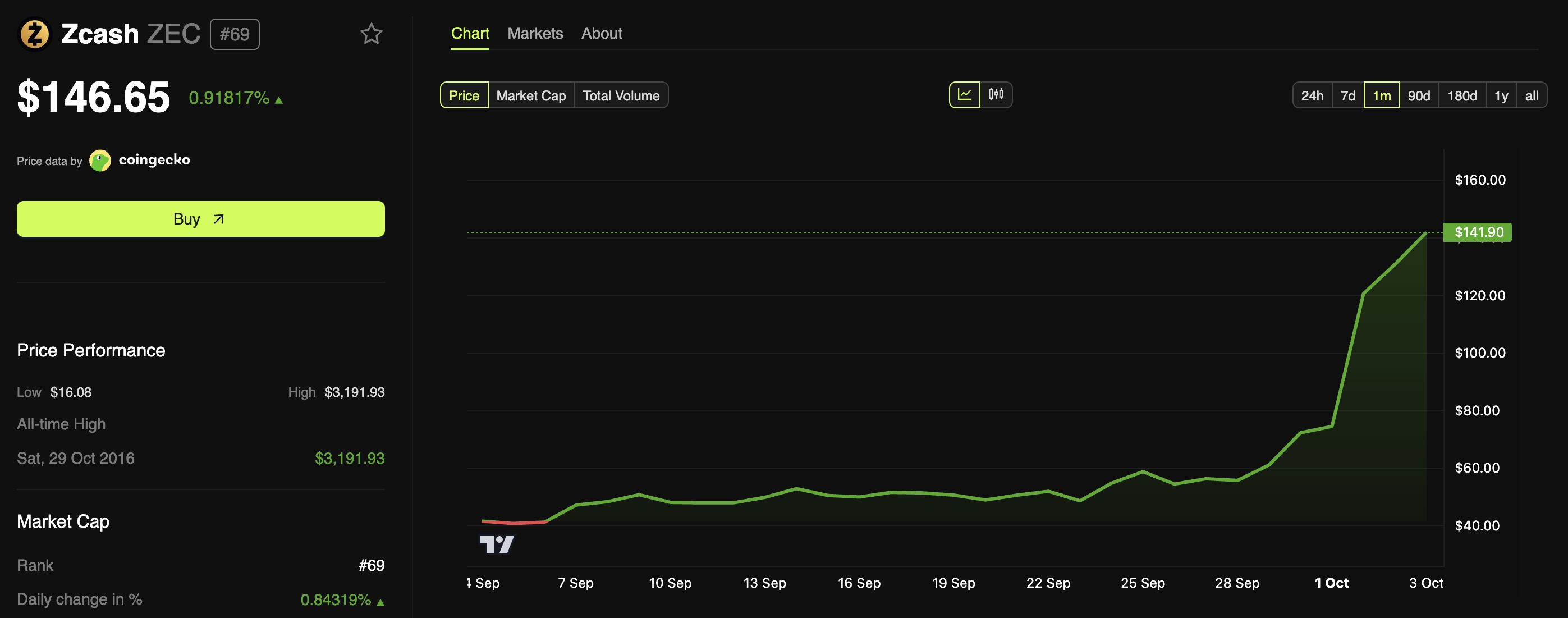
Динамика цены Zcash (ZEC). Источник: BeInCrypto Markets

Тем временем, Monero (XMR), лидер сектора с рыночной капитализацией около $6,1 млрд, также показал хорошие результаты. За последнюю неделю монета выросла почти на 14%, что меньше, чем у ZEC, но все же превосходит общие показатели крипторынка.

CryptoRank отметил, что недавний рост приватных монет связан с несколькими факторами. Одним из них является ротация капитала, часто наблюдаемая на крипторынках.

Существует мнение, что приватные токены часто показывают более сильный рост на поздних стадиях рыночного цикла. Ужесточение регулирования и ускорение внедрения технологий привлекают внимание к приватности как к потенциальной теме роста.

«Приватные монеты не только растут на пиках циклов. Данные показывают, что они развиваются на разных стадиях — XMR и ZEC, движущиеся в унисон с BTC, это доказывают», — добавил CryptoRank.
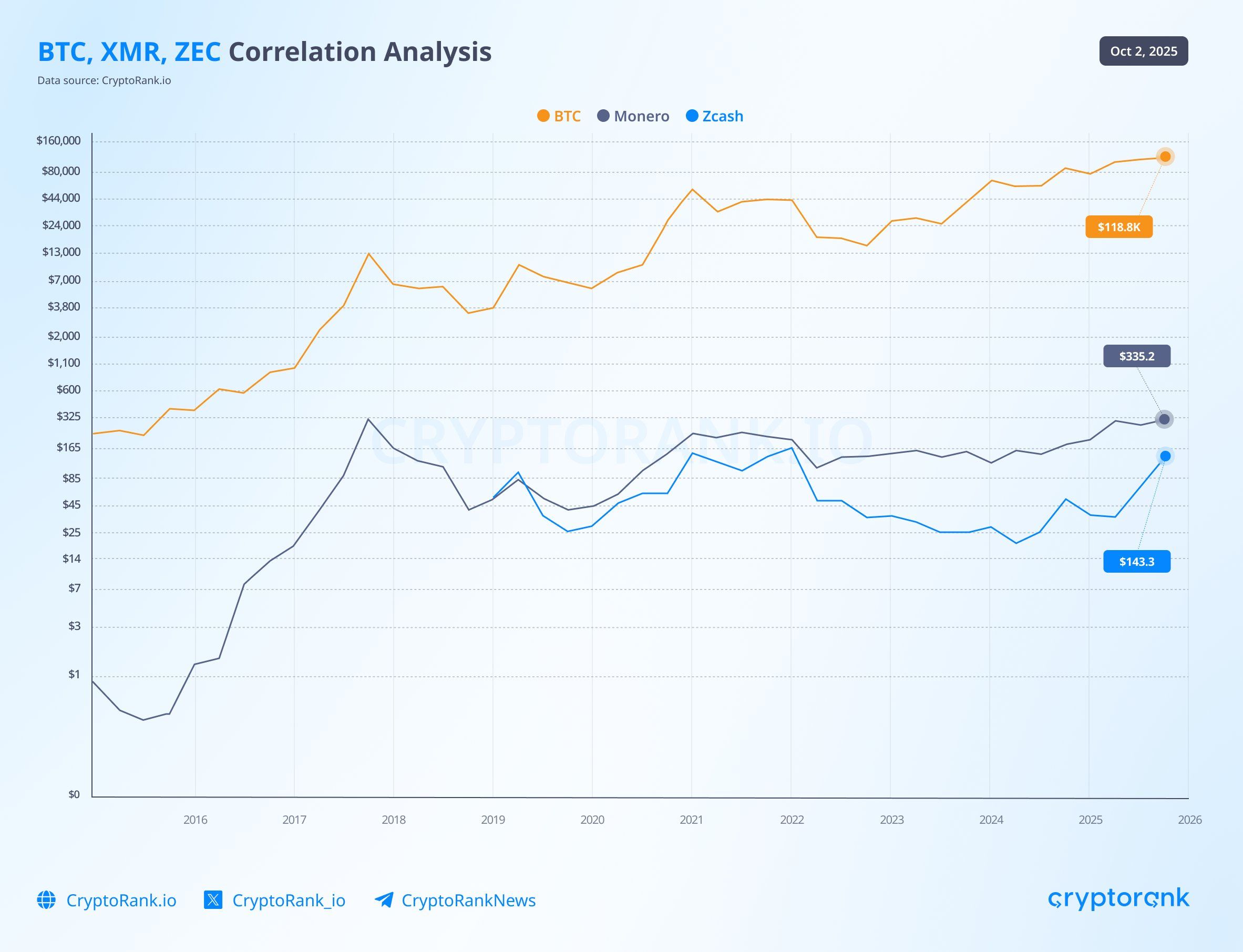
Корреляция XMR, ZEC и BTC
Корреляция XMR, ZEC и BTC. Источник: X/CryptoRank_io

Таким образом, с нарастающим импульсом, приватные токены занимают центральное место в текущем бычьем рынке.


Trending Cryptos

Related Reads

After Aave's Exit and TVL's Sharp Fluctuation, Where Does MegaETH's Valuation Anchor Lie?

Following the withdrawal of Aave and a sharp drop in its Total Value Locked (TVL), the valuation of the high-performance DeFi blockchain MegaETH faces scrutiny. Once a highly anticipated project with a fully diluted valuation (FDV) reaching around $2 billion, MegaETH saw its TVL plummet from a May peak of $245 million to just over $30 million in July, a roughly 70% decline. Its native token, MEGA, currently trades around $0.048 with a market cap of approximately $54 million and an FDV of about $480 million. The report identifies a core vulnerability: MegaETH's TVL was heavily dependent on a single protocol, Aave V3, which at its peak contributed around 90% of the chain's TVL. A significant portion of this capital is attributed to leveraged yield-farming strategies involving stablecoins like USDe. When the profitability of these strategies diminished, capital rapidly exited, exposing the lack of diversified, sustainable activity. Three key mismatches between MegaETH's valuation and its fundamentals are highlighted: 1. **Valuation vs. Real Usage:** With an FDV of ~$4.8B but only ~$1M in annualized protocol revenue and ~2,600 daily active addresses, the valuation appears disconnected from current economic activity. 2. **Token Narrative vs. Ecosystem Reality:** Despite its DeFi narrative, nearly 80% of the chain's recent protocol revenue comes from a trading card game, Monster, not from core DeFi applications like Aave. The chain's native stablecoin, USDM, also shows low trading volume and a declining market cap. 3. **Short-Term Hype vs. Long-Term Delivery:** Initial hype from token generation, blue-chip integrations, and influencer support has faded. Major protocols like Uniswap now hold minimal TVL on the chain, indicating that early capital was largely transient and driven by incentives rather than organic demand. The situation reflects a broader market trend where investors are becoming less tolerant of valuations based on inflated TVL and narrative, demanding clearer evidence of sustainable transactions, revenue, and ecosystem development. While MEGA's price may experience short-term rebounds from market sentiment, a fundamental re-rating likely depends on the team's ability to convert its remaining resources into tangible, user-retaining applications and genuine ecosystem growth.

链捕手4h ago

After Aave's Exit and TVL's Sharp Fluctuation, Where Does MegaETH's Valuation Anchor Lie?

链捕手4h ago

Goldman Sachs In-Depth Report: Who Will Be the Long-Term Winners in China's AI Large Model Industry?

Goldman Sachs Report: China's AI Models at an Inflection Point China's open-source/open-weight large language models (LLMs) have reached performance parity with top global proprietary models, according to a Goldman Sachs report. This is driven by architectural innovations and higher parameter efficiency, allowing Chinese models to achieve comparable capabilities at 2%-10% the parameter size and significantly lower cost. The market is evolving into a two-tiered structure: a high-end segment (e.g., GLM5.2, Qwen3.7 Max) with premium pricing and a low-end, price-sensitive segment for global SMEs and individual users. Key points: * **Cost & Performance:** Innovations like Mixture of Experts (MoE) enable high performance with smaller models. Projects like Meituan's LongCat 2.0, trained on domestic hardware, highlight progress in tech self-sufficiency. * **Open-Source Strategy:** Most Chinese players use open-source/open-weight models for flexibility and ecosystem growth. However, Goldman notes this may underreport actual deployment and revenue. A shift toward "open-weight + community license" models with revenue sharing (e.g., MiniMax) could improve monetization. * **Market Shift & Global Expansion:** Enterprise AI adoption is shifting from "token maximization" to "ROI-first." International expansion, especially in non-US markets, is a major growth driver. Chinese models are increasingly available on global platforms like AWS Bedrock and Microsoft Copilot. * **Competitive Landscape:** Using a framework based on pricing power, cost advantage, and financial strength, Goldman identifies **Zhipu AI and DeepSeek** as the strongest in foundational text models, and **ByteDance** as the leader in multimodal/video generation. The report maintains Buy ratings on MiniMax and Kuaishou. * **Market Growth:** China's AI model API and subscription revenue is projected to grow from an estimated ¥35 billion in 2026 to ¥879 billion by 2030.

marsbit4h ago

Goldman Sachs In-Depth Report: Who Will Be the Long-Term Winners in China's AI Large Model Industry?

marsbit4h ago

Goldman Sachs Deep Dive Report: Who Will Become the Long-Term Winners in China's AI Large Model Industry?

Goldman Sachs Report: Who Will Be the Long-Term Winners in China's AI Large Model Industry? China's AI large model sector is at a historic inflection point. Goldman Sachs argues that the intelligence of Chinese open-source/open-weight models is approaching top global proprietary models. Rapid adoption by domestic enterprises and global SMEs is creating a data flywheel effect that will further drive model iteration. The evolution is summarized as moving from "DeepSeek's cost-efficiency moment last year to GLM's model-intelligence moment this year." Chinese models achieve near-state-of-the-art performance at significantly lower cost, primarily due to architectural innovations like Mixture of Experts (MoE) and higher parameter efficiency. Models like DeepSeek V4 Pro (1.6T params), GLM5.2 (0.7T), and MiniMax M3 (0.4T) are much smaller than global leaders. Recent advancements in coding capability are attributed to better data curation and RLHF. Landmarks like Meituan's LongCat 2.0, trained fully on domestic AI chips, demonstrate progress in hardware stack independence. The market is forming a "two-tiered structure." The high-end tier (e.g., GLM5.2, Alibaba's Qwen3.7 Max) prices around $1 per million tokens, about 10-25% of US top models, with estimated inference gross margins of 10-20%. The low-end tier (priced as low as $0.06-$0.2 per million tokens) targets price-sensitive global SMEs and individuals. MiniMax derives 60-70% of revenue overseas. Goldman forecasts China's AI model API/subscription revenue to grow from an estimated RMB 35bn in 2026 to RMB 879bn by 2030. Most Chinese players adopt open-source/open-weight strategies for deployment flexibility and community feedback, though this limits monetization as deployments on third-party platforms (e.g., Alibaba Cloud) may not generate direct revenue. A shift towards "open-weight + community license" models with revenue-sharing agreements (like MiniMax's approach) could improve unit economics. International expansion, particularly in non-US markets, is the key growth driver. The global enterprise AI paradigm is shifting from "token maximization" to "ROI prioritization." Chinese models are already hosted on major global platforms like AWS Bedrock and are under consideration for integration into Microsoft Copilot. Using a competitive framework based on pricing power, cost advantage, and financial strength, Goldman identifies the strongest players: In foundational text models, Zhipu AI (initiated coverage) and DeepSeek lead. In multimodal/video generation, ByteDance's Seed is the frontrunner, with Kuaishou's Kling and MiniMax's Hailuo also well-positioned. Goldman maintains a Buy rating on MiniMax, citing its attractive valuation.

链捕手4h ago

Goldman Sachs Deep Dive Report: Who Will Become the Long-Term Winners in China's AI Large Model Industry?

链捕手4h ago

Trading

Spot

Hot Articles

Discussions

Welcome to the HTX Community. Here, you can stay informed about the latest platform developments and gain access to professional market insights. Users' opinions on the price of ETH (ETH) are presented below.

活动图片