Инвестор Machi Big Brother потерял $53 млн на позиции в токене XPL

cryptonews.ruPublished on 2025-06-02Last updated on 2025-10-03

Тайваньская музыкальная знаменитость и известный инвестор в цифровые активы Джеффри Хуан, также известный как Machi Big Brother, столкнулся с нереализованным убытком почти в $9 млн на своем счете Hyperliquid.

Адрес «0x020c», связанный с Хуаном, который также является популярным коллекционером Bored Ape Yacht Club, приближается к нереализованному убытку в размере $9 млн на децентрализованной бирже Hyperliquid (HYPE).

Согласно данным блокчейна Hyperdash, всего 13 дней назад прибыль составляла около $44 млн, а сейчас у знаменитости есть нереализованный убыток в размере $8,7 млн по длинной позиции с 5-кратным плечом. Позиция предполагает ставку на рост цены токена Plasma (XPL). Порог ликвидации позиции составляет $0,5366.

Несмотря на резкое падение, Хуан сохранил сделку, которая уже обошлась ему более чем в $115 000 на финансирование. Он также открыл длинную позицию по Ethereum с 15-кратным кредитным плечом и стоимостью финансирования $1,2 млн. В настоящее время нереализованная прибыль составляет около $534 000, а уровень ликвидации установлен на уровне $3836.
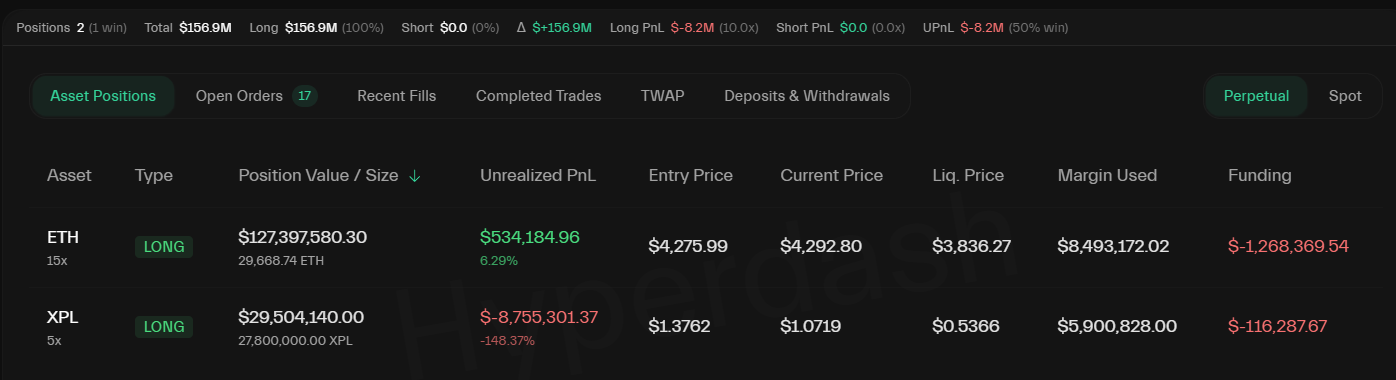

Кошелек «0x020». Источник: Hyperdash.

Нереализованный убыток стал серьезным ударом для инвестора, поскольку всего 13 дней назад его счет показывал прибыль более $44 млн, согласно данным блокчейн-платформы OnChain Lens, опубликованным в среду.

Несмотря на убыточную позицию, счет Хуана по-прежнему остается прибыльным, с общей совокупной прибылью более $11,6 млн.
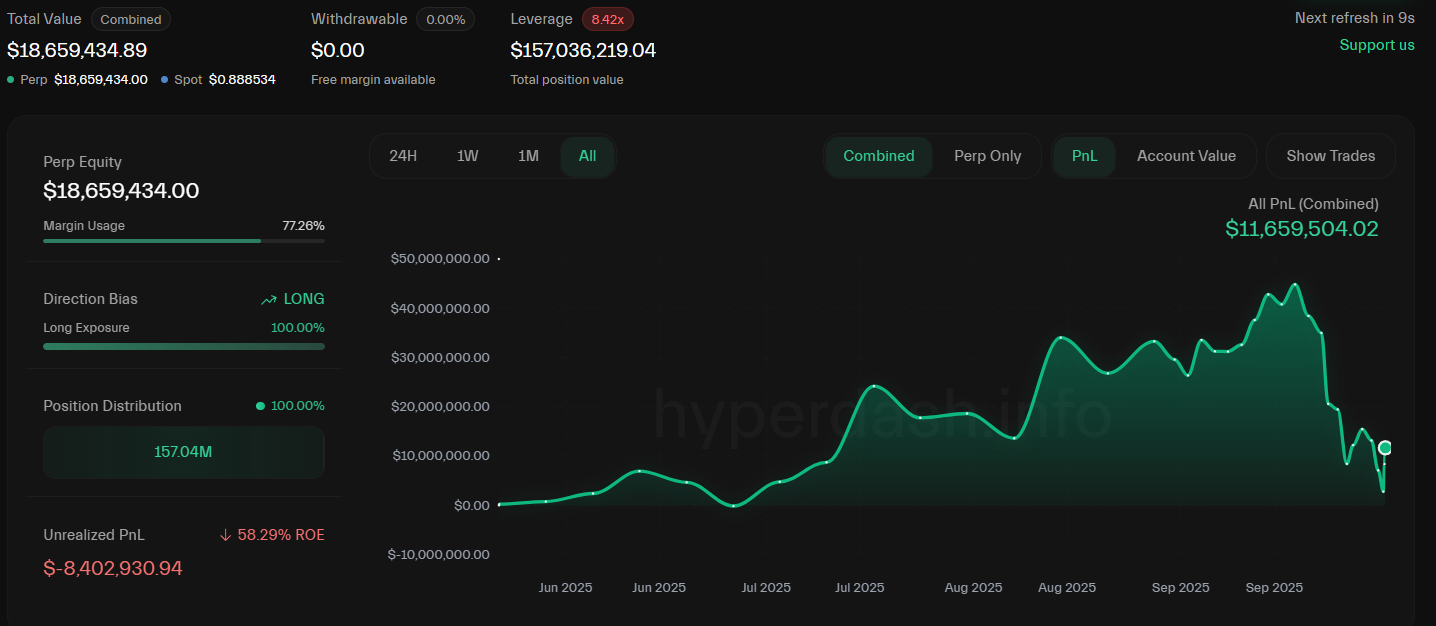

Кошелек «0x020». Источник: Hyperdash

Это событие произошло через неделю после того, как 29 сентября Хуан вышел из своей позиции Hyperliquid на $25 млн с убытком в $4,45 млн. Это произошло после того, как семейный фонд Maelstrom и соучредитель BitMEX Артур Хейс выпустили предупреждение о приближающемся выпуске токенов HYPE, который станет для токена «первым настоящим испытанием» 29 ноября, когда начнется 24-месячный график вестинга.

Киты делают ставку на восстановление цены токена Plasma

Другие киты, или крупные криптовалютные инвесторы, также делают ставку на восстановление цены токена Plasma.

По данным платформы криптоаналитики Nansen, за последнюю неделю чистые запасы токенов XPL в 226 кошельках увеличились более чем на $1,16 млн, в то время как за тот же период с бирж ушли токены XPL на сумму $3,83 млн.
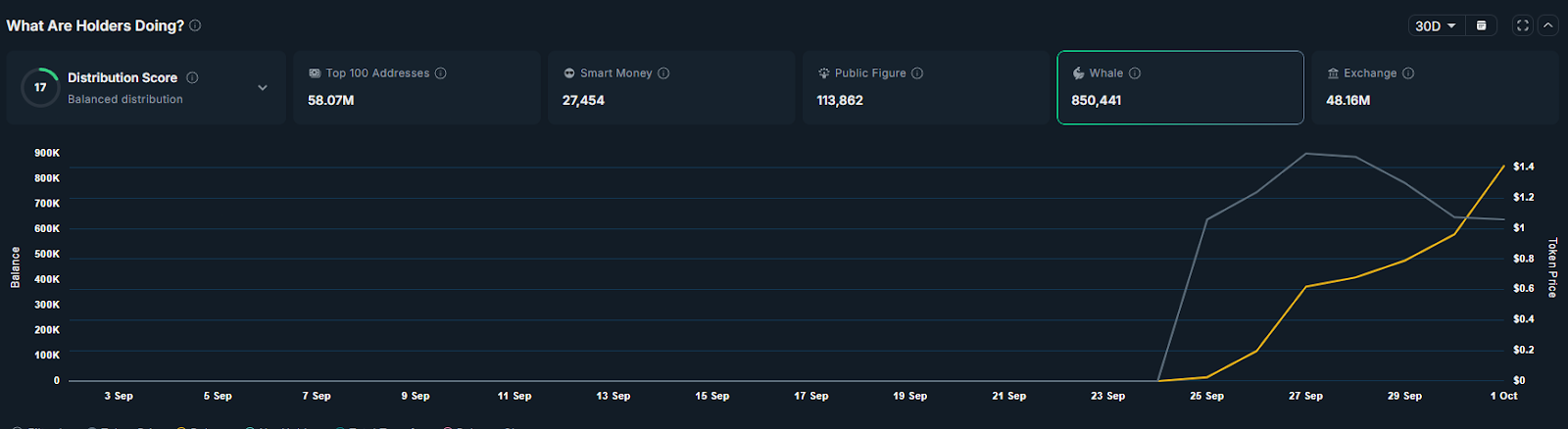

Китовые кошельки с XPL, 30-дневный график. Источник: Nansen

Ранее в среду кошелек-кит «0xd80D» также приобрел токены XPL на сумму $31 млн на Hyperliquid, достигнув общей суммы в $40,2 млн, согласно субботнему посту блокчейн-платформы Lookonchain.
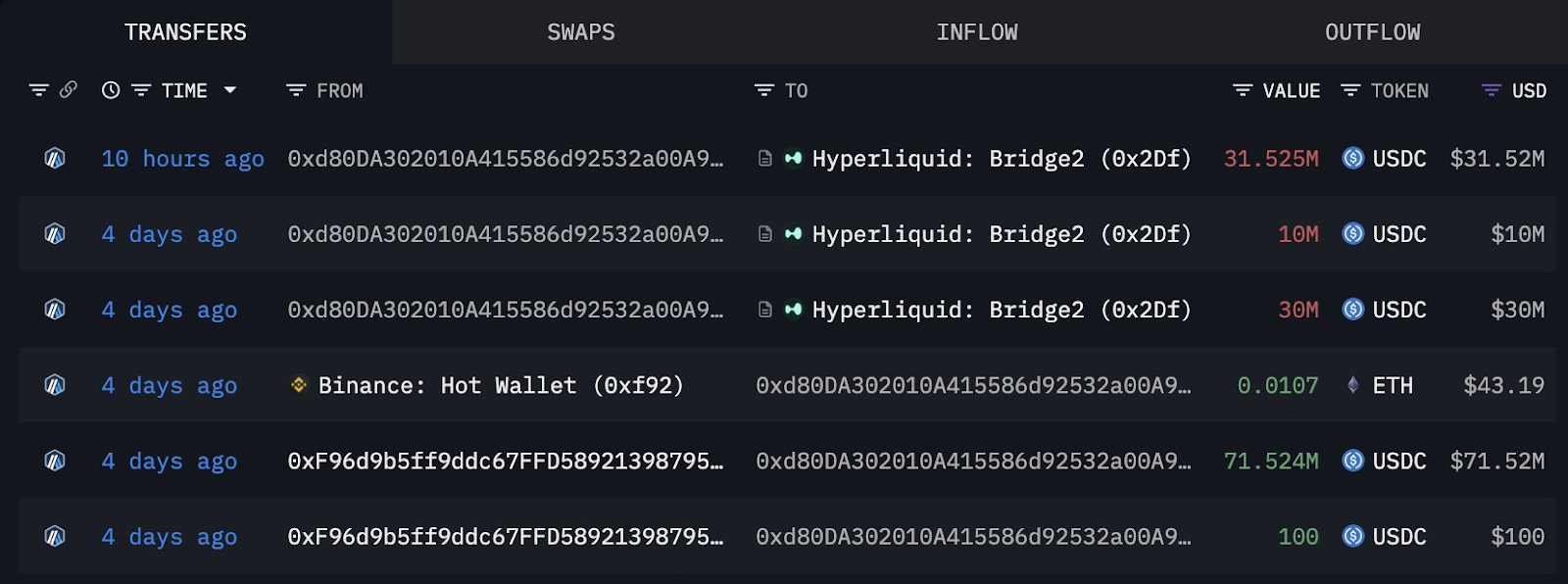

Транзакции с XPL на Hyperliquid. Источник: Lookonchain.

Однако график вестинга Plasma должен разблокировать токены XPL на сумму $90 млн 25 октября, что грозит усилением давления на продажу, поскольку это третья по величине разблокировка токенов за месяц, согласно данным CryptoRank.


Trending Cryptos

Related Reads

Trading

Spot

Hot Articles

What is PLASMA

Plasma: A Cutting-Edge Solution for Blockchain Scalability Introduction to Plasma As the cryptocurrency landscape evolves, there is an increasing need for enhanced efficiency within blockchain networks. Plasma, a Layer 2 scaling solution, emerges as a pioneering player in this area, particularly in the sphere of Web3 development. By strategically shifting a significant portion of tasks from the main chain to a series of smaller chains, Plasma aims to significantly enhance the scalability and performance of Ethereum—a widely-used blockchain platform that is at the forefront of decentralised applications. What is Plasma? Plasma is an innovative off-chain scaling solution specifically designed for the Ethereum blockchain. It was introduced in August 2017 by Vitalik Buterin, co-founder of Ethereum, and Joseph Poon, a prominent advocate of scaling solutions like the Lightning Network. Plasma serves as a framework that enables the creation of scalable applications by establishing a hierarchical structure of child chains that sit above the main Ethereum chain. At its core, Plasma facilitates the development of potentially unlimited side chains that can operate independently while still relying on the Ethereum network for security and consensus. This architecture is supported by smart contracts and Merkle Trees, which efficiently manage transactions and data storage. Core Objectives of Plasma The primary goal of Plasma is to increase the throughput of the Ethereum network. By diverting a significant volume of transactions away from the congested main chain, Plasma's architecture offers higher transaction speeds, more efficient data processing, and lower transaction costs. This is particularly crucial in an age where the demand for decentralised applications—especially in finance, gaming, and supply chain management—is reaching unprecedented levels. Creator of Plasma Plasma is the brainchild of two renowned figures in the blockchain community: Vitalik Buterin and Joseph Poon. Buterin is celebrated primarily for co-founding Ethereum and pushing the boundaries of what blockchain technology can achieve. Poon, on the other hand, is known for advocating scalable solutions that enable faster and more cost-effective transactions on blockchain networks. Their collaboration on the Plasma framework has significantly contributed to its innovative nature, merging advanced technical insights with practical applications. Investors of Plasma While the specific investment foundations or organisations supporting Plasma remain undisclosed, the project has attracted interest from various prominent figures and players in the blockchain and cryptocurrency space. With its potential for enhancing scalability within Ethereum, it has captured the attention of various entities aiming to push the boundaries of blockchain technology. How Does Plasma Work? Plasma's unique functionality stems from its architectural framework that relies on child chains and their interaction with the main Ethereum network. Below are some key factors that contribute to Plasma's innovative approach: Child Chains: Plasma establishes numerous child chains that can execute transactions independently of the main Ethereum chain. Each child chain operates as a separate smart contract with unique features, allowing developers to create tailored solutions based on their specific requirements. Smart Contracts and Merkle Trees: The framework utilises smart contracts, which are self-executing agreements with predefined conditions, combined with Merkle Trees that enable efficient verification of data. This technology allows Plasma to achieve both high scalability and security. Transaction Compression: By batching transactions on the child chains, Plasma reduces the data load on the Ethereum network. This implies that fewer transactions need to be recorded on the main chain—thereby freeing up space and alleviating congestion. Enhanced Security: Despite being off-chain, Plasma leverages the security measures of the main Ethereum network, ensuring that all transactions on child chains maintain a high level of integrity and security. Timeline of Plasma Understanding the development of Plasma involves tracing its significant milestones: August 2017: Plasma was first introduced by Vitalik Buterin and Joseph Poon as a scalable solution to address Ethereum's performance challenges. 2018: The Plasma framework was officially developed and made available on GitHub, marking a crucial step towards its implementation in practical applications. 2019: As awareness about Plasma grew, it began to attract developers interested in scaling Ethereum applications, thus increasing its adoption. 2020: Plasma continued evolving, with substantial enhancements made to its architecture and functionality—making it even more appealing to developers. Key Features of Plasma Plasma boasts several characteristics that position it as a transformative solution in the blockchain space: Scalability: By creating multiple child chains, Plasma can handle a higher volume of transactions without placing further strain on the main Ethereum chain. Speed: Each child chain can process transactions more rapidly, providing users with a better experience and service. Lower Transaction Costs: Plasma's structure effectively reduces the costs associated with transactions by minimising the burden on the main chain. Interoperability: The architecture allows Plasma to seamlessly interact with multiple blockchains, enhancing cross-network functionality. Security: By harnessing the security of Ethereum’s main chain, Plasma ensures the integrity of its operations while using its child chains. Use Cases for Plasma The innovative architecture of Plasma opens the door for various practical applications across different sectors: Decentralised Finance (DeFi): Plasma has the capacity to enhance the scalability and efficiency of DeFi applications, creating smoother and more effective trading processes. Gaming: The framework facilitates the development of quick and cost-efficient gaming experiences, making it appealing to developers in the gaming industry. Supply Chain Management: With the ability to achieve efficient transaction processing, Plasma can promote the development of decentralised supply chain management solutions. Conclusion Plasma stands at the forefront of blockchain technology, positioned as a pivotal Layer 2 scaling solution aimed at enhancing the efficiency of the Ethereum network and beyond. Through its unique structure of child chains, smart contracts, and Merkle Trees, Plasma presents a compelling solution to the scalability crisis that has long plagued blockchain networks. As blockchain technology continues to advance, solutions like Plasma promise to reshape how developers approach scalability challenges, potentially revolutionising how decentralised applications function. The ongoing efforts by its creators and the interest of various stakeholders indicate a bright future for Plasma as it seeks to elevate blockchain capabilities to new heights in the digital realm.

309 Total ViewsPublished 2024.12.03Updated 2024.12.03

What is PLASMA

Discussions

Welcome to the HTX Community. Here, you can stay informed about the latest platform developments and gain access to professional market insights. Users' opinions on the price of XPL (XPL) are presented below.

活动图片