两天爆杀7亿空头,比特币“Uptober”强势应验?

比推Published on 2025-10-02Last updated on 2026-08-16

Abstract

似乎正在兑现“十月必涨”的历史规律。

10月刚开头,加密市场便迎来强劲反弹。多项关键指标显示,这个被投资者称为“Uptober”的月份,似乎正在兑现“十月必涨”的历史规律。
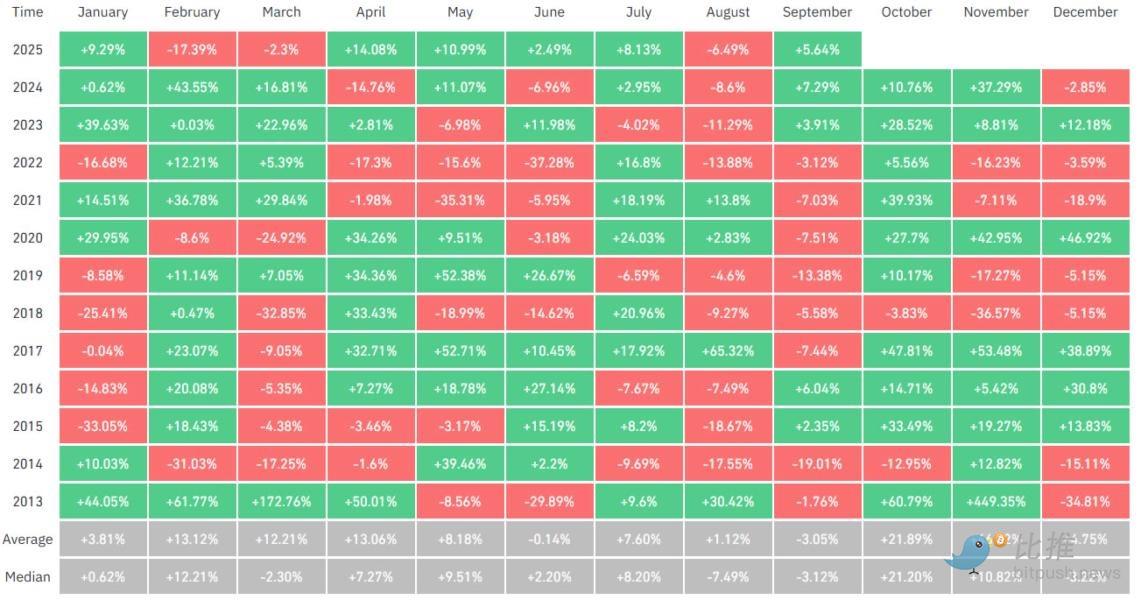
image.png


市场情绪强势反转


10月开局的两天内,加密市场经历了大规模空头爆仓。根据CoinGlass数据,全球共计超过7亿美元的空头仓位被强制平仓,其中包括一笔在Hyperliquid上达1161万美元的以太坊空单。
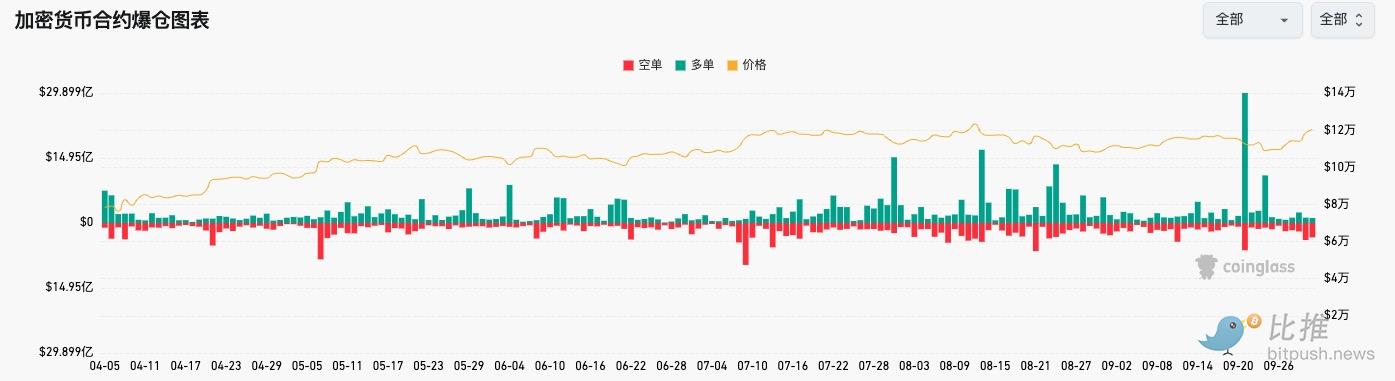
image.png


这一轮轧空行情几乎席卷整个市场,百大加密货币悉数上涨。整体加密货币总市值自9月底以来上涨超过6%,在10月2日突破4.14万亿美元,创下自8月中旬以来的新高。
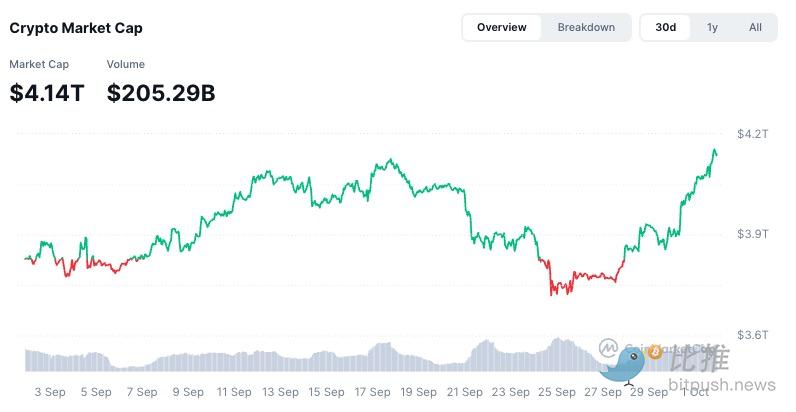
image.png


这波涨势不仅一扫9月的疲软阴霾,也让投资者重新燃起了对年末行情的期待。


作为风向标的比特币(BTC)领衔本轮反弹,过去四天涨幅高达10.3%,现报12.05万美元,创下40天新高。
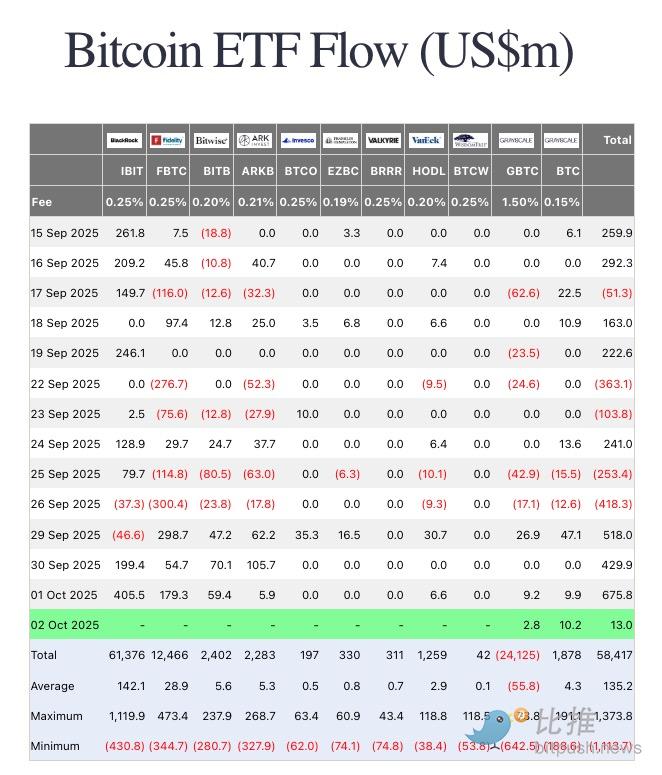
image.png


与此同时,比特币ETF资金流入创下9月中旬以来的最高纪录。根据Farside Investors数据:

  • 比特币ETF在周三吸引6.758亿美元净流入;
  • 其中,贝莱德(BlackRock)的IBIT基金单日吸金4.055亿美元;
  • 富达(Fidelity)的FBTC基金吸引1.793亿美元;
  • Bitwise的BITB基金则吸引了5940万美元。

值得注意的是,这是连续第三个交易日比特币ETF日流入超1亿美元。仅本周前三天,累计流入金额已超过16亿美元,而在9月26日,市场还曾单日流出4.18亿美元。


降息预期升温,资金从“避险”转向“增值”


最新的ADP非农就业数据显示,美国9月就业岗位减少3.2万个,大幅低于市场预期的+5.2万。就业疲软被视为经济放缓的信号,也让市场普遍预期美联储将在10月29日的FOMC会议上再次降息。当前CME FedWatch工具显示美联储10月降息25个基点的概率为97.3%。
这意味着全球流动性环境有望进一步宽松,而“降息预期 + 美债收益率下行 + 美元走弱”的组合,正是比特币和黄金等资产走强的完美土壤。


WisdomTree数字资产研究主管Dovile Silenskyte表示:“比特币兼具‘避险属性’与‘成长资产潜力’,既像黄金一样抵御通胀,又像科技股一样具备成长性。”


链上数据:长期持币者卖压减弱,底部区间正在形成


根据Glassnode数据,短期持币者实现价值比(STH-RVT)自5月以来持续收缩,表明短线投机行为降温,市场进入“健康积累期”。


与此同时,长期持币者净仓位变化(LTH Net Position Change)转为中性区间,意味着大规模获利了结潮已接近尾声。


这两项数据共同指向一个结论:比特币正在$11.5万至$12万区间构筑新的结构性支撑,类似于今年3-4月的盘整阶段。
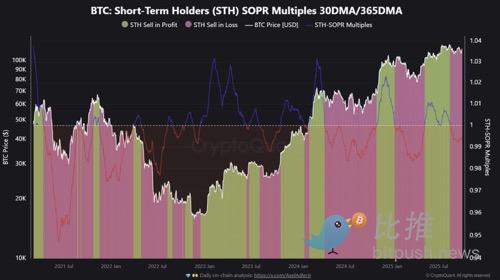
image.png


若当前供需结构维持稳定,市场极有可能在10月中旬迎来突破性行情


摩根大通喊单:比特币或指向16.5万美元


摩根大通最新报告指出,比特币目前相对黄金被严重低估。

报告测算:按波动率调整后的估值,比特币应有约42%的上行空间;这意味着其理论价格应在16.5万美元左右;若与黄金ETF、实物金投资持平,比特币总市值将达到约3.3万亿美元。


报告作者、摩根大通董事总经理Nikolaos Panigirtzoglou指出:“自2024年底以来,估值缺口已从比特币高估3.6万美元,转为低估4.6万美元。”
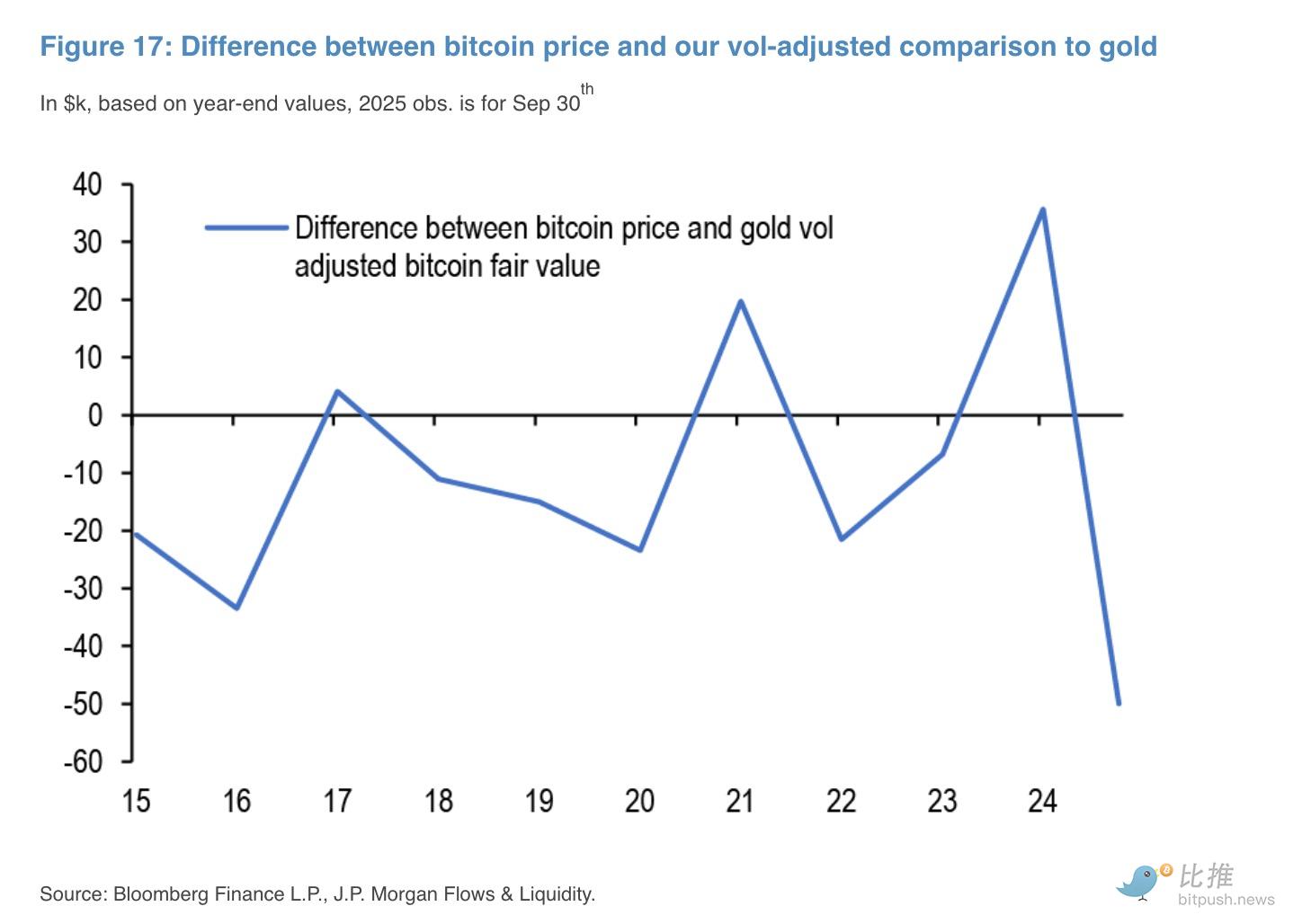
image.png


换言之,投资者正在重新拥抱“货币贬值交易”(Debasement Trade)——面对财政赤字、通胀与地缘风险,他们将资金投入黄金与比特币等稀缺资产。如果历史规律延续,十月行情往往是全年最具延续性的上涨窗口。随着供给侧压力缓解、资金回流与政策拐点叠加,比特币或正蓄势冲击16万至20万美元的新目标区间。


Trending Cryptos

Related Reads

Upbit is Anxious: A Hasty Counterattack Aimed at Regaining Stablecoin Market Share

Title: Upbit's Rushed Counterattack to Reclaim Stablecoin Market Share Facing a dramatic shift in South Korea's stablecoin market, leading exchange Upbit launched a promotional campaign from July 26 to August 9, waiving the 0.05% trading fee for stablecoins paired with the Korean Won (KRW) and rapidly listing new stablecoins like RLUSD and USDG. This move is a direct response to its plummeting market share in this sector. Historically a duopoly with Bithumb, the market has been reshaped since October 2025 when Coinone permanently removed fees for USDC trading. By June 2026, Coinone led with 34.8% of stablecoin volume, followed by Bithumb (31.1%) and Upbit (30.1%). This contrasts sharply with the overall crypto market, where Upbit commands 60%. The data shows stablecoin demand is highly sensitive to fees, as users primarily buy them to transfer capital overseas for derivatives trading or forex arbitrage. South Korean exchanges have seen a net outflow of stablecoins for 18 consecutive months, totaling approximately 14.9 trillion KRW, underscoring their role as a cross-border capital conduit. Upbit's limited-time promotion initially boosted its daily stablecoin volume by 162%, but the surge was almost entirely in USDT (98.1% of volume). The newly listed stablecoins saw negligible, fleeting interest. Furthermore, the promotional effect quickly waned in the second week, with volume dropping 33% on weekdays. A concurrent weakening of the KRW also contributed to the trading spike, independent of the fee waiver. The analysis suggests that once the promotion ends, Upbit is unlikely to retain its temporary gains unless it matches Coinone's permanent zero-fee policy, forcing a choice between market share and fee revenue. Upbit's strategic push may be less about immediate profit and more about preparing for future regulatory shifts. With South Korea's *Digital Asset Basic Act* on the horizon, which will regulate KRW-backed stablecoins, and following Dunamu's (Upbit's parent) integration into Naver Financial to build a payment ecosystem, securing a dominant position in the dollar stablecoin distribution channel holds long-term strategic value. However, potential regulatory conflicts could prevent Upbit from listing a future Naver-issued KRW stablecoin, making the current fight for dollar stablecoin flow even more critical.

marsbit8h ago

Upbit is Anxious: A Hasty Counterattack Aimed at Regaining Stablecoin Market Share

marsbit8h ago

Trading

Spot

Hot Articles

What is $BITCOIN

DIGITAL GOLD ($BITCOIN): A Comprehensive Analysis Introduction to DIGITAL GOLD ($BITCOIN) DIGITAL GOLD ($BITCOIN) is a blockchain-based project operating on the Solana network, which aims to combine the characteristics of traditional precious metals with the innovation of decentralized technologies. While it shares a name with Bitcoin, often referred to as “digital gold” due to its perception as a store of value, DIGITAL GOLD is a separate token designed to create a unique ecosystem within the Web3 landscape. Its goal is to position itself as a viable alternative digital asset, although specifics regarding its applications and functionalities are still developing. What is DIGITAL GOLD ($BITCOIN)? DIGITAL GOLD ($BITCOIN) is a cryptocurrency token explicitly designed for use on the Solana blockchain. In contrast to Bitcoin, which provides a widely recognized value storage role, this token appears to focus on broader applications and characteristics. Notable aspects include: Blockchain Infrastructure: The token is built on the Solana blockchain, known for its capacity to handle high-speed and low-cost transactions. Supply Dynamics: DIGITAL GOLD has a maximum supply capped at 100 quadrillion tokens (100P $BITCOIN), although details regarding its circulating supply are currently undisclosed. Utility: While precise functionalities are not explicitly outlined, there are indications that the token could be utilized for various applications, potentially involving decentralized applications (dApps) or asset tokenization strategies. Who is the Creator of DIGITAL GOLD ($BITCOIN)? At present, the identity of the creators and development team behind DIGITAL GOLD ($BITCOIN) remains unknown. This situation is typical among many innovative projects within the blockchain space, particularly those aligning with decentralized finance and meme coin phenomena. While such anonymity may foster a community-driven culture, it intensifies concerns about governance and accountability. Who are the Investors of DIGITAL GOLD ($BITCOIN)? The available information indicates that DIGITAL GOLD ($BITCOIN) does not have any known institutional backers or prominent venture capital investments. The project seems to operate on a peer-to-peer model focused on community support and adoption rather than traditional funding routes. Its activity and liquidity are primarily situated on decentralized exchanges (DEXs), such as PumpSwap, rather than established centralized trading platforms, further highlighting its grassroots approach. How DIGITAL GOLD ($BITCOIN) Works The operational mechanics of DIGITAL GOLD ($BITCOIN) can be elaborated on based on its blockchain design and network attributes: Consensus Mechanism: By leveraging Solana’s unique proof-of-history (PoH) combined with a proof-of-stake (PoS) model, the project ensures efficient transaction validation contributing to the network's high performance. Tokenomics: While specific deflationary mechanisms have not been extensively detailed, the vast maximum token supply implies that it may cater to microtransactions or niche use cases that are still to be defined. Interoperability: There exists the potential for integration with Solana’s broader ecosystem, including various decentralized finance (DeFi) platforms. However, the details regarding specific integrations remain unspecified. Timeline of Key Events Here is a timeline that highlights significant milestones concerning DIGITAL GOLD ($BITCOIN): 2023: The initial deployment of the token occurs on the Solana blockchain, marked by its contract address. 2024: DIGITAL GOLD gains visibility as it becomes available for trading on decentralized exchanges like PumpSwap, allowing users to trade it against SOL. 2025: The project witnesses sporadic trading activity and potential interest in community-led engagements, although no noteworthy partnerships or technical advancements have been documented as of yet. Critical Analysis Strengths Scalability: The underlying Solana infrastructure supports high transaction volumes, which could enhance the utility of $BITCOIN in various transaction scenarios. Accessibility: The potential low trading price per token could attract retail investors, facilitating wider participation due to fractional ownership opportunities. Risks Lack of Transparency: The absence of publicly known backers, developers, or an audit process may yield skepticism regarding the project's sustainability and trustworthiness. Market Volatility: The trading activity is heavily reliant on speculative behavior, which can result in significant price volatility and uncertainty for investors. Conclusion DIGITAL GOLD ($BITCOIN) emerges as an intriguing yet ambiguous project within the rapidly evolving Solana ecosystem. While it attempts to leverage the “digital gold” narrative, its departure from Bitcoin's established role as a store of value underscores the need for a clearer differentiation of its intended utility and governance structure. Future acceptance and adoption will likely depend on addressing the current opacity and defining its operational and economic strategies more explicitly. Note: This report encompasses synthesised information available as of October 2023, and developments may have transpired beyond the research period.

1.9k Total ViewsPublished 2025.05.13Updated 2025.05.13

What is $BITCOIN

Discussions

Welcome to the HTX Community. Here, you can stay informed about the latest platform developments and gain access to professional market insights. Users' opinions on the price of BTC (BTC) are presented below.

活动图片