SWIFT Unveils Blockchain Ledger: 30+ Global Banks Back Push for 24/7 Cross-Border Payments

bitcoinistPublished on 2025-09-30Last updated on 2025-09-30

Abstract

Payments giant SWIFT is developing a blockchain-based ledger with 30+ top banks and Consensys, aiming to enable 24/7 cross-border payments....

Trusted Editorial content, reviewed by leading industry experts and seasoned editors. Ad Disclosure

Payments giant SWIFT is developing a blockchain-based ledger with 30+ top banks and Consensys, aiming to enable 24/7 cross-border payments.

SWIFT Is Working With 30+ Global Financial Institutions On A Blockchain Ledger

As revealed in a press release, SWIFT is planning to add a blockchain-based ledger to its infrastructure stack, in collaboration with a group of more than 30 major financial institutions. SWIFT, short for the Society for Worldwide Interbank Financial Telecommunication, is a Belgium-based cooperative that connects banks around the world with a secure messaging network for initiating international payments.

SWIFT covers more than 11,500 institutions across over 220 countries and territories, and facilitates an estimated $150 trillion in cross-border transactions every year. The payments messaging giant is now taking its infrastructure a step further with the integration of a ledger system based on the blockchain, the same underlying technology that powers cryptocurrencies like Bitcoin.

The goal behind the system is to provide real-time 24/7 cross-border payments. The press release noted that SWIFT has already begun working with major global banks to design and build the ledger, starting with a conceptual prototype by Consensys. Consensys, a blockchain software company founded by Ethereum co-founder Joseph Lubin, is best known as the developer of Metamask and a contributor to major ETH network upgrades.

SWIFT CEO Javier Pérez-Tasso said:

Through this initial ledger concept we are paving the way for financial institutions to take the payments experience to the next level with Swift’s proven and trusted platform at the centre of the industry’s digital transformation.

Currently, banks from 16 countries are providing feedback on the ledger system. Following successful development, SWIFT plans to work with its global community on implementation. Among the major institutions already on board are several Global Systemically Important Banks (G-SIBs), including JPMorgan Chase, Bank of America, and Citigroup.

Gayathri Vasudev, Global Head of Core Payment Rails at JP Morgan, the bank considered the most critical to global economic stability by the Financial Stability Board (FSB), said:

We look forward to engaging with this coalition to help evaluate a shared ledger designed for the next generation of global payments, leveraging our expertise to help advance instant, secure and efficient cross-border payments.

According to the press release, SWIFT will also add interoperability capabilities, allowing banks to seamlessly move between existing fiat rails and emerging systems.

The payments messaging platform added:

These developments are part of Swift’s overall strategy to power a best-in-class payments experience however value moves, with parallel tracks of innovation to upgrade the experience over existing ‘fiat’ rails, as well as to ready the industry for digital finance.

Bitcoin Price Has Made Some Recovery

Bitcoin ended last week with a plummet to lows, but the cryptocurrency appears to have kicked off Monday with another shift as its price has bounced back to $112,300.

Bitcoin Price Chart

The trend in the BTC price over the last five days | Source: BTCUSDT on TradingView

The rebound across Bitcoin and other digital assets has resulted in a significant amount of liquidations for bearish bets on derivatives exchanges.
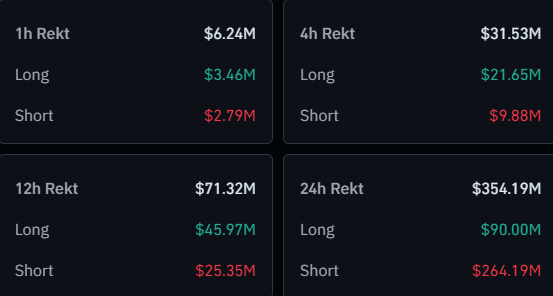
Bitcoin & Crypto Liquidations

The data for the liquidations that occurred over the past day | Source: CoinGlass
Featured image from Dall-E, CoinGlass.com, chart form TradingView.com
Editorial Process for bitcoinist is centered on delivering thoroughly researched, accurate, and unbiased content. We uphold strict sourcing standards, and each page undergoes diligent review by our team of top technology experts and seasoned editors. This process ensures the integrity, relevance, and value of our content for our readers.

Keshav is a Physics graduate who has been employed as a writer with Bitcoinist since June 2021. He is passionate about writing and through the years, he has gained experience working in a variety of niches. Keshav holds an active interest in the cryptocurrency market, with on-chain analysis being an area he particularly likes to research and write about.

Trending Cryptos

Related Reads

Report Interpretation: J.P. Morgan Details Micron's Pre-Earnings Sentiment, Current Hardware Sector Dynamics

Morgan Stanley analyst Joshua Meyers' report (June 21, 2026) highlights key trends in the hardware and semiconductor sector ahead of Micron's earnings. The core takeaways are: 1. **Micron & Memory:** Memory remains a high-conviction long theme, driven by strong AI demand and rising ASPs. However, investor focus is shifting to the sustainability of Micron's >80% gross margins and the specifics of potential new long-term supply agreements (SCAs). 2. **Hardware Supply Chain:** AI-related demand for servers, networking, and storage remains robust, but company performance is diverging. Celestica (CLS) shows improved margin confidence, Western Digital and Seagate benefit from pricing, Fabrinet (FN) sees predictable AI optics growth, and Teradyne (TER) anticipates a new Google customer. 3. **AI Capex & WFE Forecasts:** JPMorgan increased its Wafer Fab Equipment (WFE) market growth forecasts to 28% in 2026 and 29% in 2027. AI infrastructure financing is evolving, with higher project-level debt reducing constraints on capex expansion. The report signals that while the AI-driven hardware cycle is strong, the market is entering a phase focused on execution verification (e.g., Micron's SCA details, Fabrinet's ramp with Amazon) and valuation sustainability. Key near-term signals include Micron's guidance, Arista Networks' outlook, and the pace of demand normalization post potential tariff-related pull-ins.

marsbit4h ago

Report Interpretation: J.P. Morgan Details Micron's Pre-Earnings Sentiment, Current Hardware Sector Dynamics

marsbit4h ago

Research Report Analysis: The Fed's New Chair's Debut – New Leader, But Same Script?

Report Analysis: Federal Reserve's New Chair Debut – A New Captain, But the Same Script? Morgan Stanley's chief global economist Seth B. Carpenter analyzes the first FOMC meeting under new Fed Chair Kevin Warsh in a June 21 report. Warsh deliberately avoided providing forward guidance on interest rates, aligning with his philosophy. However, market expectations for a rate hike this year were reinforced. Key signals lie elsewhere: inflation may fall more than expected, and quantitative tightening (QT) could be more aggressive than anticipated. The FOMC's "dot plot" suggests only one rate hike in 2026. Carpenter argues that if inflation undershoots forecasts, the logic for even a single hike weakens, especially as projections indicate potential rate cuts in 2027. On QT, Warsh's stance is clear. Carpenter notes that measures like halving the Treasury's account balance could shrink the Fed's balance sheet by around $500 billion with minimal market impact. Combined with adjustments to reserve interest and liquidity rules, the ultimate QT scale may exceed expectations, though its market effect might be less disruptive unless the Fed actively sells Mortgage-Backed Securities (MBS). While Warsh initiated a review of the Fed's policy framework, the 2% inflation target remains intact for now. The report concludes that the market may be overestimating the significance of reduced forward guidance and the near-term rate hike risk, while potentially underestimating the scope and manageable nature of the coming balance sheet reduction. The key debates will hinge on upcoming core PCE data, the specifics of the QT path, and the framework review's findings.

marsbit5h ago

Research Report Analysis: The Fed's New Chair's Debut – New Leader, But Same Script?

marsbit5h ago

Critical Game Week: BTC Retracement Confirmation vs. HYPE Support Battle | Guest Analysis

This weekly analysis outlines a critical juncture for BTC and HYPE markets, focusing on key price level confirmations. **BTC Analysis:** BTC is at a pivotal point after a five-wave rally from the June 5th low of $59,100. The price has broken below a short-term rising channel's lower boundary, with the current move seen as a pullback to test this breakdown. Failure to reclaim this level could lead to a retest of the $59,000-$60,000 support zone. The core scenario hinges on this channel retest outcome. * **Key Levels:** Resistance at $64,500-$65,000 (channel boundary) and $69,500-$70,500. Support at $59,000-$60,000 and $55,000. * **Strategy:** A core bearish stance is maintained (20% short from last week), with short-term plans for tactical trades. Three detailed contingency plans (A/B/C) are provided for short positions on resistance tests or breakdowns, emphasizing strict stop-loss discipline. **HYPE Analysis:** HYPE shows strong momentum but is currently in a corrective phase after hitting a new high of $76.94. The price is retesting the crucial $64-$66 support area. * **Key Levels:** Resistance near $77 and $80-$82. Support at $64-$66 and $52-$54. * **Strategy:** The short-term approach is "buy on dips, avoid chasing rallies." A long position is considered only if clear stabilization signals appear at the $64-$66 or deeper $52-$54 support zones, with tight risk controls. **General Risk Management:** A standardized trailing stop-loss protocol is emphasized: set initial stop, breakeven at +1% profit, then trail stops upward to lock in gains. *Disclaimer: All analysis is presented as a personal trading framework, not investment advice. Market conditions are complex and require dynamic adjustment.*

marsbit5h ago

Critical Game Week: BTC Retracement Confirmation vs. HYPE Support Battle | Guest Analysis

marsbit5h ago

Trading

Spot
Futures

Hot Articles

How to Buy PUSH

Welcome to HTX.com! We've made purchasing Push Protocol (PUSH) simple and convenient. Follow our step-by-step guide to embark on your crypto journey.Step 1: Create Your HTX AccountUse your email or phone number to sign up for a free account on HTX. Experience a hassle-free registration journey and unlock all features.Get My AccountStep 2: Go to Buy Crypto and Choose Your Payment MethodCredit/Debit Card: Use your Visa or Mastercard to buy Push Protocol (PUSH) instantly.Balance: Use funds from your HTX account balance to trade seamlessly.Third Parties: We've added popular payment methods such as Google Pay and Apple Pay to enhance convenience.P2P: Trade directly with other users on HTX.Over-the-Counter (OTC): We offer tailor-made services and competitive exchange rates for traders.Step 3: Store Your Push Protocol (PUSH)After purchasing your Push Protocol (PUSH), store it in your HTX account. Alternatively, you can send it elsewhere via blockchain transfer or use it to trade other cryptocurrencies.Step 4: Trade Push Protocol (PUSH)Easily trade Push Protocol (PUSH) on HTX's spot market. Simply access your account, select your trading pair, execute your trades, and monitor in real-time. We offer a user-friendly experience for both beginners and seasoned traders.

3.8k Total ViewsPublished 2024.03.29Updated 2026.06.02

How to Buy PUSH

Discussions

Welcome to the HTX Community. Here, you can stay informed about the latest platform developments and gain access to professional market insights. Users' opinions on the price of PUSH (PUSH) are presented below.

活动图片