Ethereum Eyes $21,000 Target With Double Pattern In Play – Analyst

bitcoinistPublished on 2025-09-28Last updated on 2025-09-28

Abstract

Prominent market analyst with X username PlanD has shared an intriguing bullish projection of the Ethereum (ETH) market. Amid recent...

Trusted Editorial content, reviewed by leading industry experts and seasoned editors. Ad Disclosure

Prominent market analyst with X username PlanD has shared an intriguing bullish projection of the Ethereum (ETH) market. Amid recent losses, which saw the ETH decline by 10.66% over the week, PlanD backs the altcoin market leader to reach a potential $21,000 price target by end of 2025.

Ethereum Ready For Surge As Triangle, Head & Shoulder Pattern Combines 

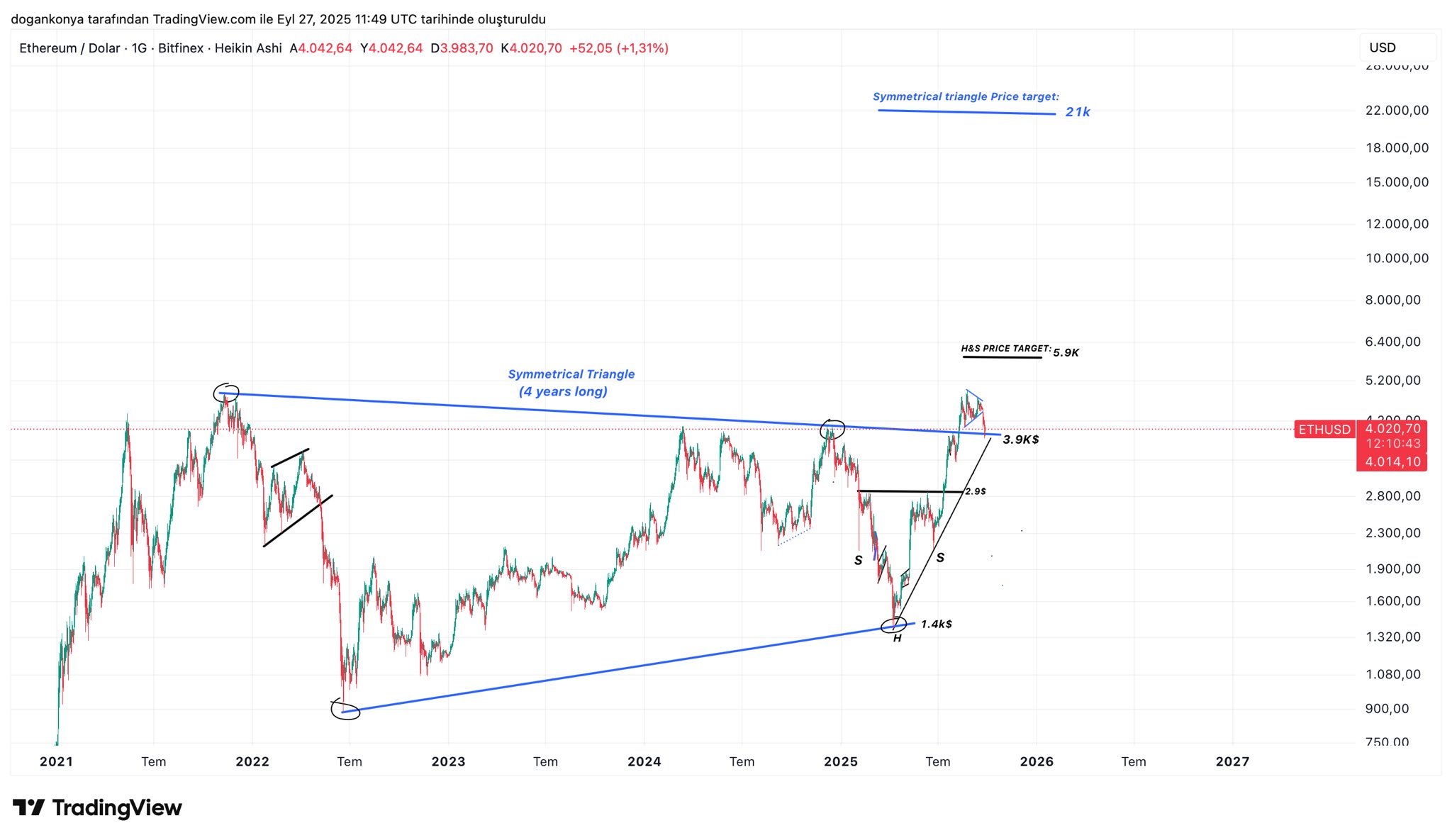
In an X post on September 27, PlanD provides a long-term price analysis of the Ethereum market, highlighting strong bullish potential. Over the last quarter, ETH has shown a strong price performance, breaking out of a four-year-long symmetrical triangle to establish a new all-time high at $4,953.

For context, the symmetrical triangle is a neutral chart pattern that forms when the price consolidates between two converging trendlines. When price breaks above the upper descending trendline, i.e., resistance as seen in the Ethereum market, it is usually interpreted as a bullish signal.
 

Ethereum
Source: @cryptododo7 on X

In line with the classic technical structure, PlanD further explains that the recent price decline over the past two weeks aligns with an expected retest of “this resistance” around $3,900. Having successfully bounced off this price zone, which now functions as a price floor, the analyst states that Ethereum has now resumed its uptrend, with the first major target being $5,900, which emerged from an inverse head and shoulders pattern (H&S)

The inverse head and shoulders is a bullish reversal chart pattern often seen after a downtrend. It signals that the market may be shifting from bearish to bullish momentum. This is clearly seen in the ETH price behavior so far in 2025. PlanD explains that if Ethereum successfully achieves the $5,900 inverse H&S target, the altcoin is expected to initiate a rally towards the symmetrical triangle formation’s major target of $21,000 by the end of 2025.

Ethereum Market Overview

At the time of writing, Ethereum is trading at $4,001 with almost no price change in the last day. However, market trading volume has dropped 58.67%, indicating weaker participation and declining short-term momentum.

According to blockchain analytics company Sentora, total network fees fell 3.9% week-on-week, suggesting reduced on-chain activity and lower demand for block space. Meanwhile, exchange netflows recorded –$3.08 billion week-on-week, meaning more Ethereum was withdrawn from exchanges than deposited, a generally bullish signal as it points to accumulation rather than selling pressure.

Ethereum
ETH trading at $3,997 on the daily chart | Source: ETHUSDT chart on Tradingview.com

Featured image from Pexels, chart from Tradingview

Editorial Process for bitcoinist is centered on delivering thoroughly researched, accurate, and unbiased content. We uphold strict sourcing standards, and each page undergoes diligent review by our team of top technology experts and seasoned editors. This process ensures the integrity, relevance, and value of our content for our readers.

Semilore Faleti works as a crypto-journalist at Bitconist, providing the latest updates on blockchain developments, crypto regulations, and the DeFi ecosystem. He is a strong crypto enthusiast passionate about covering the growing footprint of blockchain technology in the financial world.

Trending Cryptos

Related Reads

A Threefold Performance Leap! NEAR Achieves 200ms Physical Block Time Limit with SPICE

NEAR's core development team, Near One, has announced its next major protocol evolution: SPICE (Separation of Consensus and Execution). Currently in development, SPICE represents the most significant upgrade before the full implementation of Nightshade 3.0. Its core innovation is decoupling the consensus layer, responsible for ordering transactions, from the execution layer, which processes them. This allows the consensus layer to run at full speed without waiting for transaction execution to complete. Once deployed, SPICE is projected to triple NEAR's block production speed, achieving a 200ms block time, which is considered the physical limit due to the speed of light and network latency. This leap will dramatically reduce transaction latency and finality, with transactions confirming in roughly 0.4 seconds—faster than a typical card payment. The upgrade also enables more complex, long-running transactions and significantly improves user experience for applications like NEAR Intents and near.com. Beyond raw speed, SPICE enhances network scalability and security. It enables deeper parallelism, efficiently distributing workload across shards and improving resource utilization. The simpler block structure and lighter contracts also facilitate formal verification and security auditing. Furthermore, SPICE lays the critical groundwork for future Nightshade 3.0 features, most notably atomic cross-shard transactions, which would simplify complex contract logic and eliminate development hurdles caused by asynchronous execution. The Near One team is actively developing SPICE, targeting deployment in the coming months.

Foresight News5m ago

A Threefold Performance Leap! NEAR Achieves 200ms Physical Block Time Limit with SPICE

Foresight News5m ago

Deep Insight: Decentralized Inference is Not Hype, but a Key Track for AI to Break Through Centralized Monopoly

Decentralized Reasoning: Beyond the Hype, a Key to Breaking AI's Centralized Monopoly A future scenario where a powerful AI model is banned by a major government illustrates the core value proposition of decentralized AI: resistance to censorship. The core bet of decentralized inference networks is mitigating this risk, with other benefits like cost being secondary. The path is extremely difficult, involving four key challenges: 1. **Running Massive Models:** Distributing a single model across a decentralized GPU swarm requires sophisticated techniques like pipeline and speculative decoding to overcome crippling network latency, aiming for usable speeds (e.g., 30-40 tokens/second). 2. **Proving Model Integrity:** Verifying that a node runs the correct model is critical. Solutions range from cryptographically secure but slow ZKML to faster, economically-secure methods like statistical fingerprints, deterministic re-execution, or live-weight proofs, each involving trade-offs between integrity, latency, and cost. 3. **Ensuring Prompt Privacy:** Simply sharding a model does not protect user inputs from nodes. Robust solutions currently require trusted hardware (TEEs) or advanced cryptography (FHE), which are not yet widely deployed in consumer swarms. 4. **Building a Real Market:** Identifying the ideal customer is tough. Beyond speculative AI agents, the viable market currently consists of startups embedding AI and projects needing batch processing (e.g., synthetic data generation), where decentralized aggregation can be an advantage over low-latency needs. The article analyzes several projects tackling these problems, such as Dolphin Network (live-weight proofs), Inference.net (statistical verification), Morpheus (TEE-based), and Darkbloom (Apple Secure Enclave). It provides a framework: decentralization is a "tax" for latency-sensitive applications (e.g., chat) but a potential supply-side advantage for throughput-oriented tasks (e.g., batch processing). The long-term vision is a closed data loop where decentralized inference generates valuable data (traces, preferences) to feed decentralized training networks, which in turn produce better open-weight models for the inference networks. A due diligence checklist advises focusing on projects that: are truly decentralized at specific layers; have a credible integrity method; offer real cost benefits; ensure genuine privacy; handle node reliability; have paying users; and are built by teams with deep AI expertise. The ultimate goal should be products that appeal beyond the crypto-native audience, using crypto mechanisms invisibly to deliver better cost, performance, or privacy.

Foresight News33m ago

Deep Insight: Decentralized Inference is Not Hype, but a Key Track for AI to Break Through Centralized Monopoly

Foresight News33m ago

Trading

Spot
Futures

Hot Articles

Discussions

Welcome to the HTX Community. Here, you can stay informed about the latest platform developments and gain access to professional market insights. Users' opinions on the price of ETH (ETH) are presented below.

活动图片