Ethereum’s Next Milestone: November Fork Targets Scalability And Efficiency – Details

bitcoinistPublished on 2025-09-28Last updated on 2025-09-28

Abstract

Ethereum’s roadmap continues to unfold with a pivotal fork set for November, aimed at boosting scalability and streamlining efficiency across...

Trusted Editorial content, reviewed by leading industry experts and seasoned editors. Ad Disclosure

Ethereum’s roadmap continues to unfold with a pivotal fork set for November, aimed at boosting scalability and streamlining efficiency across the network. With scalability long viewed as ETH’s biggest hurdle, this fork represents a critical step toward unlocking its full potential as the world’s leading smart contract platform.

Why This Fork Matters For Ethereum’s Long-Term Roadmap

Leading smart contract platform, Ethereum, is set for another important milestone this November. Sequence has highlighted on X that the Fusaka upgrade is a foundational hard fork infrastructure designed to strengthen the Ethereum Virtual Machine (EVM) while ensuring seamless compatibility for builders. 

This upgrade is engineered to abstract the blockchain complexity and deliver smoother authentication and user flows across the blockchain ecosystem. The best part is that Sequence is already ahead of the curve by having the tools and infrastructure that prepare developers for Fusaka’s impact today.

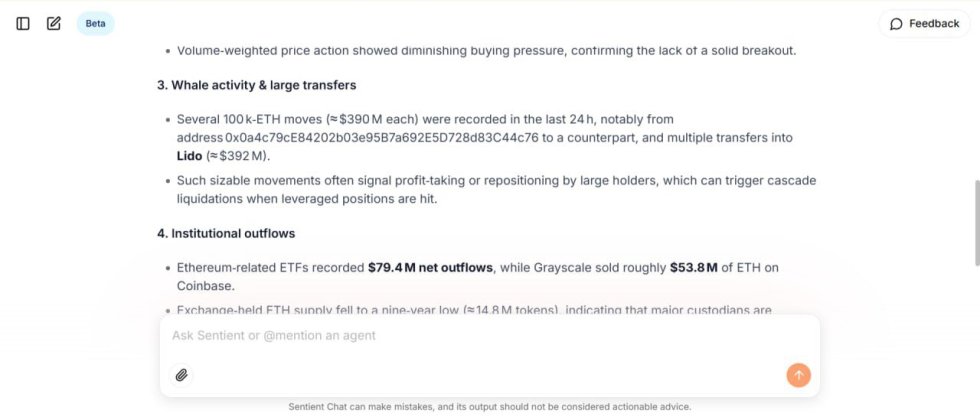
While the Fusaka upgrade aims at strengthening the ETH ecosystem, Wendy J has noted that ETH has seen a notable price dip, as the SentientAGI GRID chat has flagged some activity behind the move. According to the AI platform, several 100,000 ETH transfers were recorded in the past 24 hours.

Interestingly, this kind of large-scale transfer suggests that major holders are likely either profit-taking after the run-up or repositioning their capital. Sentient Chat also listed other factors that could have contributed to the market-wide dump. 
Ethereum
Source: Chart from Wendy J on X

In the meantime, analyst Wendy advised the community to use Sentient Chat for any crypto-related questions. With Sentient Chat, you can instantly generate asset reports fueled by DeFi data, request trading insights tailored to current conditions, or even deploy autonomous agents to handle on-chain tasks in real time to enhance decision-making and yield optimization.

Why This Correction Looks Healthy, Not Critical

On the daily time frame, the recent correction in Ethereum has pushed the Relative Strength Index (RSI) into a critical oversold zone, a level we have not witnessed since the major accumulation phase back in July. BTCBlueWhale mentioned that there is nothing critical in this current correction.  Meanwhile, back in July, ETH showed the same setup, and the price dipped into oversold territory, which retested the previous resistance level, and used that structure as a springboard for a massive rally.

Currently, the daily chart is printing a very similar scenario with trading in a comparable accumulation zone and showing a clear resistance-to-support (R/S) flip, which is a classic sign of structure holding the price strong. Layering on top of that, the setup aligns almost perfectly with the PO3 strategy.

Ethereum
ETH trading at $4,003 on the 1D chart | Source: ETHUSDT on Tradingview.com
Featured image from iStock, chart from Tradingview.com
Editorial Process for bitcoinist is centered on delivering thoroughly researched, accurate, and unbiased content. We uphold strict sourcing standards, and each page undergoes diligent review by our team of top technology experts and seasoned editors. This process ensures the integrity, relevance, and value of our content for our readers.

Godspower Owie is my name, and I work for the news platforms NewsBTC and Bitcoinist. I sometimes like to think of myself as an explorer since I enjoy exploring new places, learning new things, especially valuable ones, and meeting new people who have an impact on my life, no matter how small. I value my family, friends, career, and time. Really, those are most likely the most significant aspects of every person's existence. Not illusions, but dreams are what I pursue.

Trending Cryptos

Related Reads

A Threefold Performance Leap! NEAR Achieves 200ms Physical Block Time Limit with SPICE

NEAR's core development team, Near One, has announced its next major protocol evolution: SPICE (Separation of Consensus and Execution). Currently in development, SPICE represents the most significant upgrade before the full implementation of Nightshade 3.0. Its core innovation is decoupling the consensus layer, responsible for ordering transactions, from the execution layer, which processes them. This allows the consensus layer to run at full speed without waiting for transaction execution to complete. Once deployed, SPICE is projected to triple NEAR's block production speed, achieving a 200ms block time, which is considered the physical limit due to the speed of light and network latency. This leap will dramatically reduce transaction latency and finality, with transactions confirming in roughly 0.4 seconds—faster than a typical card payment. The upgrade also enables more complex, long-running transactions and significantly improves user experience for applications like NEAR Intents and near.com. Beyond raw speed, SPICE enhances network scalability and security. It enables deeper parallelism, efficiently distributing workload across shards and improving resource utilization. The simpler block structure and lighter contracts also facilitate formal verification and security auditing. Furthermore, SPICE lays the critical groundwork for future Nightshade 3.0 features, most notably atomic cross-shard transactions, which would simplify complex contract logic and eliminate development hurdles caused by asynchronous execution. The Near One team is actively developing SPICE, targeting deployment in the coming months.

Foresight News5m ago

A Threefold Performance Leap! NEAR Achieves 200ms Physical Block Time Limit with SPICE

Foresight News5m ago

Deep Insight: Decentralized Inference is Not Hype, but a Key Track for AI to Break Through Centralized Monopoly

Decentralized Reasoning: Beyond the Hype, a Key to Breaking AI's Centralized Monopoly A future scenario where a powerful AI model is banned by a major government illustrates the core value proposition of decentralized AI: resistance to censorship. The core bet of decentralized inference networks is mitigating this risk, with other benefits like cost being secondary. The path is extremely difficult, involving four key challenges: 1. **Running Massive Models:** Distributing a single model across a decentralized GPU swarm requires sophisticated techniques like pipeline and speculative decoding to overcome crippling network latency, aiming for usable speeds (e.g., 30-40 tokens/second). 2. **Proving Model Integrity:** Verifying that a node runs the correct model is critical. Solutions range from cryptographically secure but slow ZKML to faster, economically-secure methods like statistical fingerprints, deterministic re-execution, or live-weight proofs, each involving trade-offs between integrity, latency, and cost. 3. **Ensuring Prompt Privacy:** Simply sharding a model does not protect user inputs from nodes. Robust solutions currently require trusted hardware (TEEs) or advanced cryptography (FHE), which are not yet widely deployed in consumer swarms. 4. **Building a Real Market:** Identifying the ideal customer is tough. Beyond speculative AI agents, the viable market currently consists of startups embedding AI and projects needing batch processing (e.g., synthetic data generation), where decentralized aggregation can be an advantage over low-latency needs. The article analyzes several projects tackling these problems, such as Dolphin Network (live-weight proofs), Inference.net (statistical verification), Morpheus (TEE-based), and Darkbloom (Apple Secure Enclave). It provides a framework: decentralization is a "tax" for latency-sensitive applications (e.g., chat) but a potential supply-side advantage for throughput-oriented tasks (e.g., batch processing). The long-term vision is a closed data loop where decentralized inference generates valuable data (traces, preferences) to feed decentralized training networks, which in turn produce better open-weight models for the inference networks. A due diligence checklist advises focusing on projects that: are truly decentralized at specific layers; have a credible integrity method; offer real cost benefits; ensure genuine privacy; handle node reliability; have paying users; and are built by teams with deep AI expertise. The ultimate goal should be products that appeal beyond the crypto-native audience, using crypto mechanisms invisibly to deliver better cost, performance, or privacy.

Foresight News33m ago

Deep Insight: Decentralized Inference is Not Hype, but a Key Track for AI to Break Through Centralized Monopoly

Foresight News33m ago

Trading

Spot
Futures

Hot Articles

Discussions

Welcome to the HTX Community. Here, you can stay informed about the latest platform developments and gain access to professional market insights. Users' opinions on the price of ETH (ETH) are presented below.

活动图片