Buterin Teases Most Radical Ethereum Shift Yet: ‘Fusaka Will Fix This’

bitcoinistPublished on 2025-09-25Last updated on 2025-09-25

Abstract

Ethereum co-founder Vitalik Buterin framed the network’s next scaling step as both audacious and tightly risk-controlled, saying “Fusaka will fix...

Trusted Editorial content, reviewed by leading industry experts and seasoned editors. Ad Disclosure

Ethereum co-founder Vitalik Buterin framed the network’s next scaling step as both audacious and tightly risk-controlled, saying “Fusaka will fix this” while underscoring that “safety first is of the utmost importance.” In a detailed post, Buterin described Fusaka’s core feature—PeerDAS—as “trying to do something pretty unprecedented: have a live blockchain that does not require any single node to download the full data.”

He added that PeerDAS relies on probabilistic sampling of data “chunks,” and, if more than half of those chunks are available, nodes can retrieve them and reconstruct the remainder via erasure coding. “This is all new technology, and the core devs are wise to be super cautious on testing,” Buterin wrote, noting that blob supply will ramp “conservatively at first,” then more aggressively if conditions permit.

Buterin Calls Fusaka the Key To Ethereum L2 Scaling

Buterin’s remarks arrive just as Ethereum’s new blob market shows signs of strain. Head of Data at Dragonfly Hildebert Moulié reported that the chain “hit 6 blobs/block for the first time,” attributing the recent surge primarily to rollups and projects including Base and Worldcoin. According to the same thread, Base submitted roughly 35% of blobs and used about 42% of blobspace, with Worldcoin contributing around 20% of submissions and 25% of usage; Arbitrum, OP Mainnet, Soneium, Scroll and others comprised most of the remainder.

The analyst added that L2s now account for about $200,000 per week in mainnet fees for submissions, validators require more than 70 GB of storage for blobs (over 1.2 TB if unpruned), and that many blobs are not fully utilized—particularly on smaller rollups posting more frequently than they can fill 128 KB payloads. The first sustained base-fee spike since the Pectra hard fork was also observed, although hildobby cautioned that “blob price discovery” still requires a more prolonged saturation of demand.

PeerDAS is the architectural response. Buterin explained that each node requests only a small number of chunks to verify that over half of the data is available; if so, the node “theoretically can download those chunks, and use erasure coding to recover the rest.”

In its initial incarnation, two non-custodial roles still require full-block data to exist somewhere on the network—initial broadcast and emergency reconstruction when a publisher reveals only a fraction of a block—though “we only need one honest actor” for those tasks, and future “cell-level messaging and distributed block building will allow even these two functions to be distributed.” The endgame, he suggested, is to unlock sustained L2 scaling and, as L1 block gas limits rise, to eventually route more L1 execution data into blobs as well.

This pivot lands amid a rapidly evolving blob marketplace. After Pectra, Ethereum increased the blob target and maximum per block, expanding daily data capacity and paving the way for higher throughput from rollups; research desks have linked that shift to a complex interaction between L1 base fees, blob fees, and L2 submission behavior.

The Fusaka timetable adds urgency. Core developers have signaled a mainnet activation for December 3, 2025, following staged testnet rollouts, placing Buterin’s “safety first” emphasis in clear relief. PeerDAS will debut under strict limits, with blob counts increased “conservatively at first,” a posture designed to avoid fee whiplash and to observe how diverse L2s actually consume the added capacity.

Outside the protocol notes, empirical work is accumulating around how networks might use blobspace more efficiently. A 2024 study on “blob sharing” argued that smaller rollups frequently under-fill blobs and could cut posting costs by more than 85% by cooperatively packing data into shared blobs, smoothing the base fee and lowering the total number of blobs submitted.

Ethereum researchers have since expanded that argument, modeling how sharing reduces blocks with more than the target number of blobs and thereby dampens the exponential blob-fee adjustments that kick in when usage overshoots targets. Those findings dovetail with Moulié’s observation that “many blobs aren’t full,” implying large savings are available through better coordination as the market matures.

The conceptual roots of PeerDAS stretch back through Ethereum research notes on data-availability sampling and Buterin’s own writings on “The Surge.” PeerDAS itself implements one-dimensional sampling with erasure coding and succinct per-cell proofs, enabling nodes to validate availability without naively downloading everything. That’s what makes the approach “pretty unprecedented” in a live, high-value blockchain: it seeks to reconcile decentralization and throughput by reducing per-node bandwidth and storage requirements while preserving strong guarantees that data actually exists.

Still, the shift is not without risks. Buterin’s insistence on a careful rollout reflects the reality that Ethereum’s blob economy is young, volatile, and sensitive to sudden changes in demand. As L2s jostle for capacity, fee dynamics can invert quickly, and incomplete blobs, spiky usage, and MEV side effects complicate forecasting. The promise of Fusaka is that PeerDAS can bend those dynamics toward sustainable growth by letting the network scale data availability without forcing any single node to shoulder the whole chain—and by doing so in a way that keeps security assumptions explicit and testable.

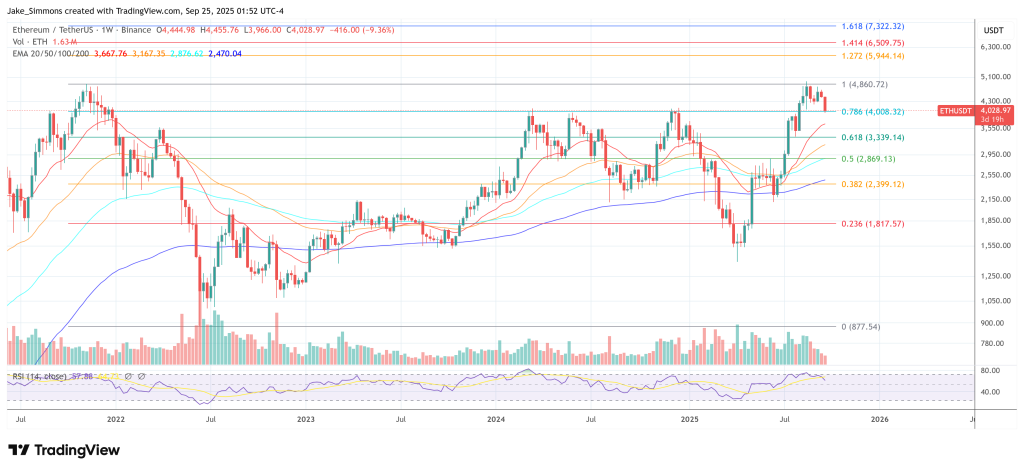
At press time, ETH traded at $4,028.
Ethereum price
ETH crashes to key support, 1-week chart | Source: ETHUSDT on TradingView.com
Featured image created with DALL.E, chart from TradingView.com
Editorial Process for bitcoinist is centered on delivering thoroughly researched, accurate, and unbiased content. We uphold strict sourcing standards, and each page undergoes diligent review by our team of top technology experts and seasoned editors. This process ensures the integrity, relevance, and value of our content for our readers.

Jake Simmons has been a Bitcoin enthusiast since 2016. Ever since he heard about Bitcoin, he has been studying the topic every day and trying to share his knowledge with others. His goal is to contribute to Bitcoin's financial revolution, which will replace the fiat money system. Besides BTC and crypto, Jake studied Business Informatics at a university. After graduation in 2017, he has been working in the blockchain and crypto sector. You can follow Jake on Twitter at @realJakeSimmons.

Trending Cryptos

Related Reads

Giants Wage the Context War, Reconstructing AI Moats

The article "Giants Launch the Context War, Reconstructing AI's Moat" discusses how leading AI companies—OpenAI, Anthropic, and Google—are shifting their competitive focus from model size to acquiring, managing, and utilizing user context (Context). Initially, Context referred to the length of text a model could process, leading to a "arms race" for longer context windows. However, the competition has evolved through three key phases: expanding text capacity (long context windows), enabling memory across sessions, and finally, integrating AI into real user environments like browsers and desktops to capture dynamic task states. Each company is pursuing a distinct strategy. OpenAI is building Context around the ChatGPT account, turning it into a central hub that accumulates user understanding across various integrated applications and tools. Anthropic, lacking a major user base, focuses on high-value verticals like coding, empowering its Claude model to actively gather Context through GUI interaction (Computer Use) and system connections (MCP protocol). Google, with vast existing user data from products like Search and Gmail, faces the challenge of restructuring this data into actionable, AI-understandable Context for its Gemini model within its ecosystem. The core argument is that the nature of competitive advantage in AI is changing. The internet era prized network effects—connecting more users. The AI era values "individual depth": the ability to build deep, task-specific understanding of a user. This creates a new moat through 1) the compounding value of accumulated Context, 2) deep integration with user tools and permissions, and 3) the establishment of trust for complex tasks. Therefore, the battle for Context is fundamentally about capturing "task entry points" and converting existing digital ecosystems into environments where AI can effectively understand and act, rather than merely scaling user numbers.

marsbit45m ago

Giants Wage the Context War, Reconstructing AI Moats

marsbit45m ago

Foundation Steps Back, Ethlabs Steps Forward: Ethereum Undergoes Its Largest Restructuring in History

On June 23rd, the Ethereum ecosystem witnessed two major shifts, signaling a significant governance realignment. First, former Ethereum Foundation researchers established Ethlabs, a new independent non-profit. Backed by major ETH holders like Bitmine and SharpLink, Ethlabs aims to address practical needs for institutional adoption, including faster settlement, native asset issuance, cross-chain transactions, and mainnet scaling. Secondly, the Ethereum Foundation announced a major restructuring, laying off 54 employees (20% of its staff) to become a leaner entity focused on protocol governance and maintenance rather than being the primary builder. This move represents a pivotal correction. Criticisms had mounted over the Foundation's perceived slowness, lack of clear strategy, and over-reliance on Vitalik Buterin's influence. Ethlabs emerges as a more execution-oriented, "industrialized" layer focused on market adoption—bridging the gap between research and real-world use. Notably, Vitalik Buterin is absent from its list of supporters, interpreted as an intentional step to avoid excessive personal endorsement and allow the organization to build independent credibility. The Ethereum Foundation's downsizing and redefinition mark a retreat from its former central coordinating role. It now aims to share the "privilege of stewarding Ethereum" with other emerging groups like Ethlabs, the Ethereum Applications Guild, and The Ethereum Economic Zone. Analysts frame this dual shift as the Foundation ensuring Ethereum remains "correct" (credibly neutral), while Ethlabs must prove it remains "effective" (competitive and attractive for capital and adoption). This addresses community "shareholder-like anxiety" about ETH's market performance. While risks exist—such as concerns over shifting from Foundation centrality to large-holder influence—the consensus is that the greater risk for Ethereum was inaction, caught between technical idealism and organizational inertia. These steps aim to create a more multi-stakeholder, execution-driven future for the network.

链捕手8h ago

Foundation Steps Back, Ethlabs Steps Forward: Ethereum Undergoes Its Largest Restructuring in History

链捕手8h ago

Second Half of U.S. Crypto Policy: The Clarity Act Aims for 60 Votes, CFTC's "One-Person Commission" Becomes Biggest Variable

In a pivotal year for US crypto policy, the "CLARITY Act" is advancing in the Senate but faces a high hurdle, needing 60 votes to pass. Key challenges include bridging partisan divides on ethics and swaying undecided Republican senators within a tight legislative calendar of only about 40 working days. The policy "second half" involves intense negotiations on a broader framework for Web3 and DeFi, including crypto tax reforms and the Blockchain Regulatory Certainty Act. A significant uncertainty is the understaffed CFTC, operating with four commissioner vacancies, which complicates regulatory clarity. Meanwhile, the departure of key "crypto champions"—SEC Commissioner Hester Peirce and Senator Cynthia Lummis—will impact ongoing policy efforts. Industry experts are cautiously optimistic but realistic. Sara K. Weed notes that while progress is being made, CLARITY is unlikely to pass this Congress, pushing agencies like the SEC and CFTC to provide more guidance. Sulolit Mukherjee suggests meaningful crypto tax legislation is more likely to be attached to larger must-pass bills. Rashan Colbert discusses the jurisdictional debate over prediction markets, emphasizing the need for a regulatory framework that fosters their development as financial tools rather than treating them broadly as gambling. The clock is ticking, but opportunities remain for substantive progress through continued bipartisan dialogue and pragmatic efforts.

marsbit10h ago

Second Half of U.S. Crypto Policy: The Clarity Act Aims for 60 Votes, CFTC's "One-Person Commission" Becomes Biggest Variable

marsbit10h ago

Dan Koe's New Essay: Escaping the Fate of the Wage Slave, How to Survive the AI Replacement Wave?

Dan Koe argues that the true threat in the AI era isn't technology itself, but a reliance on others for one's livelihood and happiness. The core problem is "wage slavery"—spending life on unfulfilling work. To survive and thrive, one must escape this by building their own enterprise. The key is developing five elements: Agency (initiative), Taste (discernment), Persuasion, Persistence, and Iteration. These boil down to problem-solving skills and experiential knowledge, which cannot be learned passively but only through doing your own projects. The solution is to become "unemployable" by shifting your identity. This requires: 1) Radically changing your environment to force growth, 2) Choosing a medium (like content creation) that provides real feedback through trial and error, and 3) Mastering either code or, preferably, media (content). Content creation is more valuable because its subjective nature and need for human perspective create a durable advantage over generic AI output. To start, define your life's work by answering foundational questions about your innate knowledge, unique abilities, and contrarian beliefs. Then, immediately act by publishing your first piece of content. The cycle of creating, receiving feedback, and iterating is the essential path to developing the skills needed for an independent, meaningful career and financial resilience.

marsbit11h ago

Dan Koe's New Essay: Escaping the Fate of the Wage Slave, How to Survive the AI Replacement Wave?

marsbit11h ago

Trading

Spot
Futures

Hot Articles

Discussions

Welcome to the HTX Community. Here, you can stay informed about the latest platform developments and gain access to professional market insights. Users' opinions on the price of ETH (ETH) are presented below.

活动图片