Whales Buy Almost $100K Bitcoin Hyper as Presale Surges Past $18M

bitcoinistPublished on 2025-09-24Last updated on 2025-09-24

Abstract

Whales just dropped nearly $100K into Bitcoin Hyper ($HYPER) within two hours today – a $87K buy followed by another...

Trusted Editorial content, reviewed by leading industry experts and seasoned editors. Ad Disclosure

Whales just dropped nearly $100K into Bitcoin Hyper ($HYPER) within two hours today – a $87K buy followed by another $12.7K minutes later. That takes the project’s viral presale haul past $18M, a number that puts it firmly on the radar of both retail speculators and seasoned traders.

Whales don’t usually bother with presales. They tend to park capital in liquid majors like $BTC and $ETH, where they can exit positions quickly. So when big wallets start piling into a presale token, it signals conviction and belief that the upside is too good to ignore.

Bitcoin Hyper ($HYPER) is gunning at Bitcoin’s oldest problem: speed and usability. For years, $BTC has been the ultimate store of value, but terrible at actually functioning as a currency.

So here’s the question: if Bitcoin is already king of crypto as digital gold, what happens if it suddenly becomes usable in daily life?

The Problem Bitcoin Still Has

Bitcoin ($BTC) remains the undisputed heavyweight of crypto, with a $2.25T market cap, Wall Street-approved ETFs, and corporate treasuries stacked with coins. But beneath the prestige lies a blunt reality: the network is painfully slow and outdated compared to modern demands.

A Bitcoin block takes around 10 minutes to confirm, and the system processes only ~7 transactions per second (TPS). To put that into perspective, Solana has a real-time TPS of 796.1, and has a max theoretical TPS of 65K. That places Bitcoin 99% short of Solana’s capabilities.
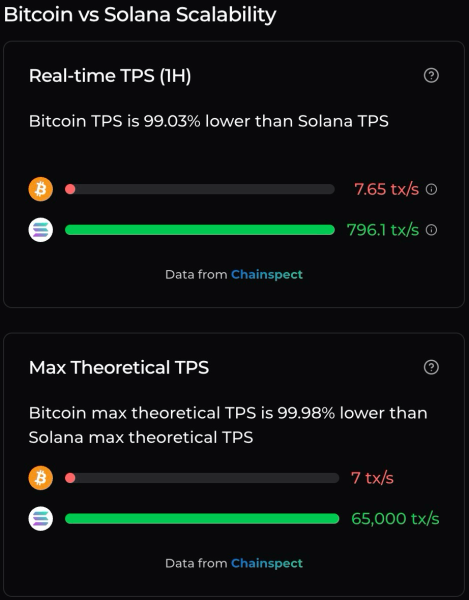
Comparison of Bitcoin and Solana scalability.
Source: Chainspect

That’s the difference between ordering a coffee and paying instantly versus standing awkwardly at the counter for 10 minutes waiting for your $BTC transaction to finalize.

This lack of throughput has left entire sectors out of Bitcoin’s reach. DeFi exploded on Ethereum, NFTs on Solana and Ethereum, and top meme coins are everywhere but on Bitcoin. The network simply couldn’t handle the traffic.

Bitcoin has been locked into its ‘digital gold’ role. Great as a store of value, nearly useless as everyday money. That gap is exactly what Bitcoin Hyper ($HYPER) is now aiming to close.

The Bitcoin Hyper Solution

Bitcoin Hyper positions itself as the first true Layer 2 for Bitcoin. Not a mere sidechain with trusted custodians, but a well-equipped execution layer that plugs directly into Bitcoin’s base chain.

Here’s how it works in practice: You bridge $BTC into the system, where a smart contract verifies the deposit against Bitcoin’s blockchain. Once confirmed, an equal amount of $BTC is minted on the Bitcoin Hyper chain – fully trustless and verifiable.

From there, you operate on Hyper’s network, which is powered by Solana’s Virtual Machine (SVM). That means sub-second transactions and near-zero fees, a world apart from Bitcoin’s ten-minute block times.
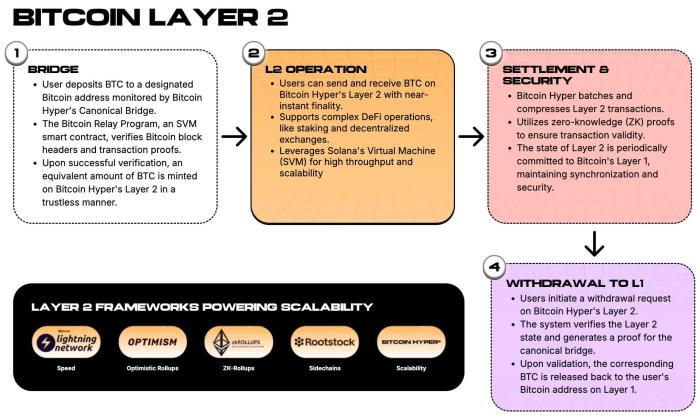
Bitcoin Hyper ($HYPER) layer 2 for powering Bitcoin scalability.

Every transaction gets bundled and secured with zero-knowledge proofs, then committed back to Bitcoin’s Layer 1. This keeps Hyper synced with Bitcoin while ensuring the speed and flexibility of a modern blockchain.

And when you want to exit, you just bridge out and your $BTC gets unlocked back on Layer 1.

The payoff is obvious. Suddenly, paying for a coffee with Bitcoin is instant. DeFi primitives like lending, staking, and yield farming can finally run on Bitcoin rails. Meme coins get a new home powered by Bitcoin liquidity. Developers also gain a full dApp stack, since Hyper’s SVM layer is Solidity-compatible.

Bitcoin Hyper ($HYPER) ecosystem.

For the first time, Bitcoin becomes a usable execution environment, not just a digital vault. Think of Bitcoin as the central bank’s settlement layer – secure but slow.

The Hyper network acts like the Visa or Mastercard layer on top, delivering speed, scalability, and flexibility without sacrificing Bitcoin’s base-layer security.

Learn more on Hyper’s official website.

Why This Could Change Bitcoin’s Place in Crypto

Bitcoin already rules the market with over 50% dominance, but its role has been limited. If Bitcoin Hyper delivers, that ceiling shatters. $BTC will no longer be an asset you buy and hold; it will become the backbone for payments, DeFi, and meme culture.

Institutional products like ETFs made Bitcoin easier to hold. Hyper makes it powerful to use. That shift mirrors what happened to Ethereum: once smart contracts launched, $ETH went from a niche asset to the base layer of DeFi and NFTs.

Hyper could be Bitcoin’s equivalent leap. Imagine Bitcoin securing its status as the hardest money and capturing transactional activity usually reserved for $ETH and $SOL. If that happens, Bitcoin’s dominance could expand even further.

Bitcoin Hyper ($HYPER) Token Presale Is Booming, Seeing Whale Action

Bitcoin Hyper ($HYPER)’s presale is booming; the numbers tell their own story. The raise has already crossed $18M, with tokens priced at $0.012965, while our Bitcoin Hyper price prediction shows it could reach $1.50 by 2030.

Whales have started circling. In just two hours today, one wallet scooped up $87K worth of $HYPER, followed by another dropping $12.7K. Nearly $100K in a single morning signals that larger players see Hyper as more than a meme coin experiment.

They’re treating it as a serious bet on Bitcoin’s next chapter.
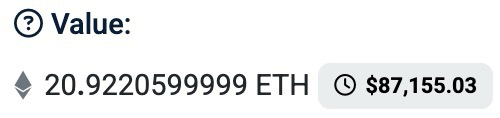
$87K whale buy on $HYPER.
Source: Etherscan

Presale buyers also get more than tokens: priority access to staking (currently 65% APY) and governance rights are just some of the major incentives for adopters. Want to get the perks? Check out our step-by-step guide on how to buy Bitcoin Hyper.

TL;DR? Backing $HYPER is an early play on making Bitcoin usable, scalable, and competitive with the chains that stole its thunder. Its promising blockchain upscaling project has attracted a lot of attention, with a $18M+ strong presale and recent whale buys nearing $100K to prove it.

Considering its presale momentum, community backing, and strong utility, our most bullish forecast sees $HYPER potentially spiking 24x soon after listing this year.

Visit the official $HYPER presale today.

As always, this article is not financial advice. Crypto carries inherent risks; please always do your own research and never invest more than you are willing to lose.

Authored by Aidan Weeks, Bitcoinist — https://bitcoinist.com/bitcoin-hyper-presale-hits-18m-as-whales-buy-100k/

Editorial Process for bitcoinist is centered on delivering thoroughly researched, accurate, and unbiased content. We uphold strict sourcing standards, and each page undergoes diligent review by our team of top technology experts and seasoned editors. This process ensures the integrity, relevance, and value of our content for our readers.

Aidan Weeks, a Master's graduate in Mechanical Engineering, has thrived as a content writer for over four years. Specializing in crypto, tech, engineering, AI, and B2B sectors, Aidan adeptly crafts web copy, blog posts, buying guides, manuals, product pages, and more, making complex concepts accessible and engaging. His transition from academia to full-time writing reflects his passion for bridging technical expertise with clear, informative content. Since joining Bitcoinist, Aidan has written extensively about DeFi, dApps, AI, and meme coins, solidifying his grasp on emerging blockchain technologies. An early adopter, he began investing in Solana in 2020, further deepening his insights into crypto markets and innovation. Today, he combines hands-on experience with a sharp editorial instinct to help readers cut through hype, spot real trends, and make sense of a fast-moving space.

Trending Cryptos

Related Reads

Chip Stocks Lead U.S. Market Decline: Is AI Trading Being Hit by Both Interest Rates and Returns?

Chip stocks led a broad decline in US markets, with the Nasdaq dropping 2.2% and the S&P 500 falling 1.4%. This selloff reflects a dual challenge for the once-high-flying AI hardware trade: rising interest rate expectations and growing investor impatience for clear returns from massive AI capital expenditures. The pressure was most acute on hardware leaders. Nvidia fell about 4%, dipping below a $5 trillion market cap, while Micron plunged 13.2% ahead of its earnings report. Declines across memory, storage, AI, and mobile chips indicated a sector-wide retreat. The selloff spread globally, with South Korea's KOSPI index dropping nearly 10% as key suppliers SK Hynix and Samsung recorded double-digit losses. Investors appeared to be taking profits from the most crowded trades first. Macro headwinds intensified as market expectations shifted toward a more aggressive Federal Reserve. Forecasts for multiple rate hikes in 2026 pressured high-valuation tech stocks, which rely on long-term growth projections that become less attractive as discount rates rise. Concurrently, investors are scrutinizing the profit potential of the immense AI spending by cloud giants like Alphabet, Amazon, and Meta. While these expenditures drive demand for chips and hardware, the market is now questioning whether AI services will generate sufficient returns to justify the ongoing costs. This adjustment is not necessarily a bubble burst but a recalibration. AI demand fundamentals remain, but the narrative of endless growth can no longer fully offset concerns over higher interest rates and a longer path to profitability. Near-term direction may hinge on Micron's upcoming earnings guidance and incoming inflation data, which will influence both the AI demand outlook and the Fed's policy path. The market is transitioning from blindly buying growth to demanding clearer visibility on returns.

marsbit1h ago

Chip Stocks Lead U.S. Market Decline: Is AI Trading Being Hit by Both Interest Rates and Returns?

marsbit1h ago

OpenAI's New Paper: How to Train an AI that "Doesn't Deteriorate Under Pressure"?

OpenAI's new paper "Reinforcement Learning Towards Broadly and Persistently Beneficial Models" explores training AI to maintain safe, helpful, and honest behavior even under pressure, in unseen scenarios, or after being fine-tuned for harmful purposes. Moving beyond simple rule-based "don'ts," the research focuses on cultivating "beneficial traits" like honesty, risk-awareness, corrigibility, and transparency. It investigates if reinforcement learning (RL), often prone to "reward hacking" where models exploit loopholes, can instead be used to instill robust, generalized positive behaviors. Researchers created a multi-domain synthetic dialogue dataset covering areas like healthcare and law. They trained a model by replacing 5% of standard RL data with "beneficial trait" data. This model outperformed the baseline in 83% of 53 evaluations, showing average gains of 9.1% in alignment, safety, and helpfulness. Crucially, improvements generalized: a model trained only on healthcare "good behavior" data also performed better in 17 out of 19 non-healthcare alignment tests. The paper also tests "alignment persistence." When subjected to adversarial prompts or harmful fine-tuning, the beneficial trait model showed greater resilience, with smaller performance drops and less "spillover" of bad behavior to unrelated tasks. While not a complete solution, this work suggests a shift from post-hoc correction to proactively shaping robust, principled AI behavior, a critical step for deploying models in high-stakes, complex decision-making scenarios.

marsbit1h ago

OpenAI's New Paper: How to Train an AI that "Doesn't Deteriorate Under Pressure"?

marsbit1h ago

Semiconductor Stock Rebound: Is the Technical Correction Over or a Trend Reversal?

The core of recent semiconductor stock volatility is not about daily price swings, but rather the market questioning whether AI-driven semiconductor pricing has entered a new phase. Following a sharp sell-off in Korean stocks on June 23rd, led by Samsung and SK Hynix, a subsequent rebound is seen more as a technical positioning adjustment rather than a confirmed trend reversal. The key variable is HBM (High Bandwidth Memory), essential for AI chips. Its supply-demand imbalance granted memory makers significant pricing power. The current market focus is on whether this dynamic remains strong enough to justify elevated valuations. All eyes are on Micron's upcoming earnings report. The critical factor is not whether results meet already high expectations, but whether the company's guidance confirms that AI memory pricing power, order visibility, and future margins are still expanding. Micron's outlook will serve as a crucial test for the broader AI semiconductor chain, including Samsung, SK Hynix, and other infrastructure players. The recent bounce appears to be a pre-earnings positioning repair. For it to evolve into a sustained uptrend, concrete evidence is needed that the AI infrastructure expansion cycle's fundamentals—particularly for high-end memory—remain robust and can continue to surpass elevated market expectations. The risk is that strong demand alone may not be sufficient if future guidance hints at peaking momentum or increasing supply-side pressures.

marsbit1h ago

Semiconductor Stock Rebound: Is the Technical Correction Over or a Trend Reversal?

marsbit1h ago

Trading

Spot
Futures

Hot Articles

What is $BITCOIN

DIGITAL GOLD ($BITCOIN): A Comprehensive Analysis Introduction to DIGITAL GOLD ($BITCOIN) DIGITAL GOLD ($BITCOIN) is a blockchain-based project operating on the Solana network, which aims to combine the characteristics of traditional precious metals with the innovation of decentralized technologies. While it shares a name with Bitcoin, often referred to as “digital gold” due to its perception as a store of value, DIGITAL GOLD is a separate token designed to create a unique ecosystem within the Web3 landscape. Its goal is to position itself as a viable alternative digital asset, although specifics regarding its applications and functionalities are still developing. What is DIGITAL GOLD ($BITCOIN)? DIGITAL GOLD ($BITCOIN) is a cryptocurrency token explicitly designed for use on the Solana blockchain. In contrast to Bitcoin, which provides a widely recognized value storage role, this token appears to focus on broader applications and characteristics. Notable aspects include: Blockchain Infrastructure: The token is built on the Solana blockchain, known for its capacity to handle high-speed and low-cost transactions. Supply Dynamics: DIGITAL GOLD has a maximum supply capped at 100 quadrillion tokens (100P $BITCOIN), although details regarding its circulating supply are currently undisclosed. Utility: While precise functionalities are not explicitly outlined, there are indications that the token could be utilized for various applications, potentially involving decentralized applications (dApps) or asset tokenization strategies. Who is the Creator of DIGITAL GOLD ($BITCOIN)? At present, the identity of the creators and development team behind DIGITAL GOLD ($BITCOIN) remains unknown. This situation is typical among many innovative projects within the blockchain space, particularly those aligning with decentralized finance and meme coin phenomena. While such anonymity may foster a community-driven culture, it intensifies concerns about governance and accountability. Who are the Investors of DIGITAL GOLD ($BITCOIN)? The available information indicates that DIGITAL GOLD ($BITCOIN) does not have any known institutional backers or prominent venture capital investments. The project seems to operate on a peer-to-peer model focused on community support and adoption rather than traditional funding routes. Its activity and liquidity are primarily situated on decentralized exchanges (DEXs), such as PumpSwap, rather than established centralized trading platforms, further highlighting its grassroots approach. How DIGITAL GOLD ($BITCOIN) Works The operational mechanics of DIGITAL GOLD ($BITCOIN) can be elaborated on based on its blockchain design and network attributes: Consensus Mechanism: By leveraging Solana’s unique proof-of-history (PoH) combined with a proof-of-stake (PoS) model, the project ensures efficient transaction validation contributing to the network's high performance. Tokenomics: While specific deflationary mechanisms have not been extensively detailed, the vast maximum token supply implies that it may cater to microtransactions or niche use cases that are still to be defined. Interoperability: There exists the potential for integration with Solana’s broader ecosystem, including various decentralized finance (DeFi) platforms. However, the details regarding specific integrations remain unspecified. Timeline of Key Events Here is a timeline that highlights significant milestones concerning DIGITAL GOLD ($BITCOIN): 2023: The initial deployment of the token occurs on the Solana blockchain, marked by its contract address. 2024: DIGITAL GOLD gains visibility as it becomes available for trading on decentralized exchanges like PumpSwap, allowing users to trade it against SOL. 2025: The project witnesses sporadic trading activity and potential interest in community-led engagements, although no noteworthy partnerships or technical advancements have been documented as of yet. Critical Analysis Strengths Scalability: The underlying Solana infrastructure supports high transaction volumes, which could enhance the utility of $BITCOIN in various transaction scenarios. Accessibility: The potential low trading price per token could attract retail investors, facilitating wider participation due to fractional ownership opportunities. Risks Lack of Transparency: The absence of publicly known backers, developers, or an audit process may yield skepticism regarding the project's sustainability and trustworthiness. Market Volatility: The trading activity is heavily reliant on speculative behavior, which can result in significant price volatility and uncertainty for investors. Conclusion DIGITAL GOLD ($BITCOIN) emerges as an intriguing yet ambiguous project within the rapidly evolving Solana ecosystem. While it attempts to leverage the “digital gold” narrative, its departure from Bitcoin's established role as a store of value underscores the need for a clearer differentiation of its intended utility and governance structure. Future acceptance and adoption will likely depend on addressing the current opacity and defining its operational and economic strategies more explicitly. Note: This report encompasses synthesised information available as of October 2023, and developments may have transpired beyond the research period.

439 Total ViewsPublished 2025.05.13Updated 2025.05.13

What is $BITCOIN

Discussions

Welcome to the HTX Community. Here, you can stay informed about the latest platform developments and gain access to professional market insights. Users' opinions on the price of BTC (BTC) are presented below.

活动图片