CFTC Eyes Stablecoins as Collateral – A Big Win for Best Wallet & $BEST Token

bitcoinistPublished on 2025-09-24Last updated on 2025-09-24

Abstract

The U.S. Commodity Futures Trading Commission (CFTC) is considering a plan that would allow tokenized assets, including stablecoins, to serve...

Trusted Editorial content, reviewed by leading industry experts and seasoned editors. Ad Disclosure

The U.S. Commodity Futures Trading Commission (CFTC) is considering a plan that would allow tokenized assets, including stablecoins, to serve as collateral in derivatives markets.

If approved, stablecoins like $USDC and $USDT would be treated as traditional collateral, like cash or US Treasurys in regulated derivatives markets.

This is excellent news for Best Wallet and its $BEST token. As stablecoins become increasingly credible and valuable to hold, this wallet’s secure, user-friendly design makes it the perfect place to store and transact them – alongside other digital assets.

The CFTC to ‘Usher in America’s Golden Age of Crypto’

Yesterday, acting CFTC chair Caroline Pham announced that the initiative builds on the CFTC’s successful Crypto CEO Forum held in February.

Moreover, it forms part of its broader ‘crypto sprint‘ to implement recommendations from the President’s Working Group on Digital Assets.

‘Since January, the CFTC has taken clear action to usher in America’s Golden Age of Crypto,’ said Acting Chairman Pham.

‘At our historic Crypto CEO Forum, we discussed how innovation and blockchain technology will drive progress in derivatives markets, especially for modernization of collateral management and greater capital efficiency. These market improvements will unleash US economic growth because market participants can put their dollars to work smarter and go further.’

Strengthening this push, the new initiative also aligns with the GENIUS Act, a new framework for licensed payment stablecoins to be used across TradFi markets.

The agency is also encouraging stakeholders to give feedback on tokenized collateral in derivatives markets until October 20.

By offering a secure, non-custodial wallet, Best Wallet makes it easy for you to benefit from the growing legitimacy of stablecoins, and thus crypto in general.

Securely Manage Major Stablecoins & Cryptos on Best Wallet

Best Wallet enhances how you interact with digital assets, whether stablecoins like $USDT and $USDC, top cryptos like $BTC or $ETH, or even the best meme coins, $DOGE and $SHIB.

The mobile wallet (available on Google Play and iOS) supports over 1K assets, soon across 60 networks, making it a go-to hub for managing your cryptos in one place.

As a non-custodial wallet, it’s a highly secure option; it gives you full control over your private keys, plus includes additional safeguarding measures such as 2FA, biometrics, and in-app suspicious token filters.

Most of the $2.1B stolen crypto during the first half of 2025 came from private key exploits and front-end compromises, making such protections more critical than ever.

Meanwhile, its cutting-edge features add even more value to the overall Best Wallet experience. Its built in launchpad, for instance, allows you to explore top crypto presales directly inside the app. By removing the need to connect to third-party sites, it reduces exposure to risks.

Another highlight is its seamless cross-chain swaps. It connects with 330+ DEXs and 30 bridges so you can seamlessly swap top cryptos for the best rates on the market.
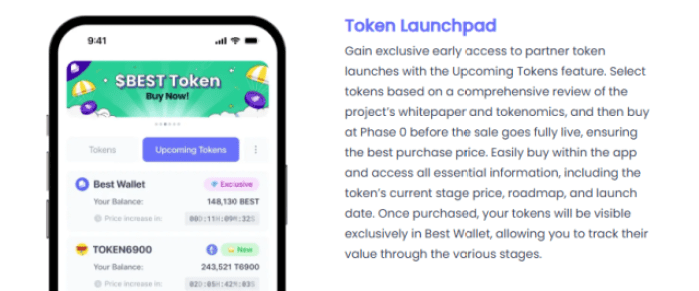
The Best Wallet crypto launchpad.
Source: Best Wallet Token

And that’s not all. Best Wallet has many future developments in the pipeline, including a crypto debit card (Best Card), NFT gallery, limit orders, and market intelligence analytics (to mention a few!).

The project’s native token, Best Wallet Token ($BEST), will help propel Best Wallet’s use cases to greater heights.

It sets aside a quarter of its total token supply to product development.
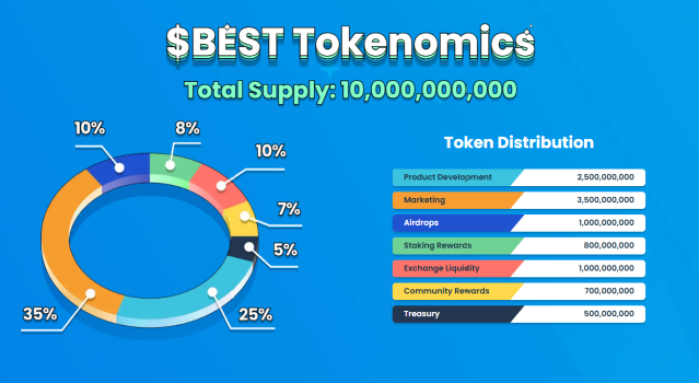
Best Wallet tokenomics.
Source: Best Wallet Token

In fact, $BEST plays a major role in the entire ecosystem. It unlocks key benefits for holders, including reduced fees, high-yield staking rewards (currently at 82% APY), governance rights, and early access to presales.

To help propel Best Wallet to even rosier pursuits and reap the perks, you can buy $BEST on presale for just $0.025685. And you certainly wouldn’t be the only one – it has already raised over $16M, after all.

With less than ten hours until the next price increase, there’s no better time to join. Our Best Wallet price prediction forecasts $BEST going up 180% this year following exchange listings.

Join the $BEST presale today.

This is not financial advice. Crypto is a competitive, high-risk market so always DYOR and invest wisely.

Authored by Leah Waters, Bitcoinist — https://bitcoinist.com/cftc-add-stablecoins-as-collateral-benefits-best

Editorial Process for bitcoinist is centered on delivering thoroughly researched, accurate, and unbiased content. We uphold strict sourcing standards, and each page undergoes diligent review by our team of top technology experts and seasoned editors. This process ensures the integrity, relevance, and value of our content for our readers.

Leah is a British journalist with a BA in Journalism, Media, and Communications and nearly a decade of content writing experience. Over the last four years, her focus has primarily been on Web3 technologies, driven by her genuine enthusiasm for decentralization and the latest technological advancements. She has contributed to leading crypto and NFT publications – Cointelegraph, Coinbound, Crypto News, NFT Plazas, Bitcolumnist, Techreport, and NFT Lately – which has elevated her to a senior role in crypto journalism. Whether crafting breaking news or in-depth reviews, she strives to engage her readers with the latest insights and information. Her articles often span the hottest cryptos, exchanges, and evolving regulations. As part of her ploy to attract crypto newbies into Web3, she explains even the most complex topics in an easily understandable and engaging way. Further underscoring her dynamic journalism background, she has written for various sectors, including software testing (TEST Magazine), travel (Travel Off Path), and music (Mixmag). When she's not deep into a crypto rabbit hole, she's probably island-hopping (with the Galapagos and Hainan being her go-to's). Or perhaps sketching chalk pencil drawings while listening to the Pixies, her all-time favorite band.

Trending Cryptos

Related Reads

DRAM ETF Issuer: Samsung, SK Hynix, Micron All Surpass $1 Trillion, the AI Era of Memory Chips Has Only Just Begun

Authors: Dave Mazza, Thomas DiFazio | Source: Deep Tide TechFlow The article, written by Roundhill Investments (issuer of the DRAM ETF), responds to Morningstar's caution about investing in memory chip stocks. Morningstar warns of the sector's history of boom-bust cycles, a lack of economic moats, and potential momentum-driven overvaluation. Roundhill argues the current situation is structurally different due to AI. Key points in Roundhill's rebuttal include: * **Changed Demand & Supply Dynamics:** AI infrastructure, not consumer electronics, is now the primary growth driver for memory demand. New, strict long-term supply agreements with hyperscalers reflect the high capital intensity of advanced manufacturing. * **Existence of a Moat:** High-Bandwidth Memory (HBM), essential for AI, has extremely high manufacturing barriers. The market is dominated by Samsung, SK Hynix, and Micron, with new entrants blocked by technological complexity and long lead times for equipment like ASML's EUV machines. * **Strong Fundamental Outlook:** Analyst consensus projects the three companies will rank among the world's most profitable by 2027, with combined profits of $704 billion on over $1 trillion in revenue. Their operating margins have already reached record highs. * **Valuation Re-rating:** Despite significant stock price gains, memory stocks trade at attractive valuations (e.g., a median NTM P/E of 8.37x for the DRAM ETF) relative to projected explosive EPS growth. Roundhill suggests historical valuation frameworks may no longer apply given the new profitability paradigm. Conclusion: Roundhill contends the rally is justified by fundamentals, marking a structural shift for the memory industry into a new era of sustained, AI-driven demand against constrained supply, rather than a repeat of past cycles.

marsbit5m ago

DRAM ETF Issuer: Samsung, SK Hynix, Micron All Surpass $1 Trillion, the AI Era of Memory Chips Has Only Just Begun

marsbit5m ago

EF's Epic Reorganization: 20% Layoffs, Budget Halved, Is Ethereum Gearing Up for a Leaner Future?

The Ethereum Foundation (EF) has announced a major organizational restructuring, involving a 20% staff reduction (approx. 54 employees) and a division into functional clusters like Protocol, Access, User, Community, and Institutional layers. Co-founder Vitalik Buterin further revealed plans to cut the EF's budget by around 40% over the coming years, aiming to reduce its annual spending rate from about 15% to roughly 5% by 2030, transitioning to an endowment-driven model. This overhaul is seen as a long-overdue correction to the EF's ambiguous role. As Ethereum grew, the foundation faced persistent criticism over ETH sales, perceived lack of execution, and unclear strategy, often becoming a focal point for community frustration amid ETH's price stagnation. The reform aims to redefine the EF's boundaries, narrowing its focus to core protocol research, public goods funding, and ecosystem coordination, while offloading more applied development work to the broader market. Concurrently, ecosystem forces like the newly formed Ethlabs (founded by ex-EF researchers) and other independent groups are stepping in to fill the space, signaling a shift from a centralized model to a more distributed, collaborative ecosystem structure. The move was notably praised by Solana co-founder toly, who viewed a "leaner" EF as potentially more decisive and agile.

Odaily星球日报45m ago

EF's Epic Reorganization: 20% Layoffs, Budget Halved, Is Ethereum Gearing Up for a Leaner Future?

Odaily星球日报45m ago

Dragonfly Partner Haseeb: The Fastest-Growing Companies of the Future May All Get Stuck at 149 Employees

Dragonfly partner Haseeb explores the distorted economics of AI model pricing, drawing parallels to tax policy. He notes that startups and small teams (under 150 users) enjoy heavily subsidized, fixed-price AI subscriptions (like Claude Code), where the marginal cost of an additional token is effectively zero. This creates a powerful incentive for them to maximize token usage ("token-maxxing") and innovate aggressively with AI automation. In contrast, large enterprises (over 150 users) are forced onto "Enterprise" plans, paying per-token API fees with high (~75%) markups. This acts like a steep "tax" on AI-powered labor, disincentivizing marginal automation and experimental use, and encouraging them to retain more human workers. Haseeb argues this pricing creates a "150-person cliff," a regulatory notch similar to labor laws in France that discourage firms from growing past 50 employees. He predicts the fastest-growing future companies may deliberately cap their headcount at 149 to avoid the punitive enterprise pricing. This would foster an "AI-first" management philosophy obsessed with automation and outsourcing to stay lean. While not intentionally designed, this bifurcated pricing could become one of the most influential de facto tax policies, shaping how AI replaces labor—not through mass layoffs at big firms, but through agile, AI-native startups outcompeting them.

marsbit57m ago

Dragonfly Partner Haseeb: The Fastest-Growing Companies of the Future May All Get Stuck at 149 Employees

marsbit57m ago

How xBubble Breaks Through in the VC-Heavily-Backed OPC Economy

xBubble: Addressing the Structural Gap in the VC-Backed OPC Economy The concept of OPC (One Person Company) is evolving from a buzzword to a significant AI-driven market. While AI coding tools like Replit and Lovable have validated demand from non-technical users wanting to build applications, a key gap remains: the leap from creating a demo to running a stable, evolving business. These tools still require users to manage the development process, including technical judgments for integrations, modifications, and deployments—a major hurdle for OPCs. xBubble, by DAPPOS, tackles this by shifting from "Prompt-to-Code" to "SOP-to-Business." Instead of generating code from instructions, its core is a system of pre-organized SOPs (Standard Operating Procedures) that translate business goals—like "sell World Cup merchandise"—into complete, executable workflows. This includes generating cohesive assets, pages, payment systems, and backend logic. The platform is augmented by a network of third-party service providers who handle infrastructure (hosting, domains, payment setup), acting like "on-site service engineers." Users can pay for these services directly with xBubble credits, simplifying onboarding. This ecosystem aims to deliver not just an app, but a complete, modifiable business launch path. xBubble targets a clear OPC segment: small commercial nodes (e.g., creators, merchants) with existing products, customers, or channels, but for whom a full tech team is unjustifiable. Its potential lies in SOPs accumulating expertise from real cases, improving reliability and reducing delivery costs over time. Additionally, its native support for crypto payments caters to global or digital-native OPCs. In summary, as AI democratizes software creation, xBubble's opportunity is to prove that "SOP-to-Business" provides more immediate value for launching a real, operational business than a powerful but unstructured AI coding tool.

链捕手59m ago

How xBubble Breaks Through in the VC-Heavily-Backed OPC Economy

链捕手59m ago

Trading

Spot
Futures

Hot Articles

How to Buy WIN

Welcome to HTX.com! We've made purchasing WINkLink (WIN) simple and convenient. Follow our step-by-step guide to embark on your crypto journey.Step 1: Create Your HTX AccountUse your email or phone number to sign up for a free account on HTX. Experience a hassle-free registration journey and unlock all features.Get My AccountStep 2: Go to Buy Crypto and Choose Your Payment MethodCredit/Debit Card: Use your Visa or Mastercard to buy WINkLink (WIN) instantly.Balance: Use funds from your HTX account balance to trade seamlessly.Third Parties: We've added popular payment methods such as Google Pay and Apple Pay to enhance convenience.P2P: Trade directly with other users on HTX.Over-the-Counter (OTC): We offer tailor-made services and competitive exchange rates for traders.Step 3: Store Your WINkLink (WIN)After purchasing your WINkLink (WIN), store it in your HTX account. Alternatively, you can send it elsewhere via blockchain transfer or use it to trade other cryptocurrencies.Step 4: Trade WINkLink (WIN)Easily trade WINkLink (WIN) on HTX's spot market. Simply access your account, select your trading pair, execute your trades, and monitor in real-time. We offer a user-friendly experience for both beginners and seasoned traders.

5.3k Total ViewsPublished 2024.03.29Updated 2026.06.02

How to Buy WIN

Discussions

Welcome to the HTX Community. Here, you can stay informed about the latest platform developments and gain access to professional market insights. Users' opinions on the price of WIN (WIN) are presented below.

活动图片