Crypto Millionaires Hit 241,700 Worldwide in 2025: Report

TheCryptoTimesPublished on 2025-09-23Last updated on 2025-09-23

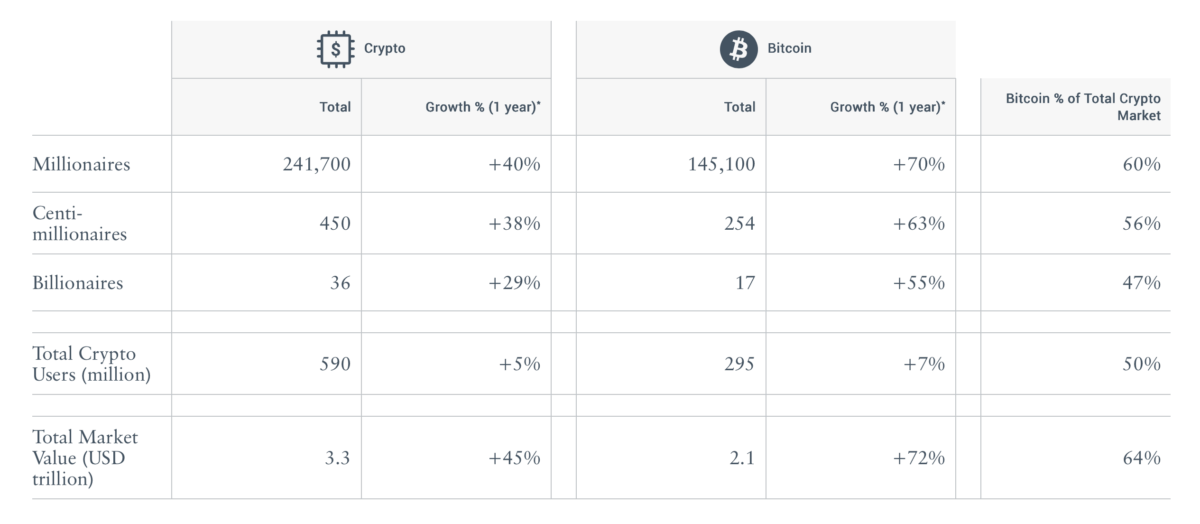
The number of people who became millionaires from the cryptocurrency space has jumped to 241,700 as of June 2025, according to Crypto Wealth Report 2025 released by Henley & Partners in collaboration with New World Wealth.

Bitcoin Led Wealth Creation with 45%

According to the research, this is 40% more compared to last year, with a total wealth valued at $3.3 trillion, up 45% from 2024. Bitcoin took the lead with the number of Bitcoin millionaires climbing 70% to 145,100 holders, while 17 of the 36 global crypto billionaires gained most of their fortunes from Bitcoin.

The report further says that 450 people now own more than $100 million or more in crypto, which is 38% from last year. The report described this as a “historic” wealth boom, thanks to institutions that are now taking interest in the market, and the increase in use globally. 

Overall, about 590 million people, roughly 7.4% of the world’s population, own cryptocurrency today, with 295 million holding Bitcoin. However, crypto millionaires represent only 0.4% of the world’s 60 million millionaires, according to UBS.
The Crypto Wealth Statistic
The crypto wealth statistic | Source: Henley & Partners

More Real Life Use Than Before

Dominic Volek, head of private clients at Henley & Partners, explains in a post on X that crypto wealth is now deeply tied to global mobility and investment choices. 

“Our data-driven evaluation of the world’s most crypto-friendly investment migration programs empowers clients to build globally diversified portfolios of alternative residence and citizenship options — unlocking tax efficiency, asset protection, and mobility in a world where geography is no longer a constraint, but a choice.” he wrote 

Meanwhile, governments are also beginning to adapt to this borderless wealth. For instance, countries like St. Kitts & Nevis, Panama, and the UAE now accept crypto payment for real estate tied to citizenship or residency programs.

“These programs only started accepting crypto in late 2023 and 2024, so there’s years of pent-up demand finally finding an outlet,” he said. For many investors, paying with crypto is not only faster but can be used to avoid taxes and fees that come with converting digital assets into traditional currency.

The Future of Borderless Wealth

However, Regulators still remain worried about how volatile the market is. Also the matter of money laundering is still a concern as well. But Volek argues that blockchain often makes money trails clearer than traditional banking.

The report also ranked the most crypto-friendly countries based on regulation, taxation, infrastructure, and innovation. Singapore, Hong Kong, and the United States lead the list, while the UAE and Monaco attract investors with zero taxes on crypto trading and income. 

Also Read: Société Générale and Bullish Launch First MiCA-Regulated Stablecoin


Mobile Only Image

Trending Cryptos

Related Reads

a16z: In the AI Era, Company Competition for Talent Starts with Job Title Naming

The article discusses how companies in the AI era are competing for talent through strategic "title arbitrage," or the renaming of key roles to reflect and attract new, high-value capabilities. It uses Palantir's creation of the "Forward-Deployed Engineer" (FDE) as a prime example. This title reframed client-facing technical work from a peripheral "implementation" role into a core, high-status engineering function. The move was strategic, allowing Palantir to attract talent that blended technical skill with business acumen and to dominate the market's perception of this capability. The piece argues that job titles are an organizational language that signals the value and authority of certain work. Effective new titles, like "Data Scientist" or "Site Reliability Engineer," emerge when a role's strategic importance genuinely outgrows its old name. Conversely, mere title inflation without substantive change is ineffective. For AI companies, particularly in B2B, this is a crucial strategy. AI transformation creates new high-leverage roles (e.g., "Legal Engineer," "GTM Engineer") that combine domain expertise with technical automation. By naming these roles, a company can help clients internally legitimize these change-makers. This, in turn, builds market mindshare, associating the company with the new capability. In conclusion, as AI blurs the lines between product and service, the ability to accurately name and organize the critical, client-adjacent work that defines product learning will be a key competitive advantage. The first to define this new organizational language plants a flag in the market's mind.

marsbit31m ago

a16z: In the AI Era, Company Competition for Talent Starts with Job Title Naming

marsbit31m ago

Interview with Strategy CEO: Can STRC Recover After Selling Bitcoin?

Interview with Strategy CEO Phong Le on the recent sale of 32 Bitcoin and its impact. He clarifies the move was a small, strategic action to demonstrate liquidity to debt holders, test internal processes, and prove operational discipline—not a response to fears of a "death spiral" from DeFi protocols leveraging STRC (Strategy's preferred stock product), which he notes holds less than 10% of STRC. Le emphasizes Strategy’s long-term focus as the largest corporate Bitcoin holder, using the adage that markets are a "voting machine" short-term but a "weighing machine" long-term. Decision-making is data-driven, involving the board, complex modeling, and multiple stakeholder considerations, moving beyond a founder-centric model. He outlines various capital options but stresses the strategic importance of "doing nothing" as a valid choice, citing resilience built during the 2022 bear market. Le expresses unwavering belief in Bitcoin's foundational value for global sovereignty and its future role in an AI-driven economy with trillions of autonomous agents. Addressing STRC's current price below its $100 face value, Le explains recent pressure was due to using dollar reserves for bond buybacks. He expects STRC to return to par as reserves are replenished and its semi-monthly dividend payments begin, noting the product is heavily over-collateralized. Finally, Le confirms the company sold Bitcoin the week prior to May 31st, as disclosed in an 8-K filing, leaving prediction market interpretations to others. The overarching philosophy remains "Spread Bitcoin with love," embracing all methods of gaining Bitcoin exposure.

marsbit1h ago

Interview with Strategy CEO: Can STRC Recover After Selling Bitcoin?

marsbit1h ago

IOSG Founder: Ethereum Doesn't Need Another Leap of Technical Faith, It Needs a Musk-style Compromise

Jocy, founder of IOSG Ventures, argues that Ethereum does not need renewed technological faith but a "Musk-like compromise." The recent formation of ETHLabs—funded by major ETH holders like BitMine and Lubin—highlights a market-driven move to fill a gap left by the Ethereum Foundation (EF), signaling a loss of confidence in its decentralized, hands-off approach. The core critique contrasts Vitalik Buterin's (V) idealistic, technology-first vision with Elon Musk's pragmatic, business-driven execution. The author asserts Ethereum's current shortage is not another technical roadmap but a clear, real-world application narrative and a leader willing to engage directly with commercial realities—like Musk. Internal issues are emphasized, citing EF's management problems and talent drain. While the new decentralized model with independent nodes like ETHLabs addresses the single foundation's limitations, it risks fragmentation without cohesive direction. True cohesion, the author suggests, must come from a shared, compelling narrative around ETH's value, not just from aligned financial interests. Independence claims for new entities are seen as aspirational, needing years of transparency to build trust. The ultimate threat is not competitors like Solana, but the broader shift of attention and talent toward AI. Ethereum has a limited window—12 to 18 months—to recapture focus by delivering tangible, real-world applications. The conclusion urges V to shift from abstract ideals to grounded, pragmatic leadership. The time for this crucial pivot is running out.

marsbit2h ago

IOSG Founder: Ethereum Doesn't Need Another Leap of Technical Faith, It Needs a Musk-style Compromise

marsbit2h ago

Trading

Spot
Futures

Hot Articles

How to Buy PEOPLE

Welcome to HTX.com! We've made purchasing ConstitutionDAO (PEOPLE) simple and convenient. Follow our step-by-step guide to embark on your crypto journey.Step 1: Create Your HTX AccountUse your email or phone number to sign up for a free account on HTX. Experience a hassle-free registration journey and unlock all features.Get My AccountStep 2: Go to Buy Crypto and Choose Your Payment MethodCredit/Debit Card: Use your Visa or Mastercard to buy ConstitutionDAO (PEOPLE) instantly.Balance: Use funds from your HTX account balance to trade seamlessly.Third Parties: We've added popular payment methods such as Google Pay and Apple Pay to enhance convenience.P2P: Trade directly with other users on HTX.Over-the-Counter (OTC): We offer tailor-made services and competitive exchange rates for traders.Step 3: Store Your ConstitutionDAO (PEOPLE)After purchasing your ConstitutionDAO (PEOPLE), store it in your HTX account. Alternatively, you can send it elsewhere via blockchain transfer or use it to trade other cryptocurrencies.Step 4: Trade ConstitutionDAO (PEOPLE)Easily trade ConstitutionDAO (PEOPLE) on HTX's spot market. Simply access your account, select your trading pair, execute your trades, and monitor in real-time. We offer a user-friendly experience for both beginners and seasoned traders.

7.2k Total ViewsPublished 2024.03.29Updated 2026.06.02

How to Buy PEOPLE

Discussions

Welcome to the HTX Community. Here, you can stay informed about the latest platform developments and gain access to professional market insights. Users' opinions on the price of PEOPLE (PEOPLE) are presented below.

活动图片