Bitcoin Poised To Rival Gold In Central Bank Vaults By 2030: Deutsche Bank

bitcoinistPublished on 2025-09-23Last updated on 2025-09-23

Abstract

Deutsche Bank’s Research Institute argues that Bitcoin is on track to sit alongside gold in central bank reserves by the...

Trusted Editorial content, reviewed by leading industry experts and seasoned editors. Ad Disclosure

Deutsche Bank’s Research Institute argues that Bitcoin is on track to sit alongside gold in central bank reserves by the end of this decade, provided current adoption and market-structure trends persist. In a paper published on September 22, 2025, research analysts Marion Laboure and Camilla Siazon conclude “there is room for both gold and Bitcoin to coexist on central bank balance sheets by 2030,” positioning the two assets as complementary hedges rather than competitors for the same reserve slot.

Central Banks Will Embrace Bitcoin Like Gold By 2030

The report frames its thesis against a year in which gold has again validated its defensive role. Spot prices set a record high above $3,700 per ounce in September, buoyed by geopolitical uncertainty, continued central-bank purchases, expectations of additional Federal Reserve rate cuts, and questions about Fed independence. Those drivers, the authors note, have reinforced gold’s status as a safe-haven and a core portfolio diversifier for official institutions.

Running in parallel, Bitcoin has displayed uncharacteristic composure at elevated price levels. After surpassing $123,500 on August 15, the asset has traded close to all-time highs, which Deutsche Bank reads as evidence of deepening institutional adoption and an “emerging status as a potential macro hedge.” The authors explicitly evaluate whether Bitcoin meets key reserve-asset criteria—volatility, liquidity, strategic value and trust—and find that while it still falls short on trust and transparency today, its trajectory resembles an earlier phase in gold’s own evolution.

A central plank of the case is volatility. The analysts acknowledge that Bitcoin “still lacks key components of a reserve asset: trust and transparency,” yet argue that the market’s maturation is beginning to compress realized swings.

They point to a notable marker in August, when Bitcoin’s 30-day volatility declined to 23% even as spot prices pushed to records. That “combination suggests we may be witnessing the start of a gradual decoupling between Bitcoin’s spot prices and volatility as the crypto’s integration into portfolios is maturing,” potentially signaling a more durable regime change beyond episodic speculation.

Regulatory clarity is cast as the catalyst: with US initiatives, the EU’s MiCA framework and the UK FCA’s crypto roadmap “accelerating,” Deutsche Bank expects deeper liquidity and, over time, lower volatility—preconditions for reserve acceptance.

Will Bitcoin Replace The US Dollar?

The authors are careful not to overstate Bitcoin’s endgame. They write that neither Bitcoin nor gold is likely to supplant the US dollar as the primary reserve asset or payment medium. History is instructive: in the 1930s and 1970s, US authorities deliberately curtailed the international system’s reliance on gold when it was seen as threatening dollar primacy.

Policymakers today, the report contends, will likewise ensure that Bitcoin and other digital assets “do not threaten the sovereignty of their currencies.” In other words, coexistence on balance sheets does not equate to displacement of the dollar at the system’s core.

If the destination is coexistence, the portfolio case hinges on diversification properties—and here Deutsche Bank presents a decade-plus of correlation data. Since 2011, Bitcoin’s correlations have been low or near-zero with most traditional assets, while remaining tightly linked to Ethereum.

The figures cited are 79% with Ethereum, 12% with the Russell 2000, 10% with the S&P 500, 8% with the Nasdaq 100, 3% with gold, 1% with WTI crude, 1% with US 10-year Treasuries, 1% with 2-year Treasuries, and −7% with the US Dollar Index.

Gold’s pattern over the same period looks markedly different: stronger positive correlations with rates markets (30% with the 10-year, 25% with the 2-year), modest positive links to equities and commodities (12% with both the S&P 500 and Russell 2000; 14% with WTI; 9% with the Nasdaq; 11% with Ethereum; 8% with Bitcoin), and a pronounced negative relationship with the Dollar Index at −48%.

Taken together, the series imply that gold and Bitcoin diversify across different channels: gold against dollar strength and real rates, Bitcoin against risk factors that do not neatly map onto traditional macro exposures. That complementarity underpins the reserve-allocation logic.

The historical analogy is explicit. “This time is not different,” the authors write, arguing that gold “was once subject to skepticism, suspicion and demand speculation,” and that its path to reserve orthodoxy was marked by episodes of volatility and sentiment swings.

These Central Banks Could Adopt BTC First

They see Bitcoin adoption continuing as demographics, macro conditions and—crucially—time allow more of the public to “embrace Bitcoin as a store of value.” In their view, the trend is secular rather than cyclical, with human preference periodically shifting toward alternative assets that sit outside conventional financial architecture. “So long as we are human,” they add, “Bitcoin and other alternative assets will likely continue to compete for our attention.”

The geography of adoption matters as well. Deutsche Bank sees a particularly strong reserve-use case in emerging markets, where capital controls and currency instability are recurring features. Citing countries such as Argentina, Egypt and Nigeria, the paper argues that Bitcoin can help holders circumvent capital controls and is “increasingly seen as a workable alternative to relatively unstable local currencies.” That argument does not require global monetary hegemony; it requires localized, functional demand and the institutional arrangements—custody, liquidity, regulatory guardrails—that make such demand durable.

What would get Bitcoin into central bank vaults? The report’s answer is incrementalism. Greater regulatory harmonization, rising transaction volumes and progressively deeper two-way liquidity are expected to continue compressing volatility and addressing the trust deficit.

The authors frame Bitcoin and gold not as substitutes vying for a single reserve slot, but as “complementary diversifications to central bank portfolios” owing to their low correlations with other asset classes, relatively scarce supplies, and roles as hedges against inflation and geopolitical risk. The institutional North Star remains unchanged—dollar centrality and currency sovereignty. Within that architecture, however, Deutsche Bank’s base case is a steady broadening of the reserve palette.

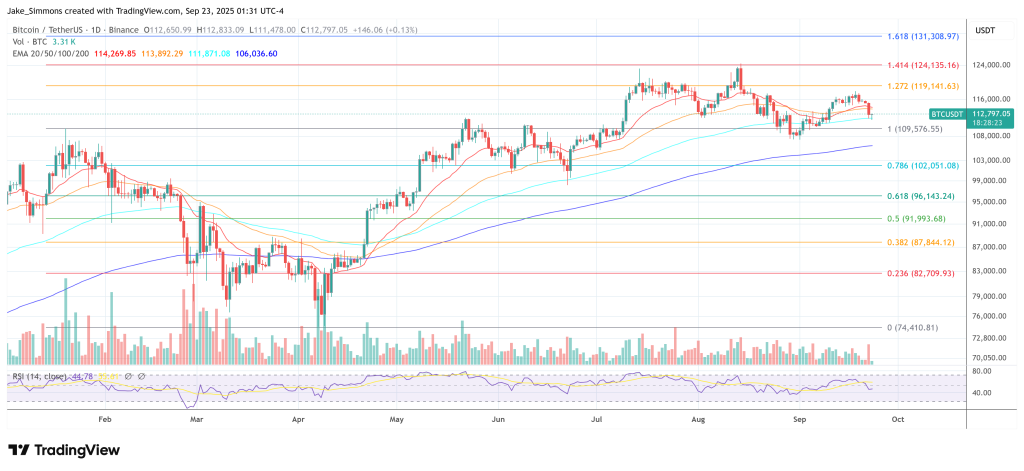
At press time, BTC traded at $112,797.
Bitcoin price
BTC is back below $113,000, 1-day chart | Source: BTCUSDT on TradingView.com
Featured image created with DALL.E, chart from TradingView.com
Editorial Process for bitcoinist is centered on delivering thoroughly researched, accurate, and unbiased content. We uphold strict sourcing standards, and each page undergoes diligent review by our team of top technology experts and seasoned editors. This process ensures the integrity, relevance, and value of our content for our readers.

Jake Simmons has been a Bitcoin enthusiast since 2016. Ever since he heard about Bitcoin, he has been studying the topic every day and trying to share his knowledge with others. His goal is to contribute to Bitcoin's financial revolution, which will replace the fiat money system. Besides BTC and crypto, Jake studied Business Informatics at a university. After graduation in 2017, he has been working in the blockchain and crypto sector. You can follow Jake on Twitter at @realJakeSimmons.

Trending Cryptos

Related Reads

The Full Story of How Crypto Unicorn Blockstream Is Mired in Serious Fraud Allegations

This article details serious allegations of fraud against Bitcoin infrastructure company Blockstream, founded by Bitcoin pioneer Adam Back. In June 2024, investigative account NatInfoSec published a report accusing Blockstream's mining note (BMN) program of potentially operating a multi-billion dollar scheme with Ponzi-like characteristics. The core allegations focus on Blockstream Mining Notes (BMNs), which offer investors fixed annual yields up to approximately 20% from Bitcoin mining. NatInfoSec's investigation raises several key issues: 1. **Suspicious Hashrate & Payout Capacity**: The analysis suggests Blockstream would need 20-45 EH/s of mining power to cover its BMN obligations, but its public dashboard shows only around 15 EH/s. Furthermore, no verifiable public evidence (e.g., grid connection records, import data) was found to support the massive mining operation required. 2. **Questionable Payout Source**: The BMN contract allows Blockstream to use Bitcoin from *any source* (Substitute Performance BTC) to fulfill investor payouts, raising concerns that payouts may not come from actual mining revenue. 3. **High-Risk, Fixed Returns**: Offering ~20% fixed yields in the volatile, cyclical Bitcoin mining industry is viewed as highly unusual and requires clear explanation. 4. **Undisclosed Criminal Record of Key Figure**: Christopher William Cook, a key figure in Blockstream's mining operations and CEO of spin-off Exacore, was found to have a federal felony conviction for mail fraud in 2008, a fact not disclosed in BMN offering documents. His background was also allegedly embellished. 5. **Potential Contagion to BSTR SPAC**: Questions were raised about whether these liabilities and Cook's record should have been disclosed in the SEC filings for Bitcoin Standard Treasury Company (BSTR), a separate Adam Back-associated firm planning a SPAC merger. The crypto community is divided. BitMEX Research validated Cook's criminal record and expressed concern over the high yields but found other evidence lacking or misleading, noting the legal separation between BMN, Blockstream, and BSTR. Blockstream defenders, like Samson Mow, argue the mining is real. Critics, however, emphasize the lack of independent, verifiable proof of the mining operation's scale and the true source of investor payouts. The article concludes that BMN remains shrouded in key unanswered questions regarding its actual size, the verifiability of its underlying mining assets and payouts, the source of its high yields, and the full role and disclosure concerning Chris Cook. Blockstream had not issued a comprehensive response at the time of writing.

marsbit29m ago

The Full Story of How Crypto Unicorn Blockstream Is Mired in Serious Fraud Allegations

marsbit29m ago

The Full Story Behind Encryption Unicorn Blockstream's Deep Entanglement in Serious Fraud Allegations

This article details allegations of serious fraud surrounding the crypto company Blockstream, founded by Bitcoin pioneer Adam Back. Investigation account NatInfoSec accuses Blockstream of raising billions through its Blockstream Mining Note (BMN) products, which offer high fixed yields of up to 20% from purported mining revenue. The core allegations are: 1) Blockstream's public mining hash rate (15 EH/s) appears insufficient to cover the massive payout obligations from sold BMN notes, raising questions about the true source of investor payouts. 2) Key executive Christopher William Cook, central to the mining operations, has a prior federal conviction for mail fraud, a fact not disclosed to investors. Cook's background and lavish lifestyle are highlighted as red flags. 3) The structure allows payouts from any source of BTC, not necessarily mining revenue, which critics argue gives it Ponzi-like characteristics. The controversy also touches on Bitcoin Standard Treasury Company (BSTR), a related entity planning a SPAC上市. Critics question whether BMN's liabilities and Cook's record should be disclosed in BSTR's filings. BitMEX Research offered a tempered analysis, confirming Cook's criminal record is likely true and the high yields concerning, but found other claims like insufficient抵押证据 less substantiated. Community debate centers on the need for verifiable proof of Blockstream's mining output and revenue. The article concludes that while fraud is not proven, BMN presents significant, unresolved questions regarding its actual scale, the source of its high fixed returns, the verifiability of its mining operations and payouts, and the full disclosure of associated risks and personnel backgrounds. Blockstream has not yet issued a formal response.

链捕手1h ago

The Full Story Behind Encryption Unicorn Blockstream's Deep Entanglement in Serious Fraud Allegations

链捕手1h ago

Trading

Spot
Futures

Hot Articles

What is $BITCOIN

DIGITAL GOLD ($BITCOIN): A Comprehensive Analysis Introduction to DIGITAL GOLD ($BITCOIN) DIGITAL GOLD ($BITCOIN) is a blockchain-based project operating on the Solana network, which aims to combine the characteristics of traditional precious metals with the innovation of decentralized technologies. While it shares a name with Bitcoin, often referred to as “digital gold” due to its perception as a store of value, DIGITAL GOLD is a separate token designed to create a unique ecosystem within the Web3 landscape. Its goal is to position itself as a viable alternative digital asset, although specifics regarding its applications and functionalities are still developing. What is DIGITAL GOLD ($BITCOIN)? DIGITAL GOLD ($BITCOIN) is a cryptocurrency token explicitly designed for use on the Solana blockchain. In contrast to Bitcoin, which provides a widely recognized value storage role, this token appears to focus on broader applications and characteristics. Notable aspects include: Blockchain Infrastructure: The token is built on the Solana blockchain, known for its capacity to handle high-speed and low-cost transactions. Supply Dynamics: DIGITAL GOLD has a maximum supply capped at 100 quadrillion tokens (100P $BITCOIN), although details regarding its circulating supply are currently undisclosed. Utility: While precise functionalities are not explicitly outlined, there are indications that the token could be utilized for various applications, potentially involving decentralized applications (dApps) or asset tokenization strategies. Who is the Creator of DIGITAL GOLD ($BITCOIN)? At present, the identity of the creators and development team behind DIGITAL GOLD ($BITCOIN) remains unknown. This situation is typical among many innovative projects within the blockchain space, particularly those aligning with decentralized finance and meme coin phenomena. While such anonymity may foster a community-driven culture, it intensifies concerns about governance and accountability. Who are the Investors of DIGITAL GOLD ($BITCOIN)? The available information indicates that DIGITAL GOLD ($BITCOIN) does not have any known institutional backers or prominent venture capital investments. The project seems to operate on a peer-to-peer model focused on community support and adoption rather than traditional funding routes. Its activity and liquidity are primarily situated on decentralized exchanges (DEXs), such as PumpSwap, rather than established centralized trading platforms, further highlighting its grassroots approach. How DIGITAL GOLD ($BITCOIN) Works The operational mechanics of DIGITAL GOLD ($BITCOIN) can be elaborated on based on its blockchain design and network attributes: Consensus Mechanism: By leveraging Solana’s unique proof-of-history (PoH) combined with a proof-of-stake (PoS) model, the project ensures efficient transaction validation contributing to the network's high performance. Tokenomics: While specific deflationary mechanisms have not been extensively detailed, the vast maximum token supply implies that it may cater to microtransactions or niche use cases that are still to be defined. Interoperability: There exists the potential for integration with Solana’s broader ecosystem, including various decentralized finance (DeFi) platforms. However, the details regarding specific integrations remain unspecified. Timeline of Key Events Here is a timeline that highlights significant milestones concerning DIGITAL GOLD ($BITCOIN): 2023: The initial deployment of the token occurs on the Solana blockchain, marked by its contract address. 2024: DIGITAL GOLD gains visibility as it becomes available for trading on decentralized exchanges like PumpSwap, allowing users to trade it against SOL. 2025: The project witnesses sporadic trading activity and potential interest in community-led engagements, although no noteworthy partnerships or technical advancements have been documented as of yet. Critical Analysis Strengths Scalability: The underlying Solana infrastructure supports high transaction volumes, which could enhance the utility of $BITCOIN in various transaction scenarios. Accessibility: The potential low trading price per token could attract retail investors, facilitating wider participation due to fractional ownership opportunities. Risks Lack of Transparency: The absence of publicly known backers, developers, or an audit process may yield skepticism regarding the project's sustainability and trustworthiness. Market Volatility: The trading activity is heavily reliant on speculative behavior, which can result in significant price volatility and uncertainty for investors. Conclusion DIGITAL GOLD ($BITCOIN) emerges as an intriguing yet ambiguous project within the rapidly evolving Solana ecosystem. While it attempts to leverage the “digital gold” narrative, its departure from Bitcoin's established role as a store of value underscores the need for a clearer differentiation of its intended utility and governance structure. Future acceptance and adoption will likely depend on addressing the current opacity and defining its operational and economic strategies more explicitly. Note: This report encompasses synthesised information available as of October 2023, and developments may have transpired beyond the research period.

441 Total ViewsPublished 2025.05.13Updated 2025.05.13

What is $BITCOIN

Discussions

Welcome to the HTX Community. Here, you can stay informed about the latest platform developments and gain access to professional market insights. Users' opinions on the price of BTC (BTC) are presented below.

活动图片