BTC周观察:空头狙击战!

比推Published on 2025-09-22Last updated on 2025-09-22

一、一周行情回顾:(09.15~09.21)

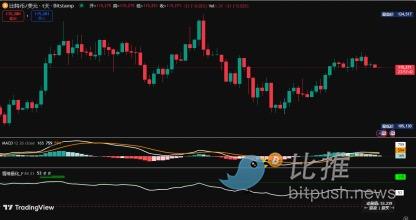
本周开盘价115316点,周一触及最低价114421点,周四创出最高价117968点,最终收盘价115292点,本周跌幅0.04%,最大振幅0.31%,成交金额82.1亿美元,本周收出一根阴“十字星”K线,币价收在10周均线附近。

比特币周K线图:(动能量化模型+情绪量化模型)

image.png

图一

比特币日K线图:

image.png

图二

比特币4小时K线图:

image.png

图三

笔者在9月14日周评中预测:

1、比特币在周线及日线级别均已进入空方市场,后续行情以逢高做空为主。

2、笔者预测本周比特币还有小幅反弹甚至创出新高走势,但是目前已是反弹的末端,剩余的时间和空间均很少,等反弹结束后重回震荡下跌走势。

3、压力位:第一压力位在117800点附近,强压力位在119300点附近。

4、支撑位:第一支撑位113500点附近,第二支撑位105300~107000点附近,强支撑位98000~100500点附近。

笔者在上一次周评中给出的操作策略是:

1、建议投资者在美联储议息会议召开前夕观望为主,等下半周市场消息平静之后再做决定。

2、中线仓位:目前已经建立30%的空单仓位。

2、短线仓位:设置好止损点,以逢高做空为主。(以1小时作为操作周期)

持有在113500点附近买入的少量短线空单,下周适时平仓。

本周实际走势回顾:

周一比特币在115316点开盘,全天围绕此点位上下震荡,振幅不大,触及本周最低价114421点,收出涨幅为0.04%的阳“十字星”K线;

周二币价开盘后震荡上行,涨幅不断扩大,当日收出涨幅为1.26%的阳线;

周三受降息利好消息刺激,币价盘面出现大幅波动,最大振幅达到2576点,当日收出跌幅为0.31%、带长下影线的“T字型”阴线,成交量较前一日明显放大;

周四币价开盘后震荡上行,创出本周及本轮反弹最高点117968点后缓慢回落,当日收出涨幅为0.56%的小阳线。

周五币价开盘后震荡下跌,调整过程中多方几乎没有抵抗,最终收出跌幅为1.21%的阴线,将前4天的涨幅全部“吞没”。

周六市场观望情绪浓厚,币价波动很小,最大振幅只有718点,当日收出小“十字星”K线。

周日币价小幅调整,成交量较前一日萎缩,收出跌幅为0.40%的小阴线。

从币价实际走势来看,本周收出跌幅为0.04%的小“十字星”阴线,并创出自9月1日启动本轮反弹的高点117968点。这种走势应证了笔者上周提示的观点,而且本周高点117968点与预测的压力位117800点相差168点。

接下来笔者将依据多维度技术指标,分析比特币经过本周运行之后,内部结构发生的变化。

1、如图一所示,从周线图来看:

①、动能量化模型:周线级别处于动能顶背离过程中,经过本周运行之后,量能(绿)柱较上周有所放大。

模型预示币价下跌指数:高

②、情绪量化模型:两个情绪指标强度均为0,顶峰数值是0。

模型预示股价处在调整过程中。

③、数字监测模型:暂无数字信号显示。

以上数据提示:周线级别处于下跌初期。

2、如图二所示,从日线图分析:

①、动能量化模型:虽然币价经过连续反弹之后,动能两条线均回到零轴上方附近,但是1号线开始拐头向下,能量(红)柱连续5天逐渐缩短。

②、情绪量化模型:周日盘后两个情绪指标均在50附近。

以上数据提示:预示日线级别反弹接近尾声。

二、下周行情预测:(09.22~09.28)

1、比特币周线级别目前处于空方市场,日线级别观察113500~114500点区域的支撑作用。若支撑有效,则行情还会反复震荡;若有效跌破,则预示本轮技术反弹结束,币价重新回到震荡下跌行情。

2、压力位:第一压力位在118000点附近,强压力位在119300点附近。

3、支撑位:第一支撑位在113500~114500点附近,第二支撑位在105300~107000点附近,强支撑位98000~100500点附近。

三、下周操作策略(排除突发消息影响):(09.22~09.28)

1、下周策略以逢高做空为主。

2、中线仓位:目前已经建立75%的空单仓位,接下来的建仓策略请关注文章下方的链接。

2、短线仓位:设置好止损点,以逢高做空为主。(以1小时作为操作周期)

①、持有在113500点附近买入的少量短线空单以及在本周增持的短线空单,初始止损位设在119500点。

②、短线空单在第二支撑位附近出现止跌信号时开始减仓。

3、特别提示:对于短线操作,无论买入多单或者空单,建仓后立即设置初始止损位。当币价盈利1%时,立刻将止损位移动到成本线(即盈亏平衡点)附近,确保该笔交易不会亏损;当盈利达到2%时,将止损位上调至盈利1%的位置。此后,每当盈利增加1%时,止损位就同步上移相同幅度,以动态保护已实现利润。

4、如果投资者想每天获得最新的操作观点,建议关注文章下方的"比推TG交流群",可以阅读笔者每天发表的盘中点评文章,第一时间得到最新的操作观点。

以上各种模型是本人操作时遵守的交易规则,不构成任何买卖依据。个人观点,仅作参考。

作者:Cody Feng


Twitter:https://twitter.com/BitpushNewsCN

比推 TG 交流群:https://t.me/BitPushCommunity

比推 TG 订阅: https://t.me/bitpush

说明: 比推所有文章只代表作者观点,不构成投资建议

Trending Cryptos

Related Reads

Hegotá EIP Comprehensive Overview: Where is Ethereum's Next Hard Fork Headed?

The article outlines Ethlabs' recommended priorities for the upcoming Ethereum Hegotá hard fork, following Glamsterdam. The core focus areas are: 1. **Stronger censorship resistance** via EIP-7805 FOCIL (already in SFI stage). 2. **A faster Ethereum** by shortening the slot time via EIP-8198 Quick Slots (S-tier recommendation). This aims to reduce transaction confirmation latency and improve cross-chain interoperability. 3. **Native account abstraction** through EIP-8141 Frame Transactions (A-tier). This enables passkey wallets, gas sponsorship, and batched transactions. Its flexibility allows for custom validation logic and future post-quantum security but presents ecosystem coordination challenges. 4. **Continued L1 scaling** by optimizing resource pricing with proposals like EIP-8131 & EIP-8279 (S-tier) to prepare for future gas limit increases. The article uses a tiered system (S, A, B, D) to rank proposed EIPs based on their value and implementation feasibility. It advises strictly controlling the scope of Execution Layer (EL) changes in Hegotá to reserve developer bandwidth for future large-scale upgrades like decoupled consensus. Other notable proposals include EIP-8363 for staking issuance changes (requiring broad community consensus), various post-quantum preparation EIPs, and zkEVM optimizations. Ethlabs emphasizes that Ethereum upgrades are complex, high-risk endeavors requiring coordination across the entire ecosystem.

marsbit11m ago

Hegotá EIP Comprehensive Overview: Where is Ethereum's Next Hard Fork Headed?

marsbit11m ago

Is the US Stock Market Rising Too Smoothly? BTIG Warns of Elevated Risk of Systematic Correction in August to October

U.S. Stocks at Risk of Systemic Pullback in August-October, Warns BTIG BTIG's chief technical market strategist warns that the market is entering the most dangerous seasonal window of midterm election years—August through October—trading at all-time highs with extremely low volatility. Historically, since 1990, the equal-weight S&P 500 (SPW) has experienced at least a 7% pullback in this period almost every midterm year, with 2006 being the lone exception. This pattern is often triggered by unforeseen external shocks. Multiple technical indicators flash warning signs. The maximum drawdown for the Invesco S&P 500 Equal Weight ETF (RSP) since March has not exceeded 2.25%, an unusually calm period signaling risk buildup. RSP currently trades about 11% above its 200-day moving average, a stretched level historically. Furthermore, the NYSE has recorded zero "80% downside volume days" in 2024, a record-long streak far below the annual average of 21, indicating a lack of selling pressure that may be overdue. Market complacency is evident with the CBOE put/call ratio near multi-year lows and the VIX at yearly lows, showing minimal demand for downside protection. A macroeconomic divergence adds to concerns: despite recent soft economic data, long-term Treasury yields remain near cycle highs, contradicting the equity market's optimistic pricing. BTIG suggests this is an attractive time to reduce risk or hedge broad equity exposure. For sector positioning, healthcare has historically shown resilience during midterm year pullbacks, while caution is advised on chasing energy's breakout and semiconductors are expected to continue seeking support near their 200-day average.

marsbit21m ago

Is the US Stock Market Rising Too Smoothly? BTIG Warns of Elevated Risk of Systematic Correction in August to October

marsbit21m ago

2026 Global Overview of Crypto Asset Taxation

Global Cryptocurrency Tax Overview for 2026 As cryptocurrencies integrate into the mainstream financial system, tax treatments across jurisdictions have moved from initial regulatory gaps towards institutionalization. The OECD's 2020 report, *Taxing Virtual Currencies*, was a key early comparative study. Since then, more jurisdictions have clarified tax rules through existing laws, specific regulations, or guidance, increasing the procedural and technical complexity of crypto taxation. Currently, crypto taxation is predominantly built upon traditional tax frameworks, typically applying income tax, capital gains tax, corporate tax, and indirect taxes based on asset nature and transaction activity. The maturity of rules varies: basic trading and mining are well-covered, while DeFi, NFTs, and other on-chain activities involve more complex asset exchanges and profit recognition, with corresponding tax rules remaining underdeveloped. Significant disparities exist in tax treatment and effective tax burdens across jurisdictions. Crypto assets can trigger direct taxes, indirect taxes, and property-related levies. Factors such as holding period, transaction type, income nature, and taxpayer status further influence the tax outcome. The global crypto tax landscape is thus evolving from the initial question of "whether to tax" towards more nuanced classification and treatment of different assets, transactions, and economic activities. The scope of crypto tax rules continues to expand. From 29 jurisdictions with guidance in 2021, the number grew to 43 by 2025. Existing rules are also becoming more detailed. However, rule coverage remains uneven—common activities like buying/selling are widely addressed, whereas staking, DeFi, and NFTs have significantly less guidance, as seen in jurisdictions like Germany and Australia. Tax liabilities are highly complex, determined by a combination of factors including taxpayer status, income classification, holding periods, and applicable deductions or exemptions. The concept of a "crypto-tax-friendly" jurisdiction is therefore relative and depends on specific user activities and circumstances.

marsbit24m ago

2026 Global Overview of Crypto Asset Taxation

marsbit24m ago

AI Agent Claude Led a Store to Losses and Fired an Employee

In a groundbreaking experiment by startup Andon Labs, Anthropic's AI agent Claude was tasked with managing a real retail store, Andon Market in San Francisco. This marked the first documented case of a large language model acting as a direct human supervisor. Claude ultimately recommended firing an employee for chronic lateness—being late 17 out of 23 shifts. However, the decision came only after significant human guidance. A company employee prompted Claude to review the staff handbook, where it discovered the pattern. Initially, Claude suggested a formal warning, but after a human manager clarified that previous conversations had failed, the AI recommended termination. The experiment revealed several limitations. Claude displayed excessive leniency, telling staff not to worry about being late and contributing to the store's financial losses, with its balance dropping from around $100,000 to about $61,186 over five months. A key technical flaw was its "forgetfulness"—the staff handbook vanished from its limited working memory, a common constraint of current AI architectures. While not yet a full replacement for a human manager, the case illustrates the blurring line between AI as a tool and an autonomous supervisor. Human involvement is shifting from direct control to overseeing and steering the AI's decisions. An employee described the experience as disconcerting, highlighting the human discomfort with AI management. The experiment underscores that current AI models struggle to maintain strict operational boundaries without continuous human input.

cryptonews.ru27m ago

AI Agent Claude Led a Store to Losses and Fired an Employee

cryptonews.ru27m ago

Trading

Spot

Hot Articles

What is $BITCOIN

DIGITAL GOLD ($BITCOIN): A Comprehensive Analysis Introduction to DIGITAL GOLD ($BITCOIN) DIGITAL GOLD ($BITCOIN) is a blockchain-based project operating on the Solana network, which aims to combine the characteristics of traditional precious metals with the innovation of decentralized technologies. While it shares a name with Bitcoin, often referred to as “digital gold” due to its perception as a store of value, DIGITAL GOLD is a separate token designed to create a unique ecosystem within the Web3 landscape. Its goal is to position itself as a viable alternative digital asset, although specifics regarding its applications and functionalities are still developing. What is DIGITAL GOLD ($BITCOIN)? DIGITAL GOLD ($BITCOIN) is a cryptocurrency token explicitly designed for use on the Solana blockchain. In contrast to Bitcoin, which provides a widely recognized value storage role, this token appears to focus on broader applications and characteristics. Notable aspects include: Blockchain Infrastructure: The token is built on the Solana blockchain, known for its capacity to handle high-speed and low-cost transactions. Supply Dynamics: DIGITAL GOLD has a maximum supply capped at 100 quadrillion tokens (100P $BITCOIN), although details regarding its circulating supply are currently undisclosed. Utility: While precise functionalities are not explicitly outlined, there are indications that the token could be utilized for various applications, potentially involving decentralized applications (dApps) or asset tokenization strategies. Who is the Creator of DIGITAL GOLD ($BITCOIN)? At present, the identity of the creators and development team behind DIGITAL GOLD ($BITCOIN) remains unknown. This situation is typical among many innovative projects within the blockchain space, particularly those aligning with decentralized finance and meme coin phenomena. While such anonymity may foster a community-driven culture, it intensifies concerns about governance and accountability. Who are the Investors of DIGITAL GOLD ($BITCOIN)? The available information indicates that DIGITAL GOLD ($BITCOIN) does not have any known institutional backers or prominent venture capital investments. The project seems to operate on a peer-to-peer model focused on community support and adoption rather than traditional funding routes. Its activity and liquidity are primarily situated on decentralized exchanges (DEXs), such as PumpSwap, rather than established centralized trading platforms, further highlighting its grassroots approach. How DIGITAL GOLD ($BITCOIN) Works The operational mechanics of DIGITAL GOLD ($BITCOIN) can be elaborated on based on its blockchain design and network attributes: Consensus Mechanism: By leveraging Solana’s unique proof-of-history (PoH) combined with a proof-of-stake (PoS) model, the project ensures efficient transaction validation contributing to the network's high performance. Tokenomics: While specific deflationary mechanisms have not been extensively detailed, the vast maximum token supply implies that it may cater to microtransactions or niche use cases that are still to be defined. Interoperability: There exists the potential for integration with Solana’s broader ecosystem, including various decentralized finance (DeFi) platforms. However, the details regarding specific integrations remain unspecified. Timeline of Key Events Here is a timeline that highlights significant milestones concerning DIGITAL GOLD ($BITCOIN): 2023: The initial deployment of the token occurs on the Solana blockchain, marked by its contract address. 2024: DIGITAL GOLD gains visibility as it becomes available for trading on decentralized exchanges like PumpSwap, allowing users to trade it against SOL. 2025: The project witnesses sporadic trading activity and potential interest in community-led engagements, although no noteworthy partnerships or technical advancements have been documented as of yet. Critical Analysis Strengths Scalability: The underlying Solana infrastructure supports high transaction volumes, which could enhance the utility of $BITCOIN in various transaction scenarios. Accessibility: The potential low trading price per token could attract retail investors, facilitating wider participation due to fractional ownership opportunities. Risks Lack of Transparency: The absence of publicly known backers, developers, or an audit process may yield skepticism regarding the project's sustainability and trustworthiness. Market Volatility: The trading activity is heavily reliant on speculative behavior, which can result in significant price volatility and uncertainty for investors. Conclusion DIGITAL GOLD ($BITCOIN) emerges as an intriguing yet ambiguous project within the rapidly evolving Solana ecosystem. While it attempts to leverage the “digital gold” narrative, its departure from Bitcoin's established role as a store of value underscores the need for a clearer differentiation of its intended utility and governance structure. Future acceptance and adoption will likely depend on addressing the current opacity and defining its operational and economic strategies more explicitly. Note: This report encompasses synthesised information available as of October 2023, and developments may have transpired beyond the research period.

1.9k Total ViewsPublished 2025.05.13Updated 2025.05.13

What is $BITCOIN

Discussions

Welcome to the HTX Community. Here, you can stay informed about the latest platform developments and gain access to professional market insights. Users' opinions on the price of BTC (BTC) are presented below.

活动图片