Crypto OI Shows Mixed Trend: Bitcoin, Solana Down, While Ethereum, XRP Up

bitcoinistPublished on 2025-09-19Last updated on 2025-09-19

Abstract

A divergence has formed in the crypto futures market during the past week as Bitcoin and Solana have seen deleveraging...

Trusted Editorial content, reviewed by leading industry experts and seasoned editors. Ad Disclosure

A divergence has formed in the crypto futures market during the past week as Bitcoin and Solana have seen deleveraging against the others.

Bitcoin, Solana Have Seen A Drop In Perpetual Futures Open Interest

In a new post on X, on-chain analytics firm Glassnode has talked about the latest trend in the Open Interest for Bitcoin and other top coins in the cryptocurrency sector.

The “Open Interest” here refers to an indicator that measures the total amount of perpetual futures positions related to a given asset that are currently open on all centralized derivatives exchanges.

When the value of this metric goes up, it means the investors are opening up fresh positions on the perpetual futures market. Generally, the total leverage present in the sector rises when this trend develops, so the asset’s price can become more unstable following it.

On the other hand, the indicator registering a decline implies holders are either closing up positions of their own volition or getting forcibly liquidated by their platform. Such a trend usually leads to a reduction in leverage, which can make the price act in a more stable manner.

Now, first, here’s a chart that shows the trend in the Open Interest for Bitcoin over the past week:
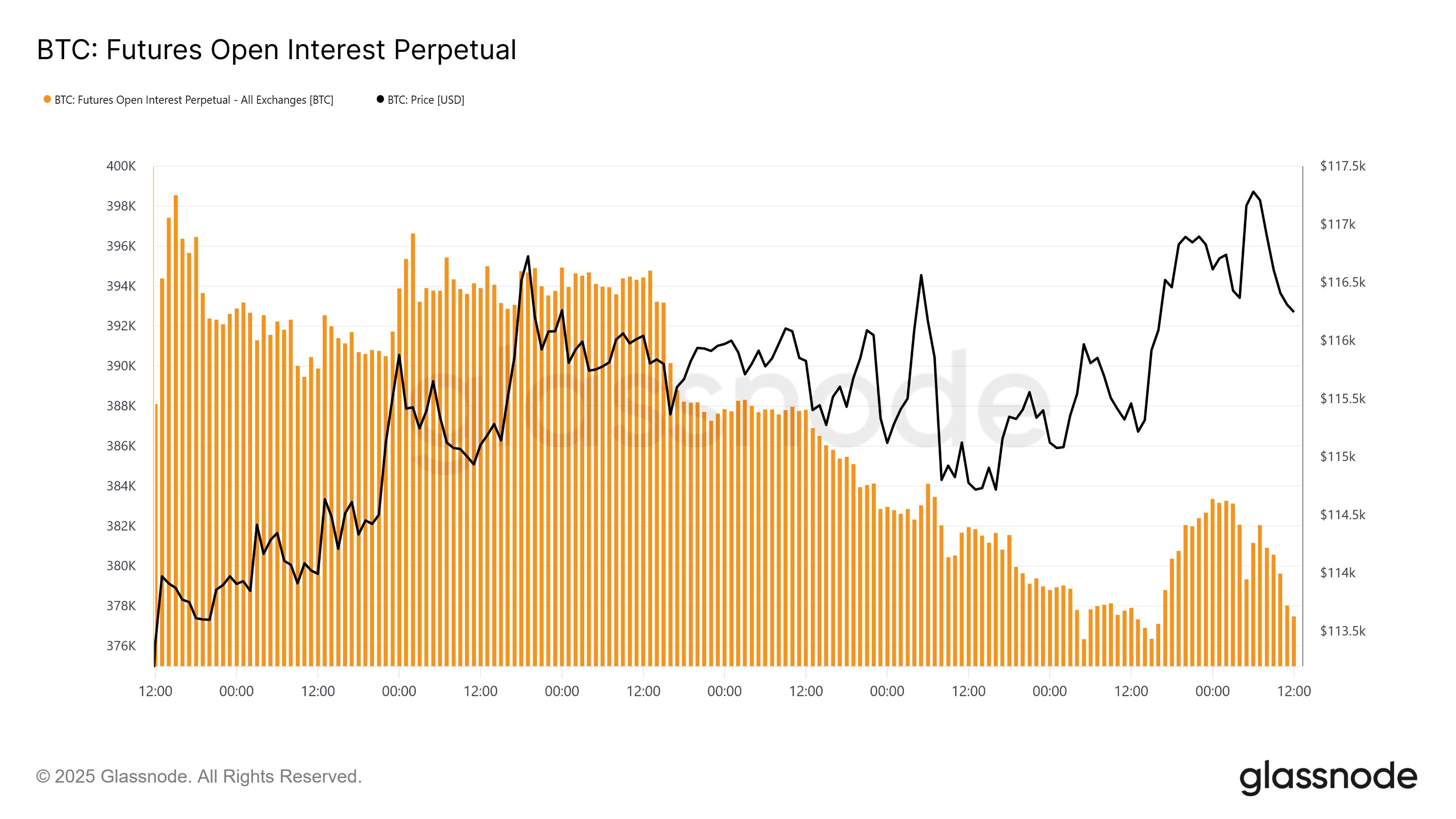
Bitcoin Open Interest

The value of the metric appears to have gone down inside this window | Source: Glassnode on X

As displayed in the above graph, the Bitcoin Open Interest has followed an overall downward trajectory in this period, a sign that a net amount of positions have disappeared.

Interestingly, this trend has developed alongside a recovery surge in the BTC price to the $117,000 level. Generally, rallies attract speculative activity so the indicator tends to rise with them, but it would appear that it hasn’t been the case this time around.

Solana, the cryptocurrency sixth largest by market cap, has seen a similar trajectory in its Open interest during the past week, as the below chart shows.
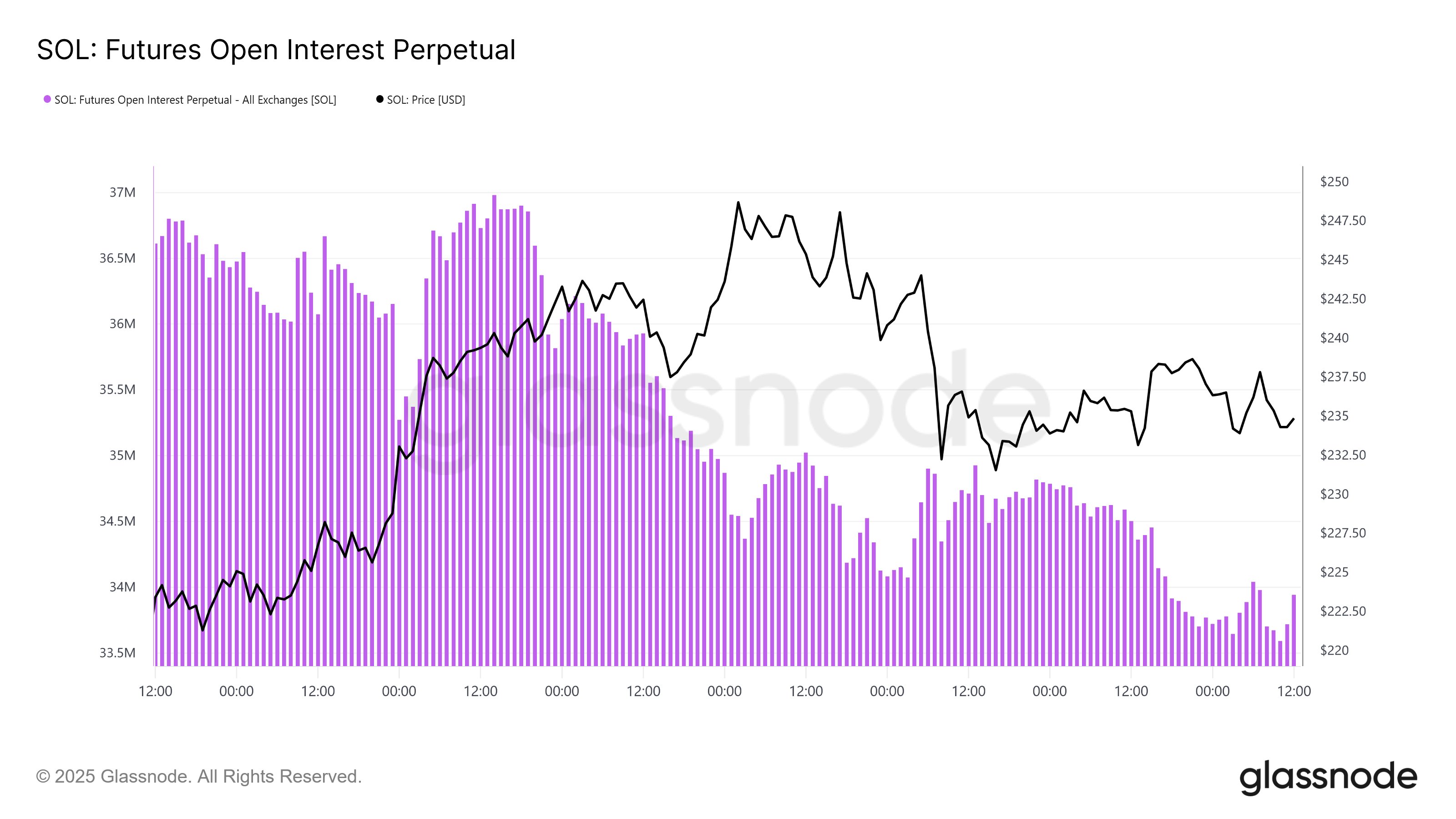
Solana Open Interest

The trend in the SOL Open Interest | Source: Glassnode on X

Thus, it seems both BTC and SOL have seen a cooldown in speculative activity even though their prices have witnessed a net increase over the past week. The same trend, however, hasn’t been seen with some of the other top digital assets.

The cryptocurrency number two only to Bitcoin, Ethereum, has witnessed a surge in the Open Interest, implying an increase in demand among the investors for leveraged positioning.
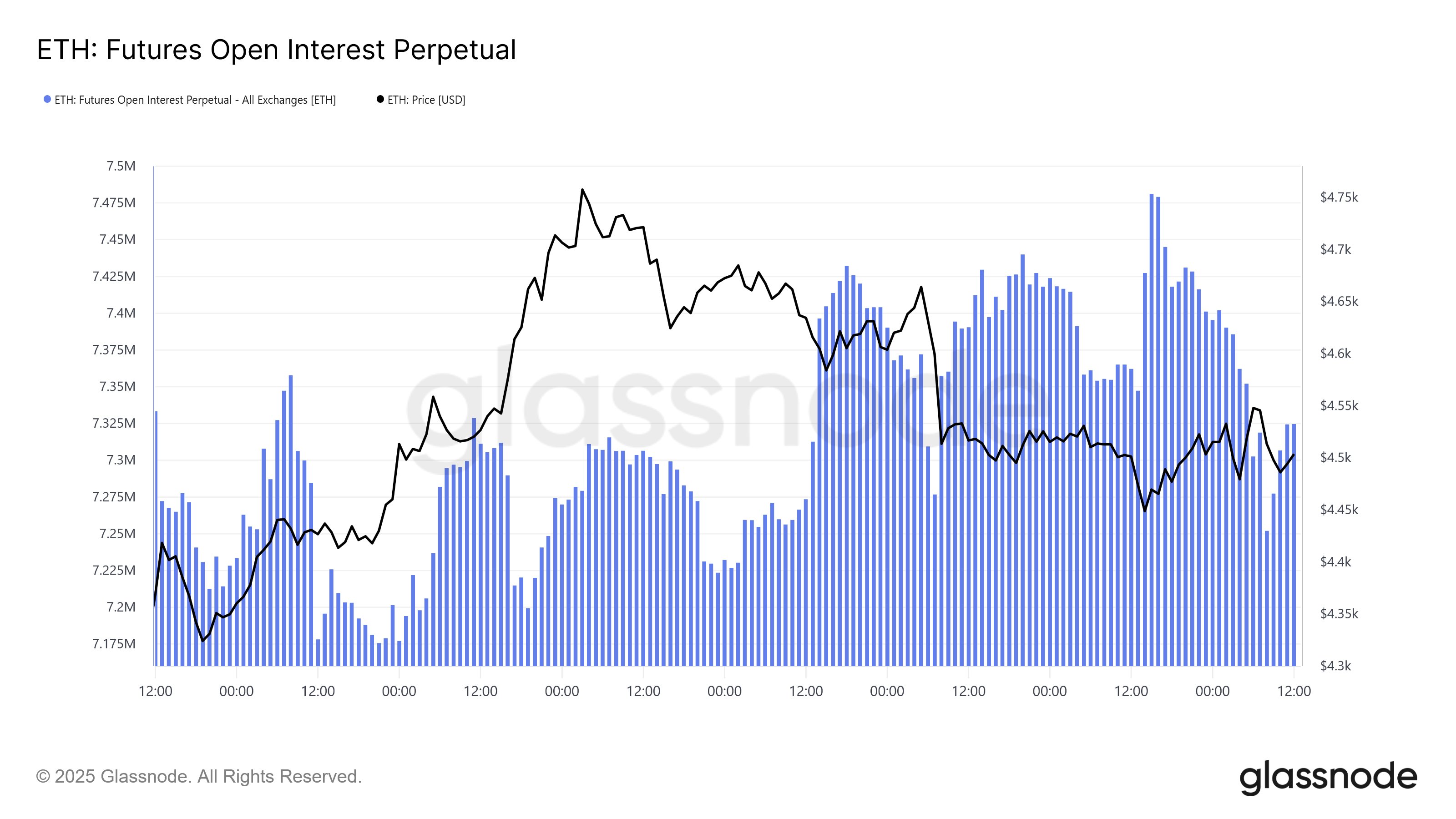
Ethereum Open Interest

Looks like the metric has gone up for ETH | Source: Glassnode on X

The analytics firm has pointed out that XRP and BNB have also observed a similar trend. Given this divergence that has formed between the assets, it’s possible that ETH and company may be in for higher volatility than BTC and SOL.

BTC Price

Bitcoin recovered to $117,900 on Wednesday, but it seems the coin has seen a minor pullback since then as it’s now back at $117,000.

Bitcoin Price Chart

How the price of the asset has moved during the last five days | Source: BTCUSDT on TradingView
Featured image from Dall-E, Glassnode.com, chart from TradingView.com
Editorial Process for bitcoinist is centered on delivering thoroughly researched, accurate, and unbiased content. We uphold strict sourcing standards, and each page undergoes diligent review by our team of top technology experts and seasoned editors. This process ensures the integrity, relevance, and value of our content for our readers.

Keshav is a Physics graduate who has been employed as a writer with Bitcoinist since June 2021. He is passionate about writing and through the years, he has gained experience working in a variety of niches. Keshav holds an active interest in the cryptocurrency market, with on-chain analysis being an area he particularly likes to research and write about.

Trending Cryptos

Related Reads

The Danger of Old Bookmarks: How an Expired Tornado Cash Domain Cost a User 1,000 ETH

A user lost over 1,010 ETH (worth millions) due to a phishing attack via an expired official domain of the Tornado Cash protocol. As reported on August 20, 2026, the domain `tornado.cash` was not renewed by the original developers amid U.S. OFAC sanctions and was subsequently registered by malicious actors. They deployed a fake frontend mimicking the legitimate Tornado Cash interface. Through this site, the attackers gained access to the user's deposit notes—the data required to withdraw funds from the protocol's pools—and drained the ETH within 12 hours. On-chain data shows the stolen funds (e.g., wallet 0xd8B356...) were withdrawn from Tornado Cash pools. However, on-chain analyst Specter cast doubt on the victim's story. He suggested the individual might be involved in illicit activity, noting that a large sum of BTC was received from a coin-mixing service (Whirlpool) and converted to ETH before being sent to the fake Tornado Cash site. The victim's explanation of urgently moving funds due to a compromised hardware wallet was questioned, as the fund trail indicated deliberate obfuscation. Specter speculated this might be a conflict between malicious actors rather than a simple phishing case. The incident highlights the danger of expired domains for major protocols, where old bookmarks can lead to compromised sites. WHOIS records show the domain was registered in March 2025. Broader analysis notes that in 2025, over $1.8 billion was lost to scams and exploits, largely through social engineering like phishing via familiar but hijacked links. This case underscores the persistent risk when a domain's legal status changes but user trust and search engine reputation remain.

cryptonews.ru39m ago

The Danger of Old Bookmarks: How an Expired Tornado Cash Domain Cost a User 1,000 ETH

cryptonews.ru39m ago

You'll Be Surprised How Much WeChat's Architecture Differs from Telegram's

An article compares the core architectural philosophies of WeChat and Telegram, highlighting fundamental differences in data storage, monetization, and developer ecosystems. **Data Storage:** Telegram offers unlimited, synchronized cloud storage for seamless access across all devices. In contrast, WeChat stores chat history locally on each device, requiring a manual migration process for transfer and tethering desktop sessions to an active smartphone. **Features & Ecosystem:** Telegram's open Bot API allows for easy, free bot creation, while WeChat's massive ecosystem of over 4.8 million "mini-programs" operates within a closed, curated, and more regulated platform. Commenting also differs: Telegram uses integrated discussion threads for channels, whereas WeChat relies on pre-moderated comments for official accounts and separate chats for interaction. **File Sharing & Payments:** Telegram supports large file transfers (up to 4GB for Premium), while WeChat limits most files to 200MB. A key divergence is in payments: WeChat Pay is deeply integrated into daily life and commerce in China, whereas Telegram lacks a comparable built-in fiat payment system, focusing instead on third-party bots and crypto. **Analysis:** The comparison reveals two distinct models: WeChat is a tightly integrated, closed ecosystem deeply embedded in the real economy, while Telegram prioritizes open protocols, flexible data handling, and low barriers for developers. An added perspective notes that WeChat's fusion of messaging and payments in a single interface without end-to-end encryption for chats potentially broadens the attack surface, raising security questions as more functions converge.

cryptonews.ru5h ago

You'll Be Surprised How Much WeChat's Architecture Differs from Telegram's

cryptonews.ru5h ago

Trading

Spot

Hot Articles

What is $BITCOIN

DIGITAL GOLD ($BITCOIN): A Comprehensive Analysis Introduction to DIGITAL GOLD ($BITCOIN) DIGITAL GOLD ($BITCOIN) is a blockchain-based project operating on the Solana network, which aims to combine the characteristics of traditional precious metals with the innovation of decentralized technologies. While it shares a name with Bitcoin, often referred to as “digital gold” due to its perception as a store of value, DIGITAL GOLD is a separate token designed to create a unique ecosystem within the Web3 landscape. Its goal is to position itself as a viable alternative digital asset, although specifics regarding its applications and functionalities are still developing. What is DIGITAL GOLD ($BITCOIN)? DIGITAL GOLD ($BITCOIN) is a cryptocurrency token explicitly designed for use on the Solana blockchain. In contrast to Bitcoin, which provides a widely recognized value storage role, this token appears to focus on broader applications and characteristics. Notable aspects include: Blockchain Infrastructure: The token is built on the Solana blockchain, known for its capacity to handle high-speed and low-cost transactions. Supply Dynamics: DIGITAL GOLD has a maximum supply capped at 100 quadrillion tokens (100P $BITCOIN), although details regarding its circulating supply are currently undisclosed. Utility: While precise functionalities are not explicitly outlined, there are indications that the token could be utilized for various applications, potentially involving decentralized applications (dApps) or asset tokenization strategies. Who is the Creator of DIGITAL GOLD ($BITCOIN)? At present, the identity of the creators and development team behind DIGITAL GOLD ($BITCOIN) remains unknown. This situation is typical among many innovative projects within the blockchain space, particularly those aligning with decentralized finance and meme coin phenomena. While such anonymity may foster a community-driven culture, it intensifies concerns about governance and accountability. Who are the Investors of DIGITAL GOLD ($BITCOIN)? The available information indicates that DIGITAL GOLD ($BITCOIN) does not have any known institutional backers or prominent venture capital investments. The project seems to operate on a peer-to-peer model focused on community support and adoption rather than traditional funding routes. Its activity and liquidity are primarily situated on decentralized exchanges (DEXs), such as PumpSwap, rather than established centralized trading platforms, further highlighting its grassroots approach. How DIGITAL GOLD ($BITCOIN) Works The operational mechanics of DIGITAL GOLD ($BITCOIN) can be elaborated on based on its blockchain design and network attributes: Consensus Mechanism: By leveraging Solana’s unique proof-of-history (PoH) combined with a proof-of-stake (PoS) model, the project ensures efficient transaction validation contributing to the network's high performance. Tokenomics: While specific deflationary mechanisms have not been extensively detailed, the vast maximum token supply implies that it may cater to microtransactions or niche use cases that are still to be defined. Interoperability: There exists the potential for integration with Solana’s broader ecosystem, including various decentralized finance (DeFi) platforms. However, the details regarding specific integrations remain unspecified. Timeline of Key Events Here is a timeline that highlights significant milestones concerning DIGITAL GOLD ($BITCOIN): 2023: The initial deployment of the token occurs on the Solana blockchain, marked by its contract address. 2024: DIGITAL GOLD gains visibility as it becomes available for trading on decentralized exchanges like PumpSwap, allowing users to trade it against SOL. 2025: The project witnesses sporadic trading activity and potential interest in community-led engagements, although no noteworthy partnerships or technical advancements have been documented as of yet. Critical Analysis Strengths Scalability: The underlying Solana infrastructure supports high transaction volumes, which could enhance the utility of $BITCOIN in various transaction scenarios. Accessibility: The potential low trading price per token could attract retail investors, facilitating wider participation due to fractional ownership opportunities. Risks Lack of Transparency: The absence of publicly known backers, developers, or an audit process may yield skepticism regarding the project's sustainability and trustworthiness. Market Volatility: The trading activity is heavily reliant on speculative behavior, which can result in significant price volatility and uncertainty for investors. Conclusion DIGITAL GOLD ($BITCOIN) emerges as an intriguing yet ambiguous project within the rapidly evolving Solana ecosystem. While it attempts to leverage the “digital gold” narrative, its departure from Bitcoin's established role as a store of value underscores the need for a clearer differentiation of its intended utility and governance structure. Future acceptance and adoption will likely depend on addressing the current opacity and defining its operational and economic strategies more explicitly. Note: This report encompasses synthesised information available as of October 2023, and developments may have transpired beyond the research period.

2.1k Total ViewsPublished 2025.05.13Updated 2025.05.13

What is $BITCOIN

Discussions

Welcome to the HTX Community. Here, you can stay informed about the latest platform developments and gain access to professional market insights. Users' opinions on the price of BTC (BTC) are presented below.

活动图片