Битва криптовалютных резервов: биткоин или Ethereum?

cryptonews.ruPublished on 2025-04-15Last updated on 2025-09-16

Компании и государства добавляют биткоин в свои резервы с растущей активностью. Сенатор США Синтия Ламмис (Cynthia Lummis) предложила законопроект о биткоине, который вынуждает казначейство США приобрести 1 млн BTC за пять лет для федерального резерва. В марте 2025 года президент Трамп объявил о создании Стратегического резерва биткоинов, финансируемого из конфискованных казначейством США криптовалют.

Почему корпорации выбирают криптовалютные резервы

Традиционно корпоративные резервы состояли из фиатных денег, золота и государственных облигаций для сохранения стоимости и обеспечения ликвидности. Однако деньги теряют покупательную способность, облигации несут процентные риски, а валютные шоки бьют по балансам без предупреждения.

Биткоин, Ethereum и стейблкоины теперь располагаются рядом с традиционными активами. Для корпораций задача проста: хеджировать инфляцию, диверсифицировать валютные риски, поддерживать круглосуточную ликвидность и тестировать цифровые расчеты. Для государств спектр расширяется до стратегических резервов, устойчивости к санкциям и доступа к нейтральной глобальной ликвидности.

Биткоин как цифровое золото

С момента появления биткоин занял уникальную позицию как первая и наиболее известная криптовалюта. Он привлекает резервы, стремящиеся защититься от инфляции и рисков традиционных валют.

Эль-Сальвадор создал сенсацию в 2021 году, приняв BTC как законное платежное средство, а такие страны, как Бутан, тихо включили биткоин в свои резервы. В корпоративном мире компания Strategy известна непрерывным приобретением BTC, сделав его основным активом в резервах.

Биткоин предлагает несколько преимуществ. Он высоколиквиден благодаря активным глобальным рынкам, дефицитен из-за ограниченного предложения и широко признан в финансовом мире. Для получения дохода с простаивающего BTC нужно сочетать его с внешними стратегиями кредитования или деривативов.

На 16 сентября 2025 года одна только Strategy контролирует приблизительно 638 985 BTC стоимостью в миллиарды долларов, демонстрируя долгосрочную стратегию удержания. Количество публичных компаний, владеющих BTC, выросло с 70 в декабре 2024 года до 134 к середине 2025 года, накопив почти 245 000 BTC.
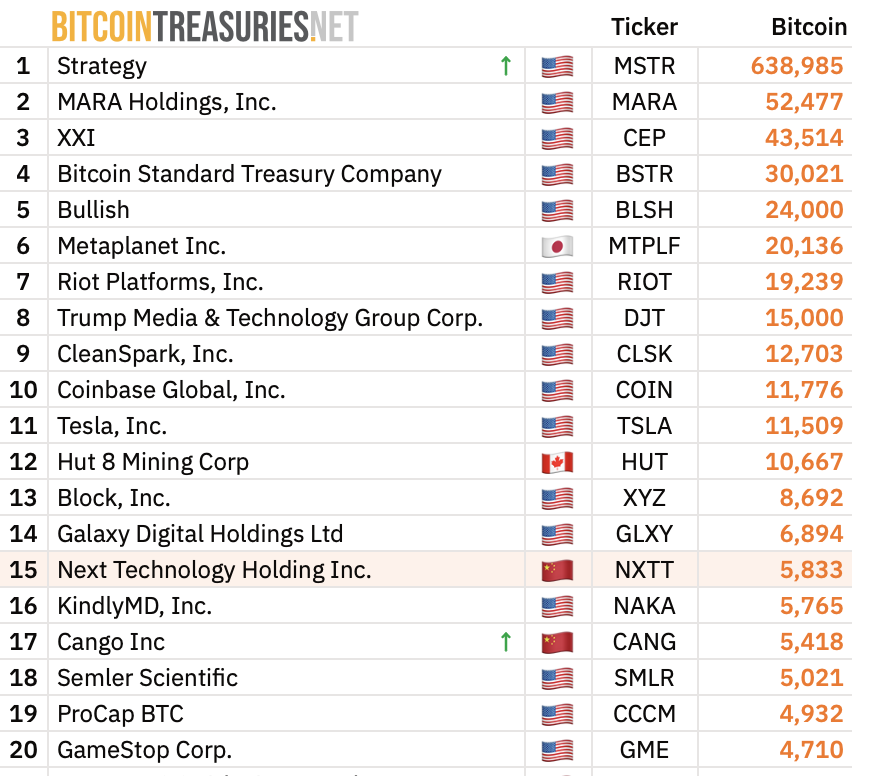
Топ-20 корпоративных держателей биткоина. Источник: Bitcoin Treasuries

Ethereum как программируемая альтернатива

Хотя биткоин остается краеугольным камнем криптовалютных резервов, Ethereum набрал популярность как привлекательная альтернатива, особенно после перехода в 2022 году на алгоритм proof-of-stake, известный как The Merge. Это изменение снизило энергопотребление и ввело стейкинг, который генерирует годовую доходность 3-5%, делая ETH продуктивным активом в отличие от BTC.

Экосистема Ethereum добавляет ему ценности. Через децентрализованные финансы (DeFi) резервы могут получать доступ к ликвидности без продажи своих активов. Растущее использование токенизированных реальных активов, таких как облигации и товары, укрепляет роль Ethereum как финансовой платформы.

Институциональное принятие ETH растет. Компании начинают держать Ethereum, а управляющие активами представили биржевые фонды (ETF) на основе Ethereum для регулируемых инвестиций. Даже децентрализованные автономные организации (DAO) используют ETH как резерв для обеспечения долгосрочной стабильности.

На 16 сентября 2025 года 71 держатель обладал 4,91 млн ETH стоимостью $21,28 млрд. Bitmine Immersion Tech (BMNR) является крупнейшим держателем Ethereum с 2,15 млн ETH стоимостью $9,74 млрд.
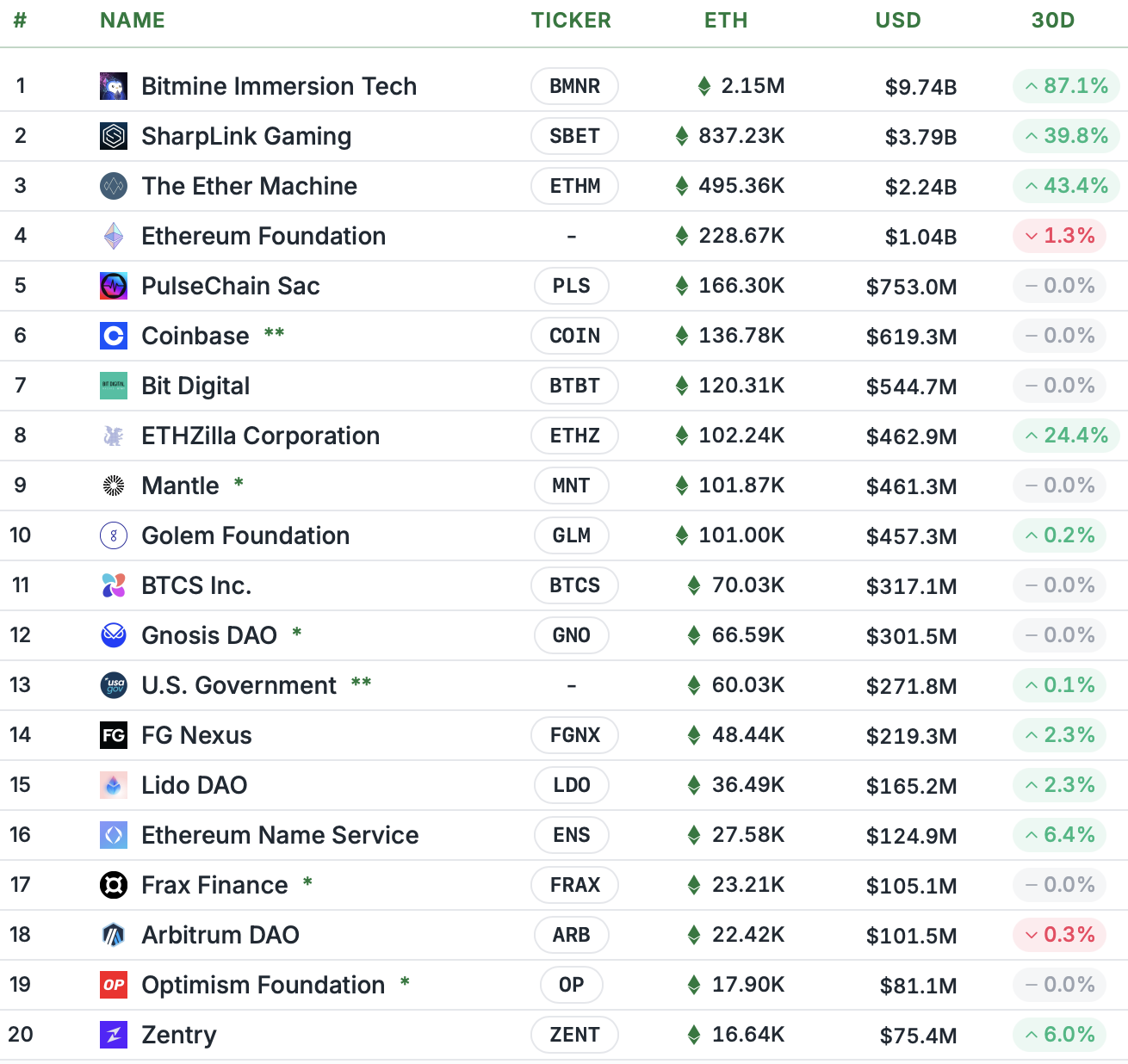
Топ-20 корпоративных держателей Ethereum. Источник: Strategic ETH Reserve

Двойная стратегия набирает обороты

С развитием криптовалютного рынка некоторые правительства и корпорации принимают двойную стратегию резервов, удерживая как BTC, так и ETH. Этот подход сочетает стабильность биткоина и его глобальное признание в качестве резервного актива с потенциалом Ethereum для генерации доходности.

Федеральное правительство США создало стратегический криптовалютный резерв, который содержит примерно 198 000-207 000 BTC (приблизительно $17-20 млрд), полученных через конфискации и другими способами.

Распределение ETH: создано американское хранилище цифровых активов для альткоинов, включая Ethereum. На 29 августа 2025 года это хранилище содержало около 60 000 ETH стоимостью около $261 млн согласно анализу правительственных адресов компанией Arkham Exchange.

BitMine Immersion Technologies демонстрирует другой пример двойной стратегии. Компания, сфокусированная на майнинге криптовалют и управлении резервами, поддерживает небольшой резерв биткоинов в 192 BTC. Одновременно BMNR держит 2,15 млн ETH с оценочной стоимостью приблизительно $9,74 млрд.

Какая стратегия побеждает в 2025 году

Конкуренция между биткоин- и Ethereum-резервами демонстрирует их уникальные сильные стороны. К середине 2025 года стало ясно, что резервы будут все чаще использовать оба актива.

Биткоин отличается стабильностью, широким доверием и глобальным признанием, действуя как «резервная валюта» криптовалютного мира. Его роль «цифрового золота» делает его предпочтительным выбором для институтов и наций, сосредоточенных на долгосрочном сохранении богатства и обеспечения ликвидности.

Ethereum, с другой стороны, набрал популярность благодаря способности генерировать доход, обладать практической пользой и поддерживать растущую экосистему токенизированных активов. Резервы, владеющие ETH, могут зарабатывать 3-5% годовых через стейкинг, получать доступ к ликвидности через DeFi и участвовать в рынках токенизированных реальных активов.

Выбор зависит от целей. Биткоин подходит тем, кто делает акцент на безопасность капитала, а Ethereum привлекает тех, кто ищет рост и потенциал дохода. Хотя BTC сейчас лидирует по общему объему резервов, ETH активно сокращает отставание, привлекая компании и децентрализованные организации, которые придают большое значение его программируемым финансовым функциям.


Trending Cryptos

Related Reads

Foundation Steps Back, Ethlabs Steps Forward: Ethereum Undergoes Its Largest Restructuring in History

On June 23rd, the Ethereum ecosystem witnessed two major shifts, signaling a significant governance realignment. First, former Ethereum Foundation researchers established Ethlabs, a new independent non-profit. Backed by major ETH holders like Bitmine and SharpLink, Ethlabs aims to address practical needs for institutional adoption, including faster settlement, native asset issuance, cross-chain transactions, and mainnet scaling. Secondly, the Ethereum Foundation announced a major restructuring, laying off 54 employees (20% of its staff) to become a leaner entity focused on protocol governance and maintenance rather than being the primary builder. This move represents a pivotal correction. Criticisms had mounted over the Foundation's perceived slowness, lack of clear strategy, and over-reliance on Vitalik Buterin's influence. Ethlabs emerges as a more execution-oriented, "industrialized" layer focused on market adoption—bridging the gap between research and real-world use. Notably, Vitalik Buterin is absent from its list of supporters, interpreted as an intentional step to avoid excessive personal endorsement and allow the organization to build independent credibility. The Ethereum Foundation's downsizing and redefinition mark a retreat from its former central coordinating role. It now aims to share the "privilege of stewarding Ethereum" with other emerging groups like Ethlabs, the Ethereum Applications Guild, and The Ethereum Economic Zone. Analysts frame this dual shift as the Foundation ensuring Ethereum remains "correct" (credibly neutral), while Ethlabs must prove it remains "effective" (competitive and attractive for capital and adoption). This addresses community "shareholder-like anxiety" about ETH's market performance. While risks exist—such as concerns over shifting from Foundation centrality to large-holder influence—the consensus is that the greater risk for Ethereum was inaction, caught between technical idealism and organizational inertia. These steps aim to create a more multi-stakeholder, execution-driven future for the network.

链捕手6h ago

Foundation Steps Back, Ethlabs Steps Forward: Ethereum Undergoes Its Largest Restructuring in History

链捕手6h ago

Second Half of U.S. Crypto Policy: The Clarity Act Aims for 60 Votes, CFTC's "One-Person Commission" Becomes Biggest Variable

In a pivotal year for US crypto policy, the "CLARITY Act" is advancing in the Senate but faces a high hurdle, needing 60 votes to pass. Key challenges include bridging partisan divides on ethics and swaying undecided Republican senators within a tight legislative calendar of only about 40 working days. The policy "second half" involves intense negotiations on a broader framework for Web3 and DeFi, including crypto tax reforms and the Blockchain Regulatory Certainty Act. A significant uncertainty is the understaffed CFTC, operating with four commissioner vacancies, which complicates regulatory clarity. Meanwhile, the departure of key "crypto champions"—SEC Commissioner Hester Peirce and Senator Cynthia Lummis—will impact ongoing policy efforts. Industry experts are cautiously optimistic but realistic. Sara K. Weed notes that while progress is being made, CLARITY is unlikely to pass this Congress, pushing agencies like the SEC and CFTC to provide more guidance. Sulolit Mukherjee suggests meaningful crypto tax legislation is more likely to be attached to larger must-pass bills. Rashan Colbert discusses the jurisdictional debate over prediction markets, emphasizing the need for a regulatory framework that fosters their development as financial tools rather than treating them broadly as gambling. The clock is ticking, but opportunities remain for substantive progress through continued bipartisan dialogue and pragmatic efforts.

marsbit9h ago

Second Half of U.S. Crypto Policy: The Clarity Act Aims for 60 Votes, CFTC's "One-Person Commission" Becomes Biggest Variable

marsbit9h ago

Dan Koe's New Essay: Escaping the Fate of the Wage Slave, How to Survive the AI Replacement Wave?

Dan Koe argues that the true threat in the AI era isn't technology itself, but a reliance on others for one's livelihood and happiness. The core problem is "wage slavery"—spending life on unfulfilling work. To survive and thrive, one must escape this by building their own enterprise. The key is developing five elements: Agency (initiative), Taste (discernment), Persuasion, Persistence, and Iteration. These boil down to problem-solving skills and experiential knowledge, which cannot be learned passively but only through doing your own projects. The solution is to become "unemployable" by shifting your identity. This requires: 1) Radically changing your environment to force growth, 2) Choosing a medium (like content creation) that provides real feedback through trial and error, and 3) Mastering either code or, preferably, media (content). Content creation is more valuable because its subjective nature and need for human perspective create a durable advantage over generic AI output. To start, define your life's work by answering foundational questions about your innate knowledge, unique abilities, and contrarian beliefs. Then, immediately act by publishing your first piece of content. The cycle of creating, receiving feedback, and iterating is the essential path to developing the skills needed for an independent, meaningful career and financial resilience.

marsbit10h ago

Dan Koe's New Essay: Escaping the Fate of the Wage Slave, How to Survive the AI Replacement Wave?

marsbit10h ago

Research Report Analysis: Morgan Stanley Details SanDisk SNDK, The Truth About Cloud Data Center Pricing Power and AI Inference Benefits

Morgan Stanley raised its price target for SanDisk (SNDK) from $1100 to $1750 on June 22, maintaining an Overweight rating. The upgrade is driven by AI inference demand reshaping the NAND market, particularly for KV Cache and context window storage in cloud data centers. These cloud clients exhibit price inelasticity and sign long-term contracts, granting SanDisk significant pricing power. SanDisk's New Business Model (NBM) agreements, covering over one-third of FY27 bit shipments with 3-5 year terms and fixed price/price collar structures, are crucial. They are projected to sustain gross margins around 80% even at floor prices, providing a buffer against cyclical downturns. Morgan Stanley forecasts gross margins to surge from 30.3% in FY25 to 86.7% in FY27e. With NAND supply expected to remain tight into 2026/2027 and cloud/data centers becoming the largest end-market, SanDisk holds supply-side pricing power. The company targets 15-19% bit growth via technology transitions, not capacity expansion. Revenue is projected to grow ~6.6x from FY25 to FY27, with EPS rising from $2.74 to $14.73, driven by high-margin cloud business. Key upside catalysts include faster enterprise SSD adoption and edge AI growth. Downside risks involve slower industry growth, competitor capex increases, market share loss, and competition from Chinese players like YMTC. The investment thesis rests on AI-driven structural demand, NBM's margin protection, and sustained supply tightness. The $1750 target implies ~28x FY27e P/E.

marsbit10h ago

Research Report Analysis: Morgan Stanley Details SanDisk SNDK, The Truth About Cloud Data Center Pricing Power and AI Inference Benefits

marsbit10h ago

Trading

Spot
Futures

Hot Articles

Discussions

Welcome to the HTX Community. Here, you can stay informed about the latest platform developments and gain access to professional market insights. Users' opinions on the price of ETH (ETH) are presented below.

活动图片