Прогноз цены XRP (XRP) на 17 сентября

cryptonews.ruPublished on 2025-05-15Last updated on 2025-09-16


  • Цена XRP консолидируется около $2,99, при этом $2,97 выступает ключевой поддержкой Фибоначчи против давления со стороны продавцов.
  • Спекуляции на рынке ETF порождают смелые прогнозы по XRP на уровне $10–$25, хотя приток средств остается скромным, а динамика неопределенной.
  • Регуляторы ЕС настаивают на ужесточении надзора, что добавляет осторожности в краткосрочных перспективах XRP, несмотря на оптимистичные прогнозы.

Цена XRP сегодня торгуется вблизи $2,99, удерживаясь чуть выше зоны поддержки $2,97 после снижения после ралли прошлой недели. Продавцы давят на 20-дневную экспоненциальную скользящую среднюю (EMA), в то время как покупатели продолжают защищать ключевые уровни Фибоначчи. В связи с обострением спекуляций вокруг ETF и требованиями европейских регуляторов к ужесточению надзора, рынку предстоит серьёзное испытание.

Цена XRP удерживает уровень поддержки Фибоначчи, но сталкивается с сопротивлением
Цена XRP удерживает уровень поддержки Фибоначчи (Источник: TradingView)

На дневном графике XRP консолидируется чуть выше уровня коррекции Фибоначчи 0,236 на уровне $2,97, при этом цена недавно преодолела сопротивление $3,08, совмещенное с уровнем коррекции 0,382. Ближайшая поддержка находится вблизи $2,94 и $2,82, а более глубокая защита — на уровне $2,57, 200-дневной экспоненциальной скользящей средней.

По теме: Прогноз цены биткоина (BTC) на 17 сентября

Нисходящая линия тренда, начинающаяся с июльского пика $3,66, продолжает сдерживать импульс. Чистый прорыв выше $3,18, где пересекаются Parabolic SAR и уровень Фибоначчи 0,618, сменит бычьи настроения. До тех пор XRP остаётся в ловушке сужающейся структуры с риском повторного тестирования базы $2,70.

Показатели импульса указывают на осторожность. Участок EMA между $2,94 и $2,97 превратился в поле битвы, а выравнивание сигналов указывает на нерешительность. Рост выше $3,08 привлечёт покупателей импульса, но неспособность удержать $2,97 рискует ускорить падение.

Спекуляции с ETF порождают смелые прогнозы

🚨JUST IN: Jake Claver told the Paul Barron Show that with ETFs on the horizon, seeing #XRP at $10–$13 is realistic and $20–$25 by year’s end isn’t crazy! 🔥🚀 pic.twitter.com/cOSlU9R11k

— John Squire (@TheCryptoSquire) September 15, 2025

Внимание рынка переключилось на заголовки новостей об ETF после того, как Джейк Клэйвер заявил на шоу Пола Баррона, что курс XRP на уровне $10–$13 реален, а к концу года возможен рост до $20–$25. Эти комментарии, поддержанные аналитиком Джоном Сквайром из X, вызвали волну спекуляций о притоке институциональных инвестиций в случае, если американские регуляторы одобрят продукты, привязанные к XRP.

Хотя многие трейдеры считают прогнозы агрессивными, оптимизм в отношении ETF даёт оптимистичный настрой. Исторически аналогичные спекуляции с биткоином и эфириумом приводили к устойчивым прорывам после подтверждения одобрения, хотя для XRP сроки остаются неопределенными..

Потоки внутри цепочки демонстрируют скромный приток
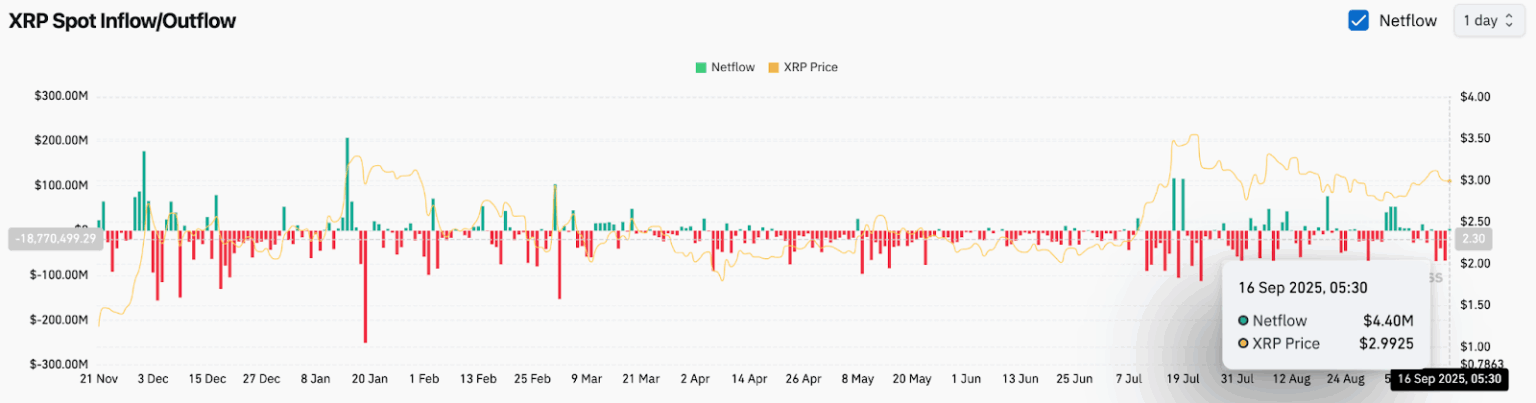
Нетто-потоки XRP за 16 сентября (Источник: Coinglass)

Данные о спотовых потоках показывают чистый приток средств на биржи XRP 16 сентября в размере 4,4 млн долларов США. Хотя этот сдвиг незначителен по сравнению с историческими всплесками свыше 100 млн долларов США, он контрастирует с устойчивым оттоком, наблюдавшимся в предыдущие недели. Это свидетельствует об осторожной позиции трейдеров, готовящихся к возможным изменениям в ETF.

По теме: Прогноз цен на Linea (LINEA) на 2025, 2026, 2027, 2028–2030 годы

Однако активность участников остаётся низкой. Рост активных адресов затормозился, а открытый интерес к фьючерсам — слабым. Без более сильного и стабильного притока средств XRP может столкнуться с трудностями при прорыве зоны $3,18–$3,30.

Регуляторы ЕС настаивают на ужесточении надзора

Помимо технических аспектов и ажиотажа вокруг ETF, ещё один уровень неопределённости добавляют изменения в регулировании. Франция, Австрия и Италия призвали Европейский союз ужесточить надзор за криптовалютными рынками в рамках MiCA, требуя прямого надзора со стороны ESMA, обязательных аудитов кибербезопасности и более строгого контроля над офшорными платформами.

Для XRP, которая сама столкнулась с правовыми проблемами, более строгое регулирование со стороны ЕС может ограничить доступ для платформ, не входящих в ЕС, и снизить ликвидность. Однако сторонники утверждают, что более строгое регулирование может повысить доверие инвесторов в долгосрочной перспективе, особенно при условии гармонизации мер по всему блоку.

Технический прогноз цены XRP

Ключевые уровни остаются чётко определёнными. С другой стороны, пробитие отметки $3,08 приведёт к достижению $3,18, а затем $3,30, где сходятся верхние уровни Фибоначчи. Прорыв этой отметки может привести к $3,46. С другой стороны, потеря $2,97 грозит ростом до $2,82, а затем до $2,70. Если $2,70 не будет достигнут, 200-дневная EMA на уровне $2,57 станет окончательной поддержкой.

Баланс рисков зависит от того, наберет ли обороты оптимизм, обусловленный ETF, прежде чем давление технических проблем снизится на покупателей.

Перспективы: вырастет ли курс XRP?

Цена XRP сегодня остаётся на распутье: спекуляции с ETF и скромный приток средств создают бычий противовес ужесточению регулирования и сопротивлению тренду. Аналитики по-прежнему расходятся во мнениях: одни прогнозируют агрессивный целевой уровень в $10–$13, другие предупреждают, что для сохранения конструктивной структуры необходимо удержаться на уровне $2,70.

По теме: Прогноз цен на породу сиба-ину (SHIB) на 16 сентября

Пока XRP держится выше $2,97, тренд склоняется к консолидации с потенциалом роста. Решительный прорыв выше $3,18 укрепит бычий тренд, но неспособность удержать $2,97 может подвергнуть XRP новому раунду потерь, прежде чем покупатели перегруппируются.


Trending Cryptos

Related Reads

NVIDIA CPU Advances, China's RISC-V Responds: Semiconductor Deep Dive - Part Four

NVIDIA is set to launch its new Vera AI data center CPU in China as early as August, with high pricing. While this move offers a new option, it highlights China's continued dependence on foreign-controlled Arm architecture. In response, the Chinese semiconductor industry is increasingly turning to RISC-V as a strategic alternative for achieving high-performance computing autonomy. The article explores the concept of the "impossible triangle" in CPU development—balancing prosperity, control, and autonomy—and posits that RISC-V's open-source, modular nature offers a unique path to achieving all three. While RISC-V is already dominant in embedded systems, the focus is now shifting to data centers and AI workloads. China has become a global hotspot for RISC-V development, driven by AI-driven compute demand, supply chain concerns from export controls, cost benefits of open-source, and strong policy support. Multiple Chinese companies have reportedly crossed the key performance threshold of 15 SPECint per GHz, a benchmark for entering the high-performance CPU club. Progress extends beyond single-core benchmarks. Companies are developing complete computing subsystems, including commercial-grade coherent network-on-chip (NoC) technology and server processors with up to 40 cores that strictly adhere to the RVA23 standard to ensure software compatibility. Real-world applications are emerging in areas like video transcoding and edge AI. However, significant challenges remain. The RISC-V ecosystem faces fragmentation, immature toolchains and verification processes, and gaps in single-core performance and energy efficiency compared to mature x86 and Arm architectures. The formidable software moat, epitomized by NVIDIA's CUDA, is a long-term hurdle. In conclusion, while RISC-V cannot immediately replace offerings like NVIDIA's Vera, it represents a viable long-term path for China to develop a self-sufficient, high-performance CPU ecosystem. The journey is acknowledged to be long and arduous, requiring sustained effort to overcome technical and ecosystem challenges.

marsbit3h ago

NVIDIA CPU Advances, China's RISC-V Responds: Semiconductor Deep Dive - Part Four

marsbit3h ago

My Coding Betting Dashboard is Profiting, but Polymarket is Truly Not a Good Place for 'Arbitrage'

The author built a custom monitoring dashboard for Polymarket, a prediction market platform, and tested it with $1,600, achieving over 30% returns. However, the core argument is that Polymarket is not a good venue for traditional arbitrage. The dashboard has two main sections: a "Portfolio Dashboard" for tracking active positions with key metrics like total capital, P&L, and a risk-control module using a tier system (T1, T2, T3), and an "Opportunity Watchlist" for monitoring markets. The article details a critical structural trap in binary markets: a bet with a high perceived probability of success still carries a 100% loss risk if wrong. The author's T1/T2/T3 system is designed to manage this by limiting position sizes based on conviction and time horizon, emphasizing that high confidence should not equal high concentration. A key insight is the danger of "pseudo-diversification"—betting on different markets driven by the same underlying variable. The author concludes that Polymarket offers few true low-risk, arbitrage opportunities. It is instead a high-risk environment where wins can create a false sense of mastery, leading to large losses. The platform is better viewed as a training ground for honing judgment through disciplined, framework-driven betting rather than a reliable income source. The tools help transform intuition into structured, rule-based decisions to mitigate the risk of catastrophic errors.

marsbit6h ago

My Coding Betting Dashboard is Profiting, but Polymarket is Truly Not a Good Place for 'Arbitrage'

marsbit6h ago

WeChat AI Card Hands-On Guide: Has the AI Shopping Era Arrived?

**"WeChat AI Card" Practical Test Guide: Has the Era of AI Shopping Arrived?** WeChat has officially launched the "AI Exclusive Card," a feature integrated into its Workbuddy AI assistant. This card is designed to handle payments for AI-initiated purchases. Our hands-on test reveals it's not yet a tool for fully autonomous AI shopping, but rather a controlled payment layer for AI agents. The AI Card functions as an isolated sub-wallet within WeChat Pay. Users must bind the card and transfer funds into it from their main wallet. Crucially, every transaction requires explicit user confirmation via smartphone scan; AI cannot spend autonomously. Currently accessible through the Workbuddy agent, the card targets specific digital consumption scenarios: purchasing paid content (reports, data), calling paid APIs/tools, and subscribing to services. Its design prioritizes security and control by separating funds and mandating approval for each payment. We tested a real-world scenario: ordering bubble tea via Workbuddy using a "Meituan Life Assistant" skill. The process encountered multiple hurdles: high "skill" usage costs (exceeding daily free credits), and most importantly, while a payment was successfully initiated, the AI purchased an incorrect product (a mismatched group-buy coupon instead of the desired drink). This highlights the current limitation: the **AI Card only solves the payment step**. The broader challenge lies in the **AI agent's execution chain**—accurately understanding intent, navigating third-party platforms, selecting the right product, and ensuring proper fulfillment. The payment succeeded, but the purchase failed to meet the user's need. In conclusion, the WeChat AI Exclusive Card is a cautious, early-step experiment in AI commerce. It provides a secure, user-controlled payment method for agent interactions but is not yet capable of reliable, end-to-end complex purchases. For now, it's best used for low-value, low-risk digital services with careful user verification at each step. The vision of AI handling complete shopping tasks remains a work in progress.

marsbit9h ago

WeChat AI Card Hands-On Guide: Has the AI Shopping Era Arrived?

marsbit9h ago

Trading

Spot
Futures

Hot Articles

What is XRP 2.0

XRP 2.0: A New Frontier in the Cryptocurrency Landscape Introduction to XRP 2.0 In the ever-evolving realm of cryptocurrency, new projects continuously emerge, vying for attention and adoption. One such promising initiative is XRP 2.0, a novel cryptocurrency project designed to leverage advanced blockchain technology and robust encryption methodologies. While the name draws parallels with Ripple’s XRP, it’s crucial to note that XRP 2.0 operates independently, focusing on enhancing transaction security, privacy, and scalability. As the digital financial landscape increasingly embraces decentralized solutions, XRP 2.0 aims to contribute meaningfully to web3 and the overall expansion of crypto projects. What is XRP 2.0? At its core, XRP 2.0 is a cryptocurrency project that aims to create a secure and decentralized digital currency ecosystem. Its foundational technology integrates sophisticated blockchain principles with cutting-edge encryption techniques. The overarching goal of XRP 2.0 is to establish itself as a reliable and efficient platform enabling swift transaction execution while prioritizing enhanced privacy protections for its users. The project is promoted as a solution to many limitations faced by existing cryptocurrencies, proposing a system that can handle a higher volume of transactions with improved speed and privacy. This versatility positions XRP 2.0 as a significant contender in a marketplace riddled with various digital currencies. Who is the Creator of XRP 2.0? The identity of the creator behind XRP 2.0 has been flagged as ‘Wilbur.’ However, comprehensive details regarding Wilbur or their associated entity remain elusive. The anonymity of many cryptocurrency creators is not an uncommon phenomenon in the industry, often designed to maintain a degree of privacy and security. Who are the Investors of XRP 2.0? As of now, specific information related to the investment foundations or organizations supporting XRP 2.0 is not publicly available. In the cryptocurrency sector, the backing by reputed investors can significantly influence a project's credibility and success, yet the transparency regarding the financial supporters of XRP 2.0 has not been established. How Does XRP 2.0 Work? XRP 2.0 stands out by employing a combination of blockchain technology and advanced encryption algorithms that ensures secure and decentralized transactions. Its innovative structure includes unique features designed to foster user engagement and broaden functionalities beyond conventional cryptocurrency transactions. Among these features, XRP 2.0 incorporates AI-powered capabilities, such as text-to-image and text-to-speech functionalities. These additions are designed to enhance the interactive experience for users, promoting broader applicability across various sectors. By bridging technological advancements with user-centered design, XRP 2.0 aims to capture the attention of a diverse range of individuals and enterprises looking to integrate cryptocurrency solutions into their operational frameworks. Timeline of XRP 2.0 Understanding XRP 2.0 requires examining the milestones that have defined its journey thus far: July 23, 2023: XRP 2.0 is introduced as a novel cryptocurrency project, aiming to revolutionize secure and decentralized transaction capabilities in the blockchain domain. September 8, 2023: The launching of another project, XRP20, occurs, marking the emergence of an ERC-20 token on the Ethereum blockchain that remains unrelated to XRP 2.0. November 13, 2023: The XRP Ledger undergoes a significant update with the release of rippled server software version 2.0.0. It is essential to note that this development is disconnected from the XRP 2.0 cryptocurrency project. Key Points About XRP 2.0 To distill the essence of XRP 2.0, several critical factors emerge: Unique Features: The inclusion of features like AI-powered text-to-image and text-to-speech further diversifies the potential applications of XRP 2.0. Blockchain Technology: The framework utilizes advanced blockchain mechanisms and encryption protocols, ensuring a secure and decentralized environment for transactions. Scalability and Privacy: XRP 2.0 prioritizes enhanced privacy protections in transaction processes and the scalability necessary to accommodate a growing user base. No Affiliation with Ripple: Importantly, despite its name, XRP 2.0 does not have any allegiance or collaboration with Ripple’s XRP, distinguishing its operational framework and objectives within the cryptocurrency ecosystem. Conclusion XRP 2.0 represents an ambitious venture into the cryptocurrency sphere, aiming to offer a combination of security, privacy, and efficiency in digital transactions. By integrating sophisticated technologies and user-friendly features, the project sets out to broaden the horizons of what cryptocurrency can achieve in today's digital economy. While the anonymity of its creator and lack of disclosed investors might raise questions for some, XRP 2.0's focus on advanced functionalities and decentralisation enhances its appeal amidst an increasingly crowded crypto market. As the cryptocurrency landscape continues to evolve, XRP 2.0 may yet emerge as a pivotal player in the expansion of secure and scalable blockchain solutions.

965 Total ViewsPublished 2024.04.01Updated 2024.12.03

What is XRP 2.0

Discussions

Welcome to the HTX Community. Here, you can stay informed about the latest platform developments and gain access to professional market insights. Users' opinions on the price of XRP (XRP) are presented below.

活动图片