Crypto Hacks Surge: $19M In Ethereum Grab by Infamous Wallet Raises Alarming Questions

bitcoinistPublished on 2025-09-15Last updated on 2025-09-16

Abstract

A crypto wallet connected to the notorious $300 million Coinbase hack has reappeared with another suspicious move on the Ethereum...

Trusted Editorial content, reviewed by leading industry experts and seasoned editors. Ad Disclosure

A crypto wallet connected to the notorious $300 million Coinbase hack has reappeared with another suspicious move on the Ethereum blockchain.

Over the weekend, the address acquired 3,976 ETH worth approximately $18.9 million, according to on-chain data from Arkham Intelligence. The purchase was executed using 18.9 million DAI, a stablecoin, and split across multiple transactions before being consolidated into the buy.

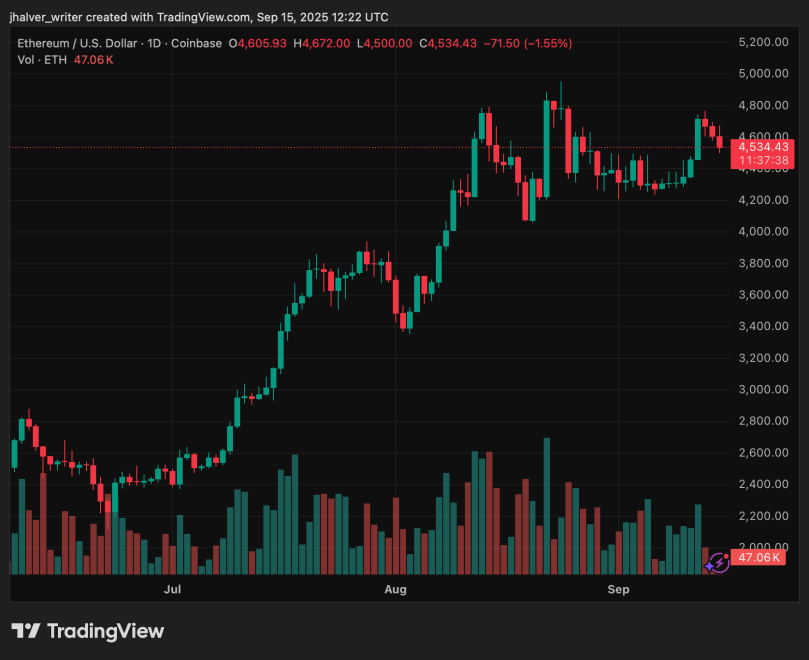
The transaction came just as Ethereum broke above $4,700, marking its highest level in more than two weeks. Currently, ETH trades at $4,538, down 2.9% in the past 24 hours.
Ethereum ETH ETHUSD

ETH's price trends to the upside on the daily chart. Source: ETHUSD on Tradingview

A Pattern of Bold Acquisitions

This is not the first time the wallet has made waves. In July, it bought 4,863 ETH for $12.6 million and later added 649 ETH at $3,562 per token. Just last month, the same wallet scooped up $8 million worth of Solana (SOL), though that position has since slipped below entry price.

Analysts say the strategy shows deliberate fund consolidation, often seen in money laundering tactics. Breaking transactions into smaller amounts and using privacy tools allows the hacker to mask movements, making tracking more difficult.

Blockchain investigator ZachXBT previously estimated that the Coinbase-related social engineering scam drained at least $330 million from victims, warning that the real figure may be significantly higher.

Growing Concerns Over Rising Crypto Hacks

The latest Ethereum purchase shows broader concerns in the crypto industry, where hack-related losses reached $163 million in August alone, according to security firm PeckShield.

With exploits shifting from smart contract bugs to social engineering and cross-chain bridge vulnerabilities, wallets like this continue to pose a major threat to investor confidence.

Despite Coinbase offering a $20 million reward for information on the perpetrators and tightening security, the hacker remains unidentified. The latest $19M ETH grab proves the resilience and boldness of cybercriminals operating in the space.

As crypto rallies and institutional inflows grow, the question remains: is the hacker simply riding bullish momentum, or is this part of a deeper strategy to launder stolen funds? Regulators and blockchain investigators are watching closely, but for now, the crypto world is left with more questions than answers.

Cover image from ChatGPT, ETHUSD chart from Tradingview

Editorial Process for bitcoinist is centered on delivering thoroughly researched, accurate, and unbiased content. We uphold strict sourcing standards, and each page undergoes diligent review by our team of top technology experts and seasoned editors. This process ensures the integrity, relevance, and value of our content for our readers.

Trending Cryptos

Related Reads

NVIDIA's AI Sweeps ARC-AGI-3, Chinese-Led Team Aces All 183 Levels in One Go

NVIDIA's general-purpose coding agent AVO has achieved a perfect 100.00 RHAE score on the ARC-AGI-3 benchmark. It solved all 183 levels across 25 game environments in just 6,624 steps. ARC-AGI-3 is a notoriously difficult test where agents are placed into unfamiliar games with no instructions, forcing them to deduce rules and goals through trial and observation. Top models like Claude Opus 5 typically score only around 30% when acting alone. AVO's breakthrough comes not from improving the underlying AI model (Claude Opus 5), but from adding an intelligent external framework or "harness" around it. This framework addresses three key failure modes: misunderstanding global rules, misapplying familiar mechanics, and failing to learn correctly from success. Two core mechanisms drive AVO's performance: 1. **Persistent Memory:** It stores past attempts, compiler outputs, and reasoning across tasks, preventing the model from resetting and re-exploring dead ends when its context window fills. 2. **Supervisor Agent:** A separate module monitors the main agent's progress, intervening to redirect strategy when it gets stuck or repeats unproductive actions. Notably, AVO processed the visual game environments using a pure 64x64 text grid representation, without any image tokens. Originally developed for GPU kernel optimization, AVO autonomously evolved CUDA code for 7 days, producing attention kernels that outperformed NVIDIA's own cuDNN and the leading open-source implementation, FlashAttention-4. The same core architecture was then successfully applied to ARC-AGI-3, demonstrating its generalizability for long-horizon, autonomous problem-solving. The project features a predominantly Chinese team, including Distinguished Engineer Bing Xu (co-author of the original GAN paper and creator of MXNet) and Tianqi Chen (creator of TVM and XGBoost). NVIDIA's strategy highlights that while AI models are crucial, the surrounding system—managing memory, tools, and feedback—is equally vital for creating capable, long-term autonomous agents. This approach aligns with NVIDIA's focus on providing the essential hardware and software infrastructure for the next generation of AI workloads.

marsbit18m ago

NVIDIA's AI Sweeps ARC-AGI-3, Chinese-Led Team Aces All 183 Levels in One Go

marsbit18m ago

Trading

Spot

Hot Articles

Discussions

Welcome to the HTX Community. Here, you can stay informed about the latest platform developments and gain access to professional market insights. Users' opinions on the price of ETH (ETH) are presented below.

活动图片