Очередь на вывод ETH со стейкинга увеличилась до 2-летнего максимума

cryptonews.ruPublished on 2025-03-11Last updated on 2025-09-12

Пока Виталик Бутерин отмечает успехи проектов, причастных к повышению быстродействия и децентрализации блокчейна Ethereum, период ожидания вывода стейкинговых эфириумов достиг 45 дней. Это самый длительный срок за последние два года.

По данным панели управления очередью валидаторов Ethereum, позавчера количество стейкинговых ETH в очереди на вывод увеличилось на 60% с миллиона ($5,7 млрд) до двух с половиной миллионов ($11,7 млрд).

Впрочем, несмотря на большое количество ETH в очереди на вывод, это всего 7% от общего объёма эфиров на стейкинге.

2025-09-11-12.44.40-1

Количество стейкинговых ETH в очереди на выход превышает стоимость в $11,7 млрд

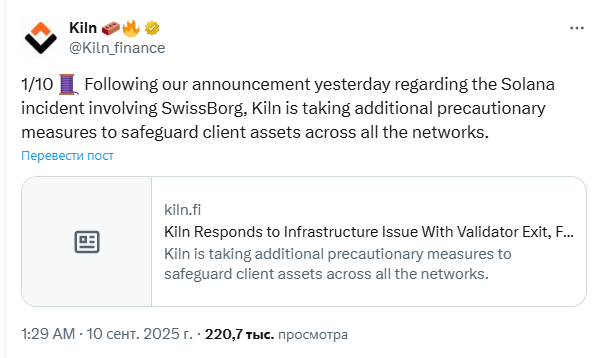
Столь резкий скачок приписывается «организованному выходу Kiln из всех своих валидаторов Ethereum (ETH)».

Эта «мера предосторожности» была предпринята после кражи стейкинговых Solana на сумму $41 млн из кошелька, управляемого Kiln. Средства принадлежали компании SwissBorg, для которого Kiln выступал «партнёром по стейкингу».
Opera Снимок_2025-09-11_221748_x.com

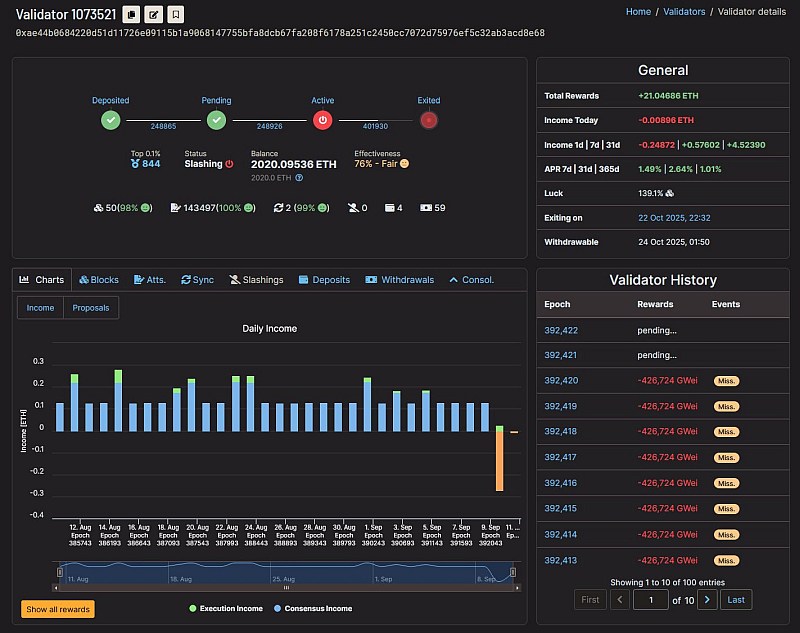
Помимо резкого роста количества ETH в очереди, произошло «массовое сокращение» валидаторов Ethereum, которое было вызвано ошибкой оператора».

Сокращение — это механизм безопасности в модели сети на PoS, при котором некорректно работающие валидаторы могут потерять часть своих ETH на стейкинге.
G0ff9i6XQAAft0S

Trending Cryptos

Related Reads

Why Is No One Buying DeFi Insurance?

"Why DeFi Insurance Remains Unpurchased" explores the paradox of decentralized finance insurance. While DeFi insurance promises automatic, unbiased payouts via smart contracts—eliminating traditional insurers' denial practices—it struggles to attract users. The core issue is economic viability. Premiums are prohibitively high relative to the yields from DeFi protocols. For example, insuring a deposit on Aave or Maple Finance can consume most or even all of the annual yield, leaving returns comparable to or worse than traditional savings. Only the safest protocols, like MakerDAO, offer affordable premiums. Furthermore, the DeFi insurance model is structurally fragile. Unlike traditional insurance where risks are uncorrelated, DeFi risks are highly interconnected (e.g., oracle failures, bridge hacks). A single major exploit can simultaneously threaten multiple protocols, potentially bankrupting the entire insurance pool, which holds only millions against billions in total value locked. The governance model also creates a conflict of interest. In platforms like Nexus Mutual, token holders who vote on claims risk their own capital if payouts are approved, incentivizing denials. Consequently, the market is tiny and shrinking. Nexus Mutual dominates with $81.56 million in assets, but the industry lacks the capacity to cover a catastrophic event like the $292M Kelp DAO hack. Other providers have dwindled or shut down. The article concludes that DeFi insurance faces a "tragedy of the commons": its stability requires widespread adoption, but individual users have no incentive to pay for it, as premiums destroy their yields. Current solutions involve preventative measures like bug bounties and seeking external capital from traditional reinsurance, acknowledging that on-chain capital alone is insufficient to cover on-chain risks.

marsbit4m ago

Why Is No One Buying DeFi Insurance?

marsbit4m ago

Kraken Sets Its Sights on Aave: Why is CeFi Starting to 'Buy the Dip' in Core DeFi Assets?

Recent market rumors suggest Kraken is planning a strategic investment in Aave, sparking widespread interest. Although Aave's co-founder clarified some inaccurate details in the reports, this event highlights a significant trend: centralized exchanges are accelerating their entry into the core areas of on-chain finance. Kraken's interest in Aave reflects its strategic expansion beyond simple trading into more profitable, higher-barrier financial services like DeFi asset management. Aave, a leading DeFi lending protocol, offers a mature lending model, deep liquidity, and a growing ecosystem, making it a key gateway to future on-chain finance. Despite a major security incident in April that caused significant withdrawals, Aave's core architecture, governance, and market trust remained intact. The protocol's strong fundamentals are underscored by its $134 million in annual revenue, suggesting its valuation may be undervalued. Aave is also designing a new tokenomics model (Aavenomics 3.0) featuring an automated token buyback mechanism to better capture value for token holders, signaling DeFi's evolution towards sustainable value models. Ultimately, this potential move signals accelerated convergence between CeFi and DeFi. Kraken's target is not just an asset but a strategic position in the future of on-chain financial infrastructure, while Aave aims to prove DeFi can evolve into a cash-flow-generating, global financial system.

marsbit1h ago

Kraken Sets Its Sights on Aave: Why is CeFi Starting to 'Buy the Dip' in Core DeFi Assets?

marsbit1h ago

Trading

Spot

Hot Articles

Discussions

Welcome to the HTX Community. Here, you can stay informed about the latest platform developments and gain access to professional market insights. Users' opinions on the price of ETH (ETH) are presented below.

活动图片