StarkWare анонсировала облегченную верификацию Bitcoin для мобильных устройств

cryptonews.ruPublished on 2025-07-10Last updated on 2025-09-11

Компания StarkWare, специализирующаяся на технологии с нулевым разглашением, представила метод ZK-верификации блокчейна Bitcoin, адаптированный для работы на мобильных устройствах. Доказательство содержит все заголовки блоков Bitcoin с момента создания сети, но не требует загрузки полной истории блокчейна, объем которой превышает 680 ГБ.

Заголовок каждого блока включает номер версии программного обеспечения Bitcoin, ссылку на предыдущий блок в цепочке, временную метку, размер блока и одноразовый код, который майнеры должны найти для добавления блока в реестр. Размер доказательства BTC-реестра от StarkWare составляет всего 1 МБ, что позволяет пользователям проверять транзакции менее чем за 100 миллисекунд, как сообщил Абдельхамид Бахта, руководитель экосистемы компании.
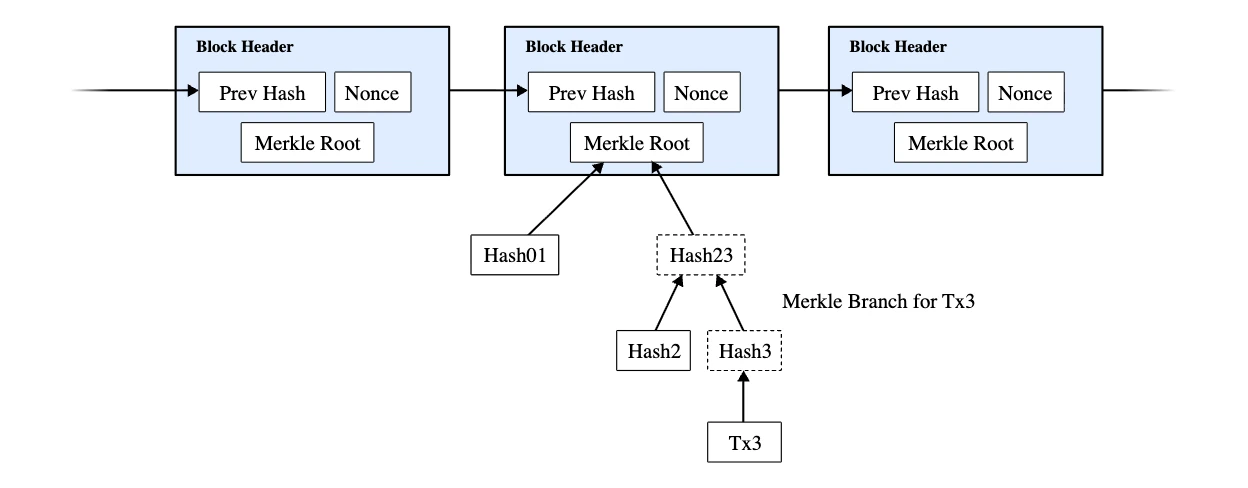

Иллюстрированная модель SPV, описанная в документе Сатоши о Bitcoin. Источник: Институт Накамото

Решение основано на концепции упрощенной проверки платежей, описанной в документе Сатоши Накамото. Эта концепция позволяет легким узлам проверять платежи без необходимости загрузки полного реестра. Разработка StarkWare важна тем, что она позволяет любому пользователю проверять платежи Bitcoin без запуска полноценного узла, стоимость которого может достигать $1000 и который требует технических знаний для установки.

Требования к хранилищу узлов и размеру реестра становятся предметом споров в сообществе BTC

Запуск узла Bitcoin остается относительно более простым по сравнению с другими блокчейн-сетями, для которых могут потребоваться десятки тысяч долларов инвестиций. Узлы Bitcoin способны работать на обычных персональных компьютерах благодаря относительной простоте протокола, который сгенерировал 680 ГБ данных с 2009 года.
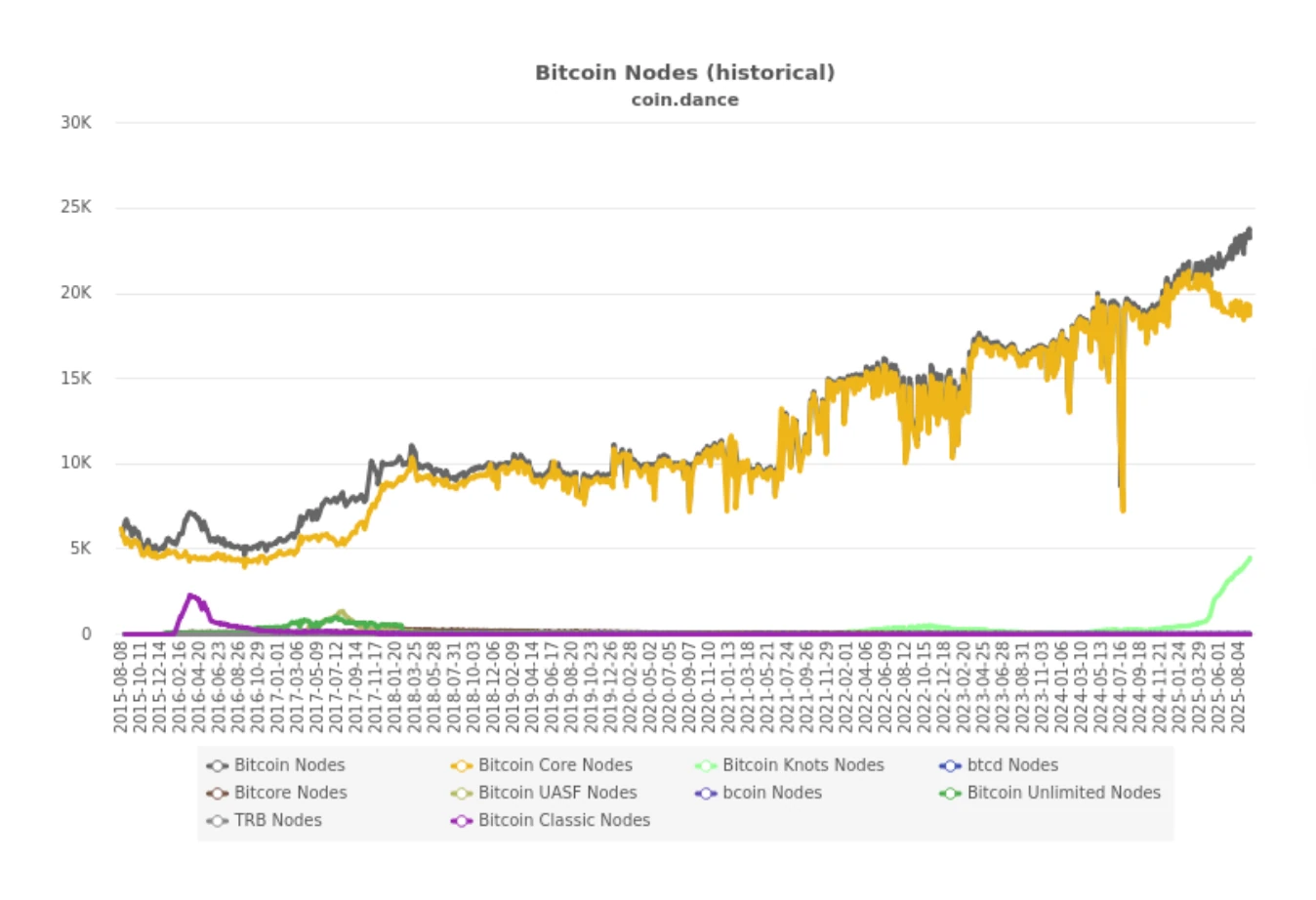

Количество узлов Bitcoin неуклонно растёт с 2015 года. Источник: Coin Dance.

Эта простота и доступные требования к оборудованию играют ключевую роль в сохранении децентрализации протокола и поддержании механизма консенсуса Bitcoin, который обеспечивается независимыми владельцами узлов. Если узлы становятся слишком дорогими из-за растущих требований к оборудованию, сеть рискует централизоваться под управлением крупных поставщиков услуг, что противоречит фундаментальным принципам Bitcoin.

Критики указывают, что надписи, порядковые номера и другие формы хранения неденежных данных в блокчейне создают риск централизации. Они увеличивают размер реестра и вынуждают операторов узлов хранить значительные объемы данных, не связанных с денежными операциями.

В мае разработчики Bitcoin Core, программного обеспечения, используемого примерно 80% владельцев узлов, объявили о предстоящем обновлении. Bitcoin Core 30, выход которого запланирован на октябрь, устранит ограничение OP_Return, которое ограничивает объем неденежных данных, встраиваемых в транзакции Bitcoin.
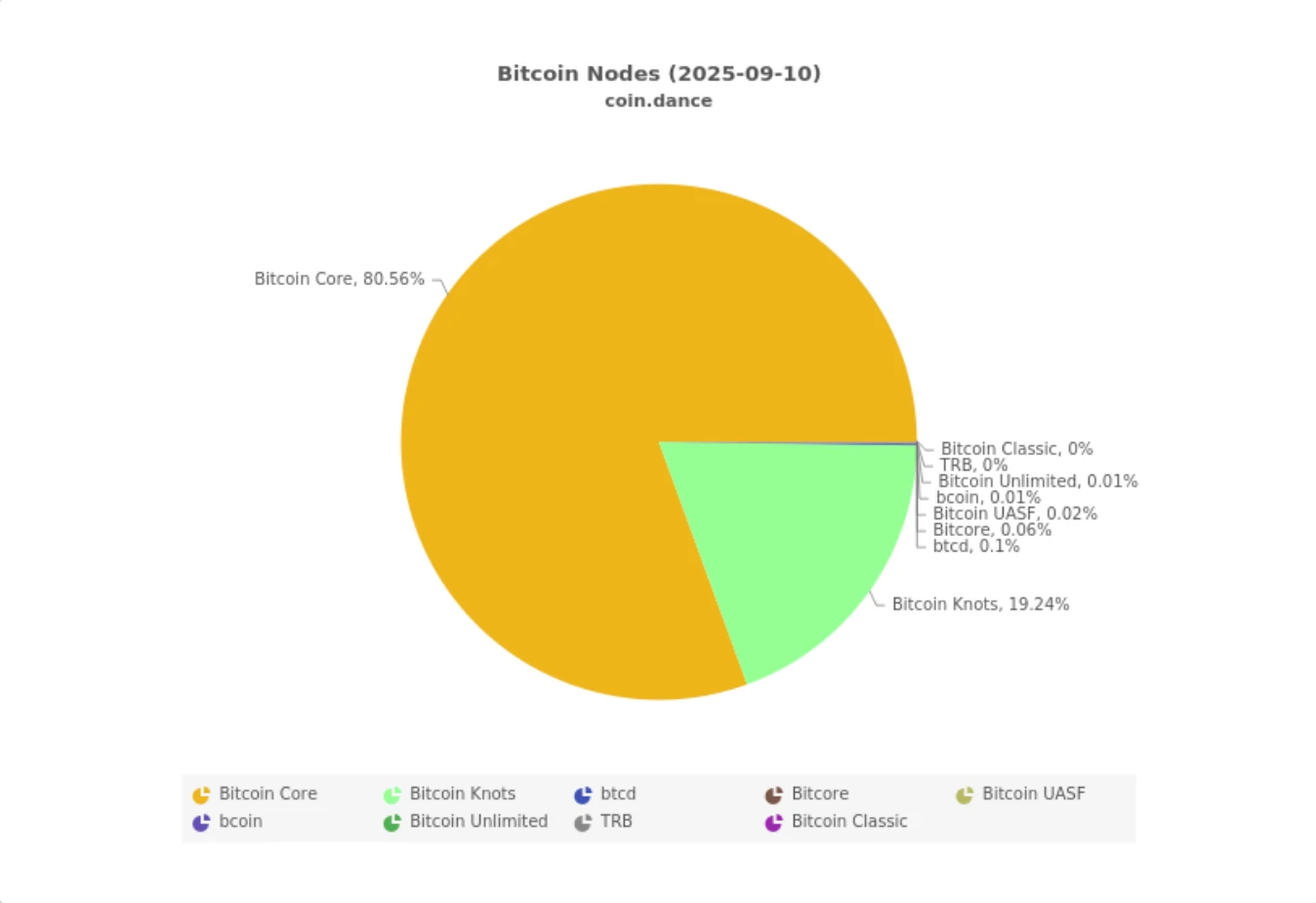

Разделение различных реализаций программного обеспечения узла Bitcoin. Источник Coin Dance

Текущее ограничение OP_Return составляет 80 байт, что недостаточно для хранения большинства современных изображений и мультимедийного контента. Предложенное изменение вызвало исторический всплеск популярности Bitcoin Knots — альтернативного программного обеспечения для узлов, предлагающего больше настраиваемых параметров. Владельцы узлов Knots могут ограничивать объем данных OP_Return, которые они хранят в своих пулах памяти и передают другим узлам.

В 2025 году на узлы Knots приходится почти 20% сети — это практически вертикальный рост по сравнению с концом 2024 года, когда их доля составляла около 1% от общего рынка.

Trending Cryptos

Related Reads

Analysis of 13F Holdings of Seven Major Funds: What Are Buffett, Duan Yongping, Li Lu, and Dan Bin Thinking?

A summary of Q2 2026 13F filings from seven major funds (Berkshire Hathaway, Duquesne Family Office, H&H International Investment, Himalaya Capital, ARK Investment, Oriental Harbor Investment Master Fund, Situational Awareness LP) reveals AI remains the central investment theme, with significant capital reallocation within the sector. Berkshire Hathaway, under Greg Abel, made its largest net stock purchases in years, heavily increasing its stake in Alphabet, signaling a strategic tilt towards tech while maintaining core holdings in consumer and financial stocks. Duquesne Family Office (Stanley Druckenmiller) rotated within semiconductors, selling Micron, Broadcom, and Intel but adding to positions in TSMC, STMicroelectronics, and AMD, while also reinvesting in cloud giants Alphabet and Amazon and cautiously re-entering Chinese tech via Baidu. H&H International Investment (Duan Yongping) and Himalaya Capital (Li Lu) both significantly increased their stakes in PDD, with Li Lu also concentrating his portfolio by selling out of several financial and energy holdings to focus on core positions like Alphabet and Berkshire. H&H also took profits from high-flying AI/tech names like Nvidia and Google, viewing the moves as valuation adjustments rather than a loss of conviction. ARK Investment (Cathie Wood) aggressively bought SpaceX upon its IPO and continued hunting for disruptive innovation across AI, energy, and biotech, while reducing its Tesla holding. Oriental Harbor Investment Master Fund (Dan Bin) executed a dramatic shift towards AI hardware, launching major new positions in Intel, SanDisk, AMD, and others while selling down software/platform holdings like Google and clearing out consumer names Apple and Tesla. Situational Awareness LP's filing, reflecting pre-liquidation positions, showed a story of missed hedging opportunities leading to significant losses. The consensus is that AI growth is continuing, but capital is actively rotating to identify the next profit centers within the value chain—from semiconductors and infrastructure to eventual commercialization. The filings, while lagging, offer a snapshot of how sophisticated investors are positioning for AI's next phase.

Odaily星球日报12m ago

Analysis of 13F Holdings of Seven Major Funds: What Are Buffett, Duan Yongping, Li Lu, and Dan Bin Thinking?

Odaily星球日报12m ago

Arthur Hayes Makes a High-Profile Comeback, Flop Labs Aims to Become the "Fuel" for the Agent Economy

Arthur Hayes, co-founder of BitMEX, has announced his return as head of a new project called Flop Labs, declaring "FLOP is food for your AI agent." This marks his first high-profile return to a leadership role since stepping back from BitMEX. Flop Labs aims to be a native monetary network and verifiable computation settlement layer for the AI Agent economy, distinguishing itself from existing AI Agent projects. Its core concept is "Proof-of-Useful-Inference," which seeks to integrate useful AI inference tasks into the blockchain consensus mechanism, allowing FLOP tokens to serve as the native currency for Agents to purchase computing resources and store memory. The ecosystem involves four key roles: Miners (provide GPU compute), Validators (verify services), Agents (consume services), and KOLs/Partners (community growth). The project promises a 100% fair launch with no presale or VC involvement. A large airdrop is planned for Q4 2026, with the genesis block targeted for Q1 2027. While the announcement has generated community excitement, particularly around the airdrop, the project is in an early conceptual stage. It currently lacks a published whitepaper, detailed tokenomics, technical specifics on its consensus mechanism, or smart contract audits. Arthur Hayes has defended the venture, separating his belief in the potential of the Agentic Economy from concerns about an AI stock bubble. The success of Flop Labs will hinge on its ability to deliver substantive technical progress and ecosystem development in the coming months.

Odaily星球日报27m ago

Arthur Hayes Makes a High-Profile Comeback, Flop Labs Aims to Become the "Fuel" for the Agent Economy

Odaily星球日报27m ago

World Chain Launches EIP-7928 Block Access Lists on Mainnet

World Chain has launched EIP-7928 block access lists on its Mainnet, becoming the first production layer-2 network to implement this standard. This deployment aims to significantly increase blockchain throughput without substantially raising the hardware requirements for validators. By providing access list data incrementally every 200 milliseconds through its flashblock architecture, World Chain enables validators to verify transactions in parallel and begin validation while a block is still being built, eliminating the need for sequential re-execution. Implemented via a runtime flag rather than a hard fork, this approach is an extension of the EIP-7928 standard, which Ethereum may incorporate in a future update. Internal benchmarks on World Chain test networks showed validation latency remained stable as throughput scaled up to one gigabit per second on standard cloud infrastructure, suggesting the potential for increased throughput without a proportional increase in computational resources for validators. This mainnet launch represents the first production use of streaming EIP-7928 block access lists and contributes to Ethereum's broader scaling strategy by expanding verification capacity while remaining accessible to independent validators. Built on the OP Stack and secured by Ethereum, World Chain is designed for scalability within the Superchain ecosystem. It focuses on applications like stablecoin finance, international remittances, and trading, utilizing World ID's proof-of-human system. The network aims to make blockchain technology widely accessible, starting with discovery and use through compatible wallets like World App.

TheNewsCrypto32m ago

World Chain Launches EIP-7928 Block Access Lists on Mainnet

TheNewsCrypto32m ago

Trading

Spot

Hot Articles

What is $BITCOIN

DIGITAL GOLD ($BITCOIN): A Comprehensive Analysis Introduction to DIGITAL GOLD ($BITCOIN) DIGITAL GOLD ($BITCOIN) is a blockchain-based project operating on the Solana network, which aims to combine the characteristics of traditional precious metals with the innovation of decentralized technologies. While it shares a name with Bitcoin, often referred to as “digital gold” due to its perception as a store of value, DIGITAL GOLD is a separate token designed to create a unique ecosystem within the Web3 landscape. Its goal is to position itself as a viable alternative digital asset, although specifics regarding its applications and functionalities are still developing. What is DIGITAL GOLD ($BITCOIN)? DIGITAL GOLD ($BITCOIN) is a cryptocurrency token explicitly designed for use on the Solana blockchain. In contrast to Bitcoin, which provides a widely recognized value storage role, this token appears to focus on broader applications and characteristics. Notable aspects include: Blockchain Infrastructure: The token is built on the Solana blockchain, known for its capacity to handle high-speed and low-cost transactions. Supply Dynamics: DIGITAL GOLD has a maximum supply capped at 100 quadrillion tokens (100P $BITCOIN), although details regarding its circulating supply are currently undisclosed. Utility: While precise functionalities are not explicitly outlined, there are indications that the token could be utilized for various applications, potentially involving decentralized applications (dApps) or asset tokenization strategies. Who is the Creator of DIGITAL GOLD ($BITCOIN)? At present, the identity of the creators and development team behind DIGITAL GOLD ($BITCOIN) remains unknown. This situation is typical among many innovative projects within the blockchain space, particularly those aligning with decentralized finance and meme coin phenomena. While such anonymity may foster a community-driven culture, it intensifies concerns about governance and accountability. Who are the Investors of DIGITAL GOLD ($BITCOIN)? The available information indicates that DIGITAL GOLD ($BITCOIN) does not have any known institutional backers or prominent venture capital investments. The project seems to operate on a peer-to-peer model focused on community support and adoption rather than traditional funding routes. Its activity and liquidity are primarily situated on decentralized exchanges (DEXs), such as PumpSwap, rather than established centralized trading platforms, further highlighting its grassroots approach. How DIGITAL GOLD ($BITCOIN) Works The operational mechanics of DIGITAL GOLD ($BITCOIN) can be elaborated on based on its blockchain design and network attributes: Consensus Mechanism: By leveraging Solana’s unique proof-of-history (PoH) combined with a proof-of-stake (PoS) model, the project ensures efficient transaction validation contributing to the network's high performance. Tokenomics: While specific deflationary mechanisms have not been extensively detailed, the vast maximum token supply implies that it may cater to microtransactions or niche use cases that are still to be defined. Interoperability: There exists the potential for integration with Solana’s broader ecosystem, including various decentralized finance (DeFi) platforms. However, the details regarding specific integrations remain unspecified. Timeline of Key Events Here is a timeline that highlights significant milestones concerning DIGITAL GOLD ($BITCOIN): 2023: The initial deployment of the token occurs on the Solana blockchain, marked by its contract address. 2024: DIGITAL GOLD gains visibility as it becomes available for trading on decentralized exchanges like PumpSwap, allowing users to trade it against SOL. 2025: The project witnesses sporadic trading activity and potential interest in community-led engagements, although no noteworthy partnerships or technical advancements have been documented as of yet. Critical Analysis Strengths Scalability: The underlying Solana infrastructure supports high transaction volumes, which could enhance the utility of $BITCOIN in various transaction scenarios. Accessibility: The potential low trading price per token could attract retail investors, facilitating wider participation due to fractional ownership opportunities. Risks Lack of Transparency: The absence of publicly known backers, developers, or an audit process may yield skepticism regarding the project's sustainability and trustworthiness. Market Volatility: The trading activity is heavily reliant on speculative behavior, which can result in significant price volatility and uncertainty for investors. Conclusion DIGITAL GOLD ($BITCOIN) emerges as an intriguing yet ambiguous project within the rapidly evolving Solana ecosystem. While it attempts to leverage the “digital gold” narrative, its departure from Bitcoin's established role as a store of value underscores the need for a clearer differentiation of its intended utility and governance structure. Future acceptance and adoption will likely depend on addressing the current opacity and defining its operational and economic strategies more explicitly. Note: This report encompasses synthesised information available as of October 2023, and developments may have transpired beyond the research period.

2.0k Total ViewsPublished 2025.05.13Updated 2025.05.13

What is $BITCOIN

Discussions

Welcome to the HTX Community. Here, you can stay informed about the latest platform developments and gain access to professional market insights. Users' opinions on the price of BTC (BTC) are presented below.

活动图片