蚂蚁链 RWA 若要「活水入市」,Plume 能否成为合规流动性引擎?

深潮Published on 2025-09-09Last updated on 2025-09-10

RWA 的难点从来不在「把合约写出来」,而在「把制度搬上来」。

撰文:Sanqing

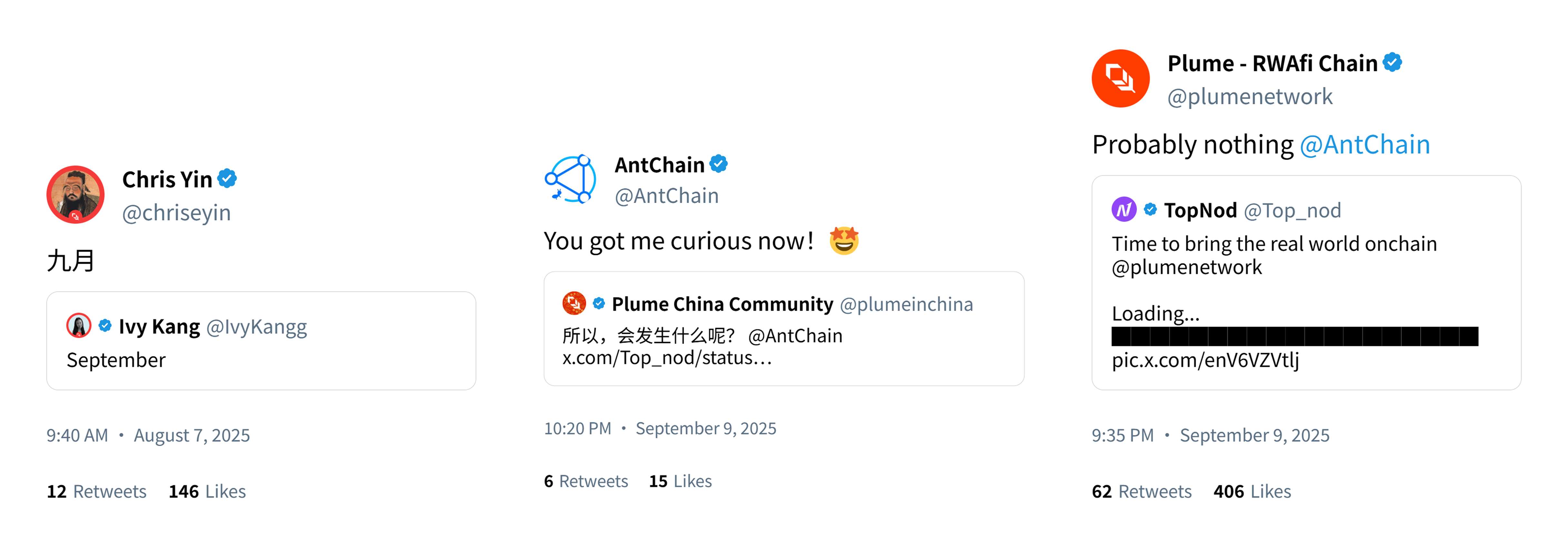
8 月初,Plume 团队以「September」预告引发联想,CEO Chris Yin 亦以中文沟通,社区据此推测九月或有合作进展。近期 Plume 与 AntChain 的公开互动进一步放大了这种期待。
两条链的「底色」与长项

蚂蚁链(AntChain)

定位:国内领先的许可型联盟链,服务政企与产业互联网场景。

技术特征:

  1. 许可制与身份体系:机构级 CA、企业 / 个人实名映射、细粒度权限控制。

  2. 可审计合规:链上留痕、节点多方共识、与线下审计 / 风控系统打通。

  3. 高性能与确定性最终性:面向业务系统对账、结算和司法取证的稳定需求。

  4. 隐私与数据治理:多方安全计算(MPC)、可信执行环境(TEE)等能力成熟。

擅长的应用:供应链金融、跨境贸易合规、电子凭证 / 存证、产业协同等——「把真实资产数字化并纳入制度框架」。

Plume

定位:面向 RWA 的 EVM 兼容链,主打 RWA ✖ DeFi 的可组合性与开发者生态。

技术特征:

  1. EVM/ 账户体系:与以太坊生态深度兼容,合约 / 工具链迁移成本低。

  2. 合规模块:链级 AML,且支持白名单、可转让限制、二次验证等模块化合规逻辑。

  3. 原生 DeFi 友好:AMM/ 借贷 /LP/ 收益分配等乐高式组合,适配各类做市与衍生策略。

  4. 开放可见度:资产在全球开发者与做市网络中更容易获得关注与二级流动性。

擅长的应用:做市、LP、稳定仓、杠杆 / 循环(loop)、收益凭证化等——「让合规资产活起来」。

许可链与公链联动的现实约束

许可链(如蚂蚁链)和公链(如 Plume)联动虽潜力巨大,但面临多重现实挑战,这些源于监管、技术和运营层面的壁垒,尤其在 2025 年 RWA 生态中凸显:

  1. 法律锚:在岸资产发行与投资者名册严格受本地监管(如中国大陆或香港金管局要求),无法简单「搬链」到公链环境,避免合规风险。

  2. 适当性与转让限制:仅限合格投资者(如机构或认证个人)持有 / 交易,名册需与原登记系统实时一致,限制散户参与并增加 KYC 门槛。

  3. 桥的信任模型:许可链往往缺少公链式的轻客户端验证,依赖运营商、托管机构和定期审计作为核心安全机制,易受中心化风险影响。

  4. 现金流与赎回:票息、租金等收益兑付及到期赎回需实现跨境合规流动,同时确保全链路可追溯、可审计,技术整合难度高。

单纯的技术桥接不足以解决问题,还需满足合规与监管,融合多链互操作性,桥接两链优势并最小化风险,为后续合作模型奠基。

不过 8 月 26 日消息:国泰君安国际(GTJAI)与蚂蚁数科合作完成了首批结构化产品通证的「蚂蚁链 - 以太坊」跨链发行,包括固定收益可赎回通证和挂钩美股 ETF 的保本型产品,实现了 T+0 结算和透明审计,体现了类似托管桥的合规流动机制。为蚂蚁链 RWA 资产跨链到 Plume 提供了成功的案例指导。并且 Plume 也在此前顺利承接了新加坡 - 香港互认的由招银国际发行的美元货币基金。

猜想三种可行的合作模型

模型 A:单向「发行网关」

流程

  1. 资产在蚂蚁链完成发行 / 托管 / 持有人 KYC;

  2. 网关机构将资产锁定,在 Plume 铸造镜像凭证(ERC-20/1155+ 合规钩子);

  3. 镜像凭证仅在白名单钱包间转让;

  4. 赎回时,Plume 销毁镜像,网关在蚂蚁链解锁原资产权益。

特性:

  • 简单、清晰、易审计;

  • 适合标准化、短久期、现金流稳定的资产(如租金、应收 / 保理)。

  • 风险:流动性有限,依赖网关信任。

模型 B:双向「托管桥」

在 A 的基础上,加入:

  1. 合规储备证明(PoR):定期披露链上 / 链下对账;

  2. 多签 / 托管人制度:分散运营风险;

  3. 分层份额:优先 / 次级结构,匹配不同风险偏好。

可增强市场信任,支持更丰富的收益型与期限管理产品。风险:托管人合谋可能放大系统性问题。

模型 C:ZK-KYC 与程序化合规

  1. 投资者在蚂蚁链侧完成资质校验,获得匿名资质凭证(ZK 证明);

  2. 在 Plume 交易时仅证明「我满足条件」,不暴露身份细节;

  3. 合规与隐私兼得,适合更开放的二级市场与做市网络。

结语

RWA 的难点从来不在「把合约写出来」,而在「把制度搬上来」。蚂蚁链提供制度与信用的锚点,Plume 提供市场与组合的引擎。若以「可信网关 + 镜像凭证」为骨架,再配以 PoR、托管与审计三件套,蚂蚁链 RWA 既能守住合规,也能拥抱流动性。但实际合作需经监管审核,且存在技术与地缘风险。建议持续关注官方更新, 当「稳」与「活」真正并行,才是这条桥最有价值的时刻。


Related Reads

On-chain Analyst: Why Are Most Zcash Transactions Still Traceable?

Title: Why Most Zcash Transactions Remain Traceable Zcash, a privacy-focused cryptocurrency launched in 2016, was designed to offer anonymity by hiding transaction details like sender, receiver, and amount using zero-knowledge proof technology (zk-SNARKs). However, in practice, a significant portion of ZEC transactions are still traceable on-chain. The key reason is Zcash's dual-address system. It features transparent addresses (t-addresses), which work like standard Bitcoin addresses with all data public, and shielded addresses (z-addresses) that encrypt transaction details. There are four transaction types with varying privacy levels: fully transparent (t→t), partially shielded (t→z and z→t), and fully private (z→z). Despite its privacy capabilities, most real-world Zcash activity involves transparent addresses, primarily because major exchanges and institutions use them for regulatory compliance. As a result, blockchain analytics platforms like Arkham can track and attribute a substantial volume of Zcash transactions. Arkham reports it has identified entities behind over $420 billion in ZEC transaction volume. Case studies highlight this traceability: the U.S. government holds seized Zcash from a dark web case, visible via its transparent wallet, and individual traders' profitable moves are trackable from purchase to exchange deposit. In conclusion, Zcash's privacy is not inherent but user-dependent. While purely shielded (z→z) transactions remain cryptographically private, the prevalence of transparent address usage makes much of the network's activity traceable. The actual privacy protection offered depends entirely on how users choose to transact.

marsbit25m ago

On-chain Analyst: Why Are Most Zcash Transactions Still Traceable?

marsbit25m ago

From Power Infrastructure to Token Economy: The 'Seven-Layer Cake' of the AI Industry Chain

From Power Grid to Token Economy: The AI Industry's "Seven-Layer Cake" The AI industry is shifting from a "model-centric" paradigm focused on massive training to a "token-centric" industrial era driven by inference demand. This new phase revolves around the production, distribution, scheduling, and consumption of tokens—the units of computation used by AI agents for every interaction and task. The article proposes a "seven-layer cake" framework for the AI economy: 1. **Power**: The foundational energy source, with competition shifting to securing stable, low-cost electricity. 2. **AIDC (AI Data Centers)**: Large-scale "Token factories." A trend toward smaller, modular, and regionally deployed AI Factories is emerging for efficiency and proximity to users. 3. **GPU**: The core production hardware for tokens. While NVIDIA dominates, competition exists from AMD, ASIC makers, and Chinese chipmakers, with a growing focus on inference efficiency. 4. **LLMs**: The "engines" that generate tokens. The competition is evolving beyond model size to prioritize factors like token cost, inference efficiency, and operational synergy with infrastructure. 5. **Token Distribution**: The "grid" that allocates and rents out compute resources, led by cloud giants and specialized AI-native platforms. 6. **Token Optimization & Intelligent Scheduling**: The critical "brain" layer that intelligently routes tasks (e.g., to local, cloud, or edge models) for optimal cost, latency, and privacy—maximizing the value of each token. 7. **AI Agents & Models**: The end consumers of tokens. The vision involves billions of AI agents working and interacting concurrently, consuming vast amounts of tokens. Currently, the industry faces fragmentation and inefficiencies between these layers. The true "mass adoption era" of AI will begin only when this seven-layer infrastructure is fully integrated and operates as a cohesive, intelligent network—transforming AI from a software tool into a global industrial system spanning energy, hardware, and compute logistics.

marsbit46m ago

From Power Infrastructure to Token Economy: The 'Seven-Layer Cake' of the AI Industry Chain

marsbit46m ago

Trading

Spot
Futures

Hot Articles

How to Buy PLUME

Welcome to HTX.com! We've made purchasing Plume Network (PLUME) simple and convenient. Follow our step-by-step guide to embark on your crypto journey.Step 1: Create Your HTX AccountUse your email or phone number to sign up for a free account on HTX. Experience a hassle-free registration journey and unlock all features.Get My AccountStep 2: Go to Buy Crypto and Choose Your Payment MethodCredit/Debit Card: Use your Visa or Mastercard to buy Plume Network (PLUME) instantly.Balance: Use funds from your HTX account balance to trade seamlessly.Third Parties: We've added popular payment methods such as Google Pay and Apple Pay to enhance convenience.P2P: Trade directly with other users on HTX.Over-the-Counter (OTC): We offer tailor-made services and competitive exchange rates for traders.Step 3: Store Your Plume Network (PLUME)After purchasing your Plume Network (PLUME), store it in your HTX account. Alternatively, you can send it elsewhere via blockchain transfer or use it to trade other cryptocurrencies.Step 4: Trade Plume Network (PLUME)Easily trade Plume Network (PLUME) on HTX's spot market. Simply access your account, select your trading pair, execute your trades, and monitor in real-time. We offer a user-friendly experience for both beginners and seasoned traders.

5.4k Total ViewsPublished 2025.01.21Updated 2025.03.21

How to Buy PLUME

Discussions

Welcome to the HTX Community. Here, you can stay informed about the latest platform developments and gain access to professional market insights. Users' opinions on the price of PLUME (PLUME) are presented below.

活动图片