New Bitcoin Reserve Bill Pressures Treasury On Custody Rules

bitcoinistPublished on 2025-09-09Last updated on 2025-09-10

Abstract

The US House Appropriations Committee has advanced H.R. 5166 — the Financial Services and General Government (FSGG) spending bill for...

Trusted Editorial content, reviewed by leading industry experts and seasoned editors. Ad Disclosure

The US House Appropriations Committee has advanced H.R. 5166 — the Financial Services and General Government (FSGG) spending bill for FY2026 — with language that would formally direct the Treasury Department to spell out how the federal government will custody Bitcoin and other digital assets it acquires, explicitly including holdings earmarked for the newly created Strategic Bitcoin Reserve. The bill was reported on September 5, 2025, as House Report 119-236 and placed on the Union Calendar.

Congress Demands Public Information On Bitcoin Reserve

At the statutory level, Section 138 of the reported bill requires the Treasury, within 90 days of enactment, to deliver a public plan for the “secure and efficient custody” of federal digital assets, “including assets held under the Strategic Bitcoin Reserve and the US Digital Asset Stockpile.” The plan must delineate custody architecture, legal authorities, cybersecurity controls, and interagency workflows for transfers and safekeeping.

Section 137 adds a second mandate: a report on the practicability of establishing the reserve and the related stockpile, addressing potential barriers, the expected impact on the Treasury Forfeiture Fund, how Bitcoin and other digital assets would be presented on the federal balance sheet, and any third-party contractors used for custody. Read together, the two sections would force the Treasury to clarify both whether and how the federal government will maintain long-term Bitcoin holdings — and what that means for government accounting and forfeiture-fund mechanics.

The committee report accompanying the bill underlines Congress’s intent to track the flow of seized assets into the program. It directs the Treasury to provide monthly tables of the Forfeiture Fund’s activity, including any “diversions from the Forfeiture Fund to the Bitcoin Strategic Reserve and/or the digital asset stockpile.” That same report section labels the custody directive “Custody of Digital Assets,” emphasizing strong safeguards to prevent loss, unauthorized access, or liquidation.

The push comes six months after the White House issued Executive Order 14233, which created both the Strategic Bitcoin Reserve and the US Digital Asset Stockpile by consolidating government-owned crypto seized in criminal and civil cases. The order states that government BTC placed into the reserve “shall not be sold,” positioning Bitcoin as a strategic asset held for national objectives subject to law. It also instructs Treasury and Commerce to develop ways to acquire additional government BTC on a budget-neutral basis.

H.R. 5166 would also bring the national-security community into the loop. Section 139 directs the Treasury Secretary and the Director of the National Security Agency to provide a classified report on inter-agency coordination within 90 days of enactment — a signal that lawmakers see digital-asset custody (and key management) as an operational risk surface as well as a balance-sheet question.

The legislative pressure is occurring alongside separate efforts to codify the reserve. In March, Rep. Byron Donalds introduced H.R. 2112 to give the executive order “the force and effect of law,” while other measures, such as H.R. 2032, have proposed building out a decentralized, cold-storage reserve network for government BTC. None of those standalone bills has been enacted, but the appropriations route, if passed, would time-box the Treasury to deliver concrete answers shortly after the spending bill becomes law.

What Changes If H.R. 5166 Becomes Law?

First, the Treasury would owe the public a detailed custody blueprint, not just internal memoranda or ad-hoc practices developed for asset seizures. Second, Congress would receive an analytical roadmap for how a Strategic Bitcoin Reserve and stockpile would interact with forfeiture processes and the federal balance sheet — key inputs for any future decision to scale the program beyond seized assets.

Third, the classified NSA-Treasury report would institutionalize security coordination around wallet infrastructure and interagency transfers. Together, those steps would shift the federal government’s handling of Bitcoin from case-by-case liquidation towards a defined reserve posture aligned with the March 6 policy that reserve BTC is not to be sold.

However, the measure does not itself appropriate BTC, purchase Bitcoin on the open market, or authorize immediate diversions into the reserve; it sets reporting and planning obligations contingent on enactment of the underlying appropriations bill. The House-reported text must still clear the full House, the Senate, and reconciliation before reaching the President’s desk. Until then, the timelines — “within 90 days of enactment” — are prospective.

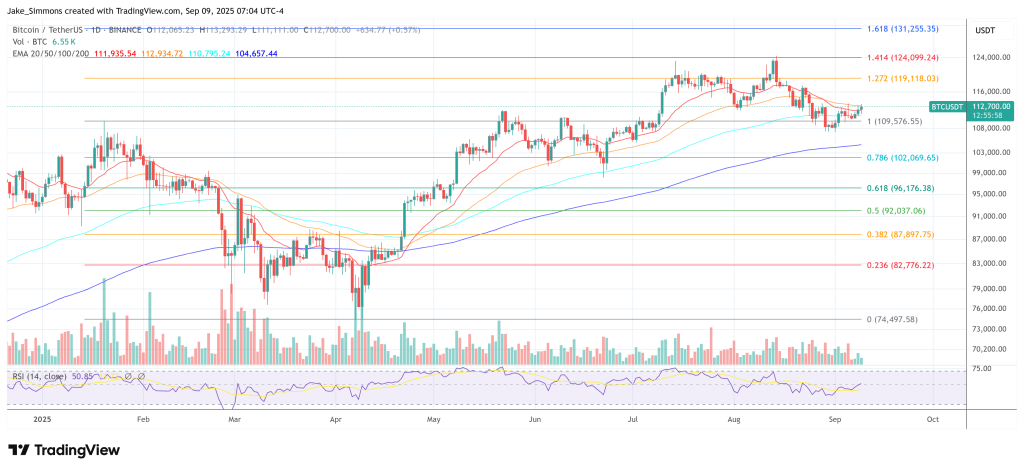
At press time, BTC traded at $112,700.
Bitcoin price
BTC faces the EMA50, 1-day chart | Source: BTCUSDT on TradingView.com
Featured image created with DALL.E, chart from TradingView.com
Editorial Process for bitcoinist is centered on delivering thoroughly researched, accurate, and unbiased content. We uphold strict sourcing standards, and each page undergoes diligent review by our team of top technology experts and seasoned editors. This process ensures the integrity, relevance, and value of our content for our readers.

Jake Simmons has been a Bitcoin enthusiast since 2016. Ever since he heard about Bitcoin, he has been studying the topic every day and trying to share his knowledge with others. His goal is to contribute to Bitcoin's financial revolution, which will replace the fiat money system. Besides BTC and crypto, Jake studied Business Informatics at a university. After graduation in 2017, he has been working in the blockchain and crypto sector. You can follow Jake on Twitter at @realJakeSimmons.

Trending Cryptos

Related Reads

Why Is No One Buying DeFi Insurance?

"Why DeFi Insurance Remains Unpurchased" explores the paradox of decentralized finance insurance. While DeFi insurance promises automatic, unbiased payouts via smart contracts—eliminating traditional insurers' denial practices—it struggles to attract users. The core issue is economic viability. Premiums are prohibitively high relative to the yields from DeFi protocols. For example, insuring a deposit on Aave or Maple Finance can consume most or even all of the annual yield, leaving returns comparable to or worse than traditional savings. Only the safest protocols, like MakerDAO, offer affordable premiums. Furthermore, the DeFi insurance model is structurally fragile. Unlike traditional insurance where risks are uncorrelated, DeFi risks are highly interconnected (e.g., oracle failures, bridge hacks). A single major exploit can simultaneously threaten multiple protocols, potentially bankrupting the entire insurance pool, which holds only millions against billions in total value locked. The governance model also creates a conflict of interest. In platforms like Nexus Mutual, token holders who vote on claims risk their own capital if payouts are approved, incentivizing denials. Consequently, the market is tiny and shrinking. Nexus Mutual dominates with $81.56 million in assets, but the industry lacks the capacity to cover a catastrophic event like the $292M Kelp DAO hack. Other providers have dwindled or shut down. The article concludes that DeFi insurance faces a "tragedy of the commons": its stability requires widespread adoption, but individual users have no incentive to pay for it, as premiums destroy their yields. Current solutions involve preventative measures like bug bounties and seeking external capital from traditional reinsurance, acknowledging that on-chain capital alone is insufficient to cover on-chain risks.

marsbit3h ago

Why Is No One Buying DeFi Insurance?

marsbit3h ago

Trading

Spot

Hot Articles

What is $BITCOIN

DIGITAL GOLD ($BITCOIN): A Comprehensive Analysis Introduction to DIGITAL GOLD ($BITCOIN) DIGITAL GOLD ($BITCOIN) is a blockchain-based project operating on the Solana network, which aims to combine the characteristics of traditional precious metals with the innovation of decentralized technologies. While it shares a name with Bitcoin, often referred to as “digital gold” due to its perception as a store of value, DIGITAL GOLD is a separate token designed to create a unique ecosystem within the Web3 landscape. Its goal is to position itself as a viable alternative digital asset, although specifics regarding its applications and functionalities are still developing. What is DIGITAL GOLD ($BITCOIN)? DIGITAL GOLD ($BITCOIN) is a cryptocurrency token explicitly designed for use on the Solana blockchain. In contrast to Bitcoin, which provides a widely recognized value storage role, this token appears to focus on broader applications and characteristics. Notable aspects include: Blockchain Infrastructure: The token is built on the Solana blockchain, known for its capacity to handle high-speed and low-cost transactions. Supply Dynamics: DIGITAL GOLD has a maximum supply capped at 100 quadrillion tokens (100P $BITCOIN), although details regarding its circulating supply are currently undisclosed. Utility: While precise functionalities are not explicitly outlined, there are indications that the token could be utilized for various applications, potentially involving decentralized applications (dApps) or asset tokenization strategies. Who is the Creator of DIGITAL GOLD ($BITCOIN)? At present, the identity of the creators and development team behind DIGITAL GOLD ($BITCOIN) remains unknown. This situation is typical among many innovative projects within the blockchain space, particularly those aligning with decentralized finance and meme coin phenomena. While such anonymity may foster a community-driven culture, it intensifies concerns about governance and accountability. Who are the Investors of DIGITAL GOLD ($BITCOIN)? The available information indicates that DIGITAL GOLD ($BITCOIN) does not have any known institutional backers or prominent venture capital investments. The project seems to operate on a peer-to-peer model focused on community support and adoption rather than traditional funding routes. Its activity and liquidity are primarily situated on decentralized exchanges (DEXs), such as PumpSwap, rather than established centralized trading platforms, further highlighting its grassroots approach. How DIGITAL GOLD ($BITCOIN) Works The operational mechanics of DIGITAL GOLD ($BITCOIN) can be elaborated on based on its blockchain design and network attributes: Consensus Mechanism: By leveraging Solana’s unique proof-of-history (PoH) combined with a proof-of-stake (PoS) model, the project ensures efficient transaction validation contributing to the network's high performance. Tokenomics: While specific deflationary mechanisms have not been extensively detailed, the vast maximum token supply implies that it may cater to microtransactions or niche use cases that are still to be defined. Interoperability: There exists the potential for integration with Solana’s broader ecosystem, including various decentralized finance (DeFi) platforms. However, the details regarding specific integrations remain unspecified. Timeline of Key Events Here is a timeline that highlights significant milestones concerning DIGITAL GOLD ($BITCOIN): 2023: The initial deployment of the token occurs on the Solana blockchain, marked by its contract address. 2024: DIGITAL GOLD gains visibility as it becomes available for trading on decentralized exchanges like PumpSwap, allowing users to trade it against SOL. 2025: The project witnesses sporadic trading activity and potential interest in community-led engagements, although no noteworthy partnerships or technical advancements have been documented as of yet. Critical Analysis Strengths Scalability: The underlying Solana infrastructure supports high transaction volumes, which could enhance the utility of $BITCOIN in various transaction scenarios. Accessibility: The potential low trading price per token could attract retail investors, facilitating wider participation due to fractional ownership opportunities. Risks Lack of Transparency: The absence of publicly known backers, developers, or an audit process may yield skepticism regarding the project's sustainability and trustworthiness. Market Volatility: The trading activity is heavily reliant on speculative behavior, which can result in significant price volatility and uncertainty for investors. Conclusion DIGITAL GOLD ($BITCOIN) emerges as an intriguing yet ambiguous project within the rapidly evolving Solana ecosystem. While it attempts to leverage the “digital gold” narrative, its departure from Bitcoin's established role as a store of value underscores the need for a clearer differentiation of its intended utility and governance structure. Future acceptance and adoption will likely depend on addressing the current opacity and defining its operational and economic strategies more explicitly. Note: This report encompasses synthesised information available as of October 2023, and developments may have transpired beyond the research period.

470 Total ViewsPublished 2025.05.13Updated 2025.05.13

What is $BITCOIN

Discussions

Welcome to the HTX Community. Here, you can stay informed about the latest platform developments and gain access to professional market insights. Users' opinions on the price of BTC (BTC) are presented below.

活动图片