Little Pepe Presale Hits $25M, Almost Sold Out Before Ethereum L2 Launch

bitcoinistPublished on 2025-09-09Last updated on 2025-09-09

Abstract

Little Pepe ($LILPEPE) is quickly attracting attention, having raised over $25M of its $25.4M target. Given that the presale is...

Trusted Editorial content, reviewed by leading industry experts and seasoned editors. Ad Disclosure

Little Pepe ($LILPEPE) is quickly attracting attention, having raised over $25M of its $25.4M target. Given that the presale is ~98% complete, it’s your final chance to hop in before it goes live on central exchanges and its price likely leaps higher.

Its early demand stems from its utility. While $LILPEPE looks like $PEPE’s baby brother, there’s nothing small about what it’s building: a fully-fledged Ethereum Layer-2 (L2) solution that addresses the network’s biggest pain points.

Solana Overrides Ethereum’s TPS by 98%

$PEPE – the OG frog coin – is currently valued at $0.0000105, down ~59% compared to its $0.000026 ATH.

As an ERC-20 token held on the Ethereum network, steep gas fees and slow transactions likely discourage traders from purchasing the iconic meme coin.

Right now, Ethereum’s average gas fees cost just 0.9356 Gwei. However, spikes earlier this year highlight how unpredictable and expensive trading can become. Of course, this doesn’t help $PEPE’s price volatility.
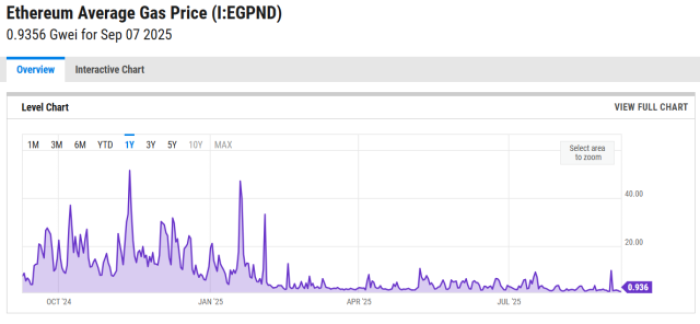
Ethereum gas fees on YCharts.
Source: YCharts

And neither does the fact that the network continues to struggle with scalability. Ethereum currently only processes 15.7 transactions per second (TPS), a whopping 98% lower than Solana’s 813.7 TPS.

Its max theoretical throughput lags far behind at 119.1 TPS, versus Solana’s 65K TPS.
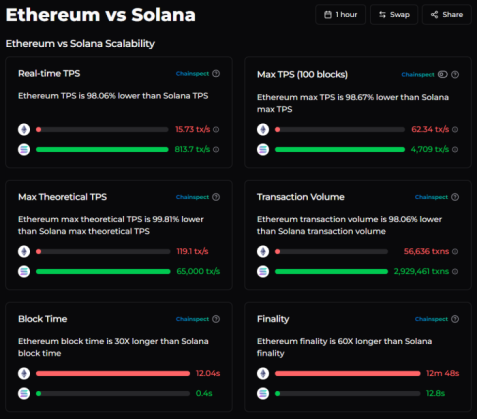
Ethereum vs Solana scalability on Chainspect.
Source: Chainspect

Making matters worse is its unimpressive throughput. Ethereum processes over 56.6K transactions, while Solana handles over 2.9M in the same span.

Block times add to the network’s woes. Ethereum averaged 12.04 seconds, 30x slower than Solana’s 0.4 seconds.

Additionally, Ethereum’s cause is hindered by the network’s 12-minute transaction finalization time. Solana takes just 12.8 seconds, and thus is a sizable 60x faster.

Crypto projects are often held back by high costs and delays on Ethereum’s base layer. But fear not: Little Pepe is getting set to launch a L2 solution that solves these issues.

Little Pepe L2 to Make Ethereum Faster & Cheaper

Little Pepe’s custom EVM-compatible L2 enables apps and games to migrate onto the network quickly and cheaply without code having to be rewritten.

The L2 is built for everyone – developers, traders, meme lovers, and NFT creators – offering fast transactions that cost less than a cent. So, you can anticipate games, decentralized dApps and NFTs without the high fees that notoriously push users away.

Essentially, it bundles transactions and processes them off-chain before settling them back on Ethereum. In turn, it boosts the network’s speed, scalability, and efficiency.

$LILPEPE is behind the L2, plus it powers transactions, staking rewards, governance (parenting rights), and liquidity.

About the Little Pepe frog coin.
Source: Little Pepe

Given that a tremendous 30% (30B) of $LILPEPE’s 100B token supply is set aside for chain reserves, the meme coin eyes stable, long-term network growth.

An additional 10% ($10B) $LILPEPE earmarked for marketing and centralized exchange reserves further strengthens the project’s sustainability. It also supports the team’s ambition to break into CoinMarketCap’s top 100.

In fact, Little Pepe’s foundation for lasting growth is already visible. With 25.7K+ X followers and 29K+ Telegram subscribers, it demonstrates organic growth ahead of larger promotional efforts and major listings.

Visit the official Little Pepe presale before it ends.

Purchase $100 $LILPEPE to Join a $777K Prize Draw

With a presale that’s nearly sold out, a custom-built EVM-compatible chain, and robust tokenomics, $LILPEPE is much more than just another frog-themed meme coin.

For early adopters, $LILPEPE is a great way to get exposure to a meme coin project with real infrastructure at an ultra low cost.

You can buy $LILPEPE on presale for just $0.0021. But don’t wait around, as it’s gearing up for a ~5% increase.

By investing $100 into the presale and sharing the project’s posts across social media channels, you can also enter Little Pepe’s $777K giveaway.

This article isn’t financial advice. Do your own homework and never invest more than you’d be sad to lose.

Authored by Leah Waters, Bitcoinist: https://bitcoinist.com/little-pepe-presale-nears-end-at-25m

Editorial Process for bitcoinist is centered on delivering thoroughly researched, accurate, and unbiased content. We uphold strict sourcing standards, and each page undergoes diligent review by our team of top technology experts and seasoned editors. This process ensures the integrity, relevance, and value of our content for our readers.

Leah is a British journalist with a BA in Journalism, Media, and Communications and nearly a decade of content writing experience. Over the last four years, her focus has primarily been on Web3 technologies, driven by her genuine enthusiasm for decentralization and the latest technological advancements. She has contributed to leading crypto and NFT publications – Cointelegraph, Coinbound, Crypto News, NFT Plazas, Bitcolumnist, Techreport, and NFT Lately – which has elevated her to a senior role in crypto journalism. Whether crafting breaking news or in-depth reviews, she strives to engage her readers with the latest insights and information. Her articles often span the hottest cryptos, exchanges, and evolving regulations. As part of her ploy to attract crypto newbies into Web3, she explains even the most complex topics in an easily understandable and engaging way. Further underscoring her dynamic journalism background, she has written for various sectors, including software testing (TEST Magazine), travel (Travel Off Path), and music (Mixmag). When she's not deep into a crypto rabbit hole, she's probably island-hopping (with the Galapagos and Hainan being her go-to's). Or perhaps sketching chalk pencil drawings while listening to the Pixies, her all-time favorite band.

Trending Cryptos

Related Reads

Just now, DeepSeek V4 updates with DSpark, improving inference speed by 80%

DeepSeek has updated its DeepSeek V4 model with the DSpark speculative decoding framework, achieving a significant 60-85% speedup in generation for Flash models and 57-78% for Pro models while maintaining the same overall throughput. This engineering-focused update, rather than a core architectural change, introduces DSpark to address latency and throughput bottlenecks in high-concurrency production environments. DSpark combines high-throughput parallel generation with adaptive load-aware verification. Its key innovations include a semi-autoregressive generation architecture to model dependencies within token blocks and a hardware-aware confidence-scheduled verification system. This system uses a confidence head to predict token acceptance probabilities, allowing it to dynamically optimize verification length per request and allocate compute only to tokens with the highest expected payoff. The asynchronous scheduler is designed for real-world deployment, ensuring zero-overhead scheduling and continuous CUDA graph replay while preserving the target model's output distribution. In tests across mathematical reasoning, code generation, and daily dialogue, DSpark outperformed state-of-the-art models like Eagle3 and DFlash, increasing average acceptance length by 26.7%-30.9% and 16.3%-18.4% respectively on Qwen3 target models. DeepSeek also open-sourced DeepSpec, a full-stack codebase for training and evaluating speculative decoding draft models, providing a standardized toolkit that includes data preparation tools, model implementations, training code, and evaluation scripts.

marsbit1h ago

Just now, DeepSeek V4 updates with DSpark, improving inference speed by 80%

marsbit1h ago

BIT Research: The 2028 Halving Is Not the End, the Real Shake-Up of the Bitcoin Mining Industry Is Just Beginning

The Bitcoin mining industry is undergoing its most complex structural adjustment since inception. Despite Bitcoin's price holding near $61,000 and the network hash rate approaching a record 1 ZH/s, miner profitability is deteriorating. The industry is operating close to its breakeven point, with the 2028 halving expected to accelerate consolidation. The challenges extend beyond the halving's subsidy reduction; the industry's revenue model has yet to successfully transition towards a fee-driven structure. Increasingly, mining companies are evolving from simple Bitcoin producers into infrastructure and energy operators, including providers of AI/HPC computing power. Competition is shifting from pure hash rate expansion to business model upgrades. Economic pressure is evident. The theoretical daily mining revenue at current prices is around $78 million, yet the actual figure is only about $33 million—a 136% gap. Transaction fees remain low at roughly $220k daily, far below historical implied levels. With a current estimated industry-wide breakeven price near $65,000, mining alone is struggling to generate ideal profits. The 2028 halving is projected to push the fundamental production cost floor to approximately $93,289. This will likely accelerate a shift towards consolidation among larger, well-capitalized miners with diversified revenue streams. Competitive advantage will belong to institutionalized players with access to low-cost energy, AI/HPC hosting operations, and stronger balance sheets. In essence, Bitcoin mining is transitioning from a "mining business" to an "infrastructure business." Future profitability and resilience will depend less on block rewards and more on diversified income sources like energy management and computational infrastructure services. For investors, the key question is not the halving itself, but which miners can successfully navigate this business model transformation.

marsbit2h ago

BIT Research: The 2028 Halving Is Not the End, the Real Shake-Up of the Bitcoin Mining Industry Is Just Beginning

marsbit2h ago

This is How God Karpathy Uses Claude?

Andrej Karpathy, a prominent figure in AI, has reportedly joined Anthropic, leading to a noticeable decrease in his open-source contributions and social media activity. A document claiming to be his personal "CLAUDE.md" file—a set of instructions for the Claude AI to follow within a specific codebase—has been circulating online. While its authenticity is unverified, the content aligns closely with Karpathy's publicly shared principles on effective AI-assisted programming. The document outlines key rules for AI coding assistants, emphasizing the importance of reading existing code thoroughly before writing new code to maintain consistency. It advises against over-engineering, advocating for simple, surgical modifications that match the project's existing style. Other guidelines include clarifying assumptions upfront, writing meaningful tests, thoughtful debugging, and carefully considering dependencies. The core message is that these principles help prevent common AI coding failures, such as introducing unnecessary abstractions, style drift, or making invisible architectural decisions. The community has noted that even experts like Karpathy require detailed instructions to guide AI effectively, akin to managing a junior developer. A related GitHub repository, "andrej-karpathy-skills," which encapsulates these ideas, is reported to significantly reduce Claude's code error rate. Ultimately, the advice stresses that the best CLAUDE.md is tailored to one's own tech stack and coding practices.

marsbit2h ago

This is How God Karpathy Uses Claude?

marsbit2h ago

Trading

Spot

Hot Articles

Discussions

Welcome to the HTX Community. Here, you can stay informed about the latest platform developments and gain access to professional market insights. Users' opinions on the price of ETH (ETH) are presented below.

活动图片