Ethereum News: BitMine hat ultra viel ETH und investiert in WorldCoin

bitcoinistPublished on 2025-09-08Last updated on 2025-09-08

Abstract

BitMine hat mehr als zwei Millionen Ethereum im Wert von rund neun Milliarden Dollar angesammelt. Zusätzlich steckt die Firma 20...

Trusted Editorial content, reviewed by leading industry experts and seasoned editors. Ad Disclosure
  • BitMine hat mehr als zwei Millionen Ethereum im Wert von rund neun Milliarden Dollar angesammelt.
  • Zusätzlich steckt die Firma 20 Millionen Dollar in ein Projekt von Sam Altman, das auf Worldcoin setzt.
  • Damit baut BitMine seine Position als einer der größten Kryptoschatzhalter weltweit aus.

Krypto ist kompliziert? Nicht unbedingt! BitMine Immersion Technologies zeigt gerade eindrucksvoll, wie groß das Spiel inzwischen geworden ist. Mit einem gigantischen Ethereum-Schatz und einem spannenden Investment sorgt das Unternehmen für Gesprächsstoff – und vielleicht auch für das nächste große Kapitel der Krypto-Geschichte.

BitMine wird zum Ethereum-Giganten

Früher war BitMine vor allem fürs Bitcoin-Schürfen bekannt. Heute hat sich das Unternehmen in einen wahren Ethereum-Giganten verwandelt. Es hält nun stolze 2.069.443 ETH im Wert von etwa neun Milliarden Dollar. Zusätzlich gibt es noch ein paar „Beigaben“: 192 Bitcoin im Wert von rund 215 Millionen Dollar sowie 266 Millionen Dollar in bar.

Damit gehört BitMine zu den größten Krypto-Schatztruhen der Welt. Wer das mit den Zahlen nicht ganz einordnen kann: Das sind über 1,7 Prozent aller existierenden Ethereum-Coins. Und genau diese Menge sorgt dafür, dass BitMine im Ranking der Kryptoschatzhalter weit vorne liegt.

Ein Superzyklus für Ethereum?

Laut BitMine ist Ethereum gerade erst am Anfang einer riesigen Wachstumsphase. Chairman Tom Lee spricht sogar von einem „Superzyklus“. Seine Begründung: Die Wall Street entdeckt die Möglichkeiten der ERC20-Blockchain, während künstliche Intelligenz ganz neue Token-Ökonomien schafft.

Klingt kompliziert, oder? Stell es dir so vor: Ethereum könnte der Motor einer neuen digitalen Wirtschaft sein. Und BitMine setzt darauf, dass diese Maschine jetzt so richtig Fahrt aufnimmt. Schon das ganze Jahr über häuft BitMine immer mehr ETH an.

BitMine investiert in Worldcoin

Neben dem eigenen Schatz hat BitMine ein neues Abenteuer gestartet. Zum ersten Mal gab es ein sogenanntes „Moonshot“-Investment – also eine riskante, aber möglicherweise extrem lohnende Wette. 20 Millionen Dollar wanderten zu Eightco Holdings, einem E-Commerce-Unternehmen, das auf Worldcoin setzt.

Worldcoin ist ein Projekt von Sam Altman, dem Mitgründer von OpenAI. Es läuft auf Ethereum und soll eine digitale Identität für alle schaffen. Für BitMine passt das perfekt ins Bild: Ein mutiges Projekt, das den Wert des Ethereum-Netzwerks steigern könnte.

Google-Style Wetten

BitMine vergleicht seinen Ansatz mit Googles „Other Bets“. Gemeint sind kleine Investments in verrückte Ideen, die irgendwann sehr groß werden können. Wer weiß – vielleicht ist Worldcoin eines Tages so etwas wie das Android der Krypto-Welt.

Chairman Lee erklärt: „Wir wollen mutige Projekte unterstützen, die Ethereum noch wertvoller machen.“ Klingt ambitioniert, doch BitMine scheint genug Geld und Geduld für solche Abenteuer zu haben.

Reaktionen an der Börse

Die Nachricht über das Investment sorgte sofort für Aufregung. Die Aktien von Eightco Holdings explodierten um über 3.000 Prozent und eröffneten bei 46,01 Dollar. So eine Rallye sieht man nicht alle Tage.
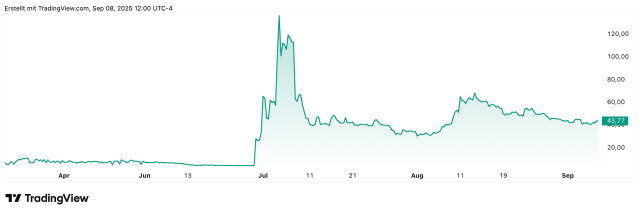
BitMine im 6 Monats Chart , Ethereum
BitMine im 6 Monats Chart Quelle: TradingView

Auch BitMine selbst konnte leicht zulegen. Die Aktie stieg um 0,5 Prozent auf 42,36 Dollar. Zwar liegt der Kurs noch rund 18 Prozent unter dem Stand vom Vormonat, doch die neuen Schlagzeilen machen Mut.

BitMine im Vergleich

Schaut man sich die Konkurrenz an, liegt BitMine klar vorne. Das nächste Unternehmen im ETH-Ranking, SharpLink Gaming, bringt es „nur“ auf 3,63 Milliarden Dollar an Ethereum. Dagegen wirken die neun Milliarden von BitMine wie ein echter Goldschatz.

Insgesamt belegt BitMine damit Platz zwei unter allen Kryptoschatzhaltern. Nur das Schwergewicht Strategy ist noch größer – und hält einen Bitcoin-Vorrat im Wert von knapp 72 Milliarden Dollar.

Ethereum im Marktgeschehen

Ethereum selbst notierte zuletzt bei 4.328 Dollar. Das entspricht einem kleinen Plus von 0,7 Prozent in den vergangenen 24 Stunden. Von seinem Rekordhoch im August liegt der Kurs allerdings noch 12 Prozent entfernt.

Doch für BitMine spielt das keine große Rolle. Der Konzern setzt nicht auf schnelle Gewinne, sondern auf die langfristige Entwicklung. Und wenn die Prognosen stimmen, könnte Ethereum schon bald das Herzstück einer ganz neuen Finanzwelt sein.

Bitcoin Hyper – Bitcoin mit Turbolader

Bitcoin gilt als Fels in der Brandung, doch in Sachen Geschwindigkeit wirkt er eher wie eine Kutsche. Bitcoin Hyper ändert das Spiel: Als erste Layer-2 kombiniert es die Solana Virtual Machine mit Bitcoin. Über eine Brücke wird BTC eingezahlt, daraus entsteht Wrapped BTC – bereit für blitzschnelle Transaktionen in DeFi, Gaming oder Payment-Apps. So wird aus dem reinen Wertspeicher endlich ein flexibles Zahlungsmittel, abgesichert durch das Bitcoin-Netzwerk und befeuert von Solanas Effizienz. Kurz: Bitcoin bekommt Beine – und zwar schnelle.
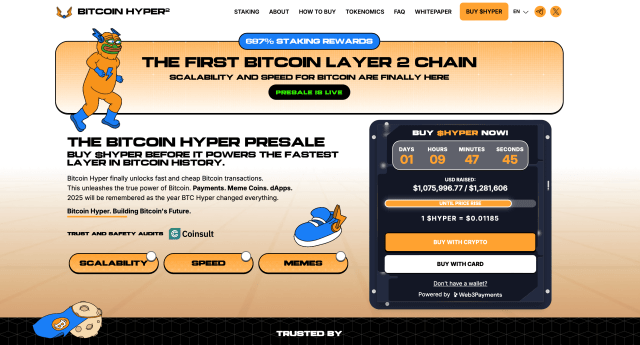
Bitcoin Hyper Presale

HYPER – der Schlüssel zum Ökosystem

Im Zentrum steht der HYPER-Token, die Währung für alles im Bitcoin-Hyper-Universum. Heute schon Transaktionsmittel, morgen zusätzlich Governance-Tool und Utility-Coin. Wer HYPER hält, verbindet die Sicherheit von Bitcoin mit der Leistungsfähigkeit eines modernen Layer-2. Noch läuft die Presale-Phase – traditionell die günstigste Gelegenheit, einzusteigen. Frühinvestoren könnten doppelt profitieren: von einem starken Fundament in BTC und dem Potenzial eines Projekts, das in Zukunft weit mehr als nur ein weiterer Coin sein will. Manche sprechen schon von möglichen 100x-Chancen – aber auch ohne Superlative: HYPER zeigt, wohin die Reise für Bitcoin gehen kann.

Jetzt rechtzeitig einsteigen und $HYPER im Presale kaufen.

Hinweis: Investieren ist spekulativ. Bei der Anlage ist Ihr Kapital in Gefahr. Diese Website ist nicht für die Verwendung in Rechtsordnungen vorgesehen, in denen der beschriebene Handel oder die beschriebenen Investitionen verboten sind, und sollte nur von Personen und auf gesetzlich zulässige Weise verwendet werden. Ihre Investition ist in Ihrem Land oder Wohnsitzstaat möglicherweise nicht für den Anlegerschutz geeignet. Führen Sie daher Ihre eigene Due Diligence durch. Diese Website steht Ihnen kostenlos zur Verfügung, wir erhalten jedoch möglicherweise Provisionen von den Unternehmen, die wir auf dieser Website anbieten.

Editorial Process for bitcoinist is centered on delivering thoroughly researched, accurate, and unbiased content. We uphold strict sourcing standards, and each page undergoes diligent review by our team of top technology experts and seasoned editors. This process ensures the integrity, relevance, and value of our content for our readers.

Related Reads

China's AI Fronts: From Yan'an to Midway

This article analyzes the competitive landscape of China's AI industry through a dual-front war analogy: the "Eastern Front" of business model competition and the "Western Front" of global strategic positioning. **The Eastern Front: The Scramble for Supply Lines and Monetization** The "Eastern Front" examines the contrasting strategies of three Chinese tech giants—Tencent, Alibaba, and ByteDance—in the face of AI's high marginal costs. Tencent integrates AI as a catalyst within its existing ecosystems (advertising, gaming, cloud) for monetization, prioritizing high-value scenarios over user growth. Alibaba bets on a full-stack, self-developed approach from chips to applications, aiming to control costs and ecosystem, though this requires immense patience and resources. ByteDance, with Doubao as its flagship, pursues a traditional traffic-driven, "super app" strategy but faces severe monetization challenges as its massive user base incurs unsustainable operational costs. The central challenge for all is building a reliable "supply line" (sustainable funding/profit) and achieving efficient monetization, moving beyond being mere "token factories." **The Western Front: "Preserving Land" vs. "Preserving People"** The "Western Front" frames a global strategic divergence. The U.S. model ("preserving land") focuses on closed-source, high-premium models (e.g., Anthropic) targeting lucrative enterprise markets. China's strategy ("preserving people") leverages open-source models (e.g., Alibaba's Qwen, DeepSeek) and extremely low pricing to attract global developers and capture long-tail markets, akin to a "surround the cities from the countryside" approach. The goal is to make Chinese models the default infrastructure, locking in future ecosystem value. However, the critical test is whether this open-source ecosystem can achieve a commercial闭环, converting developer adoption into tangible revenue (e.g., via cloud services), and bridging the monetization gap with Western models that charge for value, not just tokens. **Conclusion: The Long March from Factory to Brand** The article concludes that China's AI industry possesses technology, users, and scenarios but must integrate them to create and capture value. Its ultimate success depends on navigating both fronts: companies must establish sustainable monetization on the Eastern Front, while the industry's Western strategy must evolve from simply "preserving people" (developer adoption) to truly "preserving both people and land" — transforming open-source ecosystem dominance into commercial success and premium brand value. This journey from being a "token factory" to a "value highland" will require strategic patience and the ability to outlast competitors in a prolonged contest.

marsbit30m ago

China's AI Fronts: From Yan'an to Midway

marsbit30m ago

A History of Technological Evolution Powered by Electricity: Aluminum, Bitcoin, and AI

The journey from the Rockdale aluminum smelter in Texas to space-based data centers illustrates a core economic principle: whoever controls the cheapest electricity dictates the use of computing power. The evolution is clear. Old industrial sites with pre-existing, high-capacity power grids are being repurposed. In Rockdale, a former Alcoa plant now houses vast Bitcoin mining rigs, which are increasingly being replaced by AMD chips for AI training. The logic is purely financial: while smelting aluminum yields $0.17–0.27 per kWh and Bitcoin mining $0.05–0.11, AI inference on H100 GPUs generates $1.27–3.67 per kWh. Recent deals confirm the rush for power infrastructure. Riot Platforms leases space to AMD; TeraWulf bought an old Kentucky aluminum plant for its grid; NYDIG secured a New York site for its cheap hydropower to mine Bitcoin. As AI giants like Anthropic, Microsoft, Google, and Amazon aggressively expand, they now directly compete with crypto miners for the same industrial power resources, often outbidding them. This has led to a decline in Bitcoin's global hash rate and a wave of miner conversions to AI data centers. This "digital resource curse" extends globally. Gulf nations, long offering subsidized power to attract heavy industry like aluminum, are now pivoting to become AI and cloud computing hubs—exporting computational power instead of physical commodities. Similarly, Bhutan halted its sovereign Bitcoin mining to sell hydropower directly to India for a steadier return. The frontier is space. Projects like Starcloud plan orbital solar-powered data centers, leveraging constant sunlight and natural cooling, with Bitcoin mining as a secondary use for surplus power. Even consumer brands are transforming; Allbirds shifted from footwear to AI infrastructure, causing its stock to surge. Meanwhile, crypto projects like Bittensor, Render, and Akash propose a decentralized alternative, creating markets to aggregate distributed, idle computing resources from individual hardware. The underlying infrastructure—the power grid—remains constant. As profit margins shift, the facilities built upon it will continue to evolve, from aluminum to Bitcoin to AI and beyond, always chasing the highest yield per kilowatt-hour, whether in Texas, Abu Dhabi, or low Earth orbit.

marsbit40m ago

A History of Technological Evolution Powered by Electricity: Aluminum, Bitcoin, and AI

marsbit40m ago

Conquering is easy, governing is hard: Polymarket must bow to regulations to plant its flag globally

Polymarket, a decentralized prediction market platform, faces significant regulatory hurdles in its global expansion. Its "permissionless" model, which bypasses traditional identity and financial controls, has led to widespread crackdowns. India recently blocked the site, categorizing it as illegal online gambling under new 2025 laws. Brazil also banned it and similar platforms, though it simultaneously authorized a regulated, investor-only version on its national exchange. Across Europe, countries like France, Portugal, and the Netherlands are enforcing bans based on existing gambling and financial regulations. To enter key markets, Polymarket is adopting a pragmatic, compliant approach. In the U.S., it paid a $1.12 million fine, acquired a CFTC-licensed exchange, and now operates a regulated, KYC-mandatory platform for American users. It also secured a major investment from Intercontinental Exchange (ICE), which will distribute its prediction data to institutional investors. In Japan, where gambling laws are strict, Polymarket has begun a long-term lobbying effort, aiming for legalization by 2030 through building institutional partnerships and community presence. Despite these challenges, the prediction market industry is booming, with global volume projected to surge from $51 billion to potentially $1 trillion by 2030. Polymarket's core dilemma remains: adapting its decentralized, anonymous model to fit within sovereign regulatory frameworks focused on licensing, consumer protection, and anti-money laundering rules. Its survival in each market depends on navigating this complex political and legal landscape.

marsbit42m ago

Conquering is easy, governing is hard: Polymarket must bow to regulations to plant its flag globally

marsbit42m ago

It's Easier to Conquer than to Govern: Polymarket Must Bend to Every Rule to Plant Its Flag Globally

Polymarket, a decentralized prediction market platform, is facing significant regulatory hurdles as it expands globally, illustrating the tension between permissionless, crypto-native platforms and national legal frameworks. The platform, which allows users to bet on event outcomes, was recently blocked in India under new online gambling laws and faces similar outright bans in Brazil and Ukraine, the latter citing moral objections to wagering on active war events. In Europe, countries like France, the Netherlands, and the UK are restricting access by enforcing existing gambling and financial derivatives regulations, forcing Polymarket to geo-block users or operate in view-only modes. To navigate this complex landscape, Polymarket is adopting a market-by-market, compliant strategy. In the U.S., it paid a $1.4 million CFTC fine, acquired a licensed exchange (QCEX) for $112 million, and now operates a regulated U.S. entity with strict KYC, abandoning anonymity. It also secured a major investment from Intercontinental Exchange (ICE), which will distribute its prediction data to institutional investors. In Japan, a high-potential market, it has begun a long-term lobbying effort aiming for legalization by 2030, acknowledging the country's strict anti-gambling laws and slow regulatory processes. The article concludes that while the global prediction market is growing rapidly—projected to reach $2.4 trillion by 2030—Polymarket's core challenge is transforming its decentralized model to fit sovereign regulatory systems built on licensing, consumer protection, and anti-money laundering rules. Its survival depends on proving its legitimacy in each jurisdiction.

链捕手47m ago

It's Easier to Conquer than to Govern: Polymarket Must Bend to Every Rule to Plant Its Flag Globally

链捕手47m ago

Trading

Spot
Futures

Hot Articles

Discussions

Welcome to the HTX Community. Here, you can stay informed about the latest platform developments and gain access to professional market insights. Users' opinions on the price of ETH (ETH) are presented below.

活动图片