How Michael Saylor Hoarded Bitcoin to a Fortune of Billions, Fueling Bitcoin Hyper’s $14M Presale

bitcoinistPublished on 2025-09-08Last updated on 2025-09-08

Abstract

Strategy’s CEO, Michael Saylor, has built a $7.37B fortune off of Bitcoin hoarding, cracking Bloomberg's Billionaire 500 list, and sparking...

Trusted Editorial content, reviewed by leading industry experts and seasoned editors. Ad Disclosure

Strategy’s CEO, Michael Saylor, has built a $7.37B fortune off of Bitcoin hoarding, cracking Bloomberg’s Billionaire 500 list, and sparking talks of a potential S&P 500 inclusion for the company.

As Strategy keeps stacking Bitcoin, interest in Bitcoin Hyper ($HYPER) is growing, promising to be the key to faster and cheaper Bitcoin transactions.

Saylor’s Bitcoin Bet Pays Off

Strategy’s $14B in unrealized gains in Q2 has fueled talks of the company joining the S&P 500.

If that happens, passive investment funds might buy close to $16B worth of its stock, indirectly increasing institutional exposure to $BTC.

Michael Saylor is also now ranked 491st on Bloomberg’s Billionaire Index, with a net worth of about $7.37B; up 15.8% this year. Around $650M is in cash, while most of his wealth, about $6.72B, comes from his shares in Strategy.

In 2025 alone, Saylor added $1B to his net worth thanks to his Bitcoin accumulation plan, which saw Strategy accumulate 636,505 $BTC worth almost $69B.

Saylor declared in 2020 that he owned 17,732 Bitcoins, bought at an average price of $9,882.

Michael Saylor’s 2020 post disclosing his $BTC holdings

When assessing Saylor’s net worth, Bloomberg excluded these Bitcoins due to not being able to verify the claim independently. These assets alone would add $2B to Saylor’s personal wealth.

How Saylor Pushes Bitcoin Into the Mainstream

Aside from making him and his company a fortune, Saylor’s Bitcoin gamble has helped push the asset into the mainstream, driving increased institutional investment and adoption.

As Deribit data shows, 2025 has been the best year for Bitcoin in terms of volatility performance so far, especially between June and September.
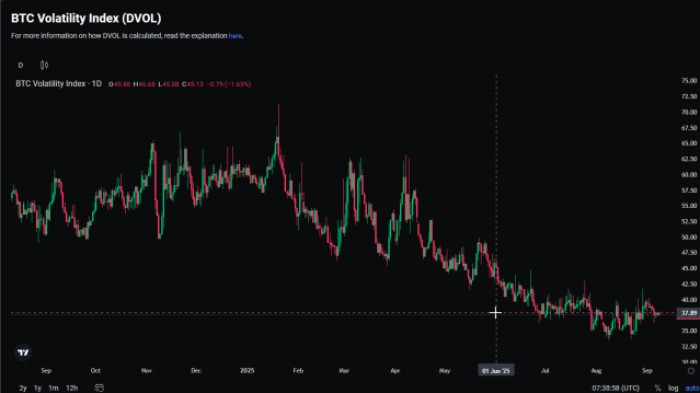
Bitcoin’s volatility chart on Deribit
Source: Deribit

This period also coincides with a string of Bitcoin buys from Strategy, with the company acquiring 56,255 $BTC in just three months, for a total investment of $6.34B.

Strategy’s ravenous Bitcoin accumulation game has pushed the asset into the public consciousness, which explains why even governments have started FOMO-investing.

El Salvador Stacks Sats

El Salvador. for example, just announced a purchase of 21 Bitcoins, increasing the government’s holdings to 6,313 $BTC, worth over $700M.

This comes four years after the country adopted Bitcoin as a legal tender, letting people use it to pay for taxes, goods, and services.

At an institutional level, some 319 public and private entities currently have Bitcoin reserves, 186 of which are public companies. Together, they hold 3.70M $BTC, with Strategy leading the list by a wide margin.
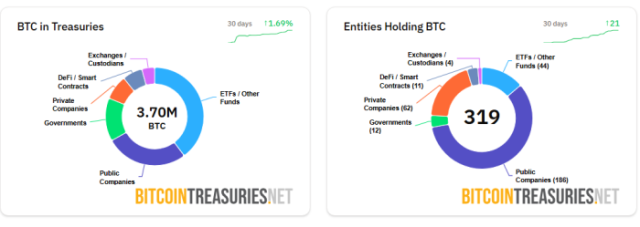
Bitcoin treasuries spread between 319 entities

Long term, institutional holdings should decrease Bitcoin’s volatility. The growing confidence in Bitcoin is also reflected in projects like Bitcoin Hyper, Bitcoin’s Layer 2 update, which is set to push Bitcoin to even higher heights.

How Bitcoin Hyper ($HYPER) Promises to Transform the Bitcoin Ecosystem

Bitcoin Hyper ($HYPER) is the Layer 2 upgrade that promises to change the game for Bitcoin.

The problem is that Bitcoin’s performance is currently capped at 7 transactions per second (TPS), which means it ranks a low 28th on the list of the fastest blockchains by TPS.

This is unacceptable in 2025, with payment processors like Visa having a TPS of 65,000.

Bitcoin Hyper aims to bring Bitcoin’s performance into the 21st century.

Bitcoin Hyper’s Canonical Bridge is the key infrastructure that securely connects Bitcoin’s main blockchain to its high-speed Layer 2 environment.
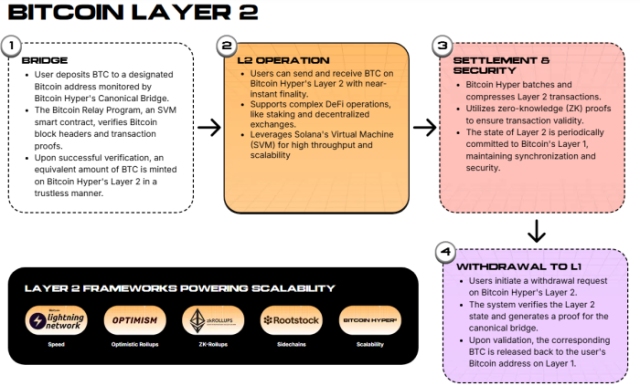
How Hyper’s Canonical Bridge works

The Canonical Bridge mints wrapped BTC tokens for use on the high-speed Hyper layer. It is also used to revert to original $BTC for withdrawal or trading.

Combined with the Solana Virtual Machine, this allows for the ultra-fast execution of smart contracts and DeFi apps, and is Bitcoin’s ticket to faster and cheaper transactions.

Long-term, Bitcoin Hyper will make Bitcoin a more reliable and feasible blockchain for large institutional players and dApp developers.

The presale currently ranks among the best presales of 2025, after raising over $14.6M so far.

Given the project’s utility within the Bitcoin ecosystem and its long-term scope, our price prediction for $HYPER puts the token at $0.32 by the end of the year. By 2030, $HYPER could easily reach $1.50 for an ROI of 11,550%.

Find out how to buy $HYPER for just $0.012875 from the official presale page.

Michael Saylor Single-Handedly Makes Bitcoin Great

Bitcoin is already great, but Michael Saylor wants to push it to legendary status. If the institutional investment frenzy he has kicked off continues, Bitcoin could transform the entire global economy.

This is especially true if Bitcoin Hyper ($HYPER) can make the Bitcoin network ultra-efficient, with near-instant finality, massive scalability, and Solana-level speeds. With successful implementation and mainstream adoption, $HYPER could propel Bitcoin to new heights.

This isn’t financial advice. Do your own research (DYOR) and invest wisely.

Authored by Bogdan Patru, Bitcoinist – https://bitcoinist.com/saylor-bitcoin-journey-is-an-inspiration-for-bitcoin-hyper-buyers/

Editorial Process for bitcoinist is centered on delivering thoroughly researched, accurate, and unbiased content. We uphold strict sourcing standards, and each page undergoes diligent review by our team of top technology experts and seasoned editors. This process ensures the integrity, relevance, and value of our content for our readers.

As a crypto writer, Bogdan’s responsibilities are split between researching and writing articles and entertaining the team with his humor bordering on the politically incorrect, an aspiring Bill Burr, if you will. Thanks to his 12+ years of writing experience in just as many fields, including tech, cybersecurity, modelling, fitness, crypto, and other topics-that-shall-not-be-named, he's become a genuine asset to the team. While his position as a senior writer at PrivacyAffairs thought him valuable lessons about the power of self-management, his entire writing career was and is an exercise in self-improvement. Now, he's ready to sink his teeth into crypto and teach people how to take control of their own money on the blockchain. With fiat as an eternally devaluing currency, Bitcoin and altcoins seem like the best-fitting alternative for Bogdan. Bogdan’s biggest professional accomplishment, aside from securing a position as a main writer for Bitcoinist, was his 5-year run as a writing manager at Blackwood Productions, where he coordinated a team of four writers. During that time, he learned the value of teamwork and that of creating a working environment that breeds efficiency, positivity, and friendship.

Trending Cryptos

Related Reads

Just now, DeepSeek V4 updates with DSpark, improving inference speed by 80%

DeepSeek has updated its DeepSeek V4 model with the DSpark speculative decoding framework, achieving a significant 60-85% speedup in generation for Flash models and 57-78% for Pro models while maintaining the same overall throughput. This engineering-focused update, rather than a core architectural change, introduces DSpark to address latency and throughput bottlenecks in high-concurrency production environments. DSpark combines high-throughput parallel generation with adaptive load-aware verification. Its key innovations include a semi-autoregressive generation architecture to model dependencies within token blocks and a hardware-aware confidence-scheduled verification system. This system uses a confidence head to predict token acceptance probabilities, allowing it to dynamically optimize verification length per request and allocate compute only to tokens with the highest expected payoff. The asynchronous scheduler is designed for real-world deployment, ensuring zero-overhead scheduling and continuous CUDA graph replay while preserving the target model's output distribution. In tests across mathematical reasoning, code generation, and daily dialogue, DSpark outperformed state-of-the-art models like Eagle3 and DFlash, increasing average acceptance length by 26.7%-30.9% and 16.3%-18.4% respectively on Qwen3 target models. DeepSeek also open-sourced DeepSpec, a full-stack codebase for training and evaluating speculative decoding draft models, providing a standardized toolkit that includes data preparation tools, model implementations, training code, and evaluation scripts.

marsbit6h ago

Just now, DeepSeek V4 updates with DSpark, improving inference speed by 80%

marsbit6h ago

BIT Research: The 2028 Halving Is Not the End, the Real Shake-Up of the Bitcoin Mining Industry Is Just Beginning

The Bitcoin mining industry is undergoing its most complex structural adjustment since inception. Despite Bitcoin's price holding near $61,000 and the network hash rate approaching a record 1 ZH/s, miner profitability is deteriorating. The industry is operating close to its breakeven point, with the 2028 halving expected to accelerate consolidation. The challenges extend beyond the halving's subsidy reduction; the industry's revenue model has yet to successfully transition towards a fee-driven structure. Increasingly, mining companies are evolving from simple Bitcoin producers into infrastructure and energy operators, including providers of AI/HPC computing power. Competition is shifting from pure hash rate expansion to business model upgrades. Economic pressure is evident. The theoretical daily mining revenue at current prices is around $78 million, yet the actual figure is only about $33 million—a 136% gap. Transaction fees remain low at roughly $220k daily, far below historical implied levels. With a current estimated industry-wide breakeven price near $65,000, mining alone is struggling to generate ideal profits. The 2028 halving is projected to push the fundamental production cost floor to approximately $93,289. This will likely accelerate a shift towards consolidation among larger, well-capitalized miners with diversified revenue streams. Competitive advantage will belong to institutionalized players with access to low-cost energy, AI/HPC hosting operations, and stronger balance sheets. In essence, Bitcoin mining is transitioning from a "mining business" to an "infrastructure business." Future profitability and resilience will depend less on block rewards and more on diversified income sources like energy management and computational infrastructure services. For investors, the key question is not the halving itself, but which miners can successfully navigate this business model transformation.

marsbit7h ago

BIT Research: The 2028 Halving Is Not the End, the Real Shake-Up of the Bitcoin Mining Industry Is Just Beginning

marsbit7h ago

Trading

Spot

Hot Articles

What is $BITCOIN

DIGITAL GOLD ($BITCOIN): A Comprehensive Analysis Introduction to DIGITAL GOLD ($BITCOIN) DIGITAL GOLD ($BITCOIN) is a blockchain-based project operating on the Solana network, which aims to combine the characteristics of traditional precious metals with the innovation of decentralized technologies. While it shares a name with Bitcoin, often referred to as “digital gold” due to its perception as a store of value, DIGITAL GOLD is a separate token designed to create a unique ecosystem within the Web3 landscape. Its goal is to position itself as a viable alternative digital asset, although specifics regarding its applications and functionalities are still developing. What is DIGITAL GOLD ($BITCOIN)? DIGITAL GOLD ($BITCOIN) is a cryptocurrency token explicitly designed for use on the Solana blockchain. In contrast to Bitcoin, which provides a widely recognized value storage role, this token appears to focus on broader applications and characteristics. Notable aspects include: Blockchain Infrastructure: The token is built on the Solana blockchain, known for its capacity to handle high-speed and low-cost transactions. Supply Dynamics: DIGITAL GOLD has a maximum supply capped at 100 quadrillion tokens (100P $BITCOIN), although details regarding its circulating supply are currently undisclosed. Utility: While precise functionalities are not explicitly outlined, there are indications that the token could be utilized for various applications, potentially involving decentralized applications (dApps) or asset tokenization strategies. Who is the Creator of DIGITAL GOLD ($BITCOIN)? At present, the identity of the creators and development team behind DIGITAL GOLD ($BITCOIN) remains unknown. This situation is typical among many innovative projects within the blockchain space, particularly those aligning with decentralized finance and meme coin phenomena. While such anonymity may foster a community-driven culture, it intensifies concerns about governance and accountability. Who are the Investors of DIGITAL GOLD ($BITCOIN)? The available information indicates that DIGITAL GOLD ($BITCOIN) does not have any known institutional backers or prominent venture capital investments. The project seems to operate on a peer-to-peer model focused on community support and adoption rather than traditional funding routes. Its activity and liquidity are primarily situated on decentralized exchanges (DEXs), such as PumpSwap, rather than established centralized trading platforms, further highlighting its grassroots approach. How DIGITAL GOLD ($BITCOIN) Works The operational mechanics of DIGITAL GOLD ($BITCOIN) can be elaborated on based on its blockchain design and network attributes: Consensus Mechanism: By leveraging Solana’s unique proof-of-history (PoH) combined with a proof-of-stake (PoS) model, the project ensures efficient transaction validation contributing to the network's high performance. Tokenomics: While specific deflationary mechanisms have not been extensively detailed, the vast maximum token supply implies that it may cater to microtransactions or niche use cases that are still to be defined. Interoperability: There exists the potential for integration with Solana’s broader ecosystem, including various decentralized finance (DeFi) platforms. However, the details regarding specific integrations remain unspecified. Timeline of Key Events Here is a timeline that highlights significant milestones concerning DIGITAL GOLD ($BITCOIN): 2023: The initial deployment of the token occurs on the Solana blockchain, marked by its contract address. 2024: DIGITAL GOLD gains visibility as it becomes available for trading on decentralized exchanges like PumpSwap, allowing users to trade it against SOL. 2025: The project witnesses sporadic trading activity and potential interest in community-led engagements, although no noteworthy partnerships or technical advancements have been documented as of yet. Critical Analysis Strengths Scalability: The underlying Solana infrastructure supports high transaction volumes, which could enhance the utility of $BITCOIN in various transaction scenarios. Accessibility: The potential low trading price per token could attract retail investors, facilitating wider participation due to fractional ownership opportunities. Risks Lack of Transparency: The absence of publicly known backers, developers, or an audit process may yield skepticism regarding the project's sustainability and trustworthiness. Market Volatility: The trading activity is heavily reliant on speculative behavior, which can result in significant price volatility and uncertainty for investors. Conclusion DIGITAL GOLD ($BITCOIN) emerges as an intriguing yet ambiguous project within the rapidly evolving Solana ecosystem. While it attempts to leverage the “digital gold” narrative, its departure from Bitcoin's established role as a store of value underscores the need for a clearer differentiation of its intended utility and governance structure. Future acceptance and adoption will likely depend on addressing the current opacity and defining its operational and economic strategies more explicitly. Note: This report encompasses synthesised information available as of October 2023, and developments may have transpired beyond the research period.

473 Total ViewsPublished 2025.05.13Updated 2025.05.13

What is $BITCOIN

Discussions

Welcome to the HTX Community. Here, you can stay informed about the latest platform developments and gain access to professional market insights. Users' opinions on the price of BTC (BTC) are presented below.

活动图片