European Central Bank Pushes Digital Euro for Resilient Payments – Best Wallet Token Stands Out

bitcoinistPublished on 2025-09-05Last updated on 2025-09-05

Abstract

The European Central Bank (ECB) has stressed the importance of developing a digital euro. Its goal is to ensure secure,...

Trusted Editorial content, reviewed by leading industry experts and seasoned editors. Ad Disclosure

The European Central Bank (ECB) has stressed the importance of developing a digital euro.
Its goal is to ensure secure, reliable capital flows even during major disruptions. And, of course, to strengthen resilience across the European financial system.

This is fantastic news for Best Wallet, a novel non-custodial crypto wallet. As digital currencies like the euro move closer to mainstream adoption, the need for secure storage like Best Wallet becomes all the more apparent.

For this reason, users might even prefer Best Wallet Token ($BEST) over the digital euro.

Digital Euro Proposal Includes Distributed Infrastructure & Peer-to-Peer Payments

In a recent press release, the ECB highlights its goals to make the euro ‘fit for the future’ with a digital euro that complements cash and guarantees payments are always possible.

Such an initiative follows the heels of growing concerns over the currency’s resilience, particularly in the face of geopolitical tensions, cyberattacks, and infrastructure outages.

By introducing a digital counterpart to cash, it aims to provide Europeans with constant access to a secure currency accepted worldwide – regardless of current circumstances.
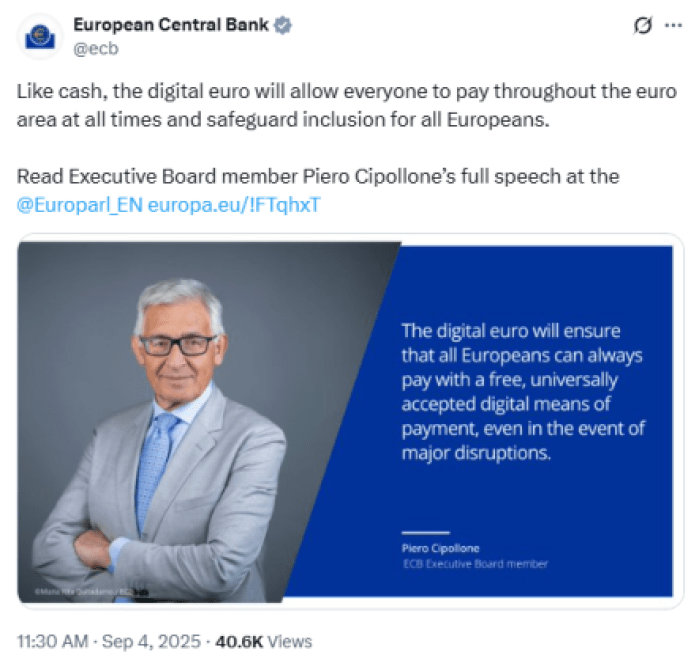
European Central Bank discussed the digital euro on X.
Source: X (European Central Bank)

The digital euro proposal cites that it would be supported by a distributed infrastructure that operates across multiple regions. In turn, this should significantly reduce the risk of single points of failure.

To top it off, it aims to launch an ECB-backed app that gives users the flexibility to switch between payment providers. This way, they can always make transactions, even if their preferred service of choice happens to be compromised.

And that’s not all. The digital euro also plans to have offline functionality. Facilitating peer-to-peer payments without internet access would further strengthen its resilience during troublesome times.

The timing perhaps couldn’t be better for $BEST. As the ECB lays the groundwork for the digital euro, demand for trusted wallets like its very own Best Wallet app is bound to surge.

Best Wallet Aims to Dominate Crypto Wallet Sector by 2027

Best Wallet is a mobile-first crypto wallet with the ultimate aim of dominating the global wallet market by the end of next year.

On the app, you can easily buy, sell, swap, and stake over a thousand tokens across major chains like Ethereum, Polygon, and BNB Chain. Support for over 60 networks is also on the way, opening up even more crypto opportunities.

Best of all, it’s a super secure option for holding digital assets. As a non-custodial wallet, it gives you complete control over your private keys. It also supports 2FA, biometrics, and local encryption, so you can rest easy knowing that only you can access your funds.

Plus, it offers personal cloud backups and simple account recovery so you can regain access anytime – even if you’ve lost your device and/or seed phrase.
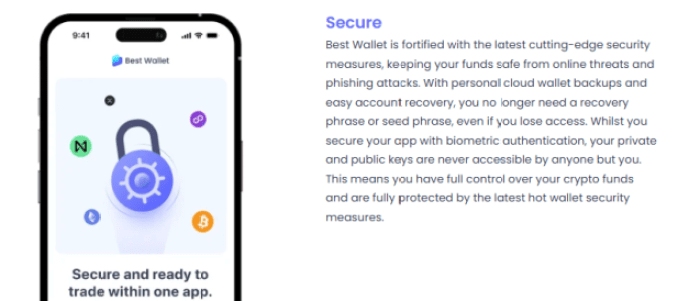
Best Wallet security.
Source: Best Wallet

Beyond storage, it’s packed with lots of cutting-edge features. This includes a token launchpad for hunting down the best crypto presales to help boost your gains.

It also has a swap feature that leverages an autorater so you can find the best exchange rates across 330+ DEXs and 30 bridges at the lowest possible prices.

And it doesn’t end there. Best Wallet’s roadmap is jam-packed with upcoming innovations, including its own crypto debit card (Best Card), NFT gallery, and rewards hub.

But to unwrap all the ecosystem’s benefits, you’ll want to scoop up some $BEST. Then, you can enjoy lower gas fees, staking rewards (currently at an 85% APY), and early access to the best crypto presales.

Verdict – Digital Euro Could Significantly Bolster Best Wallet’s Demand

The ECB’s plan to launch a digital euro highlights that the world is moving toward digital-first money.

With resilience, security, and inclusion at the heart of its design, the digital euro could have what it takes to reshape payments across the entire European Union.

As more users adopt digital currencies, they may become less skeptical about crypto assets. In turn, it could significantly help propel Best Wallet’s demand, and thus $BEST’s.

$BEST is available on presale for $0.025595 and poised for growth owing to its utility. Projections even go as far as saying that it’ll reach $0.072 this year, after the app rollouts and exchange listings.

Considering it has already attracted over $15.5M on presale, this could prove true; investor confidence is clearly substantial.

But only time can truly be the judge. So DYOR and never invest more than you’d be sad to lose.

Authored by Leah Waters, Bitcoinist – https://bitcoinist.com/ecb-pushes-digital-euro-and-best-wallet-token/

Editorial Process for bitcoinist is centered on delivering thoroughly researched, accurate, and unbiased content. We uphold strict sourcing standards, and each page undergoes diligent review by our team of top technology experts and seasoned editors. This process ensures the integrity, relevance, and value of our content for our readers.

Leah is a British journalist with a BA in Journalism, Media, and Communications and nearly a decade of content writing experience. Over the last four years, her focus has primarily been on Web3 technologies, driven by her genuine enthusiasm for decentralization and the latest technological advancements. She has contributed to leading crypto and NFT publications – Cointelegraph, Coinbound, Crypto News, NFT Plazas, Bitcolumnist, Techreport, and NFT Lately – which has elevated her to a senior role in crypto journalism. Whether crafting breaking news or in-depth reviews, she strives to engage her readers with the latest insights and information. Her articles often span the hottest cryptos, exchanges, and evolving regulations. As part of her ploy to attract crypto newbies into Web3, she explains even the most complex topics in an easily understandable and engaging way. Further underscoring her dynamic journalism background, she has written for various sectors, including software testing (TEST Magazine), travel (Travel Off Path), and music (Mixmag). When she's not deep into a crypto rabbit hole, she's probably island-hopping (with the Galapagos and Hainan being her go-to's). Or perhaps sketching chalk pencil drawings while listening to the Pixies, her all-time favorite band.

Trending Cryptos

Related Reads

Trading

Spot

Hot Articles

What is $BANK

Bank AI: A Revolutionary Step in the Future of Banking Introduction In an era marked by rapid advancements in technology, Bank AI stands at the intersection of artificial intelligence (AI) and banking services. This innovative project seeks to redefine the financial landscape, enhancing operational efficiency, security measures, and customer experiences through the power of AI. As we embark on this exploration of Bank AI, we will delve into what the project entails, its operational dynamics, its historical context, and significant milestones. What is Bank AI? At its core, Bank AI represents a transformative initiative aimed at integrating artificial intelligence into various banking operations. This project harnesses the capabilities of AI to automate processes, improve risk management protocols, and enhance customer interaction through personalised services. The primary objectives of Bank AI include: Automation of Banking Functions: By leveraging AI technologies, Bank AI aims to automate routine tasks, reducing the burden on human resources and enhancing efficiency. Enhanced Risk Management: The project utilises AI algorithms to predict and identify risks, thereby fortifying security measures against fraud and other threats. Personalisation of Banking Services: Bank AI focuses on offering tailored financial products and services by analysing customer data and behaviours. Improving Customer Experience: The implementation of AI-driven solutions, such as chatbots and virtual assistants, aims to provide users with more human-like interactions, revolutionising the way customers engage with banks. With these goals, Bank AI positions itself as a crucial player in rendering banking more efficient, secure, and user-centric. Who is the Creator of Bank AI? Details regarding the creator of Bank AI remain unknown. As such, no specific individual or organisation has been identified in the available information. The anonymity surrounding the project's inception raises questions but does not detract from its ambitious vision and objectives. Who are the Investors of Bank AI? Similar to the project's creator, specific information regarding the investors or supporting organisations of Bank AI has not been disclosed. Without this information, it is challenging to outline the financial backing and institutional support that might be propelling the project forward. Nevertheless, the importance of having a robust investment foundation is pivotal for sustaining development in such an innovative field. How Does Bank AI Work? Bank AI operates on several innovative fronts, focusing on unique factors that differentiate it from traditional banking frameworks. Below are key operational features: Automation: By applying machine learning algorithms, Bank AI automates various manual processes within banks. This results in reduced operational costs and allows human workers to redirect their efforts towards more strategic activities. Advanced Risk Management: The integration of AI into risk management practices equips banks with tools to accurately predict potential threats such as fraud, ensuring that customer information and assets remain secure. Tailored Financial Recommendations: Through continuous learning from customer interactions, the AI systems develop a nuanced understanding of user needs, enabling them to offer tailored advice on financial decisions. Enhanced Customer Interactions: Utilizing chatbots and virtual assistants powered by AI, Bank AI enables a more engaging customer experience, allowing users to have their queries resolved quickly, thus reducing wait times and improving satisfaction levels. Together, these operational features position Bank AI as a pioneer in the banking sector, establishing new benchmarks for service delivery and operational excellence. Timeline of Bank AI Understanding the trajectory of Bank AI requires a look at its historical context. Below is a timeline highlighting important milestones and developments: Early 2010s: The conceptualisation of AI integration into banking services began to gain attention as banking institutions recognised the potential benefits. 2018: A marked increase in the implementation of AI technologies occurred when banks started using AI tools like chatbots for basic customer service and risk management systems for improved security handling. 2023: The sophistication of AI continued to advance, with generative AI being introduced for more complex tasks such as document processing and real-time investment analysis. This year marked a significant leap in the capabilities afforded to banks by AI technology. 2024-Current Status: As of this year, Bank AI is on an upward trajectory, with ongoing research and developments poised to further enhance capabilities in banking operations. Continued exploration of AI applications hints at exciting developments yet to come. Key Points About Bank AI Integration of AI in Banking: Bank AI focuses on adopting artificial intelligence to streamline banking processes and improve user experiences. Automation and Risk Management Focus: The project strongly emphasises these areas, aiming to shift the burden of routine tasks while enhancing security frameworks through predictive analytics. Personalised Banking Solutions: By harnessing customer data, Bank AI enables tailored banking services that cater to individual user needs. Commitment to Development: Bank AI remains committed to ongoing research and development efforts, ensuring its adaptability and ongoing relevance as technology continues to evolve. Conclusion In summary, Bank AI exemplifies a crucial step forward in the banking industry, leveraging artificial intelligence to reshape operational paradigms, enhance security, and promote customer satisfaction. Despite gaps in information surrounding the creator and investors, the clear objectives and functional mechanisms of Bank AI provide a strong foundation for its ongoing evolution. As AI technology continues to advance and merge with the banking sector, Bank AI is well-positioned to significantly impact the future of financial services, enhancing the way we understand and interact with banking.

167 Total ViewsPublished 2024.04.06Updated 2024.12.03

What is $BANK

Discussions

Welcome to the HTX Community. Here, you can stay informed about the latest platform developments and gain access to professional market insights. Users' opinions on the price of BANK (BANK) are presented below.

活动图片