The Ripple Swell 2025 Agenda Is Out—These Are The Highlights

bitcoinistPublished on 2025-09-05Last updated on 2025-09-05

Abstract

Ripple has published the full program for its ninth annual Swell conference, confirming a two-day, invite-only gathering in New York...

Trusted Editorial content, reviewed by leading industry experts and seasoned editors. Ad Disclosure

Ripple has published the full program for its ninth annual Swell conference, confirming a two-day, invite-only gathering in New York City on November 4–5, bracketed by a welcome reception on Monday, November 3. Sessions run in Eastern Time and span tokenization, market structure, regulation, payments, custody, stablecoins, and security.

Ripple flagged the release on X, directing the community to the detailed agenda: “The Ripple Swell 2025 agenda is live! From stablecoins and payments to regulation and real-world adoption, Swell brings together the conversations shaping the future of finance. Don’t miss your chance to join us in NYC.”

Ripple Swell Day 1 Agenda

Swell opens Tuesday with President Monica Long’s “Opening Remarks”—“Welcome to Ripple Swell!”—framing the event as Ripple’s showcase for financial-utility crypto. That flows directly into a headline fireside chat with Nasdaq Chair and CEO Adena Friedman on “the potential of digital assets and blockchain across the financial industry.” The morning then pivots to market infrastructure, with BlackRock’s Maxwell Stein and Moody’s Rory Callagy examining “the transformative influence of tokenized assets on the landscape of capital markets,” before a coffee break.

The late morning drills into two areas now shaping both liquidity and access. First, a panel on “Stablecoins and Blockchain: Revolutionizing Cross-Border Payments,” featuring AMINA Bank Chief Product Officer Myles Harrison and Schuman Financial founder and CEO Martin Bruncko, focuses on cost, speed, and financial inclusion in cross-border flows. Next, Bitwise CEO Hunter Horsley, Canary Capital CEO Steven McClurg and Bitnomial founder & CEO Luke Hoersten track how “crypto ETFs and on-chain funds are popularizing access to digital assets.” Ripple follows with a product keynote demo centered on “stablecoin payments,” spotlighting where the firm wants customers to see near-term utility.

Tuesday afternoon turns to the institutional spine of the market. “Building Secure Foundations for the Digital Asset Economy” addresses custody frictions, legacy alignment and interoperability. A cross-border view on “International Regulatory Perspectives on Digital Assets” brings together European lawmaker Billy Kelleher, Argentina’s CNV Chair Roberto E. Silva and Ripple’s Matthew Osborne.

Market plumbing takes center stage in “Unlocking the Future of Prime Brokerage and Clearing with Ripple,” with Hidden Road’s Michael Higgins, XTX Markets’ Jeremy Smart, BNY’s Carolyn Weinberg, CME Group’s Giovanni Vicioso and Ripple’s Jack McDonald and Nigel Khakoo exploring re-wiring trade finance, remittance and FX rails. A separate session on how global banks are approaching tokenization and custody features Citi’s Ryan Rugg, Franklin Templeton’s Sandy Kaul and Fidelity’s Cynthia Lo Bessette. An afternoon keynote remains TBA, before the evening “Swellebration,” which folds in the Innovation Awards.

Day 2 Agenda

Day two begins with a yet-to-be-announced morning keynote and a panel on “Maturity in Digital Asset Adoption,” reflecting that institutions are at different points on the curve from pilots to scaled integration. The policy centerpiece arrives late morning: “US Regulatory Leadership in Crypto — Global Comparisons and 2025 Priorities,” introduced with the line that “The Trump Administration has opened new opportunities for the crypto industry,” and framed around what can be done via legislation, rulemaking, supervision, international coordination and public-private pilots. The agenda lists perspectives from Summer Mersinger (Blockchain Association), Ananya Kumar (Atlantic Council) and Ripple’s policy leadership.

Ripple also places consumer-oriented adoption on the stage. In “Meet the National Cryptocurrency Association,” Ripple CLO and NCA President Stuart Alderoty outlines how the new body aims to bridge “crypto curiosity and confidence,” joined by users including a real-estate investor and a caregiver to ground the discussion in real-world use.

A marquee fireside follows: José Andrés—chef, restaurateur and humanitarian—joins Ripple Executive Chairman and Co-Founder Chris Larsen to discuss innovation in disaster relief and “delivering impact at scale.” The afternoon security block—“Decentralized Defense: Combatting Crypto Crime”—brings Elliptic CEO Simone Maini, Coinbase CISO Jeff Lunglhofer and Duke finance professor Campbell Harvey onstage.

Stablecoins recur throughout the program, culminating with “Driving Global Growth and Trust with RLUSD,” in which leading exchanges discuss integrating Ripple’s dollar-pegged token and balancing regional growth with user trust. Brad Garlinghouse delivers the event’s final substantive keynote—a fireside chat on “what’s ahead for Ripple, key crypto trends for 2026 and why he’s doubling down on crypto infrastructure for financial utility”—before the closing remarks.

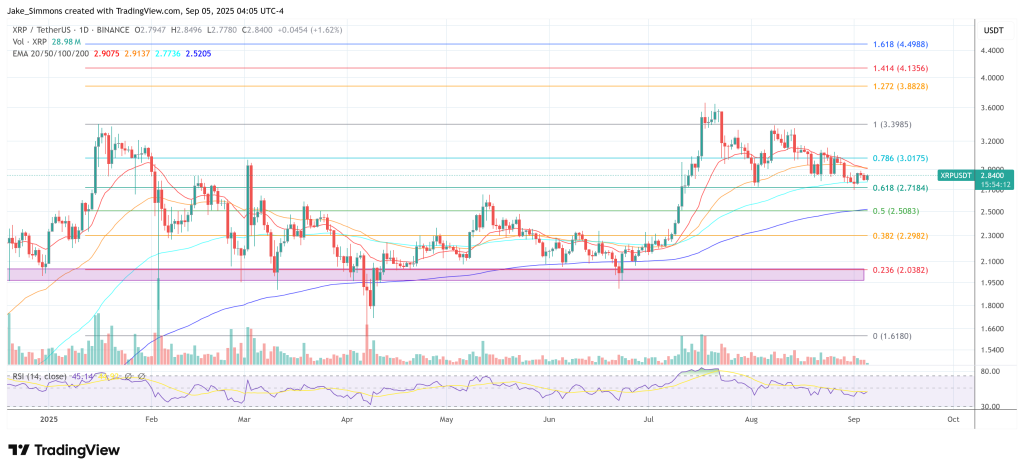
At press time, XRP traded at $2.84.
XRP price
XRP price, 1-day chart | Source: XRPUSDT on TradingView.com
Featured image created with DALL.E, chart from TradingView.com
Editorial Process for bitcoinist is centered on delivering thoroughly researched, accurate, and unbiased content. We uphold strict sourcing standards, and each page undergoes diligent review by our team of top technology experts and seasoned editors. This process ensures the integrity, relevance, and value of our content for our readers.

Jake Simmons has been a Bitcoin enthusiast since 2016. Ever since he heard about Bitcoin, he has been studying the topic every day and trying to share his knowledge with others. His goal is to contribute to Bitcoin's financial revolution, which will replace the fiat money system. Besides BTC and crypto, Jake studied Business Informatics at a university. After graduation in 2017, he has been working in the blockchain and crypto sector. You can follow Jake on Twitter at @realJakeSimmons.

Trending Cryptos

Related Reads

CPU Makes a Comeback to the Table, A $170 Billion "Power Seizure" Drama Begins

A new era is dawning for the server CPU (Central Processing Unit), driven by the shift from AI model training to large-scale reasoning and the rise of Agentic AI. This article explores how the CPU is reclaiming a central role in the AI data center. For years, the focus has been on the GPU (Graphics Processing Unit) for AI training. However, as AI moves to the inference and Agent phase—where tasks involve complex, multi-step reasoning, tool calls, and data management—the workload balance is flipping. Studies show CPUs now handle over 70% of the workload in Agentic AI, up from 10-30% in training. This is because Agent tasks generate massive intermediate data (KV Cache) that exceeds GPU memory, forcing it to be offloaded to the CPU's larger, more scalable memory pools. This increased importance is translating into market changes. Major players are taking note: NVIDIA launched its first standalone CPU line, Vera, based on ARM architecture and optimized for Agent performance. AMD doubled its server CPU market forecast to over $1200 billion by 2030. Analyst reports project the total server CPU market could reach $1700 billion by 2030, with AI-driven demand being a primary driver. Furthermore, the classic ratio of CPUs to GPUs in AI servers is rapidly changing, converging from 1:8 toward 1:1 for Agent deployments. This surge in demand has led to a rare industry-wide price increase of 10-15% for server CPUs from Intel and AMD, breaking a decade-long trend of "more performance for the same price." Demand is bifurcating into high-core-count CPUs for in-rack GPU support and moderate-core CPUs for standalone Agent task orchestration. In China, this global trend presents an opportunity for domestic CPU manufacturers like Hygon (海光信息) and Huawei Kunpeng, who are bolstered by both growing AI infrastructure needs and national policies promoting technological self-reliance ("xin chuang"). The maturity of their software ecosystems is also accelerating, evidenced by faster adaptation to new AI models. In conclusion, the narrative is shifting from a GPU-centric view to one where CPU-GPU synergy is critical. The CPU is no longer a peripheral component but a performance-defining bottleneck and a key growth driver in the AI hardware stack, opening a massive new market estimated in the hundreds of billions of dollars.

marsbit8h ago

CPU Makes a Comeback to the Table, A $170 Billion "Power Seizure" Drama Begins

marsbit8h ago

TechFlow Intelligence: AMD AI Director Publicly Criticizes Claude Code for "Becoming Dumber and Lazier", Trump Claims Full Ceasefire in Hormuz But Strait Still Has 80 Unexploded Mines

TechFlow Intelligence Report: This daily digest covers key developments in AI, crypto, hardware, and geopolitics. In AI, SK Telecom faces US export control scrutiny over its partnership with Anthropic, while a Gemini user reports being misled in a scam scenario, sparking safety debates. China's Z.AI launches the GLM-5.2 model, rivaling Claude Opus without NVIDIA chips. In crypto, Bithumb lists ReProtocol, and Upbit delists KernelDAO. On the hardware front, MIT researchers build a custom OS to study chips, ASML denies US claims its advanced lithography machines are in China, and Amazon considers selling its in-house AI chips. Apple's future A21 Pro chip may use TSMC's latest N2P process. Major tech issues include 10,000 GitHub repositories distributing malware and Apple patching a critical eavesdropping flaw in Beats earbuds. US stocks rise, led by semiconductors, with Intel surging 10.6%, while SpaceX falls 3.5%. Geopolitically, despite a US-Iran deal, the Strait of Hormuz remains risky with ~80 uncleared mines, stalling 80M barrels of oil on standby tankers. Iran postpones Switzerland talks, and Trump calls the agreement an "unconditional surrender." The report highlights a contrast: temporary geopolitical calm versus the ongoing, fundamental restructuring of tech supply chains and chip independence.

marsbit8h ago

TechFlow Intelligence: AMD AI Director Publicly Criticizes Claude Code for "Becoming Dumber and Lazier", Trump Claims Full Ceasefire in Hormuz But Strait Still Has 80 Unexploded Mines

marsbit8h ago

Trading

Spot
Futures

Hot Articles

How to Buy SWELL

Welcome to HTX.com! We've made purchasing Swell Network (SWELL) simple and convenient. Follow our step-by-step guide to embark on your crypto journey.Step 1: Create Your HTX AccountUse your email or phone number to sign up for a free account on HTX. Experience a hassle-free registration journey and unlock all features.Get My AccountStep 2: Go to Buy Crypto and Choose Your Payment MethodCredit/Debit Card: Use your Visa or Mastercard to buy Swell Network (SWELL) instantly.Balance: Use funds from your HTX account balance to trade seamlessly.Third Parties: We've added popular payment methods such as Google Pay and Apple Pay to enhance convenience.P2P: Trade directly with other users on HTX.Over-the-Counter (OTC): We offer tailor-made services and competitive exchange rates for traders.Step 3: Store Your Swell Network (SWELL)After purchasing your Swell Network (SWELL), store it in your HTX account. Alternatively, you can send it elsewhere via blockchain transfer or use it to trade other cryptocurrencies.Step 4: Trade Swell Network (SWELL)Easily trade Swell Network (SWELL) on HTX's spot market. Simply access your account, select your trading pair, execute your trades, and monitor in real-time. We offer a user-friendly experience for both beginners and seasoned traders.

2.9k Total ViewsPublished 2024.11.06Updated 2026.06.02

How to Buy SWELL

Discussions

Welcome to the HTX Community. Here, you can stay informed about the latest platform developments and gain access to professional market insights. Users' opinions on the price of SWELL (SWELL) are presented below.

活动图片