Secret Talks Hint At Spot XRP And Dogecoin ETFs Closer Than Ever

bitcoinistPublished on 2025-09-05Last updated on 2025-09-05

Abstract

The race to standardize how US exchanges list spot crypto ETFs appears to be entering its endgame, with quiet but...

Trusted Editorial content, reviewed by leading industry experts and seasoned editors. Ad Disclosure

The race to standardize how US exchanges list spot crypto ETFs appears to be entering its endgame, with quiet but coordinated rule-filing tweaks that could unlock single-asset products beyond bitcoin and ether—most notably XRP and Dogecoin.

On X, chairman and president of The ETF Store Nate Geraci captured the mood among issuers and exchanges: “Major exchanges continue to quietly work w/ SEC behind the scenes on generic listing standards for spot crypto ETFs… Given final deadlines on existing spot crypto ETF filings, [it’s] reasonable to expect this would be in place by early October. Then crypto ETF floodgates open.”

Why Spot XRP And Dogecoin ETFs Are Closer Than Ever

What’s changed is not a splashy Commission order, but the methodical convergence of three national exchanges—Cboe BZX, NYSE Arca, and Nasdaq—on nearly harmonized generic listing standards (GLS) for Commodity-Based Trust Shares. Their proposals would allow qualifying commodity ETPs—including those that hold “digital asset commodities”—to list without bespoke 19b-4 approvals each time, provided the products meet prescriptive criteria and the exchanges maintain robust surveillance. NYSE Arca’s new Rule 8.201-E (Generic), Nasdaq’s amendments to Rule 5711(d), and Cboe’s overhauled Rule 14.11(e)(4) all point the same direction: make spot crypto ETF approvals systematic rather than one-off, while preserving market-integrity guardrails.

A key technical edit running through the filings is how the term “commodity” is defined. Greg Xethalis, General Counsel at Multicoin Capital, revealed the secret talks today via X: “CBOE BZX, the NYSE and NASDAQ today filed amendments to their Commodity-Based Trust Shares ETP Generic Listing Standards.

The amendments largely touch on a technical edit to remove ‘excluded commodities’ from the definition of ‘commodity’ in the GLS,” a belt-and-suspenders move that prevents accidental sweep-in of instruments like interest-rate indexes or currencies under the Commodity Exchange Act’s “excluded commodity” heading. Nasdaq’s filing spells it out, carving those out explicitly and even footnoting the CEA §1a(19) definition to show what’s out of scope.

Equally important is the futures-market seasoning test many view as the “on-ramp” for new spot products. Cboe’s proposal requires that, among other pathways, the underlying asset underlie a futures contract that has been made available to trade on a Designated Contract Market for at least six months and that the exchange has a surveillance-sharing agreement with that DCM. In practice, the “made available to trade” phrasing anchors the six-month clock to the contract’s listing/availability date and aligns with the surveillance logic the SEC has leaned on since the 2024 spot-BTC and spot-ETH approvals.

ETF Applications In The Queue

Against that backdrop, the XRP and Dogecoin dockets are already deep into the 19b-4 pipeline—so standardized listing rules arriving in late September or early October would collide almost perfectly with several final statutory deadlines:

For XRP, several separate spot filings illustrate the cadence. On Nasdaq, the CoinShares XRP ETF (SR-NASDAQ-2025-012) was published in the Federal Register on February 25, 2025, with proceedings instituted on May 29 and the period for action extended again on August 21; under Exchange Act timing, the 240-day outside date from publication lands on October 23, 2025.

On NYSE Arca, Grayscale XRP Trust (SR-NYSEArca-2025-08) hit the Register February 20, 2025; the SEC noted the 180th day as August 19—placing the 240-day outside date on October 18, 2025. Cboe BZX’s Canary XRP Trust entered the queue with publication on February 25, 2025, likewise pointing to an October 23, 2025 outside date. These are classic 19b-4 listing files; S-1 registrations must still go effective before any shares trade.

For Dogecoin, multiple spot proposals provide similar waypoints. The Bitwise Dogecoin ETF on NYSE Arca was issued March 17, 2025, setting a 240-day outside date of November 12, 2025. On Nasdaq, the 21Shares Dogecoin ETF notice was published May 19, 2025, implying an outside date of January 14, 2026. Grayscale’s Dogecoin Trust filed an S-1 on August 15, 2025, disclosing that NYSE Arca lodged its companion 19b-4 on January 31, 2025—evidence issuers have been preparing both legs of the approval stool.

The upshot: if the SEC blesses the generic listing standards on the schedule the industry now expects, the calendar neatly lines up with XRP’s October 18–23 outside dates—and Dogecoin’s November 12 follow-on—creating exactly the “floodgates” window Geraci described.

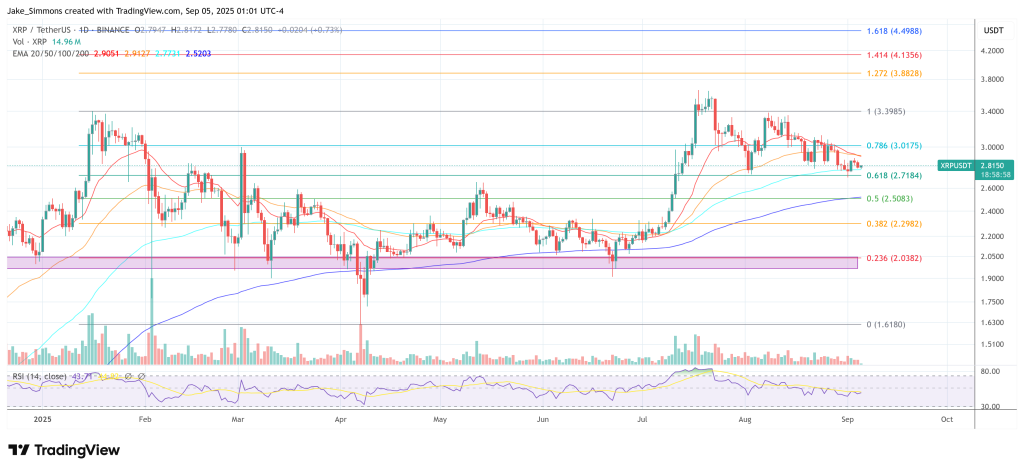
At press time, XRP traded at $2.81.
XRP price
XRP remains above the EMA100, 1-day chart | Source: XRPUSDT on TradingView.com
Featured image created with DALL.E, chart from TradingView.com
Editorial Process for bitcoinist is centered on delivering thoroughly researched, accurate, and unbiased content. We uphold strict sourcing standards, and each page undergoes diligent review by our team of top technology experts and seasoned editors. This process ensures the integrity, relevance, and value of our content for our readers.

Jake Simmons has been a Bitcoin enthusiast since 2016. Ever since he heard about Bitcoin, he has been studying the topic every day and trying to share his knowledge with others. His goal is to contribute to Bitcoin's financial revolution, which will replace the fiat money system. Besides BTC and crypto, Jake studied Business Informatics at a university. After graduation in 2017, he has been working in the blockchain and crypto sector. You can follow Jake on Twitter at @realJakeSimmons.

Trending Cryptos

Related Reads

Trading

Spot

Hot Articles

What is XRP 2.0

XRP 2.0: A New Frontier in the Cryptocurrency Landscape Introduction to XRP 2.0 In the ever-evolving realm of cryptocurrency, new projects continuously emerge, vying for attention and adoption. One such promising initiative is XRP 2.0, a novel cryptocurrency project designed to leverage advanced blockchain technology and robust encryption methodologies. While the name draws parallels with Ripple’s XRP, it’s crucial to note that XRP 2.0 operates independently, focusing on enhancing transaction security, privacy, and scalability. As the digital financial landscape increasingly embraces decentralized solutions, XRP 2.0 aims to contribute meaningfully to web3 and the overall expansion of crypto projects. What is XRP 2.0? At its core, XRP 2.0 is a cryptocurrency project that aims to create a secure and decentralized digital currency ecosystem. Its foundational technology integrates sophisticated blockchain principles with cutting-edge encryption techniques. The overarching goal of XRP 2.0 is to establish itself as a reliable and efficient platform enabling swift transaction execution while prioritizing enhanced privacy protections for its users. The project is promoted as a solution to many limitations faced by existing cryptocurrencies, proposing a system that can handle a higher volume of transactions with improved speed and privacy. This versatility positions XRP 2.0 as a significant contender in a marketplace riddled with various digital currencies. Who is the Creator of XRP 2.0? The identity of the creator behind XRP 2.0 has been flagged as ‘Wilbur.’ However, comprehensive details regarding Wilbur or their associated entity remain elusive. The anonymity of many cryptocurrency creators is not an uncommon phenomenon in the industry, often designed to maintain a degree of privacy and security. Who are the Investors of XRP 2.0? As of now, specific information related to the investment foundations or organizations supporting XRP 2.0 is not publicly available. In the cryptocurrency sector, the backing by reputed investors can significantly influence a project's credibility and success, yet the transparency regarding the financial supporters of XRP 2.0 has not been established. How Does XRP 2.0 Work? XRP 2.0 stands out by employing a combination of blockchain technology and advanced encryption algorithms that ensures secure and decentralized transactions. Its innovative structure includes unique features designed to foster user engagement and broaden functionalities beyond conventional cryptocurrency transactions. Among these features, XRP 2.0 incorporates AI-powered capabilities, such as text-to-image and text-to-speech functionalities. These additions are designed to enhance the interactive experience for users, promoting broader applicability across various sectors. By bridging technological advancements with user-centered design, XRP 2.0 aims to capture the attention of a diverse range of individuals and enterprises looking to integrate cryptocurrency solutions into their operational frameworks. Timeline of XRP 2.0 Understanding XRP 2.0 requires examining the milestones that have defined its journey thus far: July 23, 2023: XRP 2.0 is introduced as a novel cryptocurrency project, aiming to revolutionize secure and decentralized transaction capabilities in the blockchain domain. September 8, 2023: The launching of another project, XRP20, occurs, marking the emergence of an ERC-20 token on the Ethereum blockchain that remains unrelated to XRP 2.0. November 13, 2023: The XRP Ledger undergoes a significant update with the release of rippled server software version 2.0.0. It is essential to note that this development is disconnected from the XRP 2.0 cryptocurrency project. Key Points About XRP 2.0 To distill the essence of XRP 2.0, several critical factors emerge: Unique Features: The inclusion of features like AI-powered text-to-image and text-to-speech further diversifies the potential applications of XRP 2.0. Blockchain Technology: The framework utilizes advanced blockchain mechanisms and encryption protocols, ensuring a secure and decentralized environment for transactions. Scalability and Privacy: XRP 2.0 prioritizes enhanced privacy protections in transaction processes and the scalability necessary to accommodate a growing user base. No Affiliation with Ripple: Importantly, despite its name, XRP 2.0 does not have any allegiance or collaboration with Ripple’s XRP, distinguishing its operational framework and objectives within the cryptocurrency ecosystem. Conclusion XRP 2.0 represents an ambitious venture into the cryptocurrency sphere, aiming to offer a combination of security, privacy, and efficiency in digital transactions. By integrating sophisticated technologies and user-friendly features, the project sets out to broaden the horizons of what cryptocurrency can achieve in today's digital economy. While the anonymity of its creator and lack of disclosed investors might raise questions for some, XRP 2.0's focus on advanced functionalities and decentralisation enhances its appeal amidst an increasingly crowded crypto market. As the cryptocurrency landscape continues to evolve, XRP 2.0 may yet emerge as a pivotal player in the expansion of secure and scalable blockchain solutions.

1.0k Total ViewsPublished 2024.04.01Updated 2024.12.03

What is XRP 2.0

Discussions

Welcome to the HTX Community. Here, you can stay informed about the latest platform developments and gain access to professional market insights. Users' opinions on the price of XRP (XRP) are presented below.

活动图片