非农前瞻:三大剧本推演比特币今夜走势

marsbitPublished on 2025-09-04Last updated on 2025-09-05

今晚,全球金融市场的目光将聚焦于一个可能决定其未来数月命运的经济数据——美国非农就业报告(NFP)。在比特币价格于关键技术位摇摇欲坠,且宏大历史周期指针已悄然指向“顶部区域”的微妙时刻,这份报告犹如悬于市场头顶的达摩克利斯之剑,其数据的好坏,将可能成为压垮骆驼的最后一根稻草,或是点燃新一轮升势的火花。

市场正弥漫着一种复杂甚至有些扭曲的期待。在正常的经济逻辑中,强劲的就业数据意味着经济繁荣。然而在当前由央行流动性主导的语境下,逻辑发生了逆转:一份疲软的报告,暗示着经济衰退的风险,反而会被市场解读为美联-储不得不加速降息的明确信号。“坏消息,就是好消息”——这句投资谚语,已成为风险资产投资者们的共同祈祷。

对于比特币而言,这场即将在北京时间20:30上演的宏观大戏,其重要性不言而喻。它不仅关乎短期的资金流向,更可能成为验证一系列看跌理论的试金石。正如资深交易员、Spectra Markets总裁Brent Donnelly所警示的,市场可能正滑向一场更长期的回调,他甚至已未雨绸缪地在94,000美元和82,000美元这两个遥远的价位设下了买单,以应对可能到来的“恐慌性下跌”。


周期之钟:历史的指针正指向危险区

要理解Donnelly等市场老兵的审慎,我们必须暂时将目光从今晚的短线波动移开,拉升至比特币宏观周期的全景视角。加密世界一个被反复验证的规律,便是“减半周期”。比特币大约每四年发生一次“产量减半”,这一供应端的通缩事件,历史上总能开启一轮波澜壮阔的牛市。

然而,盛宴终有散席之时。历史数据显示,从减半发生到牛市触及绝对顶峰,这个过程的时间跨度似乎正在被拉长。一份来自Bitcoinsuisse的深度分析报告揭示了这一趋势:

  • 2012年减半后: 牛市顶峰出现在约 12个月 后。
  • 2016年减半后: 这一过程延长至约 17.5个月
  • 2020年减半后: 市场则花费了约 18.2个月 才走到顶点。

最近的一次减半发生在2024年4月。以此计算,我们现在正处于第17个月。这意味着,无论从哪个历史周期衡量,比特币都已经驶入了传统意义上的“顶部区域”。这并非玄学,而是基于历史模式的冷静观察。Donnelly提出的一个核心逻辑——“数字资产作为企业财库资产的热潮正在减退”,叠加“比特币减半周期的季节性因素转向看空”——正是基于对这一宏观时钟的深刻洞察。周期性的规律提示我们,当所有人都沉浸在狂欢中时,风险正在悄然积聚。


图表之声:一幅不祥的“双顶”画卷

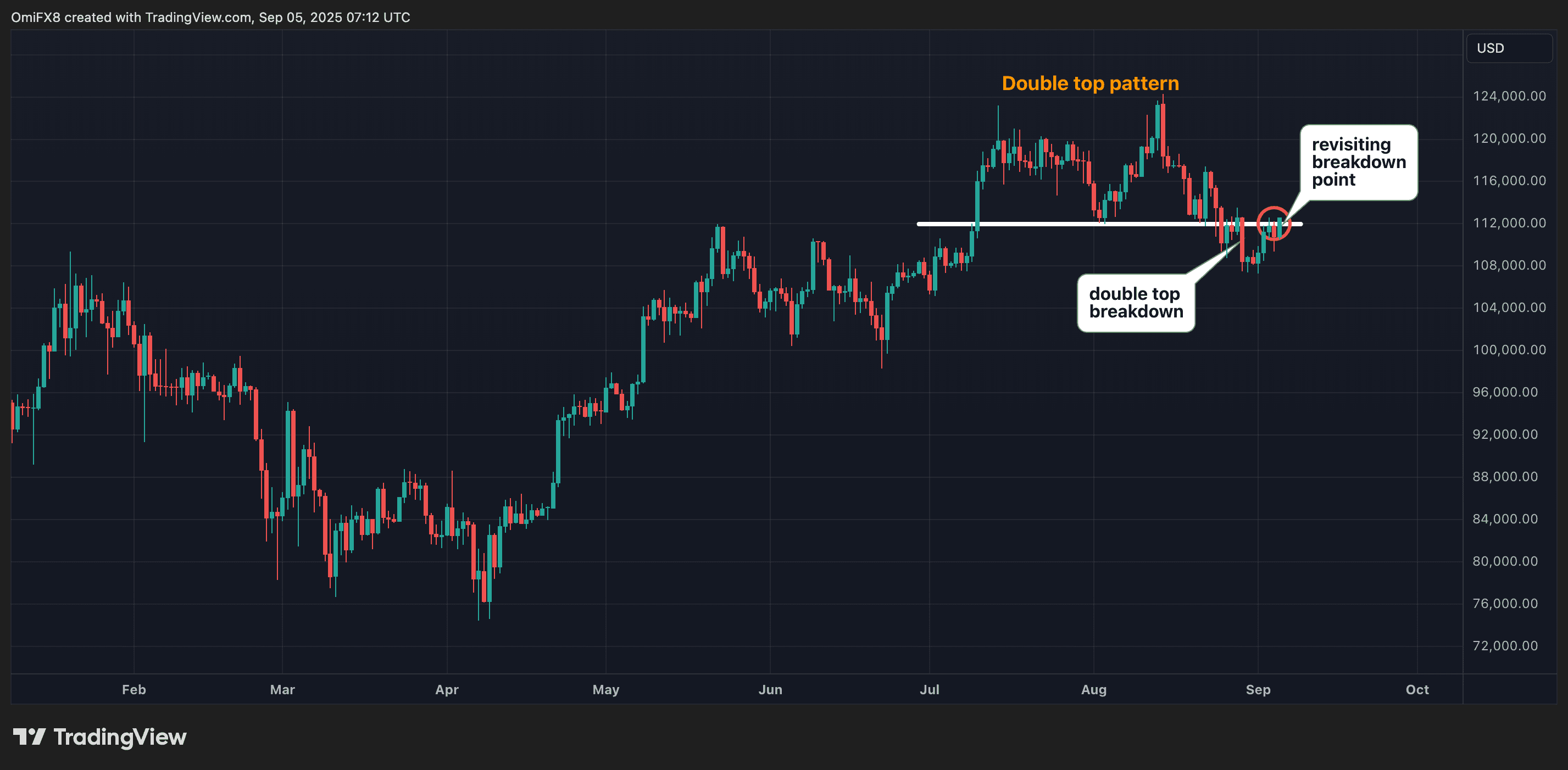
如果说宏观周期是远方的雷鸣,那么技术图表就是眼前的乌云。当前比特币的价格走势,正在描绘一幅令许多技术分析师感到不安的画卷——一个教科书式的“双顶”形态。
比特币价格

我们可以将其通俗地理解为一次“攻顶失败”。在第一次冲高回落后,多头力量再次集结,试图冲击前高,但最终无功而返,形成了第二个高度相近的峰顶。这通常被视为上涨动能衰竭、市场情绪由多转空的信号。

这一形态的关键,在于其“颈线”支撑位。目前,市场公认的颈线位于112,000美元附近。这个价位如同一道堤坝,一旦被有效跌破,便可能引发止损盘的连锁反应,从而在技术上确认反转形态的成立,开启一轮更深度的下跌。这与素材中提到的“跌破111,982美元关键支撑位”的观察完全吻合。一旦失守,该水平将由曾经的支撑变为未来的强大阻力。

图表不会说谎,它忠实地记录了市场多空双方博弈的结果。目前,价格正是在这道生死线上方徘徊,而今晚的非农数据,很可能就是那股决定堤坝是坚守还是崩溃的最终外力。


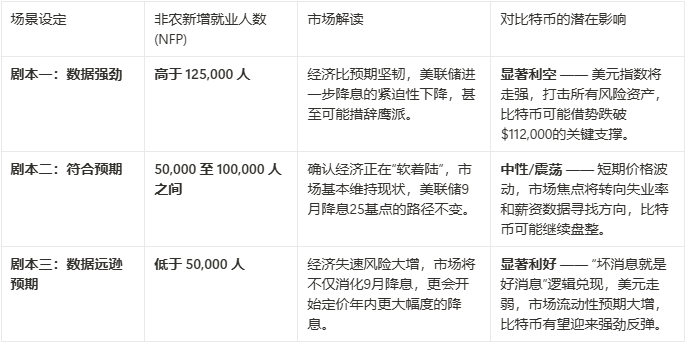
三种剧本:非农数据如何决定比特币的命运

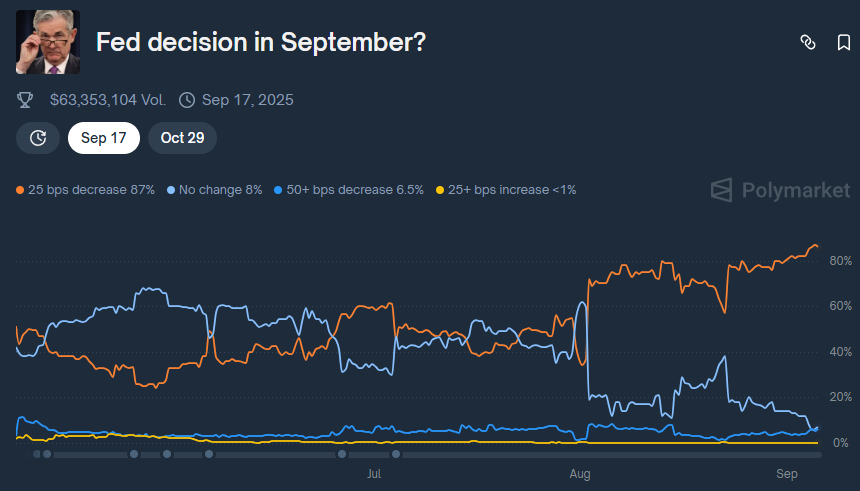
在评估不同数据结果可能带来的影响之前,我们必须先了解市场当前的“底牌”——对美联储即将开启降息周期的预期,已经达到了一个前所未有的确定性水平。数据公布前夜,CME的“美联储观察”工具显示,交易员们认为9月降息25个基点的概率高达99.3%,几乎是板上钉钉。尽管在预测市场Polymarket上,这一概率稍显保守,为87%,但市场的整体方向毫无疑问是鸽派的。
比特币价格

更深远的是,用于押注美联储政策动向的衍生品合约已经描绘出了一幅清晰的长期路线图:市场预计到明年年底,美联储将累计降息五次(每次25个基点),将联邦基金利率从当前的4.25%-4.5%区间一路引导至**3%**左右的水平。这意味着,今晚的非农数据不仅是对9月单次会议的考验,更是对这一宏大宽松预期的第一次关键验证。

正是在这种极度确定的预期背景下,任何偏离剧本的表演,都将被市场加倍放大。
比特币价格

终极变数:当经济数据遭遇政治博弈

然而,如果认为市场会像精密的机器一样,根据上述剧本按部就班地运行,那就过于简单了。今年,一个前所未有的变量被抛入了这场复杂的博弈——公开的政治压力。

近期,美国总统特朗普试图罢免美联储理事Lisa Cook的事件,已演变为一场关于央行独立性的激烈冲突。这使得美联-储主席鲍威尔的处境变得异常微妙。TwentyFour资产管理公司的合伙人Felipe Villarroe对此一针见血地指出,这份数据“不仅影响短期利率走势,还将塑造市场对美联储官员决策是否存在政治偏见的看法。”

这就给鲍威尔和他的同僚们出了一道难题:如果今晚的数据真的很糟糕(例如剧本三),美联储是应该果断释放强烈的鸽派信号以履行其稳定经济的职责,还是会有所保留,以避免给外界留下“屈服于白宫压力”的口实?反之,如果数据强劲,他们是会坦然承认经济韧性,还是会借机强调潜在风险,以一种更“政治正确”的方式为未来的降息保留空间?

这种围绕央行独立性的博弈,为纯粹的经济数据分析蒙上了一层厚厚的迷雾。它意味着,市场的最终反应可能不再是线性的,投资者的信心将经受数据和政治的双重考验。


小结

今夜,比特币正站在一个历史性的十字路口。宏观周期的时钟在滴答作响,技术图表的警报若隐若现,而一份远在华盛顿发布的就业报告,即将成为这一切的催化剂。

市场的参与者们,无论是像Brent Donnelly那样严阵以待的机构交易员,还是无数的散户投资者,都在屏息凝神。今晚的数据,究竟是会成为刺破泡沫的利针,验证周期见顶的预言,并让比特币向着那些更深的回调目标位下探?还是会意外地注入一剂强心针,为这场已持续17个月的盛宴,奏响最后的华彩乐章?

答案,将在数小时后揭晓。但无论结果如何,今晚都注定是加密市场载入史册的一页。

Related Reads

The AI Industrial Revolution: Where Are We Now?

This article explores the current stage of the AI industrial revolution, arguing we are still merely attaching new tools to old workflows rather than fundamentally redesigning production. The author compares this to the early Industrial Revolution, where factories simply replaced waterwheels with steam engines without changing their core structure. Similarly, today we embed AI chat windows into existing software but leave organizational processes unchanged. While massive investment floods into AI infrastructure (data centers, chips), akin to railway manias of the past, the real transformation lies in "dismantling the old workshop"—reorganizing companies around AI. Examples include Notion's use of hundreds of AI Agents and Y Combinator's experiments with self-improving AI systems that operate autonomously. The author notes a critical gap: while China has vast AI user growth, few companies have rebuilt core workflows. AI is beginning to impact entry-level jobs, and early adopters are gaining a compounding advantage. The conclusion is that the pivotal moment will not be the invention of better models, but when organizations decide to tear down old structures and rebuild around AI, shifting the bottleneck from human coordination to computing power. The future workplace and job titles are yet to be defined, but the imperative is to move away from legacy processes and position oneself where the new "railway" is being built.

marsbit23m ago

The AI Industrial Revolution: Where Are We Now?

marsbit23m ago

Morning Post | Hyperliquid Launches Off-chain Event Prediction Market Contract; Strategy Completes $1.5 Billion Debt Buyback; Kelp DAO Announces rsETH Fully Restored

Crypto Market Digest (May 27, 2026) Ondo Finance's founder Nathan Allman has passed away, with President Ian De Bode taking over as CEO. In regulatory news, Hong Kong authorities concluded a consultation on virtual asset service provider licensing, aiming to align rules with traditional finance. Kelp DAO announced its rsETH token has fully recovered five weeks after a $293 million hack by Lazarus Group, though the incident caused significant damage to DeFi lending protocols like Aave. Key industry developments include Hyperliquid launching off-chain event prediction market contracts, and the CME introducing futures for Avalanche and Sui. A report highlights the rise of AI Agent payments, with over $73 million settled on-chain in a year, predominantly using USDC. Meanwhile, blockchain detective ZachXBT exposed market manipulation involving several BSC tokens. In investment news, a firm referred to as "Strategy" completed a $1.5 billion debt buyback. Political contributions from the crypto sector for the 2026 U.S. elections have surpassed $500 million, heavily favoring Republican candidates. BitMEX founder Arthur Hayes revealed Zcash is his second-largest holding, citing the growing necessity for monetary privacy. The digest concludes with trending memecoins on Ethereum, Solana, and Base networks, and highlights in-depth articles covering the impending SpaceX IPO, Polymarket's regulatory challenges, and an analysis of the on-chain treasury landscape.

链捕手24m ago

Morning Post | Hyperliquid Launches Off-chain Event Prediction Market Contract; Strategy Completes $1.5 Billion Debt Buyback; Kelp DAO Announces rsETH Fully Restored

链捕手24m ago

Just Now, Chinese AI Enters Top 2 in Global Programming, Only Claude Remains Ahead

**China's AI Ranks Second Globally in Programming, Trailing Only Claude** Today, Alibaba's Qwen3.7-Max achieved a score of 1541 on the Code Arena benchmark, securing fourth place globally and surpassing top models like GPT-5.5 and Gemini 3.5 Flash. Among the top positions, it is now the only non-Claude model, placing second overall after Anthropic's Opus models. Before this official ranking, Qwen3.7-Max had already gained recognition overseas. In practical tests, it outperformed rivals on tasks like creating a self-training Tetris AI and generating complex 3D models, often at a significantly lower cost. Developers praised its ability, especially when integrated with tools like Hermes Agent and OpenCode, to effectively replace models such as GPT-5.5. In a hands-on challenge to create a 3D racing game from a detailed prompt, Qwen3.7-Max delivered a fully playable HTML file in the first attempt, requiring only minor bug fixes. It uniquely included a start menu and sound effects—details missed by other models. While competitors like Gemini 3.5 Flash and Claude Opus 4.6 produced less polished or functional versions, and GPT-5.5 had its own quirks, Qwen3.7-Max stood out for its initial completeness and playability. This performance stems from its design as an "Agent Base Model," built for long-duration, autonomous task execution. Internal tests show it can run continuously for 35 hours, making over 1158 tool calls without context degradation or instruction drift. Key technical advancements include "environment expansion" training, which improves adaptability across different frameworks, and "long-horizon autonomous execution" training, enabling sustained strategic decision-making. By entering the top tier of the programming arena, Qwen3.7-Max demonstrates that Chinese AI models are not just catching up but are becoming defining competitors, challenging the long-standing dominance of Silicon Valley in this field.

marsbit1h ago

Just Now, Chinese AI Enters Top 2 in Global Programming, Only Claude Remains Ahead

marsbit1h ago

From a Lunch Table to an Infinite Universe: Fei-Fei Li Bets on AI's Next Dimension

From a Lunch Table Conversation to an Infinite Universe: Fei-Fei Li Bets on AI's Next Frontier - Spatial Intelligence In an era dominated by large language models, AI pioneer Fei-Fei Li argues that true understanding requires spatial intelligence — the ability to perceive, reason, and interact within the physical 3D/4D world. She points to evolutionary history: spatial perception drove the Cambrian explosion 540 million years ago, while language is a far more recent, inherently "lossy" way to encode reality. Current models struggle with basic spatial tasks a child can do, like counting chairs in a video. Her company, World Labs, is pioneering this shift with "Marble," a model that generates navigable, consistent 3D worlds from text, images, or simple 3D inputs—distinct from video generators like Sora. Though smaller than models like GPT-5, due to scarce 3D data and early-stage scaling laws, Marble is already used in gaming, robot training (by NVIDIA), architectural design, and personalized therapy for conditions like OCD and acrophobia. Li envisions this technology enabling "infinite universes" for creativity, social interaction, and more. However, she cautions against utopian or dystopian extremes, advocating for a measured vision where AI enhances human dignity and prosperity, akin to how electricity transformed civilization. The journey is long — as evidenced by the 20-year path to viable autonomous vehicles — but the direction is clear: for AI to move from merely talking about the world to truly understanding and acting within it.

marsbit1h ago

From a Lunch Table to an Infinite Universe: Fei-Fei Li Bets on AI's Next Dimension

marsbit1h ago

Trading

Spot
Futures

Hot Articles

What is $BITCOIN

DIGITAL GOLD ($BITCOIN): A Comprehensive Analysis Introduction to DIGITAL GOLD ($BITCOIN) DIGITAL GOLD ($BITCOIN) is a blockchain-based project operating on the Solana network, which aims to combine the characteristics of traditional precious metals with the innovation of decentralized technologies. While it shares a name with Bitcoin, often referred to as “digital gold” due to its perception as a store of value, DIGITAL GOLD is a separate token designed to create a unique ecosystem within the Web3 landscape. Its goal is to position itself as a viable alternative digital asset, although specifics regarding its applications and functionalities are still developing. What is DIGITAL GOLD ($BITCOIN)? DIGITAL GOLD ($BITCOIN) is a cryptocurrency token explicitly designed for use on the Solana blockchain. In contrast to Bitcoin, which provides a widely recognized value storage role, this token appears to focus on broader applications and characteristics. Notable aspects include: Blockchain Infrastructure: The token is built on the Solana blockchain, known for its capacity to handle high-speed and low-cost transactions. Supply Dynamics: DIGITAL GOLD has a maximum supply capped at 100 quadrillion tokens (100P $BITCOIN), although details regarding its circulating supply are currently undisclosed. Utility: While precise functionalities are not explicitly outlined, there are indications that the token could be utilized for various applications, potentially involving decentralized applications (dApps) or asset tokenization strategies. Who is the Creator of DIGITAL GOLD ($BITCOIN)? At present, the identity of the creators and development team behind DIGITAL GOLD ($BITCOIN) remains unknown. This situation is typical among many innovative projects within the blockchain space, particularly those aligning with decentralized finance and meme coin phenomena. While such anonymity may foster a community-driven culture, it intensifies concerns about governance and accountability. Who are the Investors of DIGITAL GOLD ($BITCOIN)? The available information indicates that DIGITAL GOLD ($BITCOIN) does not have any known institutional backers or prominent venture capital investments. The project seems to operate on a peer-to-peer model focused on community support and adoption rather than traditional funding routes. Its activity and liquidity are primarily situated on decentralized exchanges (DEXs), such as PumpSwap, rather than established centralized trading platforms, further highlighting its grassroots approach. How DIGITAL GOLD ($BITCOIN) Works The operational mechanics of DIGITAL GOLD ($BITCOIN) can be elaborated on based on its blockchain design and network attributes: Consensus Mechanism: By leveraging Solana’s unique proof-of-history (PoH) combined with a proof-of-stake (PoS) model, the project ensures efficient transaction validation contributing to the network's high performance. Tokenomics: While specific deflationary mechanisms have not been extensively detailed, the vast maximum token supply implies that it may cater to microtransactions or niche use cases that are still to be defined. Interoperability: There exists the potential for integration with Solana’s broader ecosystem, including various decentralized finance (DeFi) platforms. However, the details regarding specific integrations remain unspecified. Timeline of Key Events Here is a timeline that highlights significant milestones concerning DIGITAL GOLD ($BITCOIN): 2023: The initial deployment of the token occurs on the Solana blockchain, marked by its contract address. 2024: DIGITAL GOLD gains visibility as it becomes available for trading on decentralized exchanges like PumpSwap, allowing users to trade it against SOL. 2025: The project witnesses sporadic trading activity and potential interest in community-led engagements, although no noteworthy partnerships or technical advancements have been documented as of yet. Critical Analysis Strengths Scalability: The underlying Solana infrastructure supports high transaction volumes, which could enhance the utility of $BITCOIN in various transaction scenarios. Accessibility: The potential low trading price per token could attract retail investors, facilitating wider participation due to fractional ownership opportunities. Risks Lack of Transparency: The absence of publicly known backers, developers, or an audit process may yield skepticism regarding the project's sustainability and trustworthiness. Market Volatility: The trading activity is heavily reliant on speculative behavior, which can result in significant price volatility and uncertainty for investors. Conclusion DIGITAL GOLD ($BITCOIN) emerges as an intriguing yet ambiguous project within the rapidly evolving Solana ecosystem. While it attempts to leverage the “digital gold” narrative, its departure from Bitcoin's established role as a store of value underscores the need for a clearer differentiation of its intended utility and governance structure. Future acceptance and adoption will likely depend on addressing the current opacity and defining its operational and economic strategies more explicitly. Note: This report encompasses synthesised information available as of October 2023, and developments may have transpired beyond the research period.

363 Total ViewsPublished 2025.05.13Updated 2025.05.13

What is $BITCOIN

Discussions

Welcome to the HTX Community. Here, you can stay informed about the latest platform developments and gain access to professional market insights. Users' opinions on the price of BTC (BTC) are presented below.

活动图片