Best Cryptos to Buy as ChatGPT Predicts $400 Solana By Year’s End

bitcoinistPublished on 2025-09-04Last updated on 2025-09-04

Abstract

With gains of over 2,500% in just the past three years, there’s hardly a token more deserving of a seat...

Trusted Editorial content, reviewed by leading industry experts and seasoned editors. Ad Disclosure

With gains of over 2,500% in just the past three years, there’s hardly a token more deserving of a seat at crypto’s headquarters than Solana ($SOL).

And it offers more than just raw gains. Thanks to its unique Proof of History design, low costs, and comparatively simple user experience, Solana has emerged as the go-to hub for meme coins, NFTs, and on-chain trading apps.

Naturally, a crypto with both groundbreaking utility and market hype is destined for a bright future.

But just how high can Solana’s price climb in 2025? To find out, we turned to ChatGPT, one of the most powerful AI tools available right now.

Here’s the kicker: ChatGPT swam through a sea of crypto-related information, including price charts, corporate buys, important announcements, and even online chatter, to arrive at a lofty $400 target.

Read on as we unpack the AI’s Solana price prediction, the top factors driving the token’s growth, and the best cryptos to buy now to ride this potentially massive rally.

Why $SOL Could Reach $400 in 2025?

Ever since hitting a low of $95 in April, $SOL has been in an upward trend. Slowly but surely, it climbed into the $200-$220 zone, but has repeatedly failed to break past it.

The reason? A strong upward-sloping resistance line that has capped Solana’s run-up on multiple occasions.

That said, ChatGPT noted that the token has now grappled with this resistance four times in the past month and is gearing up for a fifth attempt – one that could finally see it break through.
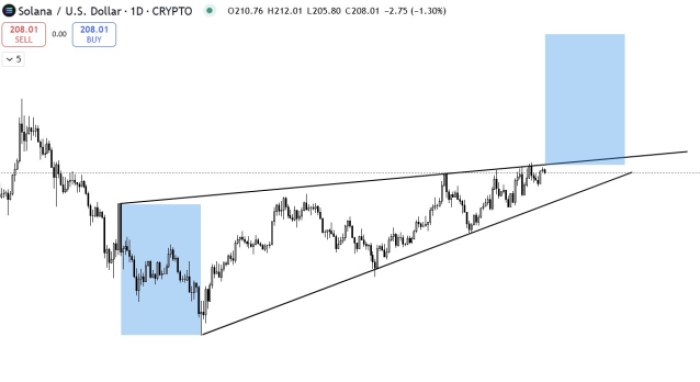
$SOL $400 price prediction by ChatGPT on TradingView

The best part? Because this all-important resistance has already been tested multiple times, the odds of Solana breaking past it are now higher than ever. It’s currently trading around $208.

Anticipating a breakout, ChatGPT measured the width of the consolidation zone (blue box) and mapped it on top of the breakout level to project Solana’s next target: $400.

In addition to strong technicals, Solana is also set to receive a massive boost from the upcoming ETF approval and a potential Federal Reserve rate cut.

According to Polymarket, the odds of a SOL ETF being approved in 2025 and a rate cut in September stand at >99% and 95%, respectively – both extremely bullish for Solana.

It’s also worth noting that large corporations like Bit Mining, DeFi Development Corp, and Sharps Technology have scooped up significant amounts of Solana in recent weeks.

This kind of institutional accumulation is a major bullish signal, as it shows confidence from deep-pocketed players who are not only betting on Solana’s long-term fundamentals but also soaking up available supply, thereby increasing scarcity and setting the stage for higher prices.

With that in mind, here are the best altcoins to buy right now to capitalize on the Solana frenzy.

1. Snorter Token ($SNORT) – Telegram-Based Trading Bot for Sniping Liquidity in New Meme Coins

If $SOL comes anywhere close to its predicted potential this year, chances are it could also send Snorter Token ($SNORT) – the best Solana meme coin currently in presale – straight to the moon and beyond.

That’s because Snorter is the only crypto project right now aiming to tackle the problem of whale dominance in Solana’s meme coin trading space.

At the moment, big-money players armed with advanced trading tools and algorithms scoop up nearly all the liquidity in newly listed meme coins, leaving retail participants with little to no share of those early meme coin pumps.

Snorter’s new Telegram trading bot changes the game by letting you place buy/sell orders in advance.

It then automatically executes those trades the moment liquidity arrives, undercutting institutional traders and restoring parity.
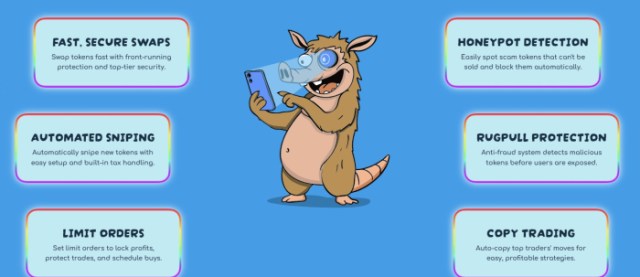
Snorter Bot features.

Even better, you don’t have to worry about jealous traders you outrun, thanks to Snorter’s airtight security stack. It includes protections against rug pulls, honeypots, front-running, and even sophisticated sandwich attacks.

Buying $SNORT further unlocks a bunch of exclusive perks, including:

  • No daily sniping limits
  • Advanced analytics for better trading decisions
  • Reduced trading fees: just 0.85% compared to 1.50% charged to non-holders
  • Staking rewards, currently yielding an impressive 125%

1 $SNORT is currently priced at just $0.1033, and the project has in total raised over $3.7M so far.

According to our $SNORT price prediction, the token could hit $0.94 by the end of 2025 alone – a whopping 800% gain from current levels.

Visit Snorter Token’s official website for more information.

2. Best Wallet Token ($BEST) – Powering a New Crypto Wallet That’s Both Secure & User-Friendly

Best Wallet Token ($BEST) is also likely to see a huge surge in popularity – and therefore price – alongside the growth of Solana and the broader crypto market.

Why? Because it’s the native cryptocurrency of Best Wallet, a new free crypto wallet that’s not only super-secure but also incredibly easy to use, making it an ideal choice for both experts and beginners.

As a top non-custodial wallet, no one but you can access your private keys. That means your funds remain fully under your control and safe from malicious intervention.

And it doesn’t stop there. Best Wallet comes with robust safeguards against scams, hacks, and phishing sites, plus top-tier 2FA options, including biometric login.

Best Wallet's useful features, from multi-chain support and swaps to keyless security.

Best Wallet is also redefining usability with its unique Presale Aggregator section, which lets you buy the best crypto presales directly within the app.

While other wallets force you to visit external presale sites, connect your wallet there, and then return to authorize the transaction, Best Wallet makes the entire process seamless, simplifying the way you spot and buy under-the-radar presale gems like no other.

Why buy $BEST?

  • A potential 2,323% ROI by the end of 2026, according to our $BEST price prediction
  • Voting rights on key platform decisions
  • Reduced trading and gas fees
  • Staking rewards, currently offering 86%
  • Early access to new meme coins in presale

Currently in presale, $BEST has already gathered a brain-melting $15.5M in early investor funding, and each token is available for just $0.025585.

Check out Best Wallet Token’s official website to learn more.

3. Comedian ($BAN) – Viral Meme Coin Preparing for a Massive Rally

Comedian ($BAN), like Unstable Coin ($USDUC), relies more on virality and the crypto community’s blessings than on intrinsic value, a game-changing mission, or staking mechanisms.

Based on the controversial art piece featuring a banana taped to a wall, $BAN has ridden the traction created by the debate around modern art: whether it’s revolutionary or just plain stupid.

The token is already up over 59% in the last month, but that could be just the start of a far more explosive rally.
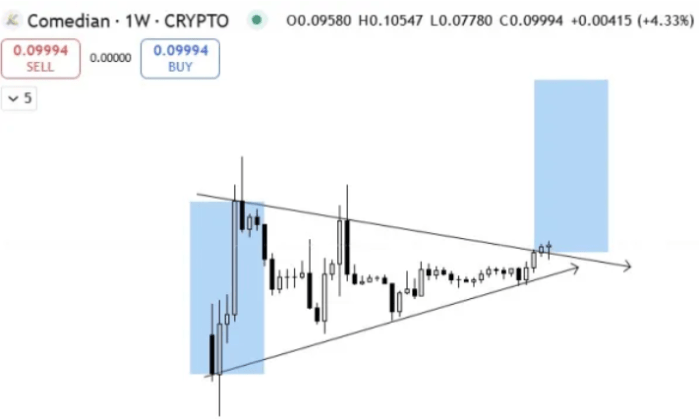
Comedian ($BAN) breaks out of a descending triangle pattern

According to classic technical analysis, $BAN has only just begun its breakout after escaping a long-drawn descending triangle pattern – a harsh consolidation phase that lasted more than nine months.

If this pattern plays out, $BAN could be headed to $1.419360, representing an eye-popping 1,300% gain from its current price of $0.1009.

Final Thoughts

With Solana poised for a run-up to $400 (a 92% move from current levels) in the weeks ahead, the stage is set for low-cap, high-upside Solana coins to rocket to the moon.

When we asked ChatGPT about its top crypto picks right now, the AI quickly pointed us toward Snorter Token ($SNORT), Best Wallet Token ($BEST), and Comedian ($BAN).

That said, kindly remember that crypto investments are highly risky due to the market’s volatility and uncertainty. Also, this article is not financial advice, so kindly do your own research before investing.

Authored by Krishi Chowdhary, Bitcoinist — https://bitcoinist.com/best-cryptos-to-buy-chatgpt-predicts-400-solana-by-year-end

Editorial Process for bitcoinist is centered on delivering thoroughly researched, accurate, and unbiased content. We uphold strict sourcing standards, and each page undergoes diligent review by our team of top technology experts and seasoned editors. This process ensures the integrity, relevance, and value of our content for our readers.

As a crypto writer, Krishi splits his time between decoding the chaos of the markets and writing about it in a way that doesn’t put you to sleep. He’s been at it for nearly two years in the crypto trenches. Yes, he regrets missing the magnificent rallies that came before that (who doesn’t!), but he’s more than ready to put his money where his words are. Before diving headfirst into crypto, Krishi spent over five years writing for some of the biggest names in tech, including TechRadar, Tom’s Guide, and PC Gaming, covering everything from gadgets and cybersecurity to gaming and software. When he’s not scouring and writing about the latest happenings in crypto, Krishi trades the forex market while keeping crypto in his long-term HODL plans. He’s a Bitcoin believer, though he never lets that bias creep into his writing.

Trending Cryptos

Related Reads

Apple and the Power Rebalancing with 'The Microns': Dissecting the Profit Ledger Behind the iPhone

The article analyzes the shifting profit dynamics and power balance between Apple and memory suppliers like Micron within the iPhone supply chain. It highlights a social media post criticizing Apple for raising iPhone prices while blaming memory chip cost increases, despite historically paying suppliers like Micron very little. An estimated iPhone 18 cost breakdown is referenced. Historically, memory was a minor cost component. In 2017's iPhone X, memory accounted for only about 1.6-2.3% of the price, with Apple capturing nearly 50% net profit. Over time, memory's share of the Bill-of-Materials (BOM) cost has grown significantly, reaching an estimated 12-15% for the iPhone 17 series. The core driver of this change is soaring demand for memory from the AI industry, particularly for High Bandwidth Memory (HBM) and AI servers, which is diverting production capacity and squeezing supply for consumer electronics. Memory manufacturers, after enduring periods of low profits, now hold greater pricing power. This is reflected in their recent strong financials, like Micron's 84.6% gross margin. Apple CEO Tim Cook initially described the memory price pressure as unprecedented in his 40-year career, later calling it a "once-in-a-century flood," before Apple announced price hikes across several product lines, causing a significant stock drop. Elon Musk echoed Cook's sentiment about the dramatic cost surge. The article concludes that the era of memory suppliers being at the mercy of Apple's pricing power has temporarily reversed, thanks to AI-driven demand. It notes Apple is reportedly seeking to diversify its supply chain, including exploring chips from China's CXMT.

Odaily星球日报1h ago

Apple and the Power Rebalancing with 'The Microns': Dissecting the Profit Ledger Behind the iPhone

Odaily星球日报1h ago

Conversation with the Founder of 42 Macro: The Fed's 'Boiling the Frog Slowly' and the K-Shaped Economy

In a conversation with Anthony Pompliano, Darius Dale, founder of 42 Macro, discusses the Federal Reserve's monetary policy and the K-shaped U.S. economy. Dale characterizes new Fed Chair Kevin Warsh as a "dove in hawk's clothing," expecting the Fed to signal or enact policy tightening in the coming quarters to create room for later easing. He argues current economic signals, including high deficit spending, debt monetization, and credit growth, strongly indicate inflation is not on a credible path back to 2%, forcing the Fed to act. The discussion highlights the stark "K-shaped" economic reality. While top earners, buoyed by massive cash savings (up ~$8 trillion since pre-pandemic), continue robust spending, those at the bottom face severe financial strain, with delinquency rates on consumer loans reaching crisis-era highs. Dale attributes much of the current social and political anxiety to this divergence, driven by the "Cantillon effects" of monetary expansion, which disproportionately benefits asset owners. He emphasizes that in this environment of "financial repression," individuals must participate in asset markets to avoid being left behind. On equities, Dale notes a rotation from the "Magnificent Seven" tech giants into broader AI-exposed companies, while warning that the tech giants' massive capital expenditure cycles could eventually puncture over-optimistic cash flow projections. Dale concludes by stressing that the core desire across all economic strata is simply the dignity to provide for one's family, a goal currently undermined by systemic policies that act as a "wealth siphon" from the bottom to the top.

marsbit1h ago

Conversation with the Founder of 42 Macro: The Fed's 'Boiling the Frog Slowly' and the K-Shaped Economy

marsbit1h ago

The Domestic Answer to Space Computing Power: Photonics Are More Efficient, Musk and Huang's Approaches Are Too Roundabout

The Space Computing Race: A Photonic Advantage The competition for space-based computing has intensified, with figures like Elon Musk and NVIDIA's Jensen Huang highlighting its potential. Musk predicts solar-powered AI satellites could offer the most cost-effective computing by 2032. However, space presents extreme challenges for traditional electronic chips: radiation from cosmic particles can cause errors, the vacuum environment hinders heat dissipation, and limited solar power constrains energy-hungry systems. Photonic computing, using light instead of electrons, offers a promising solution. Its core advantages for space are threefold: 1) **Radiation Resistance**: Photons are charge-neutral, making them inherently immune to particle interference. 2) **Low Heat Generation**: Light propagation in waveguides generates minimal heat, bypassing critical thermal management issues. 3) **Low Power Consumption**: Photonic chips have near-zero static power draw, aligning perfectly with the energy constraints of satellites. Furthermore, for a given payload weight and volume, photonic systems can potentially deliver higher total compute density. Since they require less bulky cooling and power infrastructure, more space can be allocated to the compute units themselves. While photonic computing holds great promise, current industry approaches face hurdles like the memory-compute bottleneck (separate storage and processing) and challenges in large-scale integration. Engineering for space—withstanding launch vibrations and validating full system operation in orbit—remains a critical step. The path forward resembles the evolution from single GPUs to computing clusters, but via a photonic route. As electronic chips approach physical limits in miniaturization, photonic computing and optical interconnects (光算光联) may provide a key alternative to bypass these constraints and define the next generation of space-based computing capabilities.

marsbit2h ago

The Domestic Answer to Space Computing Power: Photonics Are More Efficient, Musk and Huang's Approaches Are Too Roundabout

marsbit2h ago

Trading

Spot

Hot Articles

Discussions

Welcome to the HTX Community. Here, you can stay informed about the latest platform developments and gain access to professional market insights. Users' opinions on the price of SOL (SOL) are presented below.

活动图片