马云成为 E 卫兵,谁在主导云锋金融的 Web3 战略?

Foresight NewsPublished on 2025-09-03Last updated on 2026-08-19

Abstract

肖风作为云锋金融的独立非执行董事,也极有可能在公司的战略决策过程中发挥着至关重要的作用。

撰文:KarenZ,Foresight News

2025 年 9 月 2 日,香港上市公司云锋金融集团发布一则公告:公司已动用 4400 万美元自有现金储备,在公开市场累计购买 10,000 枚以太坊作为战略储备资产。

事实上,早在 7 月份,云锋金融公司董事会便以宣布该,集团计划布局 Web 3、现实世界资产(RWA)、数字货币、ESG 零碳资产领域及人工智能(AI)等前沿领域,将加大对数字货币的投资力度。

在这一系列大胆举措的背后,马云和肖风两位关键人物成为行业关注的焦点。马云或为云锋金融的间接股东。而肖风作为云锋金融的独立非执行董事,也极有可能在公司的战略决策过程中发挥着至关重要的作用。

云锋金融是什么?

根据官网, 云锋金融是一家在香港主板上市的创新型金融科技集团,拥有证券经纪、资产管理、保险业务、金融科技业务板块。

而云锋金融的前身为瑞东集团,原来是香港一家老牌证券公司。2015 年,云锋基金的控股股东 Jade Passion Ltd 以 26.8 亿港元拿下瑞东约 56% 股份,2016 年瑞东更名为云锋金融。

而云锋基金由阿里巴巴创始人马云和聚众传媒创始人虞锋于 2010 年联合发起,是一家私募股权投资机构,关注硬科技、企业服务、绿色能源、现代农业、生物科技、消费等领域。

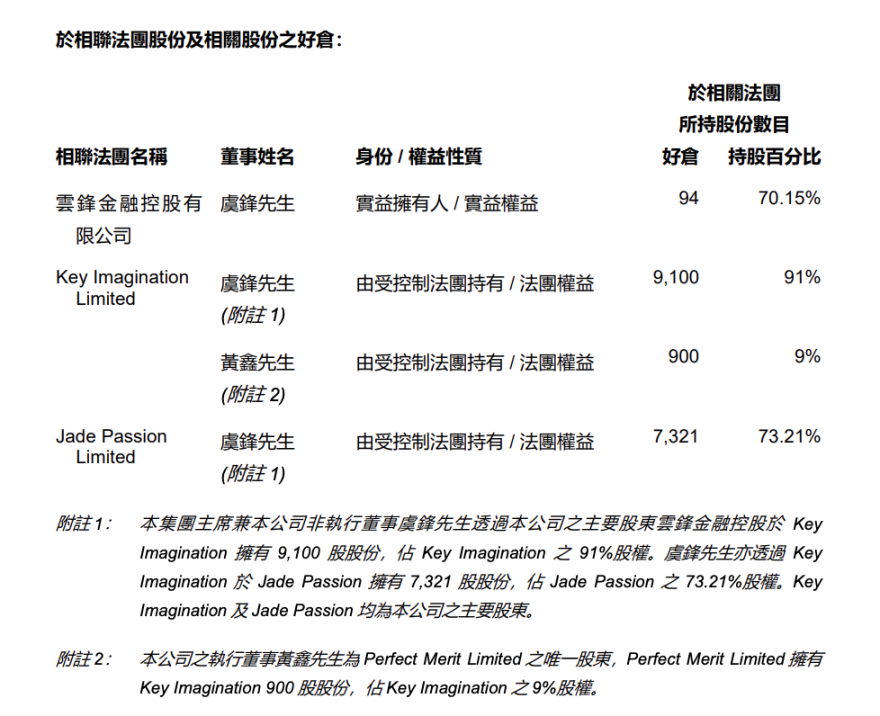
虞锋现任云锋基金主席、云锋金融集团主席兼非执行董事,也是云锋金融控股、Key Imagination 及 Jade Passion 之董事。云锋金融控股、KeyImagination 及 Jade Passion 为云锋金融之主要股东。

股权和控制结构

首先是董事和主要行政人员的持股情况:

1、根据 2025 年年中报告,虞锋(集团主席兼非执行董事)通过多层控股结构实际控制云锋金融 47.25% 的股份。具体路径为:Key Imagination Limited 拥有 Jade Passion 已发行股本之 73.21%;云锋金融控股拥有 Key Imagination 已发行股本之 91%;而虞锋拥有云锋金融控股已发行股本之 70.15%。Key Imagination 及 Jade Passion 均为云锋金融之主要股东。

2、云锋金融执行董事黄鑫为 Perfect Merit Limited 之唯一股东,Perfect Merit Limited 拥有 Key Imagination 900 股股份,占 Key Imagination 之 9% 股权。

3、除上述披露之外,云锋金融年中报告称,截至 2025 年 6 月 30 日,公司的董事、高管及他们的关联人,在公司及关联公司的股份或债券中,没有需要特别申报的持仓情况。
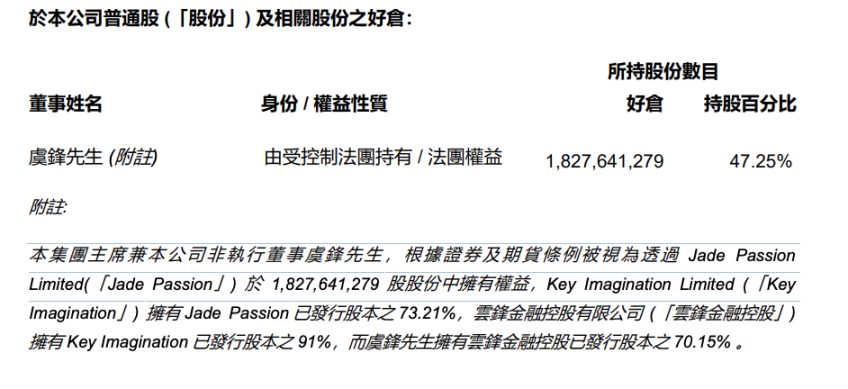
来源:云锋金融 2025 年年中报告

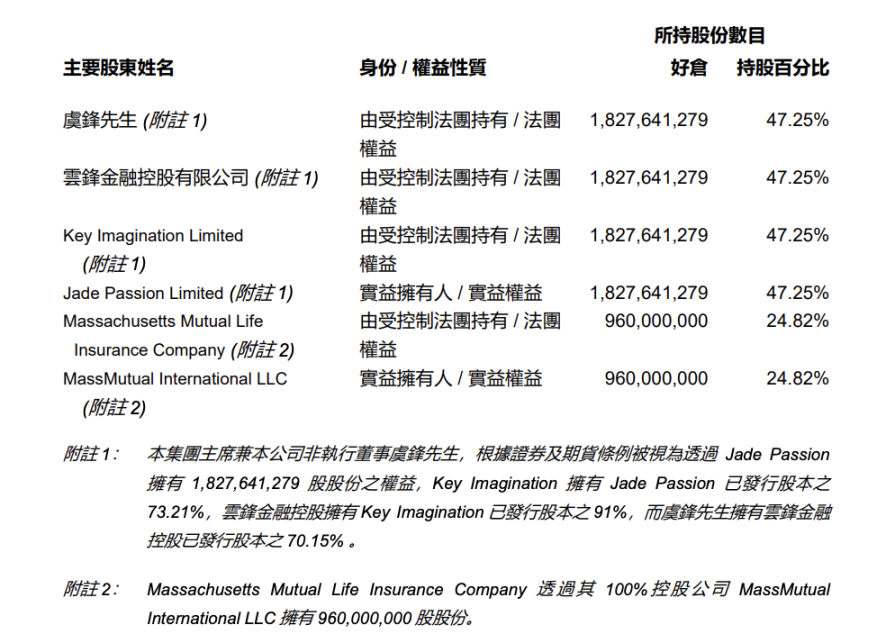
其次为云锋金融主要股东及其他人士的持股情况,云锋金融已发行股份中持股达到或超过 5% 的主要股东及其他人士的权益情况如下:

1、如上所示,虞锋通过多层控股结构实际控制云锋金融 47.25% 的股份。

2、Massachusetts Mutual Life Insurance Company(美国万通人寿保险公司)通过其 100% 控股公司 MassMutual International LLC 持有 960,000,000 股股份,持股百分比为 24.82%。

3、除上述两大股东外,无其他人士持有公司 5% 或以上的股份权益或空头头寸。
演员赵薇前夫黄有龙此前一度持有 Jade Passion Limited 的 26.79% 股权,也曾是云锋金融的非执行董事之一。2018 年 1 月,黄有龙已辞去了云锋金融非执行董事职务。

马云和肖风的角色

市场猜测,马云虽未在云锋金融和云峰基金中担任管理职务,但通过持有云锋基金相关实体股权,仍对公司战略具备重要影响力。

根据上海证券报在 2024 年 10 月份报道,云锋基金关联公司上海云锋投资管理有限公司 2024 年 10 月 16 日发生工商信息变更,注册资本由 2.9 亿元减至 1000 万元,降幅超过 96.55%。云锋投资成立于 2010 年 7 月 1 日,为云锋基金的人民币第一期基金执行主体,其初始注册资本为 1000 万元。2013 年 12 月 9 日,其一期基金完成募集并进入投资阶段后,公司注册资本增加到了 2.9 亿元。其中,虞锋持股 60%,马云持股 40%。

上海证券报报道称,随后,云锋投资经历了几次投资人变更,此次减资前,黄鑫出资 1.74 亿元,持股 60%,为第一大股东;马云出资 1.16 亿元,持股 40%,为第二大股东。在此次减资后,黄鑫、马云出资额分别降至 600 万元、400 万元,仍分别持股 60%、40%。目前暂不清楚之后的股权变动情况,也不清楚马云在云锋金融的具体持股情况。

另一位关键人物肖风,自 2019 年 3 月起担任云锋金融独立非执行董事。作为中国区块链领域的领军人物、万向区块链董事长,他虽不参与日常经营,但可能会在董事会中就重大战略决策,尤其是 Web3、数字货币及区块链投资等方面,提供专业判断与监督意见。市场普遍认为,他在云锋金融近期对 ETH 及 Pharos 公链的投资决策中提供了重要指导性意见。
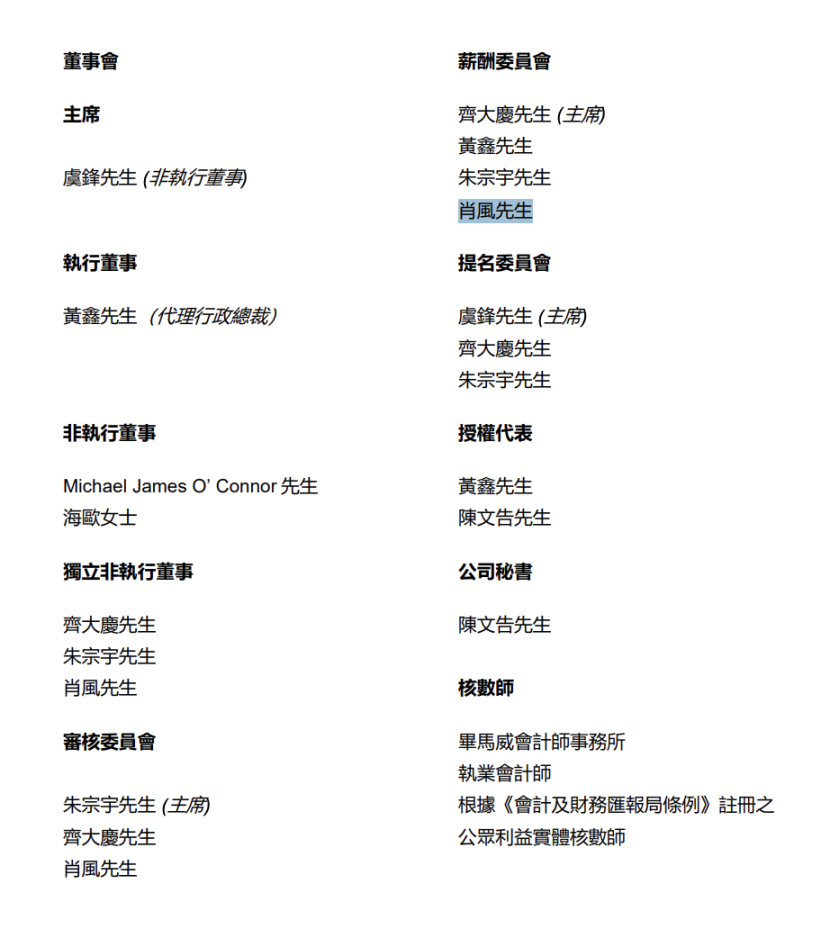
来源:云锋金融

云锋金融近期 Web3 举措

自 2025 年 7 月以来,云锋金融以清晰的节奏和强大的执行力,一步步推进其 Web3 蓝图:

7 月份,云锋金融集团宣布在现有保险与金融科技业务的基础上,将战略布局 Web 3.0、现实世界资产(RWA)、数字货币、ESG 零碳资产领域及人工智能(AI)等前沿领域,以及探索上述前沿领域与本集团保险公司的各项应用场景相连的创新。

云锋金融集团在 2025 年 8 月份提交的中期业绩报告中表示,云锋金融已计划迈向 Web3 新纪元,旗下证券牌照公司已向香港证监会申请升级 1、4、9 号牌照,升级获批准后,将可提供全方位虚拟资产相关交易服务及管理投资虚拟资产的投资组合。云锋金融官网显示,云锋金融集团旗下子公司持有香港证监会授予的 1、4、9 号金融服务牌照,同时,集团通过控股万通保险国际有限公司持有香港保监局长期保险业务牌照及香港强积金核准受托人资格。

「碳链」计划:8 月 29 日,云锋金融万通保险控股公司联合澳门国际碳排放权交易所宣布完成碳信用资产交易数据全面上链,正式启动聚焦高质量碳信用的「碳链」(Carbon Trading BlockChain)计划。

与蚂蚁数科达成战略合作协议、战略投资 Pharos 公链:9 月 1 日,云锋金融集团宣布与蚂蚁数字科技达成战略合作协议,同时对 Layer1 公链 Pharos Network Technology Limited(Pharos)进行战略投资。双方将通过 Pharos 高性能公链平台,共同合规拓展现实世界资产(RWA)代币化及下一代互联网(Web3)等前沿领域。

购买 1 万枚 ETH 作为战略储备资产:9 月 2 日,云锋金融集团宣布董事会已批准于公开市场购买以太坊(ETH)作为储备资产。截至本公告日期,本集团已于公开市场累计购买 10,000 枚 ETH,总投资成本为 4,400 万美元(本集团内部现金储备)。未来,公司还将持续增加在数字资产方面的投入比重。董事会认为,将 ETH 纳入公司战略储备资产符合本集团在 Web3 等前沿领域的布局,并能够为现实世界资产(RWA)代币化活动提供关键基础设施支持。此外,云锋金融将探索 ETH 在本集团保险业务中的潜在应用模式,以及与 Web3 相适应的创新业务场景。同时,云锋金融将 ETH 作为储备资产可优化本集团资产结构,减少对传统货币的依赖。

除 ETH 外,云锋金融计划探索将包括比特币(BTC)、SOL 等多元化的主流数字资产纳入公司战略储备资产。

云锋金融明确表示,购买 ETH 不仅是为了优化资产结构,更是为了支持 RWA 代币化活动的基础设施,推动集团在 Web3 领域的科技创新,以及探索 ETH 在保险业务中的潜在应用(如保单抵押、支付等)。

小结

云锋金融近期的这一系列动作,勾勒出了一幅传统金融科技公司向 Web3 转型的完整路径图:从顶层战略设计、到人才与牌照准备、再到合作伙伴与基础设施搭建(蚂蚁、Pharos)、最后到资产端的直接配置(购买 ETH)。

这远非一次简单的投机性投资,而是一次经过深思熟虑的、系统性的战略升级。其核心目的是通过拥抱区块链技术,在未来由 RWA 代币化、数字货币和 DeFi 构成的 Web3 金融中抢占先机,成为连接传统世界与数字世界的桥梁。


Trending Cryptos

Related Reads

Latest: Korean QFI Has Bought Changxin Technology

Latest Data Shows Korean QFI Has Purchased Changxin Technology According to data from SEIBro (under Korea Securities Depository, KSD), Korean investors, acting as Qualified Foreign Investors (QFI), have been actively purchasing shares of Changxin Technology (stock code 688825), a company recently listed on China's Sci-Tech Innovation Board (STAR Market). Over the past month until August 18, they made a net purchase of this stock worth approximately $45.32 million (around CNY 307 million), making it the top A-share by net purchase volume for Korean investors during that period. This activity has significantly boosted overall Korean net buying in A-shares. As Changxin Technology is not yet included in the Stock Connect schemes, QFI is currently the only channel for overseas investors like these Koreans to access its shares. SEIBro data indicates Korean buying began as early as July 28, the stock's second trading day. The stock appeared in Korean investor purchase lists using a temporary virtual ISIN code in settlement instructions, as its official international code had not yet been assigned. The listing has garnered significant international attention. On its first trading day (July 27), the actively managed U.S. ETF Tema Memory ETF (DISK) swiftly added Changxin Technology to its portfolio, giving it a substantial 10.56% weighting. Another active ETF, Roundhill Memory ETF (DRAM), also quickly included the stock. Furthermore, global index provider MSCI has added Changxin Technology to its MSCI China All Shares Index, prompting passive fund inflows. Analysts highlight Changxin Technology's unique position to serve China's rapidly growing AI ecosystem amid a global semiconductor memory supply shortage driven by AI demand. Besides Changxin Technology, other A-shares heavily bought by Korean investors recently include Weichai Power, Demingli, Changdian Technology, and CSOP China STAR Chip ETF.

marsbit29m ago

Latest: Korean QFI Has Bought Changxin Technology

marsbit29m ago

China Pinches the Vital Point of CPO

The article "China Grips the Achilles' Heel of CPO" details how China holds a strategic position in the global indium phosphide (InP) supply chain, a critical material for high-speed optical modules and CPO (Co-Packaged Optics) technology used in AI data centers. China controls over 70% of global indium reserves and produces more than half of the world's primary indium, primarily as a by-product of zinc/tin smelting. It further refines 70-80% of the globe's refined indium. This upstream dominance is compounded by the fact that key InP wafer producer AXT operates its primary production through its Chinese subsidiary, Beijing Tongmei. Adding to this leverage are China's export controls, first on InP products and later extending to high-purity indium (6N+ grade). These restrictions have created supply bottlenecks and uncertainty, straining foreign manufacturers like Japan's Sumitomo and Dowa, who rely heavily on Chinese materials. The resulting shortage has led to intense demand, with industry figures like Lumentum's CEO warning of severe constraints and companies like Coherent seeking direct assurances from China. This situation benefits Chinese InP supply chain companies. Firms like Yunnan Chihong Zinc & Germanium (a leading domestic InP wafer producer) and Zhuzhou Keneng (high-purity indium) report surging domestic revenues and orders. They are also making progress in high-end product validation and capacity expansion. However, challenges remain, including lengthy customer qualification cycles and a significant capacity gap compared to foreign leaders. The article frames the current AI-driven demand surge as a pivotal moment for China's InP industry. It references a historical lesson where China, despite controlling indium resources, once ceded value-add and pricing power to Japanese processors. The current scenario is seen as an opportunity to leverage upstream resource control to develop advanced manufacturing capabilities and secure greater influence in the global semiconductor materials market.

marsbit39m ago

China Pinches the Vital Point of CPO

marsbit39m ago

Russian Suspected of Stealing Cryptocurrency from Cold Wallet Worth Almost 10 Million Rubles

Russian authorities are investigating a suspect accused of stealing nearly 10 million rubles worth of cryptocurrency from a cold wallet. According to investigators, the wallet belonged to an unnamed commercial company executive's assistant. In March, the suspect allegedly gained access to the victim's wallet by "an unidentified method" and transferred the digital assets to another address. During a search of the suspect's home, police seized three computers and three mobile phones for forensic examination, as they may contain important digital evidence. The case is being investigated as grand larceny under the Russian Criminal Code, carrying a potential sentence of up to ten years in prison. Police are also checking the suspect's possible involvement in other cryptocurrency thefts and identifying potential accomplices. The article notes that while cold wallets (hardware wallets storing private keys offline) are considered more secure against remote hacking, they remain vulnerable if a perpetrator gains physical or direct access to the keys. In a related case earlier in June, a court in Tomsk sentenced two men to 8 and 9.5 years in a strict-regime colony for a robbery and cryptocurrency theft. They forced an acquaintance at knifepoint to log into a crypto exchange account and transfer over 85 bitcoins, valued at approximately $5.1 million at the time.

cryptonews.ru1h ago

Russian Suspected of Stealing Cryptocurrency from Cold Wallet Worth Almost 10 Million Rubles

cryptonews.ru1h ago

Trading

Spot

Hot Articles

Discussions

Welcome to the HTX Community. Here, you can stay informed about the latest platform developments and gain access to professional market insights. Users' opinions on the price of ETH (ETH) are presented below.

活动图片